

Apple’s AI leadership shake-up is the clearest signal yet that the company’s grand plan for Siri and “Apple Intelligence” needs more than a software patch — it needs fresh leadership, reorganized reporting lines, and a hard reckoning with the technical and cultural limits that have left Apple trailing rivals in the generative-AI race.
When Apple introduced the Apple Intelligence vision at WWDC 2024 it promised a new era for Siri: a more conversational, context-aware assistant that could act across apps, use personal context securely, and tap third‑party models when appropriate. The roadmap was ambitious: systemwide generative features, on-device personalization, and a new class of foundation models calibrated for Apple’s privacy-first approach.
Those ambitions collided with engineering reality in 2025. Apple publicly acknowledged development delays and pushed the most advanced Siri features out of the initial iOS 18 timeframe. The company later set an internal target for a larger Siri refresh in spring 2026. That delay, the exodus of talent from parts of Apple’s AI organization, and mounting criticism about the gap between marketing claims and shipped features have culminated in a leadership change that moves John Giannandrea — the executive who built Apple’s AI effort after leaving Google in 2018 — into an advisory role and brings Amar Subramanya in as vice president of AI reporting to Craig Federighi.
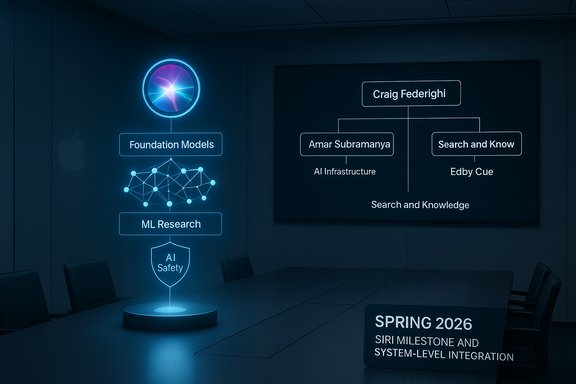
The transition is more than a personnel swap. It reshuffles responsibilities, moving elements such as AI infrastructure and search/knowledge to operational and services leaders Sabih Khan and Eddy Cue, while concentrating foundation models, machine-learning research, and AI safety under Subramanya and Federighi. Apple frames the change as a natural evolution; critics frame it as tacit admission that Apple’s original AI timeline failed to deliver.
This leadership change matters for three overlapping reasons:
Short-term (next 6–12 months)
That said, the move does not eliminate the fundamental technical constraints Apple faces: the tension between on-device privacy and model capability, the compute demands of state‑of‑the‑art models, and the integration complexity of system‑level assistants. The new leadership must balance speed with safety and maintain Apple’s privacy differentiator without hamstringing product competitiveness.
The next 12 months will be critical. Delivering demonstrable improvements in Siri and providing clearer, verifiable roadmaps for Apple Intelligence will determine whether this is a moment of course correction or merely a public-relations reset. For users, developers, and competitors, the cues are simple: measurable feature rollouts, transparent evaluation practices, and steady engineering execution will signal that Apple’s AI reboot is real.
Apple has the resources to close the gap. What it lacks right now is momentum and, perhaps more importantly, a public narrative that matches delivered capability. The new AI leadership architecture gives Apple a fighting chance — but the hard engineering work and consequential tradeoffs remain squarely ahead.
Source: theregister.com Apple shuffles AI leadership team in bid to fix Siri mess
 Background
When Apple introduced the Apple Intelligence vision at WWDC 2024 it promised a new era for Siri: a more conversational, context-aware assistant that could act across apps, use personal context securely, and tap third‑party models when appropriate. The roadmap was ambitious: systemwide generative features, on-device personalization, and a new class of foundation models calibrated for Apple’s privacy-first approach.Those ambitions collided with engineering reality in 2025. Apple publicly acknowledged development delays and pushed the most advanced Siri features out of the initial iOS 18 timeframe. The company later set an internal target for a larger Siri refresh in spring 2026. That delay, the exodus of talent from parts of Apple’s AI organization, and mounting criticism about the gap between marketing claims and shipped features have culminated in a leadership change that moves John Giannandrea — the executive who built Apple’s AI effort after leaving Google in 2018 — into an advisory role and brings Amar Subramanya in as vice president of AI reporting to Craig Federighi.
The transition is more than a personnel swap. It reshuffles responsibilities, moving elements such as AI infrastructure and search/knowledge to operational and services leaders Sabih Khan and Eddy Cue, while concentrating foundation models, machine-learning research, and AI safety under Subramanya and Federighi. Apple frames the change as a natural evolution; critics frame it as tacit admission that Apple’s original AI timeline failed to deliver.
What changed, exactly
- John Giannandrea, Apple’s senior vice president for Machine Learning and AI Strategy, is stepping down from that day‑to‑day leadership role and will act as an advisor until he retires in spring 2026.
- Amar Subramanya has been appointed vice president of AI and will report to Senior Vice President of Software Engineering Craig Federighi.
- Subramanya will lead Apple Foundation Models, machine-learning research, and AI Safety and Evaluation.
- The teams responsible for AI infrastructure and Search and Knowledge will now report to Chief Operating Officer Sabih Khan and Senior Vice President Eddy Cue, respectively.
- Apple continues to publicly target a more personalized Siri rollout in 2026, but development work will be overseen under the reorganized leadership.
Why this matters: product, strategy, and optics
Apple is a product company that sells hardware and software as a coherent experience. AI — particularly the large-model, generative kind — is not just a research challenge but a product-engineering problem that spans chips, OS integration, cloud services, and privacy guarantees.This leadership change matters for three overlapping reasons:
- Product alignment. Reporting Subramanya to Federighi signals a shift toward integrating AI work directly with the software-engineering organization that owns iOS, macOS, and the system frameworks Siri relies on. That can shorten decision cycles between model research and OS-level implementation.
- Technical focus. Concentrating foundation-model work and ML research under a single VP clarifies responsibility for the core models that will power Apple Intelligence. It suggests Apple intends to build — or at least curate and deploy — foundation models that are tightly optimized for the Apple ecosystem.
- Public confidence. The change is an explicit response to the perception that Apple has lagged. Bringing in an experienced model-builder from the centre of the industry is intended to reassure developers, partners, and customers that Apple is accelerating.
The strengths Subramanya brings
Amar Subramanya’s track record makes him an unconventional but sensible hire to steer Apple’s next chapter in AI.- Deep technical pedigree. Subramanya spent the bulk of his career at Google, where he rose to a leadership role in engineering for conversational AI projects. That background gives him hands-on experience with the life cycle of foundation‑model development and deployment.
- Cross‑platform perspective. A recent stint at Microsoft — where he worked on foundation models for consumer products — means he understands how cloud and product teams coordinate to deliver large-model features at scale.
- Productization experience. Subramanya’s career has straddled research and engineering; he knows what it takes to turn experimental models into product-ready features that meet latency, cost, and safety constraints.
- Talent credibility. Bringing in a known quantity from Google/Microsoft helps Apple in the competition for top AI engineers; it signals that Apple is willing to recruit industry veterans who can hit the ground running.
Where the hard parts remain
Despite the leadership upgrade, Apple faces a long list of technical and organizational problems that won’t be fixed solely by a star hire.- On‑device compute constraints. Apple’s privacy-first posture pushes much of the experience toward on-device computation. While Apple Silicon is powerful, running large foundation models entirely on device — especially for memory- and compute‑heavy tasks — remains a technical stretch without significant model compression, quantization, or a move to lighter architectures.
- Hybrid-cloud tradeoffs. The balance between on-device inference and cloud-hosted models is fraught. Sending user data to cloud models can improve capabilities but raises privacy and regulatory scrutiny. Apple’s historical insistence on minimizing off‑device data flows constrains options that competitors exploit aggressively.
- Model safety and evaluation. Apple emphasizes safety; embedding rigorous evaluation and red‑team controls into a rapid product cadence is a nontrivial problem. Safety work can slow releases, and the public will judge Apple on both capability and trustworthiness.
- Integration complexity. Siri is not a standalone lab project. It touches system UI, developer APIs, third‑party apps, search and knowledge systems, and device resource management. Reorganizing teams reduces friction in theory but introduces short‑term coordination costs.
- Talent churn and morale. Multiple reorganizations and public criticism can accelerate departures. Apple already saw attrition in parts of its AI staff; rebuilding momentum requires steady leadership and a clear roadmap that engineers trust.
Organizational implications: power, reporting, and product focus
The reporting lines Apple set publicly are revealing.- Putting Subramanya under Federighi moves AI research and model-building into the software-engineering chain. That is a product-centric move: models should be designed for product constraints rather than being pure research endeavours.
- Assigning AI infrastructure to Sabih Khan — Apple’s COO — aligns cloud and platform reliability with operations. That can accelerate provisioning and scale but risks creating two competing axes if product and infra disagree on priorities.
- Moving Search and Knowledge to Eddy Cue — the services veteran who oversees Apple’s content and cloud services — suggests Apple intends to integrate AI-driven search and knowledge features more tightly with its services business.
Technical choices Apple must make (and tradeoffs)
Apple’s path forward will hinge on several technical decisions — each with practical tradeoffs.- Build vs. license foundation models. Apple can invest in proprietary foundation models tuned for Apple Silicon and privacy, or it can license/partner with third‑party model providers and adapt them. Building gives more control; partnering is faster. Either path has cost, speed, and control implications.
- On‑device model design. To run well on iPhones and Macs, models require aggressive compression: pruning, distillation, quantization, and architectural changes. These techniques preserve privacy but often reduce capability compared with cloud-scale models.
- Hybrid orchestration. A pragmatic approach is hybrid: perform sensitive personalization on device, and offload non‑sensitive or compute‑heavy tasks to the cloud. Implementing this split securely and predictably is technically demanding.
- Privacy guarantees. Apple must maintain its reputation for user privacy — e.g., differential privacy, secure enclaves, attestation of models, and transparent data flows. Strong privacy can be a market advantage, but it can also limit performance compared with competitors who accept broader data telemetry.
- Safety evaluation. Implementing robust testing, adversarial evaluation, and content moderation pipelines before public releases slows time‑to‑market but reduces reputational and legal risk.
Competition and the market context
Apple is racing against companies that made earlier and bolder bets on large models and cloud deployment.- Google has deployed Gemini and tight cloud integration across Search and Android; its scale in models and data remains an advantage.
- Microsoft has partnered deeply with OpenAI and baked Copilot capabilities across Windows and Office, leveraging cloud scale and multi‑product distribution.
- OpenAI and well‑funded startups continue to push model capabilities and experimental UXs, forcing incumbents to iterate quickly.
- Hardware vendors and phone makers (including Samsung) are also integrating advanced conversational features, eroding a previously defensive moat Apple enjoyed.
PR, legal exposure, and the “Siri promises” problem
The delay to Siri’s personalized features has already had consequences beyond product timelines.- Credibility gap. Apple marketed Apple Intelligence and associated Siri improvements publicly; delays and unmet timelines erode trust among customers and developers.
- Legal risk. There are active lawsuits and regulatory interest in the accuracy and claims made about device capabilities. Overstated marketing relative to shipped functionality creates legal exposure and public-relations headaches.
- Developer relations. Third‑party developers expecting robust system‑level AI hooks may become frustrated if APIs change or timelines slip. That risk can dampen platform enthusiasm.
What success looks like for Apple’s new AI leadership
Short-term and long-term success metrics should differ.Short-term (next 6–12 months)
- Stabilize the AI organization and retain key researchers and engineers.
- Publish a clear, credible roadmap for the spring 2026 Siri milestone with transparency about scope.
- Demonstrate incremental, measurable improvements in Siri responsiveness, context-awareness, and app integration.
- Show concrete progress on safety and evaluation standards, with internal benchmarks that can be briefly summarized to the public.
- Deploy foundation models tuned for Apple Silicon and the platform that can perform core tasks with acceptable latency and resource use.
- Deliver on Apple’s privacy commitments with verifiable guarantees for on‑device personalization.
- Integrate AI features across Apple’s hardware line without compromising battery life or thermal performance.
- Maintain or grow developer adoption of Apple Intelligence APIs and developer tools.
Risks that could still derail recovery
- Overdependence on external models. Relying too much on third‑party models for core functionality undermines Apple’s control and may expose it to upstream changes.
- Underestimating hardware limits. If future flagship features require next‑generation chips that aren’t imminent, users will be disappointed and Apple will be accused of gating features behind hardware upgrades.
- Cultural friction. Bringing in executives steeped in Google/Microsoft cultures and expecting them to adapt quickly to Apple’s design-first, privacy-centric model could produce management friction.
- Regulatory scrutiny. Privacy regulators in Europe and elsewhere are tightening rules on AI; Apple’s decisions may invite scrutiny if data flows or model behaviors are ambiguous.
- Market impatience. Consumers and enterprise customers have short attention spans for promised AI features. Repeated delays can drive users to rivals.
What to watch next: checkpoints and signals
- Product milestones. Watch Apple’s developer communications and beta releases for concrete API previews or model behaviors that demonstrate progress.
- Hiring and retention. Monitor whether Apple continues to recruit senior AI talent and whether the churn of mid- and senior‑level engineers slows.
- Roadmap clarity. The cadence and specificity of Apple’s public roadmap (and the language used in developer documentation) will indicate whether leadership is restoring discipline.
- Partnerships and licensing. Public signals about partnerships with model providers, academic labs, or cloud vendors will reveal whether Apple chooses a build-or-partner strategy.
- Safety transparency. Any publication of safety benchmarks, red-team findings, or internal evaluation frameworks would be a strong positive signal.
Final assessment
Apple’s reorganization is a necessary and overdue course correction: placing foundation-model work under a product-focused chain of command and bringing in a proven engineering leader addresses several weaknesses that were exposed by Siri’s delayed evolution. Amar Subramanya’s experience across Google and Microsoft is a meaningful asset, especially for closing the gap between research and usable product.That said, the move does not eliminate the fundamental technical constraints Apple faces: the tension between on-device privacy and model capability, the compute demands of state‑of‑the‑art models, and the integration complexity of system‑level assistants. The new leadership must balance speed with safety and maintain Apple’s privacy differentiator without hamstringing product competitiveness.
The next 12 months will be critical. Delivering demonstrable improvements in Siri and providing clearer, verifiable roadmaps for Apple Intelligence will determine whether this is a moment of course correction or merely a public-relations reset. For users, developers, and competitors, the cues are simple: measurable feature rollouts, transparent evaluation practices, and steady engineering execution will signal that Apple’s AI reboot is real.
Apple has the resources to close the gap. What it lacks right now is momentum and, perhaps more importantly, a public narrative that matches delivered capability. The new AI leadership architecture gives Apple a fighting chance — but the hard engineering work and consequential tradeoffs remain squarely ahead.
Source: theregister.com Apple shuffles AI leadership team in bid to fix Siri mess
