

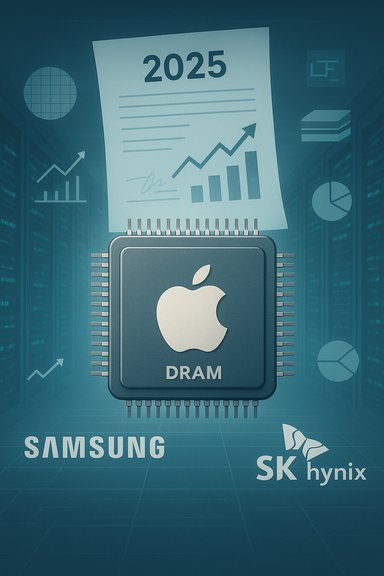
Apple appears to be at the center of a quiet but consequential supply-chain story: industry observers are reporting that some of Apple’s long-term DRAM supply agreements with Samsung Electronics and SK hynix may be scheduled to lapse at the end of 2025, potentially forcing fresh negotiations in a market that has tightened sharply since 2024. These reports are speculative and based on analyst commentary rather than corporate disclosure; there are no official confirmations from Apple, Samsung, or SK hynix about contract lengths, renewal plans, or pricing terms. The broader context matters: DRAM availability and prices have swung from surplus to scarcity over the last 18 months as hyperscale AI, server deployments, and cautious capacity expansion by major fabs reallocated wafer starts and packaging capacity to higher‑margin enterprise and HBM products — a dynamic that has driven steep contract and spot price increases across many DRAM segments in 2025.
Background / Overview
Apple’s reported situation sits at the intersection of two facts that are individually well documented and jointly significant. First, major memory makers have shifted production emphasis toward server DRAM, HBM, and specialized high-performance mobile DRAM (LPDDR5/LPDDR5X) to serve hyperscalers and AI infrastructure buyers; that shift has reduced the effective supply available to commodity channels and raised contract prices for many buyers. Independent market-tracking groups and industry press have tracked recurring price rallies and allocation-driven shortages since early 2024 and into 2025. Second, Apple is a very large, sophisticated buyer of mobile DRAM (LPDDR variants), and its memory needs for iPhones, iPads, and Apple Silicon Macs are a meaningful part of the global LPDDR market. Long-term purchase agreements between large OEMs and memory manufacturers are common industry practice — they smooth supply, lock in volume, and sometimes include price bands or floors to reduce volatility risk for both sides. The suggestion that some of Apple’s long‑term contracts could expire at year‑end 2025 is plausible in that context, but it is currently an unverified industry inference rather than an established corporate fact.Why this matters: the DRAM market in 2024–2025
Supply reallocation and the AI squeeze
Since 2024 the DRAM landscape has been reshaped by hyperscaler and AI demand. High‑bandwidth memory (HBM) and server DRAM for AI hosts command far higher per‑wafer revenue than commodity PC and some mobile DRAM, so manufacturers have prioritized those segments when they allocate wafer starts, test/assembly slots, and advanced packaging capacity. The result: fewer wafer starts available for legacy and mainstream DRAM, upward pressure on contract pricing, and rapidly rising spot prices in many subsegments. Independent trackers and industry briefs show repeated quarter‑to‑quarter price increases through 2025 and repeated warnings that tightness could persist until new fabs and packaging lines ramp — a process that typically takes years and multibillion‑dollar investments. TrendForce/DRAMeXchange and other market research firms reported steep contract price rises across DDR4/DDR5, LPDDR variants, and graphics DRAM in 2025, with legacy formats like DDR4 and LPDDR4X experiencing especially large percentage jumps because suppliers deliberately reduced or reclassified legacy production. Those datasets track the supply‑side shift and corroborate the broader narrative of a multisegment upcycle.Observable effects downstream: OEMs and channel prices
The supply shock is not purely academic. Major OEMs have started to communicate higher component cost risk to commercial customers and channel partners. Reports of price increases from large PC and server vendors, and retailers revising RAM kit pricing, indicate that higher contract prices are feeding through to quotes and retail listings. Some vendors even warned that placing an order today does not guarantee the price at delivery, because contract windows and wafer allocations are moving fast. These are real procurement headaches for OEMs planning 2026 builds and for IT buyers budgeting refresh cycles.The most affected segments
- High‑performance AI/HPC (HBM‑centric) — prioritized and commanding the highest margins.
- Server DDR5 — heavy procurement from hyperscalers and enterprise servers.
- Mobile LPDDR (LPDDR5/LPDDR5X) — tight, because mobile vendors still need large bit volumes for phones and some laptop platforms.
- Consumer DDR4 and DDR5 modules — squeezed distribution inventories and volatile spot pricing.
Market trackers show divergent price impacts across those product families; the pain profile varies by buyer.
The Apple angle: what would expiring long-term DRAM contracts mean?
The immediate commercial mechanics
If Apple’s long-term DRAM agreements with Samsung and SK hynix were indeed set to expire at the end of 2025, the practical consequences would be straightforward from a commercial perspective: Apple and its suppliers would either negotiate extensions (with terms that could include escalators, volume guarantees, or allocation clauses), move to shorter-term spot/contract rollovers, or re‑contract with alternative suppliers where feasible. In a tighter market, suppliers have stronger leverage to demand higher per‑unit prices, surcharges, or premium lead‑time payments for guaranteed allocation. Those dynamics are typical in any industrial negotiation where buyers lose the buffer of long-term locked pricing while demand and allocations are tightening.The potential price sensitivity for Apple devices
Apple is a major buyer of LPDDR memory used in iPhones, iPads and some Macs; even modest per‑unit price increases can scale to substantial changes in component cost at the volume Apple ships. If Apple had to accept higher LPDDR prices for contract renewals or new short-term purchases in 2026, that would alter margins or reallocate budgets inside Apple’s product BOM. Historically Apple has absorbed some component cost swings internally and has occasionally adjusted device pricing, but the company has multiple levers — cost cutting elsewhere, strategic timing of product features, and careful positioning of premium models — that let it smooth customer pricing volatility more conservatively than smaller OEMs. That said, how Apple would allocate any increased cost — absorb it, accept margin compression, or push it to consumers — is a corporate strategy decision and cannot be predicted with certainty without direct statements from Apple or statutory filings.Apple’s structural advantages and levers
Apple is not a typical handset OEM. The company enjoys several structural defenses that reduce direct vulnerability to short‑term supply shocks:- Large cash and liquidity reserves and diversified financing options provide negotiation flexibility that smaller OEMs lack.
- Vertical integration — Apple’s in‑house SoCs, custom packaging work, and investments in chip‑system integration reduce dependence on commodity components in some places and allow different BOM tradeoffs.
- Supplier relationships and long histories with memory makers give Apple commercial and engineering influence that smaller buyers rarely command.
Evidence and verification: what’s confirmed, what’s speculation
Confirmed and verifiable facts
- DRAM market tightness and price increases in 2024–2025 — corroborated by multiple independent market trackers and industry press. TrendForce and DRAMeXchange published repeated reports in 2025 documenting rising contract prices and constrained supply in several DRAM segments.
- OEMs warning of higher component costs — large vendors and resellers publicly signaled that DRAM and NAND cost escalation was affecting quotes and may lead to price increases for customers. Dell’s pricing adjustments and public advisories about memory-led cost risk are an observable example.
- Apple is a major LPDDR buyer and historically sources memory from Samsung, SK hynix and Micron — multiple industry reports and supplier win analyses show those companies occupy the bulk of the LPDDR market and are routine Apple partners. The exact contractual structures are not public, but the supplier‑OEM relationships are well documented.
Claims that remain unverified or speculative
- The core claim that Apple’s long‑term DRAM supply contracts with Samsung and SK hynix formally expire at the end of 2025 is currently an analyst inference reported in some outlets and forums. There is no public confirmation from any of the named companies identifying contract expiry dates, extension terms, or renegotiation timelines. Treat that scenario as plausible but not proven.
- Assertions about precise price uplift percentages Apple might face, or how those costs would be allocated within Apple’s product BOM and pricing decisions, are hypothetical unless backed by leaked contract terms or company filings. Those numbers should be viewed as scenario modelling rather than hard facts.
Scenarios and likely outcomes
Scenario A — Contracts extended on similar terms
Apple and its suppliers agree to extend the existing long‑term contracts with relatively modest price adjustments or allocation clauses. This outcome would be the least disruptive to Apple’s product planning and would minimize upstream pricing shocks for consumers, but suppliers might demand some concessions (volume guarantees, staggered price increases). This is an attractive outcome for all parties in a tense market because it preserves planning stability.Likelihood: plausible, because long-standing OEM‑supplier relationships are often renewed by negotiation rather than market‑driven breaks. Caveat: suppliers have stronger leverage in a tight market, so any renewals may include price upward adjustments.
Scenario B — New contracts at materially higher prices
Suppliers use the tight market to press for higher per‑unit prices or surcharges in new long‑term arrangements. Apple, faced with a choice to accept higher BOM costs or lose allocation certainty, may accept higher prices for guaranteed supply. Apple’s internal levers (other BOM savings, product mix changes) could offset some impact, but margins or consumer pricing could feel pressure if the differential is large.Likelihood: realistic, especially given broad industry price rises in 2025 and supplier reallocation to higher‑margin AI/server DRAM products. Evidence: contract and spot price indices rising and OEM warnings about cost pass-throughs.
Scenario C — Shorter-term spot buys and allocation risk
Apple chooses (or is forced) to shift some purchasing to shorter-term contracts or spot markets to exploit immediate availability or manage cash flow, thereby increasing exposure to price volatility. This raises allocation risk if suppliers prioritize hyperscalers with multi-year commitments.Likelihood: less attractive for Apple but possible if suppliers refuse long-term renewal terms Apple finds acceptable. This would increase uncertainty for Apple’s product roadmaps and inventory planning.
What Apple could — and likely would — do to mitigate impact
- Negotiate multi‑year allocation commitments that tie certain wafer starts or process lines to Apple‑specific LPDDR products in return for long-term minimum purchases. Established OEMs commonly secure capacity this way in tight markets.
- Use diversified sourcing: where technically possible, shift orders among suppliers (Samsung, SK hynix, Micron) to spread risk and exploit pockets of available capacity. Market reports show Apple has historically engaged multiple DRAM suppliers.
- Increase vertical engineering integration: Apple has explored packaging and memory architecture changes (including memory-on-package and other packaging approaches) that create product differentiation and reduce commodity substitution risk. Those engineering choices can change the set of compatible suppliers and give Apple unique negotiation leverage.
- Absorb costs in other BOM areas or accept temporary margin compression while postponing consumer price moves, using liquidity to smooth transitions. Apple’s balance sheet and product pricing strategy make this commercially feasible, though not certain.
Risks and blind spots
- Single‑sided reporting and rumor risk: Many of the public discussions about specific contract expiry dates are based on analyst leaks or market observers, not on filings or supplier statements. These reports should be treated as informed conjecture until a party confirms terms.
- Allocation vs. pricing trade-offs: Even if Apple secures capacity, it may come at a cost — higher prices or more complex logistics — so securing supply is not a free hedge against price inflation. Suppliers can and do tie allocation to premium pricing or prepayment. TrendForce data and OEM press indicate suppliers have been extracting market rents during 2025 tightness.
- Product segmentation effects: If Apple absorbs costs selectively (e.g., paying more for LPDDR for Pro models while constraining memory on base models), it could widen the gulf between entry and premium tiers and affect consumer perception. That’s a commercial risk that larger OEMs frequently manage, but it matters for brand and demand elasticity.
- Long ramp time for capacity relief: New memory fabs and advanced packaging lines typically come online over multi‑year timelines. Even widely publicized fab projects planned for 2026–2029 will not relieve 2026 allocation pressures immediately. This structural lag supports the view that tightness could persist beyond a single quarter.
Practical takeaways for WindowsForum readers, OEMs and IT buyers
- For corporate procurement and OEM planners: assume allocation risk and price volatility are real in early‑to‑mid 2026; consider hedging strategies (earlier block buys, multi‑vendor contracts, staged procurement). Locking predictable supply often costs more in raw dollars but reduces the risk of production delays or SKU downgrades.
- For consumers and system builders: if a near‑term upgrade is necessary, buying sooner rather than later can avoid potential step increases in retail DRAM prices; for non‑urgent upgrades, monitoring market indicators and vendor announcements is prudent. The “buy now” advice is context-dependent — some categories showed price declines earlier in 2025, but the 2H25 to 2026 trend has been upward.
- For Apple watchers: treat reports about contract expiries as early‑warning signals rather than definitive proof. Watch for corroborating signs: supplier investor calls that disclose allocation strategies, Apple supplier‑related filings, or significant announcements from Samsung, SK hynix, or Micron that reference major OEM commitments. Until a named party confirms, the story sits in the plausible-but‑unconfirmed category.
Verdict and final analysis
The narrative that Apple’s long‑term DRAM contracts with Samsung and SK hynix could expire around the turn of 2025/2026 is credible as a hypothetical risk, but it remains unproven. The underlying market facts that give the hypothesis traction are verifiable and well documented: DRAM supply tightness, robust hyperscaler demand for HBM and server DRAM, and significant contract and spot price increases across multiple DRAM families in 2025. Those market forces increase the bargaining power of suppliers in any negotiation that coincides with shrinking available wafer starts and packaging capacity. However, the leap from a tense market to the conclusion that Apple will necessarily face materially higher per‑unit DRAM costs, or that those costs will be passed directly and fully to consumers in 2026, involves many conditional steps — renewal terms may be negotiated; Apple’s in‑house advantages and multi‑supplier relationships could blunt the impact; and suppliers may prefer predictable long‑term partners over one‑off spot premiums. In short, the scenario is plausible and important to monitor but not proven.Readers should treat early reports about specific contract expiry dates as an indicator to watch the market rather than as a trigger for panic. For those managing budgets or product roadmaps, the prudent response is simple: prepare for higher DRAM prices and allocation risk in early 2026, explore hedging and multi‑vendor approaches, and keep an eye on supplier statements and market reports from established trackers (TrendForce, DRAMeXchange and similar) for the most reliable forward signals.
Apple’s contract story is a useful case study in modern supply‑chain fragility: when a few suppliers control critical capacity, major shifts in end‑market demand (like a rapid AI buildout) can ripple across consumer and enterprise markets with remarkable speed. Whether Apple, Samsung, and SK hynix will release definitive contract details or simply choose commercially quiet renewals remains to be seen; until then, the correct posture is cautious verification, active supply planning, and recognition that plausible industry scenarios are not the same as hard facts.
Source: igor´sLAB Apple and expiring long-term DRAM contracts from 2026 | igor´sLAB
