

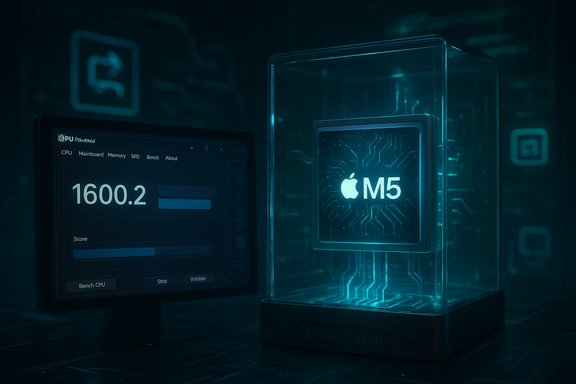
Apple’s latest M5 system-on-chip stunned the enthusiast community this week after a Chinese tester published a CPU-Z (ARM64) run inside a virtualized Windows 11 session that recorded a staggering single‑thread score — one that, on paper, dwarfs the top desktop chips from Intel and AMD in the same synthetic test. The result, reported by a hardware news outlet and traced back to an NPacific post (shared by leaker HXL), lists the M5 at 1600.2 points in CPU‑Z 1.04.arm64 (single‑thread) when running Windows 11 in a VM, a score that would be the highest non‑overclocked single‑thread entry in CPU‑Z’s ARM-oriented hall of fame. This article unpacks what that number means, what it doesn’t, and why Windows fans, IT pros, and PC buyers should treat the headline with both excitement and a healthy dose of skepticism. It draws on the published benchmark claims, CPUID’s own ARM CPU‑Z notes, and precedent testing of Apple Silicon under virtualization to verify the core facts and identify gaps that still need independent, repeatable validation.
Background and overview
Apple’s M‑series silicon has been a consistent disruptor in single‑thread IPC and energy‑efficient performance since the M1 era. Apple’s architecture strategy emphasizes high instructions‑per‑clock (IPC), aggressive microarchitectural optimizations, and tightly integrated power/thermal management inside macOS. That design goal — maximizing per‑core performance while keeping power low — is the key explanation vendors and reviewers cite for why Apple cores often lead in short, single‑thread bursts. The new claim about the M5 underscores that same design priority but uses a less conventional measurement: CPU‑Z running inside a virtualized Windows 11 environment on an Apple platform. Why this matters: Apple’s M5 scoring 1600.2 in CPU‑Z single‑thread would represent a very large lead over the highest single‑core numbers recorded for mainstream x86 desktop CPUs in the same tool. Reported comparators include Intel’s Core i9‑14900KS (≈952 in the same CPU‑Z test) and AMD’s Ryzen 9 9950X3D (≈867), numbers that the Tom’s Hardware writeup uses to put the M5 result into context. If validated on native platforms and across multiple benchmarks, a gap this large would reshape some performance narratives — particularly around single‑thread throughput versus peak boost clocks on x86 silicon.What was actually tested
The raw claim
- An enthusiast (NPacific) uploaded a CPU‑Z ARM64 run of an Apple M5 inside a Windows 11 virtual machine. The report lists:
- CPU‑Z 1.04.arm64 single‑thread score: 1600.2
- CPU‑Z multithread score: ~5976.2 (10 cores reported, no SMT)
- The Tom’s Hardware story relays those numbers and compares them to existing CPU‑Z entries for high‑end Intel and AMD desktop CPUs.
Tools and environment
- CPU‑Z now ships a native Windows on ARM (ARM64) build, which makes it possible to run CPU‑Z directly inside a Windows ARM guest. CPUID documents the ARM64 release and the existence of a hall‑of‑fame/benchmark database for entries, though the ARM variant is newer and still maturing.
- Virtualized Windows on Apple Silicon typically runs through Parallels Desktop (the most common consumer virtualization hypervisor for macOS), VMware Fusion Tech Preview, or other hobbyist setups. Prior community benchmarking has shown that Parallels can host Windows ARM VMs reliably and that synthetic test numbers inside these VMs historically differ from macOS native benchmarks — both because of VM overhead and because CPU utilities report the virtualized environment’s view of the hardware.
Technical analysis — single‑thread result explained
Why a 1600.2 single‑thread score is plausible (architecturally)
- Apple’s custom Armv9 cores in the M5 are tuned for high IPC and efficient burst clocks. Architecture-level improvements combined with process and micro‑op optimizations can produce per‑core performance leaps that show up strongly in single‑thread microbenchmarks.
- Synthetic utilities like CPU‑Z single‑thread tests stress a small set of code paths where IPC and single‑core clock rate dominate. In that narrow context, a large lead is technically possible if Apple’s core design and boost behavior vastly outperform the microarchitectures used by x86 rivals on the specific instructions CPU‑Z exercises.
Why virtualization inflates uncertainty
- A Windows ARM guest running on Apple Silicon does not access the CPU the same way macOS does. Hypervisor layers, emulation of certain instructions, and how Windows schedules threads inside the guest can change benchmark behavior.
- VM frameworks can present a simplified or modified topology to the guest OS. That means the benchmark may be exercising a virtualized execution path that does not match native scheduling behavior or thermal constraints.
- Windows’ scheduler — and app binaries built for Windows ARM — may use different instruction encodings or code paths than optimized macOS binaries, producing divergent synthetic results. CPUID’s ARM‑native CPU‑Z is itself young, and behavior under VMs is a new frontier for the tool.
Measurement artifacts that could exaggerate single‑thread numbers
- Short synthetic bursts often reflect instantaneous frequency and turbo headroom, not sustained throughput. Apple’s cores can do high‑frequency bursts for brief windows; if CPU‑Z samples during a thermal/power headroom window, it will record a higher score than a sustained workload would.
- Some utilities and test harnesses read CPU frequency/timer registers that can be affected by virtualization or by how the hypervisor exposes “max clock” to the guest — the reported clocks may not reflect sustained, stable operating frequencies.
- Benchmarks can be gamed or misreported (accidentally or intentionally) by altering affinities, changing power profiles, or by using modified binaries. Independent reproduction is essential before treating the number as definitive.
Multi‑thread results and why they look different
The M5’s CPU‑Z multi‑thread score (~5976.2) sits comfortably ahead of all CPUs running eight threads but falls behind higher‑threaded x86 parts once thread counts increase. That mixed outcome aligns with what you’d expect from a 10‑core, no‑SMT Arm chip competing against x86 parts that offer many cores and simultaneous multithreading.Key points:
- The M5 is a 10‑core design without SMT, so its multi‑threaded scaling is limited by raw core count.
- Intel and AMD server/desktop chips with 12, 16, or 20 threads will naturally win heavily parallel synthetic tests even if their single‑thread IPC is lower.
- Windows’ thread scheduler, and how it behaves inside a VM on Apple Silicon, may also blunt the M5’s multi‑thread scaling measured in the guest. In short: great single‑core performance does not automatically translate into class‑leading multi‑core throughput.
Methodological red flags and verification steps
Before rewriting ranking charts or procurement guidance, the community should insist on the following verification steps:- Reproduce the CPU‑Z ARM64 run in more than one VM/hypervisor (Parallels, VMware Fusion, UTM/QEMU) to rule out hypervisor‑specific artifacts.
- Run the same CPU‑Z ARM64 test on native macOS targets when possible — even though CPU‑Z lacks a macOS client, equivalent, well‑instrumented macOS microbenchmarks (or macOS builds of CPU‑Z if ever released) should be used to cross‑check single‑thread behavior.
- Use additional benchmarks that focus on distinct instruction mixes and real‑world workloads: Cinebench (per‑core runs), SPEC CPU (where available), compiler/build timings, and real‑world app tests (single‑threaded productivity tasks).
- Measure thermal and power metrics during the runs: peak power, thermal throttling characteristics, and sustained clocks across minutes, not just single bursts.
- Confirm CPU‑Z entries against validated, reproducible submissions to CPUID’s hall‑of‑fame or equivalent validator logs, and correlate with other crowdsourced databases (e.g., Geekbench, independent lab reports).
How trustworthy is CPU‑Z ARM64 for cross‑platform ranking?
CPU‑Z is a respected diagnostic and microbenchmark tool, but it has limits:- It’s a focused microbenchmark; it measures a tiny cross‑section of CPU behavior. Microbenchmarks can be useful early indicators, but they do not always predict application‑level performance.
- The ARM64 edition is newer than the long‑serving x86 build. Tools mature over iterations; early releases sometimes show quirks when run under unusual environments, like nested virtualization or on untested SoCs.
- Historical precedent: earlier community runs of Apple M‑series chips inside Windows VMs have shown large single‑thread synthetic numbers in some tools, but cross‑tool correlations have not always matched (some synthetic spikes don’t translate to real apps). Prior tests of Apple M chips in Windows VMs prove the setup can produce interesting, but not definitive, numbers.
Practical implications for buyers and PC enthusiasts
- For most users and IT shops, the headline single‑thread number is interesting but not yet actionable. Real‑world application performance, driver/OS support, ecosystem compatibility, and sustained thermal behavior still matter far more than one synthetic value.
- If you prioritize short‑duration, latency‑sensitive single‑thread tasks (some code‑compile hotspots, single‑threaded editor responsiveness), Apple’s M‑series has historically been excellent — and M5’s architecture suggests Apple is continuing that trend.
- For heavy multi‑threaded workloads (render farms, large parallel builds, native Windows server tasks), x86 chips with many cores and SMT remain stronger in aggregate throughput — and they run Windows natively without the VM compatibility caveats.
- If you’re a Windows‑on‑ARM early adopter, the CPU‑Z ARM64 release and these results are a sign that the platform is maturing. But expect a jagged compatibility landscape for legacy x86/x64 apps that still rely on emulation layers.
Security and credibility risks
- Unverified benchmark leaks can distort market sentiment and purchasing decisions. Synthetic scores make splashy headlines but can mislead if not corroborated with transparent methodology and reproducible logs.
- The CPU‑Z hall of fame and validators help with traceability, but the ARM64 space is new enough that the community should invite formal, reproducible submissions rather than treat a single screenshot or post as definitive. CPUID’s official ARM64 notes remind users that the tool is functional on Windows ARM, but they do not absolve the need for rigorous validation.
- There is potential for accidental misconfiguration (power‑profile tweaks, hypervisor optimization flags, or affinity hacks) or deliberate manipulation. Any single, outstanding result should be considered provisional until independent labs and multiple community testers reproduce it under documented conditions.
What to watch next — experiments that will settle this
- Independent lab tests: reputable review sites that can access M5 hardware should run CPU‑Z ARM64 inside identical virtualization stacks and also run cross‑platform tests on the macOS side. Repeatable test logs and thermal/power traces are essential.
- Multi‑tool correlation: check whether M5’s lead appears in other microbenchmarks (e.g., Geekbench single‑core), in real‑world single‑thread runs (compilers, Chrome/Edge scripting hotspots), and in per‑core Cinebench runs.
- Native Windows Arm results: if Microsoft‑approved Arm Windows builds on Apple hardware (or emulation modes) become more common, native ARM Windows tests on M5 silicon (outside a VM) would give the most direct comparison for Windows apps.
- Long‑duration workloads: sustained renders, lengthy single‑thread tasks, and mixed workloads will show whether the single‑thread headroom translates into meaningful advantages in day‑to‑day workflows.
Bottom line
The NPacific/HXL CPU‑Z ARM64 runs of the Apple M5 inside a Windows 11 VM produced an eye‑catching 1600.2 single‑thread score, a figure that — if reproduced on native or independently verified setups — would underline Apple’s continued leadership in single‑core IPC and burst performance. That said, the result today is a synthetic snapshot seen inside a virtualized environment, and it must be treated as provisional: virtualization artifacts, sampling windows, and the infancy of CPU‑Z’s ARM64 ecosystem make it impossible to accept the number as a final verdict without independent reproduction. For Windows users and IT decision‑makers, the cautious takeaway is straightforward: Apple’s SoC architecture continues to be impressive on per‑core workloads, but real‑world Windows performance, application compatibility, and multi‑thread throughput remain governed by platform support and workload profiles. Benchmarks like CPU‑Z are valuable early signals — and they should prompt deeper, reproducible testing rather than instant reordering of procurement lists.Quick checklist for readers evaluating the claim
- Treat the single number as a signal, not the full story.
- Demand reproducibility: same test on different hypervisors, native macOS comparisons, and independent lab validation.
- Check multiple benchmarks: microbenchmarks, real‑world app testing, and sustained thermal/power traces.
- Watch for updated CPU‑Z ARM releases and validated hall‑of‑fame submissions that include reproducible logs.
Source: Tom's Hardware Virtualized Windows 11 test shows Apple's M5 destroying Intel and AMD's best in single-core benchmark — Chinese enthusiast pits Ryzen 9 9950X3D and Core i9 14900KS against Apple's latest SoC
