

Apple is planning a staged MacBook refresh that will extend Apple Silicon’s AI-first momentum into 2026 with an M5-powered MacBook Air line and higher‑end M5 Pro / M5 Max MacBook Pro updates — and industry chatter now includes a separate low‑cost MacBook allegedly aimed at the $599–$699 band.
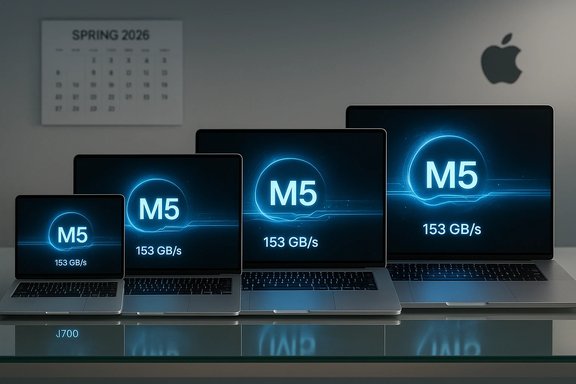
Apple closed out 2025 having pushed Apple Silicon into more product tiers and leaned heavily into on‑device AI as a marketing and engineering priority. The M4 MacBook Air family launched earlier in 2025 with a lower entry price and broad consumer appeal, while Apple introduced the first M5‑equipped machine — a refreshed 14‑inch MacBook Pro — in October 2025. Those moves set the stage for additional M5 rollouts in early 2026 and rekindled speculation about a budget MacBook that would compete directly with Windows and Chromebook entries. What’s new in the current wave of reporting is both a schedule (Air first in spring 2026, followed by Pro models) and a clearer set of product targets: the 13‑inch and 15‑inch MacBook Airs will switch to M5 silicon with mostly carry‑over chassis designs, while 14‑inch and 16‑inch MacBook Pro configurations are expected to receive M5 Pro and M5 Max variants with higher memory bandwidth and faster SSDs. At the same time, supply‑chain leaks and analyst notes point to Apple testing a truly low‑cost model (codename J700 in some reports) priced well below the MacBook Air to capture budget buyers.
That said, the low‑cost MacBook narrative is still a rumor‑to‑watch and the competitive landscape — notably Qualcomm’s Snapdragon X2 Elite family and aggressive Windows OEM pricing — will shape how buyers choose between macOS and Windows solutions. For buyers and IT decision makers, the key is to match workloads to hardware characteristics, wait for independent sustained tests for new silicon, and treat early pricing/timing reports as provisional until Apple posts official SKUs and availability.
Source: Technobezz Apple plans to launch three new MacBook models in early 2026
 Background / Overview
Apple closed out 2025 having pushed Apple Silicon into more product tiers and leaned heavily into on‑device AI as a marketing and engineering priority. The M4 MacBook Air family launched earlier in 2025 with a lower entry price and broad consumer appeal, while Apple introduced the first M5‑equipped machine — a refreshed 14‑inch MacBook Pro — in October 2025. Those moves set the stage for additional M5 rollouts in early 2026 and rekindled speculation about a budget MacBook that would compete directly with Windows and Chromebook entries. What’s new in the current wave of reporting is both a schedule (Air first in spring 2026, followed by Pro models) and a clearer set of product targets: the 13‑inch and 15‑inch MacBook Airs will switch to M5 silicon with mostly carry‑over chassis designs, while 14‑inch and 16‑inch MacBook Pro configurations are expected to receive M5 Pro and M5 Max variants with higher memory bandwidth and faster SSDs. At the same time, supply‑chain leaks and analyst notes point to Apple testing a truly low‑cost model (codename J700 in some reports) priced well below the MacBook Air to capture budget buyers. What Apple has already confirmed (and what remains rumor)
Confirmed: M5 and the new 14‑inch MacBook Pro
Apple publicly announced the 14‑inch MacBook Pro with the M5 chip in October 2025. The company’s own materials emphasize new GPU/GPU‑side neural hardware, higher unified memory bandwidth, and faster SSDs — features Apple positions as enabling stronger on‑device AI and faster pro workflows. Apple’s specs and marketing highlight up to a 20% multithreaded CPU uplift versus M4 in some workloads, higher GPU throughput, and dramatic AI improvements from a Neural Accelerator design that is integrated at the core level.Strongly reported (but not yet official): M5 Air updates, Pro M5 Pro / M5 Max, and timing
Multiple reputable outlets and supply‑chain briefs now point to an M5 MacBook Air refresh in spring 2026 (13‑inch and 15‑inch models, broadly retaining the current Air designs) followed by higher‑end 14‑inch and 16‑inch MacBook Pro models that will adopt the M5 Pro and M5 Max chips in the same early‑2026 window. These reports come from a combination of supply‑chain tracking, analyst notes, and well‑sourced writers who follow Apple’s cadence. Treat the specific months and SKU lists as provisional until Apple announces them publicly.Rumor / supply‑chain claim: A low‑cost MacBook at $599–$699
Industry leaks and analyst notes repeatedly surface a lower‑cost MacBook effort (often referenced internally as J700) that aims at a $599–$699 price band. The play is clear: capture students and price‑sensitive buyers who today favor Windows notebooks or Chromebooks. Multiple supply‑chain snippets and commentary discuss using an A‑series iPhone‑class SoC (A18 Pro or similar), a smaller LCD panel, and trimmed I/O to meet such price targets — but those claims remain unverified until Apple posts formal specs and SKUs.What the M5 architecture actually brings — verified technical highlights
Apple and independent reviewers agree on the architectural direction for M5: more neural compute, better memory bandwidth, and GPU changes oriented toward AI workloads rather than simply raw rasterization throughput. Key verified points:- Neural acceleration per GPU core — Apple publicly described a Neural Accelerator integrated into each GPU core to speed model inference and AI tasks on device. This is central to Apple’s Apple Intelligence initiatives.
- Increased unified memory bandwidth — packaged M5 configurations show higher bandwidth numbers (Apple quoted ~153 GB/s for some Pro configurations), which reduces data‑movement bottlenecks when running larger local models and heavy GPU tasks.
- Measured performance uplift — independent reviews and lab tests report CPU and GPU gains: reviewers recorded roughly 20% faster multithreaded CPU performance in some M5 configurations versus M4, and double‑digit GPU percentage gains in real workloads and synthetic tests. TechRadar’s lab tests and other reviews document meaningful GPU and ray‑tracing improvements alongside improved SSD speeds and efficiency.
Product roadmap and expected changes (what to expect model‑by‑model)
M5 MacBook Air (spring 2026 — expected)
- Two sizes: 13‑inch and 15‑inch, preserving the same industrial design Apple used for the M4 Airs.
- Minor updates are likely: color options, internal tweaks to thermal tuning, and the new M5 silicon for better AI responsiveness. Significant chassis redesigns are not expected in this cycle.
M5 Pro / M5 Max MacBook Pro (14‑inch and 16‑inch — early 2026 follow‑up)
- Higher memory bandwidth and faster SSD options compared with the base M5 model announced in October 2025.
- Configurations will include M5 Pro and M5 Max chips designed for pro workflows, large memory footprints, and heavier GPU/compute rigs.
- These Pro SKUs are the ones expected to show clearer generational performance gains in sustained multi‑threaded and GPU‑heavy tasks.
The low‑cost “J700” MacBook (rumored)
- Target price band: $599–$699 in some leaks.
- Likely tradeoffs: an A‑series SoC (A18 Pro) or similarly binned iPhone silicon, a smaller LCD panel instead of high‑end Liquid Retina/OLED, limited RAM ceiling, and USB‑C (no Thunderbolt).
- The device would aim to deliver Apple polish and battery life at a price point that addresses students and migrating Windows 10 households — but expect constraints for pro workflows and external‑display setups. These claims remain speculative until Apple confirms details.
Independent testing and numbers readers should know
Industry lab testing and reviews coalesce around several repeatable results for M5 systems:- SSD speeds — Apple shifted certain MacBook Pro SKUs to faster storage controllers (PCIe 5.0/next‑gen controllers) delivering roughly 2× read/write throughput in disk speed tests versus prior internal SSDs. That translates to noticeable improvements in large file loads, scratch disk work, and application launch times.
- GPU and ray tracing — multiple independent outlets reported GPU performance uplifts: around 30% faster GPU throughput in some cross‑platform tests, and ray tracing improvements reported in the 40–50% range depending on benchmark and configuration. These gains are especially pronounced in workloads optimized for Metal and Apple’s neural paths.
- Battery life — Apple advertises long runtimes and TechRadar’s lab runs confirm outstanding endurance for light workloads (video and web browsing), with Apple’s quoted “up to 24 hours” figures approaching reality in specific test profiles. Mixed‑use and heavy GPU tasks predictably shorten those numbers.
Market implications — why Apple is pushing down and up at the same time
Apple’s 2025–2026 strategy appears twofold: defend and expand premium margins while incrementally encroaching on lower price bands to slow defections to Windows and ChromeOS.- On the premium side, the M5 Pro/Max variants and future M6 redesign rumors (OLED touchscreen, hole‑punch camera) preserve differentiation for creative pros and enterprise users. Rumors of a 2026 OLED Pro with a hole‑punch camera and a lighter chassis circulate among analysts and supply‑chain leakers. These future design claims are speculative and should be watched for confirmation.
- On the lower end, a $599–$699 Mac — if executed without losing Apple’s quality bar — could change buying calculus for students and education buyers. It would elevate macOS into a price band traditionally dominated by Chromebooks or low‑cost Windows laptops and could create longer retention across Apple’s ecosystem. However, this risks cannibalizing the entry MacBook Air unless Apple clearly segments features.
Competition: Qualcomm, Windows OEMs and the ARM fightback
Qualcomm’s Snapdragon X2 Elite family of chips (including the X2 Elite Extreme variants) has shown impressive early benchmarks that challenge Apple’s narrative that only Apple can deliver high efficiency and AI‑capable silicon in thin laptops.- Independent tests and early benchmarks for Snapdragon X2 Elite chips show strong multi‑core CPU scores and very high NPU TOPS numbers — making Arm‑based Windows laptops credible alternatives for AI workloads. Benchmarks suggest Qualcomm’s X2 family can outperform Apple’s lower‑tier Apple Silicon in raw CPU or NPU procyon scores for some workloads, though Apple maintains advantages in GPU‑gen and Metal‑optimized pipelines.
Risks, limitations and cautionary flags
- Rumors vs reality — Multiple supply‑chain leaks describe production timelines and internal codenames. These are helpful indicators, but Apple’s launch calendars and final SKUs often shift. Treat pricing and timing as plausible but unconfirmed until Apple posts SKUs.
- A‑series tradeoffs on cheap MacBook — If Apple uses an A‑series SoC in the low‑cost model, expect constraints: limited RAM ceilings, no Thunderbolt/USB4, potential single external display support, and lower I/O bandwidth than M‑series machines. That will matter for buyers who need docks, high‑speed storage or multi‑display setups.
- Ecosystem and compatibility — Mac hardware excellence does not erase OS mismatches. Windows‑only line‑of‑business apps, some enterprise security agents, and certain device drivers do not translate seamlessly to macOS. Organizations must plan migration, virtualization (Parallels/VM), or cloud options.
- Marketing “up to” numbers — Apple and chip vendors often publish optimistic "up to X%" figures that depend heavily on the benchmark and SKU. Independent labs frequently show lower but meaningful gains in real workloads; use independent reviews to inform purchase timing.
- Cannibalization and channel complexity — A $599 MacBook could compress Apple’s product ladder, forcing careful SKU segmentation to avoid undermining MacBook Air sales and margin structure. Apple has historically avoided volume plays that clearly erode its premium positioning; this makes execution and messaging critical.
Practical buying guidance (for consumers and IT buyers)
- If you need the best on‑device AI today and work within the Apple ecosystem, wait for the M5 Pro/Max MacBook Pros if your workloads are GPU‑ or memory‑heavy. The Pro chips and memory bandwidth lift matter for creative and data workloads.
- If you want long battery life, excellent integration with iPhone/iPad, and you’re not chasing the absolute fastest GPU throughput, the M5 14‑inch and upcoming M5 Air models remain excellent choices — especially as M4 Pro models are currently heavily discounted in some channels.
- If price is the single most important factor and you’re willing to accept modest performance tradeoffs, watch the rumours around the $599–$699 MacBook — but confirm RAM, storage, and port details before committing. If you need Thunderbolt, multiple external displays, or large RAM configurations, that budget Mac may not be suitable.
- Identify the highest‑impact workload you run today (rendering, compiling, VM workloads, Office web work).
- Match that workload to the SKU features you need (unified memory, Thunderbolt, SSD speed).
- Wait for hands‑on reviews for any newly announced M5 Pro/Max SKUs before upgrading high‑cost enterprise fleets.
- If you plan to buy the rumored budget MacBook, prioritize the highest RAM and storage SKU you can afford to minimize early obsolescence.
What to watch next (verification checklist)
- Apple’s official product pages and press releases for confirmed SKUs, prices and availability dates.
- Independent lab reviews focusing on sustained multi‑hour workloads and thermal/clock stability rather than short bursts.
- Supply‑chain updates for J700 production ramps and whether Apple lists Thunderbolt or only USB‑C in product specs.
- Snapdragon X2 Elite laptop availability and independent tests on retail units (not just Qualcomm reference platforms) to compare real‑world Windows‑on‑Arm alternatives.
Conclusion
Apple’s early‑2026 MacBook ambitions stitch together two visible strategies: refine and extend Apple Silicon’s AI advantage across its mainstream laptop lineup while probing the low‑cost market with a narrowly engineered MacBook that could disrupt the sub‑$700 band. The M5 architecture’s real strength is less about raw single‑bench numbers and more about how Apple integrates neural acceleration, memory‑bandwidth increases, and faster storage into a complete hardware/software experience for on‑device AI.That said, the low‑cost MacBook narrative is still a rumor‑to‑watch and the competitive landscape — notably Qualcomm’s Snapdragon X2 Elite family and aggressive Windows OEM pricing — will shape how buyers choose between macOS and Windows solutions. For buyers and IT decision makers, the key is to match workloads to hardware characteristics, wait for independent sustained tests for new silicon, and treat early pricing/timing reports as provisional until Apple posts official SKUs and availability.
Source: Technobezz Apple plans to launch three new MacBook models in early 2026
