

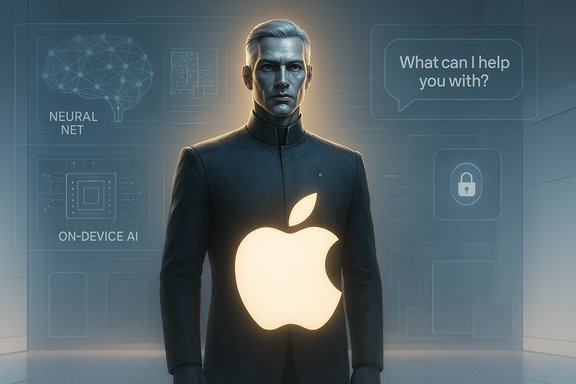
Apple's decision to install Amar Subramanya as vice president of AI marks a sharp inflection point in the company's AI strategy and an unmistakable signal: Apple intends to get serious, fast, about closing the gap on generative AI and large-scale model work that powers modern intelligent assistants and platform services.
Amar Subramanya arrives at Apple with deep experience across the industry's most consequential AI projects — long stints at Google (including leadership on the Gemini assistant), a brief but high‑profile role as Corporate Vice President of AI at Microsoft, and a research pedigree grounded in a PhD from the University of Washington. Apple’s formal announcement places him in charge of Apple Foundation Models, machine learning research, and AI safety and evaluation, and makes clear he will report to Craig Federighi, Apple’s senior vice president of Software Engineering.
The move coincides with the retirement plan for John Giannandrea, Apple’s long-serving AI leader, and an internal reshuffle that redistributes large parts of the AI organization under Sabih Khan and Eddy Cue. It also arrives amid public scrutiny of Apple’s rollout of its Apple Intelligence suite and repeated delays in delivering the much‑promised, deeply personalized upgrade to Siri. For Apple users and the broader industry, the appointment raises urgent questions about product timelines, Apple's approach to on‑device privacy-oriented AI, and how tightly Apple can couple advanced foundation models with its hardware and services without compromising the niche that has defined the company for years.
Despite a major product announcement and aggressive marketing, a key centerpiece — a next‑generation, personalized Siri — encountered repeated engineering setbacks and was delayed into the following year. The delay exposed the tension between Apple’s high quality thresholds and the speed at which rivals have iterated with cloud‑centric foundation models. Internally, this has prompted leadership changes and a redistribution of responsibilities across Apple’s software, services, and operations leadership.
Apple still retains compelling structural advantages in the AI era: a tightly integrated hardware and silicon stack with Apple Silicon, a massive installed base of high‑quality sensor hardware (iPhone cameras, LiDAR, microphones), and rich, personal user data distributed across devices. Turning those structural assets into competitive AI experiences hinges on two things: effective foundation model engineering that respects privacy constraints, and tight cross‑discipline product execution.
This research background matters: Apple’s AI ambitions require both rigorous academic foundations and the engineering discipline to translate models into product features that work reliably at scale and under Apple's privacy constraints.
In mid‑2025 he joined Microsoft as Corporate Vice President of AI, a move he characterized publicly as energizing and collaborative. His tenure at Microsoft was brief — measured in months rather than years — before Apple recruited him to take a primary AI leadership role. The swift transitions reflect intense competition among major tech companies for AI leadership talent and a marketplace where top executives move quickly between platform leaders.
From a market perspective, Apple’s leadership shakeup signals seriousness to investors, partners, and talent markets. Recruitment competition for AI leaders is intense, and acquiring executives with both deep research credentials and production experience is now table stakes.
Regulators are increasingly focused on AI transparency, model disclosures, and consumer protections. Apple’s strong privacy posture gives it a defensible position, but it must pair that posture with measurable, auditable safety practices and clear user controls to withstand regulatory scrutiny.
Apple’s enduring strengths — hardware control, device ecosystem, and a privacy brand — give it a differentiated path through the AI era. Delivering on that path will require surgical engineering, ruthless product prioritization, and a safety-first ethos scaled to modern foundation models. How quickly and well Apple pulls those threads together will determine whether the company moves from cautious AI aspirant to a leader of privacy‑preserving, high‑quality consumer intelligence.
The next milestones — notably the planned Siri upgrades and the first wave of Apple Intelligence improvements — will be the clearest early tests of whether this leadership change catalyzes the acceleration Apple needs or simply reshuffles familiar problems under a new banner.
Source: Moneycontrol https://www.moneycontrol.com/news/t...e-ai-chief-meet-amar-subramanya-13705802.html
 Overview
Amar Subramanya arrives at Apple with deep experience across the industry's most consequential AI projects — long stints at Google (including leadership on the Gemini assistant), a brief but high‑profile role as Corporate Vice President of AI at Microsoft, and a research pedigree grounded in a PhD from the University of Washington. Apple’s formal announcement places him in charge of Apple Foundation Models, machine learning research, and AI safety and evaluation, and makes clear he will report to Craig Federighi, Apple’s senior vice president of Software Engineering.The move coincides with the retirement plan for John Giannandrea, Apple’s long-serving AI leader, and an internal reshuffle that redistributes large parts of the AI organization under Sabih Khan and Eddy Cue. It also arrives amid public scrutiny of Apple’s rollout of its Apple Intelligence suite and repeated delays in delivering the much‑promised, deeply personalized upgrade to Siri. For Apple users and the broader industry, the appointment raises urgent questions about product timelines, Apple's approach to on‑device privacy-oriented AI, and how tightly Apple can couple advanced foundation models with its hardware and services without compromising the niche that has defined the company for years.
Background: where Apple stands in the AI race
Apple’s official pivot into mainstream generative AI was publicly launched with the Apple Intelligence suite introduced in mid‑2024. The initiative promised to weave AI deeply into iPhone, iPad, and Mac experiences — from smarter Siri interactions to contextual, on‑device comprehension of personal data and apps. The company positioned these features around privacy-first processing, emphasizing on‑device computation supported by a private cloud compute model for heavier workloads.Despite a major product announcement and aggressive marketing, a key centerpiece — a next‑generation, personalized Siri — encountered repeated engineering setbacks and was delayed into the following year. The delay exposed the tension between Apple’s high quality thresholds and the speed at which rivals have iterated with cloud‑centric foundation models. Internally, this has prompted leadership changes and a redistribution of responsibilities across Apple’s software, services, and operations leadership.
Apple still retains compelling structural advantages in the AI era: a tightly integrated hardware and silicon stack with Apple Silicon, a massive installed base of high‑quality sensor hardware (iPhone cameras, LiDAR, microphones), and rich, personal user data distributed across devices. Turning those structural assets into competitive AI experiences hinges on two things: effective foundation model engineering that respects privacy constraints, and tight cross‑discipline product execution.
Amar Subramanya: profile of the new AI lead
Academic and early research grounding
Amar Subramanya’s academic record is anchored in machine learning and natural language processing. He earned a Bachelor of Engineering in Electrical, Electronics and Communication Engineering and completed a PhD in Computer Science at the University of Washington, where his doctoral work focused on large‑scale machine learning algorithms, speech technologies, and statistical modeling for natural language tasks.This research background matters: Apple’s AI ambitions require both rigorous academic foundations and the engineering discipline to translate models into product features that work reliably at scale and under Apple's privacy constraints.
Industry experience and the “product-first” narrative
Subramanya spent roughly 16 years at Google, rising to lead engineering for Google’s Gemini assistant — a high‑profile program built to rival other large language model assistants. His role at Google placed him at the intersection of research, product engineering, and operations, working on both foundational model development and deployment at scale.In mid‑2025 he joined Microsoft as Corporate Vice President of AI, a move he characterized publicly as energizing and collaborative. His tenure at Microsoft was brief — measured in months rather than years — before Apple recruited him to take a primary AI leadership role. The swift transitions reflect intense competition among major tech companies for AI leadership talent and a marketplace where top executives move quickly between platform leaders.
What the title and reporting line imply
Subramanya’s title — Vice President of AI — and his reporting line to Federighi are noteworthy. Unlike the previous Senior Vice President structure under Giannandrea, this configuration embeds the AI function more directly inside Apple’s software engineering leadership. Practically, that suggests a renewed emphasis on product‑engineering integration: making AI features cohesive and practical for daily users across iOS, macOS, and other Apple platforms.What Subramanya will oversee — the technical remit
Apple’s public description of his responsibilities centers on three pillars:- Apple Foundation Models: development, tailoring, and deployment of base models that can support a variety of Apple services and devices.
- Machine Learning Research: advancing core algorithms, architectures, and evaluation methodologies that underpin Apple Intelligence.
- AI Safety and Evaluation: building verification, monitoring, and governance systems to ensure reliability, privacy compliance, and ethical behavior.
Strategic implications for Apple Intelligence and Siri
1) Faster engineering cadence, with product discipline
Bringing in a leader with deep foundation model experience signals Apple’s desire to accelerate model development without sacrificing product polish. Expect an emphasis on production‑grade model architectures that are optimized for Apple’s mixed compute strategy: specialized on‑device runtimes for latency and privacy, coupled with a “private cloud compute” layer for heavy inference and fine‑tuning.2) Potential shifts in model sourcing and partnerships
Apple historically emphasized in‑house tech and tight control over stacks. However, constraints created by on‑device compute limits and time‑to‑market pressures could push Apple to be pragmatic: selectively partnering for model components or licensing model technology while maintaining user data privacy guarantees. This pragmatic posture could include negotiated uplifts with external vendors or targeted collaboration on specific model capabilities.3) Privacy vs. performance trade-offs get technical leadership
Apple’s signature privacy stance will be a focal constraint. Subramanya’s remit includes AI Safety and Evaluation — a technical responsibility that must reconcile ambitious model capabilities with strict privacy-preserving operation modes. The leadership challenge is to create architectures that deliver visible user benefits while ensuring minimal transfer of personal information off device, or to craft new hybrid privacy models that keep sensitive data private even when leveraging cloud-scale models.Technical challenges and engineering realities
On-device compute and model optimization
Apple’s hardware advantage is meaningful: Apple Silicon chips provide high perf-per-watt, and on-device ML accelerators are continually improving. However, state‑of‑the‑art foundation models are resource intensive and often require data center class accelerators for both training and large‑scale inference. Engineering teams will need to:- Prune, quantize, and distill models to run effectively on‑device without eroding user‑facing quality.
- Build hybrid pipelines that route complex queries to secure cloud resources while preserving on‑device fast paths.
- Develop robust mechanisms for versioning and updating models across a heterogeneous device fleet.
Data governance, personalization, and safety
Delivering personalized Siri and contextual Apple Intelligence features requires access to personal content and activity signals. The engineering work is not only algorithmic; it is governance: strict evaluation suites, continuous monitoring, and a safety framework that can detect and mitigate hallucinations, bias, and data leakage.Integrating foundation models into user experiences
The hardest part is rarely the model itself; it’s the human‑facing integration. Apple’s value proposition depends on natural, intuitive interactions that feel trustworthy. Project teams must address:- Latency and responsiveness across under‑connected environments.
- Seamless fallback behavior when on‑device models cannot answer.
- Clear user controls and transparency regarding when cloud resources are used.
Organizational and cultural shifts: what the leadership change means inside Apple
Redistribution of responsibilities
Apple’s reorganization moves parts of Giannandrea’s prior responsibilities to Sabih Khan (operations) and Eddy Cue (services), while Subramanya takes a focused research-and-models brief. This redistribution is strategic: it aligns model building under software engineering and places infrastructure and product operations closer to executives historically responsible for those domains.Cultural friction and onboarding risk
Subramanya’s brief time at Microsoft — sandwiched between a long Google career and now Apple — raises onboarding questions. Cultural fit is crucial at Apple, where cross‑discipline collaboration and extremely high quality standards are baked into product development. Rapid integration into Apple’s development rhythms and leadership norms will be essential to avoid further delays.Talent retention and morale
Apple has weathered departures in its AI ranks in recent months. Stabilizing teams, retaining key engineers, and creating a compelling product roadmap will be immediate priorities for the new AI leadership. The company must balance rapid hiring and external recruitment with internal team cohesion and mission clarity.Risks and red flags
- Timeline pressure may reintroduce quality risks. The public expectation for a revamped Siri in spring 2026 creates a hard deadline. Rushing model integration could compromise stability or privacy guarantees that Apple emphasizes.
- Privacy constraints could blunt competitiveness. Apple’s commitment to on‑device processing and stringent privacy can make it slower to adopt the largest, most capable cloud models unless hybrid approaches are effectively engineered.
- Organizational frictions could hamper execution. Redistributing responsibilities is structurally sound but operationally complex; cross‑org dependencies (software, services, hardware, operations) will require high‑bandwidth coordination.
- Reputational exposure if public promises slip. Users and regulators have heightened expectations for safe, responsible AI behavior. Any visible failure — hallucinations, data leaks, biased outputs — will draw immediate scrutiny.
- Dependence on external model ecosystems. If Apple chooses to lean on third‑party models or partnerships, it may face strategic dependencies that complicate its privacy story and product differentiation.
What Apple should prioritize next: a practical roadmap
- Tighten the product scope for early launches.
- Focus on a small set of high‑impact Siri capabilities that can be robustly delivered with hybrid architectures.
- Invest in model engineering for on‑device efficiency.
- Prioritize distillation, quantization, and architecture redesign to maximize performance on Apple Silicon.
- Strengthen evaluation and safety pipelines.
- Build continuous evaluation suites that stress test hallucinations, privacy leaks, bias, and adversarial failure modes.
- Stabilize talent and cross‑org alignment.
- Create cross‑functional "delivery pods" with clear ownership and lifecycle accountability to reduce handoffs.
- Communicate transparently with users.
- If features are delayed for quality, set precise expectations and explain technical reasons in plain language to preserve trust.
Competitive landscape and market signals
Apple is entering a phase where being first is less important than being reliably excellent. Rival platforms have pushed aggressively with cloud-first models and rapid feature rollouts. Apple’s opportunity is to differentiate on trustworthy personalization — delivering AI that respects privacy, performs consistently across devices, and integrates seamlessly with apps.From a market perspective, Apple’s leadership shakeup signals seriousness to investors, partners, and talent markets. Recruitment competition for AI leaders is intense, and acquiring executives with both deep research credentials and production experience is now table stakes.
AI safety, regulation, and public policy considerations
Apple has an opportunity to set a higher bar for responsible AI. Subramanya’s explicit remit for AI safety and evaluation is telling: Apple plans to invest engineering resources into building robust guardrails rather than treating safety as an afterthought.Regulators are increasingly focused on AI transparency, model disclosures, and consumer protections. Apple’s strong privacy posture gives it a defensible position, but it must pair that posture with measurable, auditable safety practices and clear user controls to withstand regulatory scrutiny.
Final analysis: what success looks like — and how we’ll know
Success for Amar Subramanya and Apple’s reorganized AI function will be visible in three tangible ways:- Product trustworthiness and quality: Real‑world Apple Intelligence features must demonstrate consistent, reliable behavior across devices and contexts without sacrificing privacy.
- Technical parity or advantage in key experiences: Apple needs to achieve feature parity with leading assistants in key areas (contextual understanding, task execution, multimodal comprehension) while differentiating through privacy and integration.
- Operational stability and reduced churn: Retaining top talent, delivering predictable release cadences, and maintaining clear organizational accountability will show that Apple’s internal machine is functioning.
Conclusion
The appointment of Amar Subramanya is both a pragmatic hire and a public statement: Apple wants a leader who understands foundation models, large‑scale machine learning engineering, and the product discipline required to translate cutting‑edge research into everyday features. The challenge ahead is not purely technical; it is organizational, cultural, and strategic.Apple’s enduring strengths — hardware control, device ecosystem, and a privacy brand — give it a differentiated path through the AI era. Delivering on that path will require surgical engineering, ruthless product prioritization, and a safety-first ethos scaled to modern foundation models. How quickly and well Apple pulls those threads together will determine whether the company moves from cautious AI aspirant to a leader of privacy‑preserving, high‑quality consumer intelligence.
The next milestones — notably the planned Siri upgrades and the first wave of Apple Intelligence improvements — will be the clearest early tests of whether this leadership change catalyzes the acceleration Apple needs or simply reshuffles familiar problems under a new banner.
Source: Moneycontrol https://www.moneycontrol.com/news/t...e-ai-chief-meet-amar-subramanya-13705802.html
