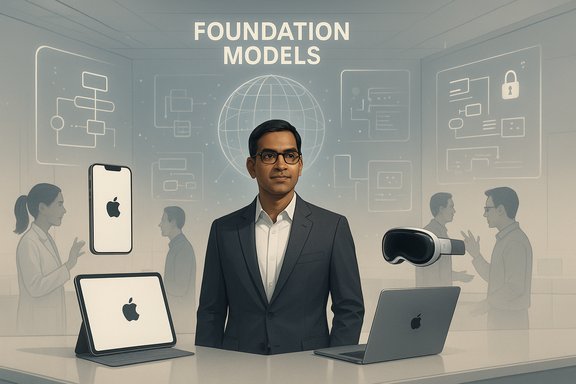
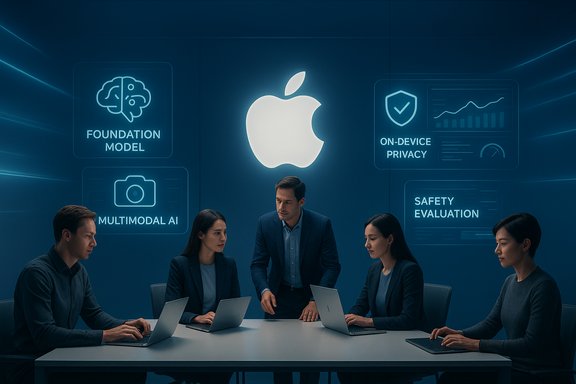
Apple’s AI leadership has been reshuffled again: Amar Subramanya, a Bangalore‑born researcher‑engineer with a long Google pedigree and a brief stint at Microsoft, has been named Apple’s new Vice President of AI. The appointment places Subramanya in charge of Apple Foundation Models, machine‑learning research, and AI safety and evaluation while John Giannandrea steps down from his Senior Vice President role to serve as an adviser before retiring in spring 2026 — a timetable Apple confirmed in its corporate statement.
Technical and governance must go hand in hand:
However, execution is the arbiter. The pitfalls are real: timeline pressure, vendor dependence, governance gaps, and integration failures all pose existential risks to Apple’s brand promise. The appointment creates an opportunity for Apple to demonstrate that privacy‑first, on‑device‑biased architectures can compete on functionality and velocity. It will take disciplined engineering, transparent governance, and product humility to realize that vision.
The next 6–12 months will be telling: watch for demonstrable Siri improvements, transparent safety reporting, and evidence that Apple can move from cautious research to dependable, measurable product outcomes without renouncing the privacy guarantees that are core to its identity. Internal forum analysis and industry discussion have already started to unpack these themes and will track concrete metrics and releases as the company moves from announcement to delivery.
Apple’s choice of a technical leader with both research depth and production experience is a sensible step given the company’s goals. Yet the appointment alone does not guarantee success; the true test will be in how Apple balances speed, privacy and safety while delivering AI features that feel genuinely useful and trustworthy to users.
Source: The Bridge Chronicle Apple Appoints Indian Origin Amar Subramanya as New Vice President of AI
 Background
The immediate facts
Apple publicly announced the change on December 1, 2025: John Giannandrea will transition to an advisory role and retire in spring 2026; Amar Subramanya joins Apple reporting to Craig Federighi and will lead foundation models, ML research, and AI safety and evaluation. These are company‑level assertions in Apple’s press release and they were independently reported by major news outlets. Subramanya arrives at Apple after roughly 16 years at Google and a short period as Corporate Vice President of AI at Microsoft earlier in 2025. Reports say his responsibilities at Google included engineering leadership on Google’s Gemini assistant and collaboration with teams tied to DeepMind research; his public LinkedIn posts and multiple news outlets corroborate his 2025 move to Microsoft and subsequent transition to Apple.Why this is news
Apple’s decision is consequential because it realigns technical authority for the company’s core AI capabilities at a time when the industry is racing to ship foundation model features across mobile, desktop and cloud services. Apple has been positioning its Apple Intelligence suite and a more personalized Siri as central differentiators, but product rollouts have lagged, and the company now faces heightened pressure to marry privacy commitments with faster model development and deployment. The new hire signals Apple’s intent to accelerate that work under technical leadership with deep experience in building assistant systems and foundation models.Who is Amar Subramanya?
Academic pedigree and research track record
Subramanya is a veteran machine‑learning researcher with documented academic work in semi‑supervised learning and graph‑based methods. His doctoral work at the University of Washington is regularly cited in technical literature and he is a co‑author of work on graph‑based semi‑supervised learning — a body of research relevant to data‑efficient and privacy‑aware model techniques. These academic credentials are corroborated by technical publishing listings. Key academic facts that can be verified:- PhD in Computer Science (University of Washington) with a dissertation on scalable graph‑based semi‑supervised learning and speech/NLP tasks.
- Co‑author of technical works on graph‑based semi‑supervised learning and related ML topics.
Industry experience: Google, Microsoft, Apple
Subramanya spent the majority of his career at Google, rising from research positions into senior engineering leadership across product and infrastructure teams. Multiple independent reports say he led engineering efforts for Google’s Gemini assistant and worked closely with DeepMind teams on multimodal systems. After a lengthy Google tenure, he joined Microsoft in mid‑2025 as Corporate Vice President of AI and shortly thereafter moved again to Apple. These transitions have been widely covered by mainstream outlets. Notable industry points:- ~16 years at Google with senior roles and engineering leadership on Gemini and related assistant initiatives.
- Corporate Vice President of AI at Microsoft for a short period in 2025, working on enterprise and consumer AI systems including components that integrate with Microsoft Copilot.
- Joins Apple as Vice President of AI, reporting to Craig Federighi, with remit over foundation models, ML research, and AI safety and evaluation.
What Subramanya inherits: Apple’s AI remit and organizational map
The technical remit
Apple’s announcement assigns Subramanya three principal technical responsibilities:- Apple Foundation Models — the development and tailoring of base models that will underpin Apple Intelligence features.
- Machine‑Learning Research — advancing algorithms and architectures to support Apple’s product roadmap.
- AI Safety & Evaluation — building verification, monitoring and governance systems to measure and mitigate risk.
Strategic implications
- Product velocity: The structural change suggests Apple wants faster iteration on foundation model engineering, while keeping product‑integration and services delivery closely aligned with platform leaders.
- Privacy and architecture tradeoffs: Apple’s insistence on privacy and on‑device processing complicates development of larger foundation models. Subramanya’s remit implies Apple is doubling down on hybrid approaches that combine compact on‑device models with a tightly controlled private cloud compute layer for heavier workloads.
- Safety and regulatory posture: Putting AI Safety & Evaluation squarely under the vice‑president role signals recognition that robust evaluation — not just model capability — will be central to sustaining consumer trust and complying with evolving regulation.
Technical realities and engineering tradeoffs
On‑device AI vs. cloud scale
Apple has two advantages: proprietary Apple Silicon and deep integration of hardware and software. Those advantages make aggressive on‑device inference optimization plausible, but they do not erase the hard facts:- Modern foundation models remain resource‑intensive for training and many inference tasks.
- Even heavily distilled or quantized variants demand careful runtime engineering to meet latency, power and accuracy targets on mobile devices.
- Distillation, pruning and quantization pipelines to squeeze model capability into power‑budgeted device runtimes.
- Custom runtimes and accelerators optimized for the Apple Neural Engine and Apple Silicon.
- A private cloud compute (PCC) layer for queries that exceed on‑device capability — with contractual and telemetry guarantees when external code or third‑party model runs are used.
Data, personalization and governance
Delivering personalized experiences — deep context retention across apps and devices, smart summarization of user content, health or finance agents — requires fine‑grained telemetry and content signals. Apple’s privacy posture adds governance constraints that make naive productization impossible.Technical and governance must go hand in hand:
- Clear non‑training guarantees and telemetry boundaries for any cloud inference.
- Auditable, repeatable safety evaluation pipelines that measure hallucination rates, privacy leakage, and fairness metrics.
- Versioned model deployment with staged rollouts and explicit user transparency (e.g., when a cloud service is invoked).
Product and market implications
Siri and Apple Intelligence
A visible, near‑term test of success will be the promised overhaul of Siri and Apple Intelligence features. Apple previously acknowledged delays in Siri improvements and has positioned a revamped, more personalized assistant for the 2026 timeline — now with Subramanya at the technical helm. Observers will measure this appointment by Apple’s ability to ship demonstrable improvements in natural language understanding, context retention, and multimodal comprehension that work within the company’s privacy constraints.Competitive positioning
Apple’s rivals — Google, Microsoft (OpenAI integrations) and others — have pursued cloud‑first models and rapid iteration. Apple’s path is different: tighter integration and a privacy‑first marketing proposition. The challenge is whether Apple can deliver parity in functionality and velocity without compromising the privacy promise that distinguishes its brand. Moving quickly risks tradeoffs in telemetry and third‑party model reliance; moving too slowly risks falling behind on user expectations and platform attractiveness.Vendor and partnership posture
Reports indicate Apple explored external partnerships, and industry speculation about model sourcing (including trial use of third‑party models) has surfaced. Those procurement negotiations are commercially sensitive and partially corroborated by reporting, but details about contract terms, non‑training clauses and model parameter counts are not publicly verifiable. Any reliance on external models should be accompanied by transparent, enforceable guarantees to maintain Apple’s privacy positioning.Organizational and cultural questions
From SVP to VP: what the title change signals
Shifting from a single Senior Vice President model to a Vice President focused on technical depth, with delivery responsibilities handed to other executives, is a deliberate organizational choice. It suggests Apple wants deep technical ownership of model engineering and safety while aligning product, services and infrastructure under the leaders responsible for shipping features. That split can accelerate execution if coordination works; it will fail if cross‑org handoffs proliferate.Talent dynamics and onboarding risk
Senior executives who move between top platform companies carry talent and operational approaches, but rapid movement (Google → Microsoft → Apple within months) risks cultural friction and onboarding overhead. Success will depend on how quickly Subramanya can institutionalize model engineering practices, build trust with platform teams, and stabilize critical hiring and retention in ML infrastructure and evaluation roles.Strengths Subramanya brings — and why they matter
- Research‑to‑product fluency: A career that spans deep academic work and large‑scale engineering programs positions Subramanya to translate methodological advances into production systems that respect Apple’s constraints.
- Assistant and multimodal experience: Engineering leadership on Gemini and related multimodal systems brings direct, relevant experience building interactive, multimodal assistants at scale.
- Safety and evaluation emphasis: The explicit assignment of AI Safety & Evaluation to his portfolio signals a practical expectation that model governance will be a central deliverable rather than a peripheral compliance exercise.
Risks and failure modes
- Speed at the expense of privacy
- The pressure to ship may incentivize looser telemetry or cloud‑first shortcuts that undermine Apple’s privacy brand. Even a single high‑profile data exposure or model misbehavior on a sensitive topic could erode years of trust.
- Overreliance on third‑party models
- Pragmatic use of third‑party models to accelerate capability is understandable; however, customer and regulator perception of “outsourced intelligence” requires clear contractual, telemetry and non‑training guarantees. Unclear vendor dependencies are a reputational and compliance risk.
- Integration and UX failure
- Technical model competence is necessary but not sufficient. If model outputs fail to integrate elegantly with UI flows or produce unpredictable behavior, user adoption and satisfaction will suffer. Apple’s design bar is high; model integration must match that level.
- Organizational churn and hidden debt
- Rapid changes in leadership and team composition can introduce technical debt, reduce institutional memory and slow delivery if not managed with clear cross‑org ownership and delivery pods.
- Regulatory headwinds
- The EU AI Act and other regulatory frameworks are tightening obligations around high‑risk AI systems, data processing and transparency. Apple’s safety and evaluation pipelines will be scrutinized, especially if Apple extends Apple Intelligence into regulated domains such as health.
What to watch next — short‑term milestones and signals
- Product milestones (0–12 months)
- Visible improvements to Siri and staged Apple Intelligence features with measurable metrics: hallucination rates, latency, and stated privacy boundaries.
- Public communication about where inference occurs (on‑device vs cloud) and what telemetry is collected.
- Technical milestones (3–12 months)
- Publication or description of Apple’s safety and evaluation framework — ideally with reproducible metrics and independent auditability.
- Evidence of distillation pipelines and runtime improvements that show substantive capability per watt increases on Apple Silicon.
- Organizational milestones (6–12 months)
- Evidence of cross‑org delivery pods or pod ownership models to reduce handoffs and accelerate integration between model teams, platform engineering and services.
- Talent and hiring signals
- Stabilization in ML infrastructure hiring and retention; announcements of new leadership hires in evaluation, safety engineering, and runtime optimization.
Practical recommendations for Apple (what good execution looks like)
- Publish clear, measurable safety commitments
- Non‑training guarantees, telemetry boundaries, and public audit commitments for third‑party runs inside private cloud compute.
- Establish independent evaluation pipelines
- Repeatable testbeds that report hallucination, bias and leakage metrics and that can be referenced by regulators and enterprise customers.
- Ship in staged ringed rollouts
- Conservative staged releases with public beta metrics rather than large simultaneous launches; preserve rollback and versioning discipline.
- Create cross‑functional product pods
- Small, mission‑focused teams that own the whole lifecycle: research → model engineering → runtime → UX.
- Communicate transparently with users
- Plain‑language explanations of when the device uses on‑device vs cloud inference and easy opt‑out controls for sensitive contexts.
Verification and caveats
- Apple’s corporate announcement is the primary source that confirms the appointment, reporting line and Giannandrea’s retirement timeline. This was issued publicly by Apple.
- Major independent news organizations corroborated the appointment and the broad outlines of Subramanya’s background (Google tenure, Microsoft role, Gemini association). Cross‑checking across corporate statements and several reputable outlets confirms the high‑level claims.
- Several widely circulated numeric claims about model parameter counts or exact team sizes on Gemini or other projects remain unverified in public company disclosures. Those specifics should be treated with caution until confirmed by official technical papers or vendor statements. Where reporting includes firm numbers (for instance, parameter counts), readers should note those figures are often estimates or sourced to anonymous briefings and should be independently verified before being used as a factual basis for technical or procurement decisions.
Final assessment: why this hire matters — and what success will look like
Amar Subramanya’s appointment as Vice President of AI is one of the clearest public signals that Apple intends to accelerate its foundation model work while keeping safety and privacy commitments front and center. The hire combines deep academic credibility with hands‑on engineering experience on high‑profile assistant projects. If Apple successfully executes, the company can convert its hardware advantages (Apple Silicon and the Neural Engine), integrated product design, and device footprint into differentiated, trustworthy AI experiences that respect user privacy.However, execution is the arbiter. The pitfalls are real: timeline pressure, vendor dependence, governance gaps, and integration failures all pose existential risks to Apple’s brand promise. The appointment creates an opportunity for Apple to demonstrate that privacy‑first, on‑device‑biased architectures can compete on functionality and velocity. It will take disciplined engineering, transparent governance, and product humility to realize that vision.
The next 6–12 months will be telling: watch for demonstrable Siri improvements, transparent safety reporting, and evidence that Apple can move from cautious research to dependable, measurable product outcomes without renouncing the privacy guarantees that are core to its identity. Internal forum analysis and industry discussion have already started to unpack these themes and will track concrete metrics and releases as the company moves from announcement to delivery.
Apple’s choice of a technical leader with both research depth and production experience is a sensible step given the company’s goals. Yet the appointment alone does not guarantee success; the true test will be in how Apple balances speed, privacy and safety while delivering AI features that feel genuinely useful and trustworthy to users.
Source: The Bridge Chronicle Apple Appoints Indian Origin Amar Subramanya as New Vice President of AI