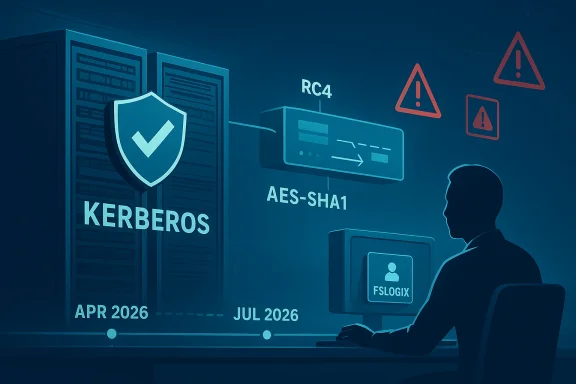
Windows is heading into another important authentication hardening cycle, and this one could have real-world consequences for organizations that still rely on older Kerberos defaults. Microsoft has confirmed that April 2026 Windows updates will move domain controllers into an enforcement phase that changes how Kerberos handles accounts without explicit encryption settings, shifting those cases to AES-SHA1-only behavior instead of falling back to RC4. For many enterprises that’s a security win, but for some FSLogix and SMB-backed profile deployments, it could also become an authentication break if the environment has not been modernized in time. Microsoft is giving administrators a runway, but the clock is now firmly visible.
The immediate story is not that Windows is “breaking” Kerberos. It is that Microsoft is removing a long-tolerated compatibility crutch that has helped older environments keep functioning even when encryption settings were incomplete or stale. In practical terms, accounts that previously rode along with a legacy fallback path may soon be expected to negotiate stronger AES-SHA1 keys, and that matters most where authentication is embedded deep inside storage workflows and user-profile infrastructure.
This is part of a broader hardening trend that has been building for years. Microsoft previously shifted Kerberos default behavior away from RC4 in the wake of CVE-2022-37966, and its newer guidance now says it plans to disable RC4 as the assumed supported encryption type for domain controllers by the end of Q2 2026. That means the April update is not an isolated surprise; it is the next step in a deliberate security migration that has been telegraphed through documentation, support notes, and technical blog posts.
The most visible near-term risk is to FSLogix environments that depend on Kerberos authentication to reach SMB file shares containing profile containers. Microsoft’s own FSLogix guidance says profile containers are stored on SMB shares and, depending on the storage platform, can require Kerberos authentication through Active Directory Domain Services or Microsoft Entra Domain Services. That makes encryption compatibility a foundational dependency, not a side detail. If a share or account path is still effectively RC4-only, the new Kerberos behavior can turn a normal logon into a failure.
There is a subtle but important nuance here. The breakage is not framed as an Azure Virtual Desktop service outage or a general Microsoft cloud issue. Rather, it is a Windows-side authentication policy change that can affect any environment using the vulnerable configuration pattern, including on-premises AD DS deployments and hybrid setups. That distinction matters because organizations often blame the cloud platform when the actual weak link sits in directory objects, service accounts, or storage auth settings.
The key technical point is that Microsoft is removing ambiguity from Kerberos negotiation. If an account does not clearly advertise its supported encryption types, Windows has historically tried to be generous for compatibility, often permitting weaker legacy paths. The new behavior narrows that flexibility. That is a classic security-hardening trade-off: fewer silent compatibility assumptions, fewer weak tickets, and more predictable cryptographic behavior.
Microsoft also explicitly calls out that RC4 remains a security concern because it is linked to ticket-cracking and Kerberoasting-style attacks. The company’s direction is therefore understandable: weaken the attack surface first, then force the environment to catch up. In security terms, the move is overdue. In operations terms, it can be painful if administrators have deferred encryption hygiene for too long.
That matters in non-persistent desktop environments, where the user profile is not just a convenience but the mechanism that makes the entire session feel durable. If the profile container fails to mount, the user may end up with a temporary or local profile, missing settings, or a login failure. For remote desktop and virtual desktop platforms, that is not cosmetic; it is a direct productivity issue.
The practical risk is not limited to one platform. Microsoft’s documentation covers Azure Files, Azure NetApp Files, AD DS-backed storage, and Microsoft Entra-related Kerberos scenarios. So while the Neowin report focused on a coming Windows change, the blast radius really depends on how old the authentication settings are and which storage integration path the organization uses.
This is also why Microsoft has been methodical rather than abrupt. The company previously altered default Kerberos behavior in 2022 and has since continued publishing detection and remediation guidance for RC4 usage. That pattern suggests a staged deprecation, not a surprise switch-off. The April and July 2026 checkpoints are simply the next visible milestones in a multi-year cleanup.
The other important benefit is standardization. Mixed-mode crypto settings are where many enterprise auth problems begin, because nobody can say with confidence which object is still living in the past. Forcing explicit AES support reduces that uncertainty and makes audit data far more meaningful. That alone is a win for incident response and compliance teams.
Older service accounts are particularly suspect. Microsoft notes that user and service objects created before AES support became standard may lack AES-SHA1 keys if passwords were never reset or if the account metadata never received a modern encryption-type configuration. That means this is often not a storage problem at all; it is an identity-object problem hiding behind a storage symptom.
There is also a configuration trap in Windows itself. Microsoft documents the policy path for controlling allowed Kerberos encryption types and provides commands for setting supported encryption attributes. That means an organization can unknowingly leave a domain in a compatibility mode long after it should have been tightened. Old defaults linger because they are easy to forget.
The good news is that Microsoft provides tools and examples to help with that work. Its documentation points admins toward Kerberos encryption auditing, event log analysis, and PowerShell-based inspection of encryption usage. The key is to treat Kerberos as a living dependency map, not as a box checked during domain setup.
It is also wise to test the most business-critical paths first, especially profile container mounts and SMB-authenticated storage access. If those logons work under the new policy, the remainder of the domain is more likely to survive the switch. If they fail, admins can still use the temporary audit rollback window while fixing the underlying objects. That window is the safety net; it is not the solution.
For enterprises, however, the impact could be significant, especially in remote desktop, virtual desktop, and shared workstation environments. These are the places where logon-time profile mounts are business-critical and where authentication failures can halt work before users ever reach the desktop. In those scenarios, a single weak account object can feel like a platform outage.
This is also a reminder that security hardening often lands hardest on organizations that have delayed operational cleanup. The more legacy accounts, older trusts, and inherited service objects you have, the more likely a “simple” cryptography change will ripple outward. Technical debt is never just technical.
That broader context matters because it explains Microsoft’s willingness to accept short-term compatibility pain. Once a platform vendor decides a legacy authentication primitive is too risky, the burden shifts to customers to modernize their estate. From Microsoft’s perspective, the long tail of compatibility cannot indefinitely outweigh the security cost of keeping weak defaults alive.
What makes this wave especially notable is timing. Microsoft is stacking several significant changes into 2026, from Kerberos enforcement to other OS hardening efforts, which means enterprises will need a broader patch management and validation discipline than they may have used in the past. The old habit of “install updates and hope nothing broke” is no longer a safe operating model.
For organizations that use FSLogix, the safest strategy is to treat the coming update as a validation deadline. Review account encryption types, verify SMB auth flows, test profile container mounts, and make sure every service account that depends on Kerberos can negotiate AES-SHA1 without hidden exceptions. If that sounds tedious, it is — but that is exactly what a serious hardening cycle looks like.
Source: Neowin Windows Kerberos hardening may cause authentication issues for some PCs next month
 Overview
The immediate story is not that Windows is “breaking” Kerberos. It is that Microsoft is removing a long-tolerated compatibility crutch that has helped older environments keep functioning even when encryption settings were incomplete or stale. In practical terms, accounts that previously rode along with a legacy fallback path may soon be expected to negotiate stronger AES-SHA1 keys, and that matters most where authentication is embedded deep inside storage workflows and user-profile infrastructure.This is part of a broader hardening trend that has been building for years. Microsoft previously shifted Kerberos default behavior away from RC4 in the wake of CVE-2022-37966, and its newer guidance now says it plans to disable RC4 as the assumed supported encryption type for domain controllers by the end of Q2 2026. That means the April update is not an isolated surprise; it is the next step in a deliberate security migration that has been telegraphed through documentation, support notes, and technical blog posts.
The most visible near-term risk is to FSLogix environments that depend on Kerberos authentication to reach SMB file shares containing profile containers. Microsoft’s own FSLogix guidance says profile containers are stored on SMB shares and, depending on the storage platform, can require Kerberos authentication through Active Directory Domain Services or Microsoft Entra Domain Services. That makes encryption compatibility a foundational dependency, not a side detail. If a share or account path is still effectively RC4-only, the new Kerberos behavior can turn a normal logon into a failure.
There is a subtle but important nuance here. The breakage is not framed as an Azure Virtual Desktop service outage or a general Microsoft cloud issue. Rather, it is a Windows-side authentication policy change that can affect any environment using the vulnerable configuration pattern, including on-premises AD DS deployments and hybrid setups. That distinction matters because organizations often blame the cloud platform when the actual weak link sits in directory objects, service accounts, or storage auth settings.
What Microsoft Is Changing
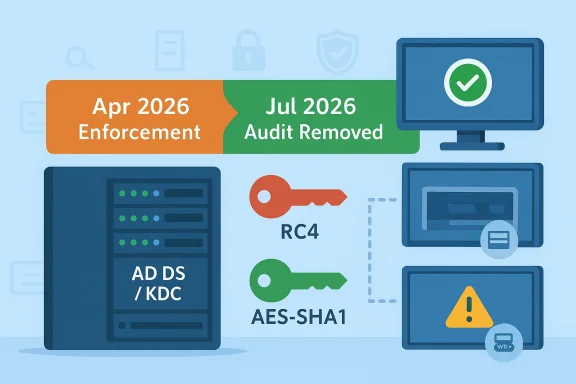
Microsoft’s current Kerberos guidance says that, in the April 2026 update wave, domain controllers will enter an enforcement phase where the default supported encryption type for accounts lacking explicit settings becomes AES-SHA1 only. The support note for CVE-2026-20833 says this phase also enables enforcement by default, with an audit mode still available as a manual rollback option until July 2026. After that, the fallback disappears.The key technical point is that Microsoft is removing ambiguity from Kerberos negotiation. If an account does not clearly advertise its supported encryption types, Windows has historically tried to be generous for compatibility, often permitting weaker legacy paths. The new behavior narrows that flexibility. That is a classic security-hardening trade-off: fewer silent compatibility assumptions, fewer weak tickets, and more predictable cryptographic behavior.
Why this matters
Kerberos is not just “another login method.” It is the backbone of single sign-on for many Windows enterprise workflows, from file shares to application service tickets. When Microsoft changes default encryption behavior in Kerberos, it is not tweaking a background setting; it is rewriting a trust assumption that many older systems quietly depended on. That’s why seemingly small policy changes can have outsized operational impact.Microsoft also explicitly calls out that RC4 remains a security concern because it is linked to ticket-cracking and Kerberoasting-style attacks. The company’s direction is therefore understandable: weaken the attack surface first, then force the environment to catch up. In security terms, the move is overdue. In operations terms, it can be painful if administrators have deferred encryption hygiene for too long.
- April 2026: enforcement phase begins, and audit mode remains a temporary rollback path.
- July 2026: audit mode is removed, leaving enforcement as the only supported posture.
- End of Q2 2026: Microsoft says it plans to disable RC4 as the default assumed supported encryption type on domain controllers.
Why FSLogix Is in the Spotlight
FSLogix gets singled out because it commonly uses SMB shares to store profile containers, and those shares often depend on Kerberos for access control and session mounting. Microsoft documents that FSLogix containers can be stored on SMB file shares and that the built-in Windows SMB client is used to access them. In other words, the profile mechanism is only as resilient as the surrounding authentication stack.That matters in non-persistent desktop environments, where the user profile is not just a convenience but the mechanism that makes the entire session feel durable. If the profile container fails to mount, the user may end up with a temporary or local profile, missing settings, or a login failure. For remote desktop and virtual desktop platforms, that is not cosmetic; it is a direct productivity issue.
Profile containers and SMB authentication
FSLogix profile containers are designed to roam with the user by mounting a VHD-based container from network storage at sign-in. Microsoft says those containers can live on SMB file shares and that certain Azure-based storage options require Kerberos authentication. That means if the account or storage object can’t negotiate the right encryption type, the profile mount can fail before the desktop even finishes loading.The practical risk is not limited to one platform. Microsoft’s documentation covers Azure Files, Azure NetApp Files, AD DS-backed storage, and Microsoft Entra-related Kerberos scenarios. So while the Neowin report focused on a coming Windows change, the blast radius really depends on how old the authentication settings are and which storage integration path the organization uses.
- FSLogix depends on SMB storage for profile containers.
- Some FSLogix scenarios require Kerberos authentication from AD DS or Microsoft Entra Domain Services.
- A broken Kerberos negotiation can prevent the profile from mounting at logon.
- The issue is environmental, not simply “an AVD bug.”
The Security Rationale
Microsoft’s long-term objective is clear: reduce dependence on RC4 and other legacy encryption behavior because those defaults are easier to abuse. The company’s Kerberos documentation explicitly notes that RC4 defaults can be exploited in Kerberoasting attacks, where attackers capture service tickets and attempt offline cracking. From a defensive standpoint, pushing environments toward AES-SHA1 is a rational and necessary move.This is also why Microsoft has been methodical rather than abrupt. The company previously altered default Kerberos behavior in 2022 and has since continued publishing detection and remediation guidance for RC4 usage. That pattern suggests a staged deprecation, not a surprise switch-off. The April and July 2026 checkpoints are simply the next visible milestones in a multi-year cleanup.
Security upside
The upside of this change is stronger default protection with less ambiguity. When encryption types are explicit and modern, administrators get better visibility, tickets are harder to attack offline, and the environment is less likely to accept a weak negotiation just because it can. That is the kind of hardening that usually looks invisible when it works and dramatic when it doesn’t.The other important benefit is standardization. Mixed-mode crypto settings are where many enterprise auth problems begin, because nobody can say with confidence which object is still living in the past. Forcing explicit AES support reduces that uncertainty and makes audit data far more meaningful. That alone is a win for incident response and compliance teams.
- Stronger default Kerberos posture.
- Less exposure to legacy-ticket attacks.
- Better encryption-type visibility in logs and audits.
- Fewer silent compatibility fallbacks.
Who Is Most Likely to Break
The highest-risk group is any organization that still has Kerberos accounts whose encryption settings are null, incomplete, or effectively RC4-only. Microsoft says admins should identify RC4 usage associated with SMB access, especially for FSLogix profiles, because those accounts may fail after the new default behavior lands. If the environment was built in layers over many years, that hidden debt can be easy to miss.Older service accounts are particularly suspect. Microsoft notes that user and service objects created before AES support became standard may lack AES-SHA1 keys if passwords were never reset or if the account metadata never received a modern encryption-type configuration. That means this is often not a storage problem at all; it is an identity-object problem hiding behind a storage symptom.
Common red flags
Administrators should be wary of accounts, shares, or trusts that still depend on legacy defaults. Microsoft’s troubleshooting and remediation materials repeatedly point tomsDS-SupportedEncryptionTypes, event log fields, and encryption-type auditing as the main clues for finding weak links. If those values don’t clearly include AES-SHA1, the clock is already ticking.There is also a configuration trap in Windows itself. Microsoft documents the policy path for controlling allowed Kerberos encryption types and provides commands for setting supported encryption attributes. That means an organization can unknowingly leave a domain in a compatibility mode long after it should have been tightened. Old defaults linger because they are easy to forget.
- Legacy service accounts without modern password resets.
- SMB shares used for profile containers with weak Kerberos settings.
- Domains that still advertise RC4 support unnecessarily.
- Hybrid environments where the storage path and identity path are managed by different teams.
How IT Teams Should Prepare
Microsoft’s guidance is clear that administrators should not wait for the April update to discover which objects still depend on RC4. The company recommends identifying RC4 usage first, then updating affected accounts so they support AES-SHA1, and finally validating authentication paths before the enforcement date. That is the right sequence because remediation without verification is just hope with a change window.The good news is that Microsoft provides tools and examples to help with that work. Its documentation points admins toward Kerberos encryption auditing, event log analysis, and PowerShell-based inspection of encryption usage. The key is to treat Kerberos as a living dependency map, not as a box checked during domain setup.
A practical rollout approach
A sound remediation project should start with inventory, not with blanket policy flips. First identify the accounts and services that still use RC4 or have null encryption metadata; then update passwords or supported encryption settings where appropriate; then test logons for the user populations that matter most. Only after that should enforcement be expanded broadly.It is also wise to test the most business-critical paths first, especially profile container mounts and SMB-authenticated storage access. If those logons work under the new policy, the remainder of the domain is more likely to survive the switch. If they fail, admins can still use the temporary audit rollback window while fixing the underlying objects. That window is the safety net; it is not the solution.
- Inventory Kerberos accounts and services that still advertise RC4 or lack explicit AES-SHA1 support.
- Reset or reconfigure affected account objects so AES keys exist and are preferred.
- Test SMB and FSLogix sign-ins in a controlled pilot group.
- Monitor event logs for unexpected fallback or denial behavior.
- Use audit mode only as a temporary bridge, not a permanent state.
Enterprise Impact vs Consumer Impact
For consumers, this story will mostly remain invisible. Home PCs do not usually depend on enterprise Kerberos service tickets, AD DS-backed SMB shares, or FSLogix profile containers. If your laptop is not attached to a corporate domain or roaming user-profile infrastructure, you are unlikely to notice anything beyond the broader hardening trend.For enterprises, however, the impact could be significant, especially in remote desktop, virtual desktop, and shared workstation environments. These are the places where logon-time profile mounts are business-critical and where authentication failures can halt work before users ever reach the desktop. In those scenarios, a single weak account object can feel like a platform outage.
Why hybrid IT feels this more sharply
Hybrid environments can be more fragile because identity, storage, and session-host management may live in different administrative silos. One team updates a file share, another handles the domain controller policy, and a third manages the VDI stack. If those groups do not coordinate encryption posture, the organization can discover incompatibilities only after the update lands.This is also a reminder that security hardening often lands hardest on organizations that have delayed operational cleanup. The more legacy accounts, older trusts, and inherited service objects you have, the more likely a “simple” cryptography change will ripple outward. Technical debt is never just technical.
- Consumers likely see little to no direct impact.
- Enterprises with domain-based profile stores are the real risk group.
- Hybrid teams may need cross-functional coordination to avoid outages.
- VDI and shared desktop fleets should be treated as priority test targets.
The Bigger Windows Hardening Trend
The Kerberos change is not happening in isolation. Microsoft has been tightening adjacent security areas, including efforts to reduce NTLM reliance and to harden related authentication paths. The company has also recently published guidance around RC4 detection and remediation, showing that the deprecation path is active and ongoing rather than theoretical.That broader context matters because it explains Microsoft’s willingness to accept short-term compatibility pain. Once a platform vendor decides a legacy authentication primitive is too risky, the burden shifts to customers to modernize their estate. From Microsoft’s perspective, the long tail of compatibility cannot indefinitely outweigh the security cost of keeping weak defaults alive.
Compatibility is being redefined
In earlier eras, compatibility meant “make it work, even if the path is old.” The modern Windows security posture is moving toward “make it work securely, or make the problem explicit.” That shift is uncomfortable for administrators but healthy for the platform over the long term. It also explains why more issues are being surfaced in audit and enforcement phases before the final cutoff.What makes this wave especially notable is timing. Microsoft is stacking several significant changes into 2026, from Kerberos enforcement to other OS hardening efforts, which means enterprises will need a broader patch management and validation discipline than they may have used in the past. The old habit of “install updates and hope nothing broke” is no longer a safe operating model.
- Kerberos hardening is part of a larger authentication cleanup.
- Microsoft is steadily reducing reliance on legacy crypto defaults.
- Audit windows are being used to guide migration before enforcement.
- Enterprises should expect more such changes, not fewer.
Strengths and Opportunities
The upside of Microsoft’s approach is that it gives organizations a clear deadline and a clear technical direction. That may be painful, but it is also predictable, and predictability is valuable in enterprise change management. The organizations that treat this as a forcing function can come out with a cleaner identity estate and fewer latent security issues.- Clear migration timeline with audit-to-enforcement staging.
- Stronger default Kerberos security posture.
- Better visibility into RC4 dependencies.
- Opportunity to clean up legacy service accounts.
- Improved resilience for future hardening changes.
- Reduced exposure to ticket-based credential attacks.
Risks and Concerns
The downside is equally clear: organizations that are not already auditing encryption types may be surprised by a logon failure in a place they did not expect. FSLogix and SMB-backed profile workflows are especially sensitive because they sit on the critical path of user sign-in, and a failure there can ripple across an entire workday.- Authentication failures for accounts with null or RC4-only settings.
- Profile container mount problems in FSLogix deployments.
- Confusion between platform changes and storage misconfiguration.
- Hidden legacy service accounts resurfacing under enforcement.
- Operational disruption if testing is skipped or rushed.
- Temporary rollback becoming a crutch instead of a bridge.
Looking Ahead
The real question now is not whether Microsoft will keep hardening Kerberos, but how much friction the April and July 2026 milestones will create in the field. The company has already made the security rationale public, and its documentation shows a clear intention to remove RC4 assumptions from the default path. That means the burden is squarely on administrators to find lingering legacy settings before Windows does it for them.For organizations that use FSLogix, the safest strategy is to treat the coming update as a validation deadline. Review account encryption types, verify SMB auth flows, test profile container mounts, and make sure every service account that depends on Kerberos can negotiate AES-SHA1 without hidden exceptions. If that sounds tedious, it is — but that is exactly what a serious hardening cycle looks like.
- Audit Kerberos accounts and service principals now.
- Confirm FSLogix profile shares support the required auth path.
- Use the April 2026 enforcement window as a pilot, not a surprise.
- Remove RC4 dependencies before the July 2026 rollback option disappears.
Source: Neowin Windows Kerberos hardening may cause authentication issues for some PCs next month