

Microsoft’s five‑year recommitment by the Department of Finance to use Microsoft as the Australian Public Service’s standard operating environment is less a surprise than a strategic punctuation mark: it locks the APS into a single vendor’s productivity stack — desktop apps, collaboration tooling, cloud infrastructure and now AI services — for another half‑decade, with all the operational simplicity and concentration risk that brings.
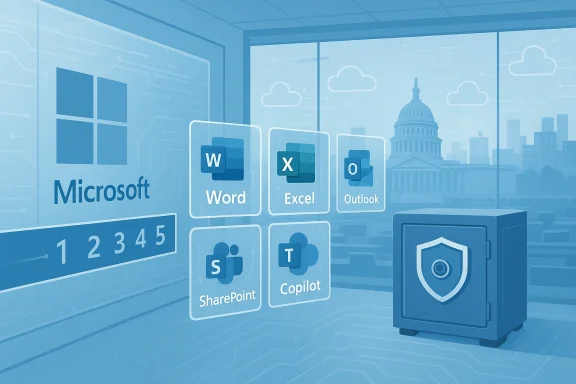
The Australian Public Service (APS) has, for many years, standardized around Microsoft productivity tools — Word, Excel, Outlook, SharePoint and Teams — as the baseline for everyday office work. That standard grew from practical forces: wide market adoption, strong application compatibility, rich administrative tooling for identity and device management, and an ecosystem of third‑party solutions and integrators built around Microsoft platforms.
Those same forces have now been formalized into a renewed whole‑of‑government arrangement. The new deal formally re‑establishes Microsoft’s products as the default desktop, cloud, and AI platforms for federal agencies for the next five years. The arrangement reportedly carries no public price tag, and while government purchasing often secures favorable volume pricing, the lack of transparent numbers raises questions about the true cost and comparative value of the arrangement.
This is a procurement at the intersection of three fast‑moving trends: (1) the shift of government workloads to cloud platforms; (2) the embedding of generative AI into productivity suites; and (3) a global move by major vendors to rework enterprise licensing and pricing models. Those trends make a multi‑year contract both attractive for stability and fraught with potential future misalignment.
From an operational viewpoint, the common model is that government enterprise agreements set a ceiling rather than a floor—your negotiated government price should be the best available for that channel. However, when producers standardize pricing across price bands or remove level‑based discounts, the ceiling can rise; whatever discount the government previously enjoyed loses negotiating leverage if the vendor standardizes price lists.
This deal's lack of a published price means two things for watchdogs and IT leaders: first, taxpayers and parliamentarians cannot easily compare this arrangement against alternative procurement outcomes; second, agencies must be vigilant about usage patterns, license creep, and new feature add‑ons (particularly AI offerings) that can increase costs after contract signature.
Generative AI changes the risk calculus in three ways:
Agencies should treat this renewal as the starting point, not the end point, of a broader program of governance. The practical steps above — contractual safeguards, technical controls, transparent costing, and an active market posture — are necessary to keep the benefits of standardization while constraining the downside.
In short: centralizing on one productivity, cloud and AI provider can accelerate modernization — but only if matched with rigorous procurement discipline, clear AI governance, and a continuing willingness to use competition and technical segmentation where public interest demands it.
The imperative for public sector leaders is straightforward: secure clear contractual limits around AI and data use, maintain discipline on cost and usage, keep competition alive for specialist services, and publish the high‑level figures that let parliament and the public judge whether scale is delivering value. Without those guardrails, the operational gains from one‑vendor simplicity risk being outweighed by strategic fragility and spiralling costs as the market evolves.
Source: The Mandarin | Public sector news & government learning Microsoft renews lease on APS ubiquity
 Background
The Australian Public Service (APS) has, for many years, standardized around Microsoft productivity tools — Word, Excel, Outlook, SharePoint and Teams — as the baseline for everyday office work. That standard grew from practical forces: wide market adoption, strong application compatibility, rich administrative tooling for identity and device management, and an ecosystem of third‑party solutions and integrators built around Microsoft platforms.Those same forces have now been formalized into a renewed whole‑of‑government arrangement. The new deal formally re‑establishes Microsoft’s products as the default desktop, cloud, and AI platforms for federal agencies for the next five years. The arrangement reportedly carries no public price tag, and while government purchasing often secures favorable volume pricing, the lack of transparent numbers raises questions about the true cost and comparative value of the arrangement.
This is a procurement at the intersection of three fast‑moving trends: (1) the shift of government workloads to cloud platforms; (2) the embedding of generative AI into productivity suites; and (3) a global move by major vendors to rework enterprise licensing and pricing models. Those trends make a multi‑year contract both attractive for stability and fraught with potential future misalignment.
What the arrangement likely covers — and what it doesn’t
What’s included (typical enterprise scope)
- Microsoft 365 suite: desktop Office apps, Exchange/Outlook, OneDrive, SharePoint, Teams and associated services that underpin day‑to‑day collaboration.
- Azure cloud services: identity (Azure AD), infrastructure and platform services, managed cloud workloads, and platform features used by agencies for hosting applications and data.
- Endpoint management and security: Intune, Defender for Endpoint and Microsoft security stacks used to enforce policy across devices and users.
- AI capabilities: Copilot and other generative AI integrations inside Microsoft 365 and Azure services, increasingly central to productivity roadmaps.
- Support and licensing frameworks: enterprise enrollment, subscription entitlements and enterprise servicing under an enterprise agreement model.
What remains uncertain or outside the visible scope
- Price per seat or total contract value — the arrangement reportedly carries no public price; without published figures the fiscal exposure is opaque.
- Data residency and access clauses — commercial and national security conditions governing data handling, third‑party access, and law enforcement/foreign government requests are typically negotiated but not always public.
- Exit, portability and interoperability terms — how easily an agency can migrate away from the suite, or interoperate with alternative stacks, depends on contract terms that are rarely published in full.
Pricing context: why “no price” does not mean “no cost”
The public sector has traditionally negotiated volume discounts and government price lists for software. But the license landscape has shifted: major vendors have modified how they price cloud services, flattened volume discounts, and aligned online services pricing across channels. Those moves can raise headline costs even where per‑user feature parity remains.From an operational viewpoint, the common model is that government enterprise agreements set a ceiling rather than a floor—your negotiated government price should be the best available for that channel. However, when producers standardize pricing across price bands or remove level‑based discounts, the ceiling can rise; whatever discount the government previously enjoyed loses negotiating leverage if the vendor standardizes price lists.
This deal's lack of a published price means two things for watchdogs and IT leaders: first, taxpayers and parliamentarians cannot easily compare this arrangement against alternative procurement outcomes; second, agencies must be vigilant about usage patterns, license creep, and new feature add‑ons (particularly AI offerings) that can increase costs after contract signature.
Strategic upside: reasons this makes sense
Standardizing on a single vendor across desktop, cloud and AI offers clear operational benefits:- Reduced friction for users: common tools and identities lower training costs and improve collaboration across agencies.
- Simplified identity and device management: single‑pane controls (Azure AD, Intune) make large‑scale policy enforcement more practical.
- Integrated security capabilities: the vendor’s security stack is designed to interoperate across endpoints, identity and cloud telemetry — enabling faster detection and remediation at scale.
- Faster rollout of AI innovations: having a single vendor roadmap for Copilot‑style features reduces integration work and lets agencies trial generative AI features quickly.
- Economies of scale in procurement, support and training, which can be significant for a distributed public service.
Concentration risks: what the deal amplifies
However, recommitting to a dominant vendor for five years also concentrates several classes of systemic risk:- Vendor lock‑in: deep technical dependency on proprietary formats, identity models, authentication flows and management tooling makes migration expensive and slow.
- Single‑vector outages: reliance on one cloud and collaboration provider concentrates operational risk. Regional outages or provider disruptions can affect many agencies simultaneously.
- Negotiation leverage erosion: if the government becomes the incumbent customer across the APS, it loses the leverage that competition provides during renewals.
- Security/sovereignty exposure: defaulting to a single vendor raises questions about cross‑jurisdictional access to data, responses to lawful requests, and national security considerations.
- Unpredictable pricing exposure: platform vendors are aggressively monetizing AI features; a standard contract that normalizes the vendor’s stack can make it harder to refuse new paid add‑ons without disrupting services.
AI adds a new dimension: capabilities, governance, and risk
This renewal explicitly names AI services as part of the default platform mix. That is consequential.Generative AI changes the risk calculus in three ways:
- Data sharing and retention — many AI features operate by sending prompts and data to cloud models. Without stringent contractual safeguards, agency data or derived insights could be used to improve vendor models or could be exposed via model training sets.
- Decision‑making opacity — AI‑augmented workflows may be used in administrative decisions. Ensuring explainability, fairness and audit trails is essential, particularly where choices have legal or welfare impacts.
- Rapid feature creep — AI capabilities are evolving quickly. Vendors will roll features into suites and may reclassify them under paid SKUs. This accelerates the risk of unbudgeted cost increases.
Technical controls and contract clauses agencies should insist on
To preserve agility while limiting downside, agencies should push for explicit technical and contractual protections:- Strict data‑use commitments for AI: contractual clauses that prohibit the vendor from using agency data to train models or from exposing agency content across customers.
- Data residency and sovereign handling: guarantees on where data is stored, processed and who has administrative access — especially for classified or sensitive workloads.
- Robust exit and portability clauses: practical mechanisms for exporting content, metadata and identity mappings to alternative platforms without loss of audit trails.
- Interoperability and open document standards: enforceable requirements to support open formats and APIs to allow hybrid workflows or phased migration.
- Resilience and incident SLAs: clear service level commitments and failover arrangements for regional or global outages.
- Auditable logs and transparency: the vendor must provide agency‑level audit logs for AI prompts, administrative actions and data exfiltration attempts.
- Segmentation of critical services: allow agencies to opt out of specific services where risk is unacceptable (for instance, exempting high‑risk systems from Copilot ingestion).
Procurement and governance levers beyond the contract
A wise procurement strategy treats the vendor agreement as one tool among many. Agencies and central procurement bodies should deploy a set of complementary levers:- Ongoing demand management: continuous inventory of licenses, periodic true‑up processes, and automated reporting to cut unused seats and manage license tiers.
- Segmented sourcing: preserve competition by segmenting procurement for categories like hosting, data analytics, identity, or endpoint management where alternatives exist.
- Use‑case gating for AI: require program‑level signoff and security assessment before new AI features are turned on for business processes.
- Third‑party assurance: independent security and supply‑chain audits beyond vendor self‑attestation.
- Cost transparency: publish aggregate spend and per‑user economics to parliament and oversight bodies to allow scrutiny and comparisons against alternative approaches.
- Pilots and hybrid architectures: permit small, controlled pilots of alternative productivity stacks or open‑source tools for niche or high‑risk use cases.
Practical checklist: what agencies should do now
- Conduct a full license and usage inventory across the agency, with a spotlight on under‑used or duplicative SKUs.
- Map all sensitive data flows into Microsoft services and run a data classification review focused on AI ingestion risks.
- Demand written contractual assurances about AI data use, model training exclusions, and where data is processed and stored.
- Produce an exit playbook: roadmap, tools, and timelines to extract content, identities and integrations if migration becomes necessary.
- Implement a strict change‑control gate for enabling new AI features, with CISO and legal sign‑off.
- Strengthen identity hygiene: multi‑factor auth, privileged‑access management and conditional access policies linked to device posture.
- Right‑size licensing: shift to consumption or role‑based licensing where appropriate to avoid blanket purchases of high‑value SKUs.
- Run competition pilots for specialist workloads (e.g., analytics, records management) to maintain market muscle.
- Publish a summary of contract terms that can be made public without compromising security, to improve transparency.
- Train staff in secure prompt engineering and the risks of exposing sensitive material to AI assistants.
Policy and public interest considerations
When a government central agency signs a multi‑year default with a single vendor, it raises legitimate questions about oversight, competition policy, and digital sovereignty. Parliaments and auditors should expect:- Transparent cost reporting to compare vendor outcomes against alternative procurement models and cloud providers.
- Regular reviews — not just at renewal time — of the strategic fit of the platform, the fiscal profile and the threshold for enabling new platform features tied to AI.
- Interagency coordination so that shared services, law enforcement, and national security agencies can opt for alternative arrangements where necessary.
- A national data governance policy that clarifies how classified or sensitive datasets are handled when embedded inside commercial AI services.
Weighing the trade‑offs
The Department of Finance’s decision to renew and make Microsoft the APS’s default platform for another five years is defensible on operational grounds: stability, scale and faster access to integrated AI capabilities. Yet it is not risk‑free. The deal amplifies concentration risk and reduces the government’s leverage at a moment when major platform vendors are reshaping licensing and monetization models around cloud and AI.Agencies should treat this renewal as the starting point, not the end point, of a broader program of governance. The practical steps above — contractual safeguards, technical controls, transparent costing, and an active market posture — are necessary to keep the benefits of standardization while constraining the downside.
In short: centralizing on one productivity, cloud and AI provider can accelerate modernization — but only if matched with rigorous procurement discipline, clear AI governance, and a continuing willingness to use competition and technical segmentation where public interest demands it.
Conclusion
Stability matters for government IT: a consistent platform reduces training overhead, speeds collaboration and simplifies security management. But five years is long in the life cycle of cloud and AI technologies. The Department of Finance’s recommitment to Microsoft buys operational harmony but also extends a period in which the APS will be materially shaped by a single commercial roadmap.The imperative for public sector leaders is straightforward: secure clear contractual limits around AI and data use, maintain discipline on cost and usage, keep competition alive for specialist services, and publish the high‑level figures that let parliament and the public judge whether scale is delivering value. Without those guardrails, the operational gains from one‑vendor simplicity risk being outweighed by strategic fragility and spiralling costs as the market evolves.
Source: The Mandarin | Public sector news & government learning Microsoft renews lease on APS ubiquity
