

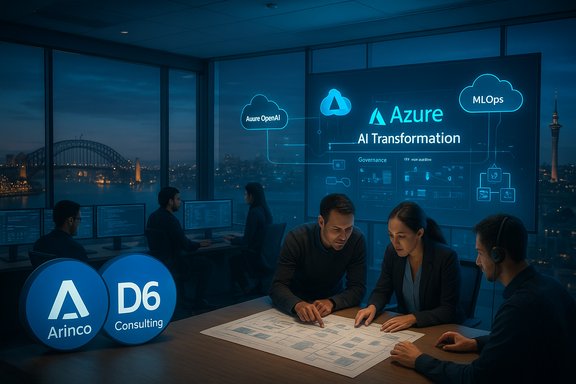
Arinco has formally integrated D6 Consulting — a fellow Connetico group company — into its operations to create a consolidated AI transformation practice, folding business consulting and program delivery into its existing Microsoft‑focused technical capability and asserting a stronger regional play across Australia and New Zealand. The integration, effective 1 November 2025, brings together complementary strengths: Arinco’s Azure and Microsoft 365 engineering pedigree and D6’s project, program and change‑management expertise, creating a single partner proposition aimed at moving organisations from AI pilots to production‑grade, governed deployments.
Arinco began as a Microsoft‑centred consultancy founded by former Kloud executives and has grown rapidly since 2019, expanding across Australia and into New Zealand while accumulating multiple Microsoft specialisations and partner awards. The company publicly notes recognition as Microsoft Australia Partner of the Year 2024 and the ANZ Azure Partner of the Year in 2023, credentials it places at the centre of its go‑to‑market for enterprise AI and cloud projects. D6 Consulting launched in mid‑2022 as a people‑first consulting boutique focused on program delivery, business analysis, experience design and change management, with co‑founders Joanne Spencer and Lisa Applegarth coming from Cevo and prior roles in the Kloud/Telstra ecosystem. In late 2022, all three Connetico group businesses — Arinco, Cevo and D6 — received growth capital from Quadrant, forming Connetico as the umbrella group supporting both Microsoft and AWS specialist plays. The recent integration is presented as an organisational consolidation rather than a conventional acquisition: operationally the teams have worked together for years under Connetico and will now operate under the Arinco brand to deliver end‑to‑end AI transformation programs. Company statements emphasise staff retention and continuity for customer projects. The move is effective from 1 November 2025, with integration work already in progress at the time of announcement.
Mid‑market and enterprise buyers now choose among three types of integrators:
However, success will be measured in execution — not announcements. The primary risks are integration overhead, inconsistent headcount and resourcing reporting, potential changes to commercial terms, and cultural alignment. Customers should adopt a posture of pragmatic optimism: welcome the consolidated single‑vendor path but insist on contractual protections and verifiable operational deliverables.
The Arinco–D6 integration signals a maturing ANZ market where business consulting and technical engineering must coexist to industrialise AI. For organisations intent on scaling AI beyond pilots, the consolidated practice offers a compelling single‑vendor path — but its real value will be proven by demonstrable production outcomes, transparent integration artifacts, and the vendor’s ability to deliver continuous operations without disruption.
Source: Consultancy.com.au AI consultancy Arinco adds Connetico stable-mate D6 Consulting
 Background / Overview
Arinco began as a Microsoft‑centred consultancy founded by former Kloud executives and has grown rapidly since 2019, expanding across Australia and into New Zealand while accumulating multiple Microsoft specialisations and partner awards. The company publicly notes recognition as Microsoft Australia Partner of the Year 2024 and the ANZ Azure Partner of the Year in 2023, credentials it places at the centre of its go‑to‑market for enterprise AI and cloud projects. D6 Consulting launched in mid‑2022 as a people‑first consulting boutique focused on program delivery, business analysis, experience design and change management, with co‑founders Joanne Spencer and Lisa Applegarth coming from Cevo and prior roles in the Kloud/Telstra ecosystem. In late 2022, all three Connetico group businesses — Arinco, Cevo and D6 — received growth capital from Quadrant, forming Connetico as the umbrella group supporting both Microsoft and AWS specialist plays. The recent integration is presented as an organisational consolidation rather than a conventional acquisition: operationally the teams have worked together for years under Connetico and will now operate under the Arinco brand to deliver end‑to‑end AI transformation programs. Company statements emphasise staff retention and continuity for customer projects. The move is effective from 1 November 2025, with integration work already in progress at the time of announcement. Why this matters: the business case for consolidation
Enterprise AI adoption has shifted from experimentation to production concerns: organisations increasingly demand partners that can bridge strategy, operating model change, and technical productionisation. This integration addresses three linked market needs:- End‑to‑end accountability — combining advisory, program governance, and cloud engineering under one leadership chain reduces handoffs and the “blame passing” risk between separate strategy and delivery teams.
- Platform alignment with Microsoft — Arinco’s deep Microsoft focus (Azure, Microsoft 365, Copilot, Azure OpenAI) positions the combined firm to exploit vendor productisation of productivity and enterprise AI. That alignment matters for organisations standardising on Microsoft stacks.
- Scale to manage complexity — larger, multi‑year AI programs require governance, data readiness, MLOps pipelines, and operational runbooks. The combined capabilities are designed to offer a repeatable delivery model from strategy to run operations.
What the combined capability stack looks like
The integration creates a composite set of services designed to cover the lifecycle of enterprise AI transformation:- Strategy and business consulting (use‑case prioritisation, operating model redesign, ROI modelling).
- Program and project delivery (PMO, delivery governance, change management).
- Azure and cloud engineering (infrastructure, identity, security, cost governance).
- Data engineering and MLOps (data lakes, model pipelines, monitoring, drift detection).
- Copilot and Modern Work adoption (Microsoft 365 copilots, productivity change programs).
- Managed services and co‑delivery (Co‑Ops style managed operations and optimisation).
Verified facts and independent corroboration
Key claims in the announcement were explicitly verified against independent sources:- Arinco’s recognition as Microsoft Australia Partner of the Year (2024) is confirmed both by Microsoft’s partner announcements and Arinco’s corporate pages. This strengthens Arinco’s vendor credentials when pitching large Microsoft‑centric AI programs.
- D6 Consulting’s founding and focus (launched mid‑2022, Sydney and Melbourne presence, founders Joanne Spencer and Lisa Applegarth) is documented on Connetico’s D6 announcement and press coverage. Both sources corroborate D6’s people‑first consulting posture and the founders’ provenance from Cevo.
- The capital and governance context — that Arinco, Cevo and D6 are part of Connetico and were backed by private equity firm Quadrant — is confirmed by Connetico’s announcement and contemporaneous industry press. That corporate backdrop explains the integration pathway rather than an open market M&A transaction.
- The effective integration date (1 November 2025) and operational messaging (no expected job losses, retention emphasis) are reported in independent trade press and channel coverage of the announcement.
Strengths of the integration
- Single accountability for outcomes
Organisations gain a single commercial and delivery nexus: strategy, program governance and technical implementation now report into one team. That reduces coordination overhead and helps maintain momentum from pilot to production. - Stronger Microsoft co‑sell and credibility
Arinco’s award and partner credentials increase access to Microsoft resources and product trackings (Copilot, Azure AI Foundry, GitHub integration) which often accelerate procurement and technical support when scaling AI across an enterprise. - Complementary skill sets
D6’s program delivery, change management and business analysis plug gaps typical in tech‑led AI projects. Combining that with Arinco’s engineering bench improves the realistic prospects of productionisation and adoption. - Regional scale with local presence
Offices across major Australian markets and an established New Zealand presence mean clients can access local delivery teams and regulatory familiarity — important for public sector, healthcare and finance.
Risks and execution challenges
Large integrations bring friction; the announcement itself flags several potential execution risks that clients and procurement teams should explicitly manage:- Integration overhead and delivery continuity — merging delivery frameworks, tooling and reporting lines can temporarily distract teams. Even with staff retained, shifting responsibilities or system migrations could delay active projects unless carefully managed.
- Service rationalisation and contractual change — standardising service catalogs and SLAs may change billing models, SOWs and managed‑service SLAs. Customers should confirm whether existing SOWs remain unchanged during the transition and request written transition plans.
- Cultural alignment — combining a people‑first consulting boutique with a technically driven engineering firm requires active change programs to align career paths, incentives, and delivery norms; misalignment could accelerate attrition among senior consultants.
- Vendor concentration and lock‑in risk — the consolidated offering is Microsoft‑centric, which is beneficial for customers standardising on Azure and Microsoft 365 but raises vendor concentration considerations for organisations seeking multi‑cloud flexibility. Procurement should ensure portability and exit clauses for vector stores, model artifacts and data.
- Undisclosed financial terms — public statements emphasise continuity and capability but avoid transactional economics. Any financial exposures or governance changes introduced by Quadrant or Connetico should be clarified in writing for major customers.
What CIOs, CISOs and procurement teams should ask next
To protect ongoing programs and reduce transition risk, organisations should insist on concrete, measurable assurances. At minimum, request the following:- A written integration transition plan with explicit milestones and SLAs for project continuity, escalation paths and named resource guarantees.
- Confirmation that current SOWs, pricing and delivery SLAs will remain unchanged for a specified transition period, including any planned changes to managed‑service terms.
- Sample technical deliverables and runbooks (security architecture, MLOps pipeline templates, model factsheets, cost‑governance models) to validate operational readiness.
- Evidence of certifications and third‑party attestations (Azure specialisations, penetration test reports, SOC audits) and clear data residency mapping for sensitive workloads.
- Contractual controls for model training, data use and portability (no‑training/no‑derivative clauses, data deletion SLAs, exportability of embeddings/vector stores).
Integration playbook: the technical checklist for AI programs
When a vendor says they can take AI projects from strategy to production, customers must verify specific technical competencies and artifacts. Demand evidence of the following:- Data estate readiness: lineage, catalog, MDM and quality controls.
- MLOps and model governance: CI/CD for models, testing gates, drift detection, rollback strategies and versioning.
- Security & identity integration: Azure AD binding, key management, least privilege controls, and secure enclave practices for sensitive data.
- Responsible AI practices: bias testing, explainability evidence, model factsheets and human approval gates for consumer‑facing agents.
- FinOps controls: telemetry, cost projection models and consumption caps, especially when using managed services like Azure OpenAI which can drive inference costs.
Competitive and market context
The Arinco + D6 integration is part of a broader consolidation trend within the Microsoft partner ecosystem: regional specialists are combining consulting and delivery depth to compete with global systems integrators on multi‑year AI programs. This pattern is visible across the channel as partners respond to Microsoft’s push to productise enterprise AI (Copilot, Microsoft 365 integrations, Fabric) and to customer demand for unified delivery models.Mid‑market and enterprise buyers now choose among three types of integrators:
- Global systems integrators (Accenture, Deloitte) for cross‑country scale and heavy vertical playbooks.
- Hyperscaler‑aligned regional specialists (Arinco, Cognizant’s Azure plays) for fast Microsoft integration and local presence.
- Niche data engineering and MLOps specialists for deep technical needs (real‑time streaming, custom model research).
Practical implications for customers and partners
- For customers already invested in Microsoft 365 and Azure, the combined Arinco proposition could reduce procurement friction and accelerate time‑to‑value, provided the integration maintains delivery quality and named resource continuity.
- For partners and competitors, the consolidation raises the competitive bar in ANZ: boutique consultancies may need to demonstrate deeper delivery frameworks or specialised product IP, while global integrators will continue to compete on scale.
- For regulated sectors (health, finance, government), clarity on data residency, attestations and model governance will be the deciding factor; headline capability claims are insufficient without documented proofs.
Assessment: pragmatic positives with conditional caveats
The integration is strategically coherent: it matches a clear market requirement for integrated AI transformation partners who can manage governance, change and production operations. Arinco’s Microsoft credentials combined with D6’s business consulting and delivery experience form a sensible capability set for customers seeking to scale Copilot and Azure AI programs.However, success will be measured in execution — not announcements. The primary risks are integration overhead, inconsistent headcount and resourcing reporting, potential changes to commercial terms, and cultural alignment. Customers should adopt a posture of pragmatic optimism: welcome the consolidated single‑vendor path but insist on contractual protections and verifiable operational deliverables.
Final checklist for procurement (quick reference)
- Obtain the written integration transition plan and named resource guarantees.
- Request sample operational artifacts (security architecture, MLOps pipeline templates, cost models).
- Verify partner specialisations and third‑party attestations (Azure certifications, SOC reports).
- Include contractual clauses for model/data portability, no‑training restrictions, and FinOps governance.
- Maintain a client steering committee during the integration window to handle escalations and scope control.
The Arinco–D6 integration signals a maturing ANZ market where business consulting and technical engineering must coexist to industrialise AI. For organisations intent on scaling AI beyond pilots, the consolidated practice offers a compelling single‑vendor path — but its real value will be proven by demonstrable production outcomes, transparent integration artifacts, and the vendor’s ability to deliver continuous operations without disruption.
Source: Consultancy.com.au AI consultancy Arinco adds Connetico stable-mate D6 Consulting
