

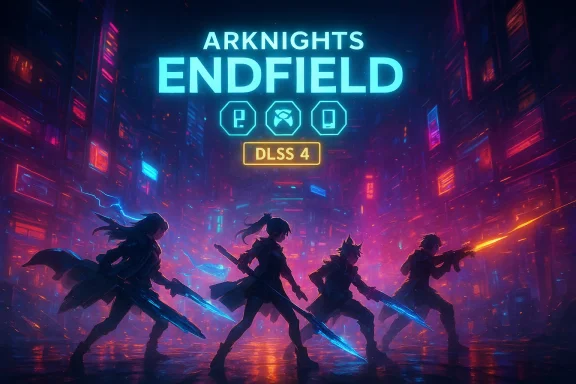
Arknights: Endfield has arrived on Windows — a bold, cross‑platform pivot for Hypergryph that brings the studio’s signature aesthetic and gacha lineage into a full 3D action‑RPG built for modern PCs, consoles and phones. Released on January 22, 2026, the PC edition arrives with day‑one visual features (including DLSS 4 Multi‑Frame Generation and support for high refresh rates), Epic Games Store distribution, and the cross‑device ambitions that have driven the project since its first teasers.
Arknights began life as a tightly designed tower‑defense gacha on mobile, winning fans for its art direction, world‑building and cast of characters. Arknights: Endfield is the franchise’s ambitious 3D spin‑off: a story‑driven, action‑RPG that preserves the series’ tone while overhauling gameplay toward real‑time combat, base management and narrative exploration. The game is developed by Hypergryph (with international publishing under Gryphline and regional partners) and uses Unity as its engine. The official global launch date—January 22, 2026—was confirmed by multiple outlets around the time of release.
Before launch the title passed through several high‑profile betas, each progressively larger in scope. Those tests expanded story beats, added regions and stress‑tested cross‑platform systems; the scale of those tests helped shape Hypergryph’s roadmap for a simultaneous cross‑platform rollout. Even so, the final product reflects both iterative design and marketing scale: Hypergryph and partners leaned on significant preregistration and promotional campaigns to prime a crowded launch window.
Why this matters on PC:
Critical reaction at and immediately after launch was mixed-to‑positive in early coverage: praise centered on art direction, atmosphere, and the novelty of moving Arknights into 3D action, while criticism focused on live‑service friction (menu UX, monetization pacing) and the inevitable balance questions that come with gacha and time‑limited content. Be aware that initial patch cadence and hotfix responsiveness will shape public sentiment in the weeks after launch.
Why this matters for players:
From a player’s perspective, Endfield is worth watching closely in its first weeks: the core combat and worldbuilding promise a rewarding experience, but long‑term satisfaction will depend on the studio’s balance choices and post‑launch support. From a PC tech angle, the title demonstrates how modern games are shipping with sophisticated GPU features out of the box — and how those features will increasingly shape the expectations of Windows players.
If you’re planning to jump in on Windows: prepare your hardware profile, decide whether you want the visual fidelity or the highest frame rate, and take a moment to review privacy options for the launcher and publisher websites — the opt‑out signals described in typical publisher privacy notices are effective tools for reducing targeted ad sharing on the devices and browsers where you enable them.
Source: Digg Arknights: Endfield is out on Windows PC — the factory loop is the surprise | technology
 Background / Overview
Arknights began life as a tightly designed tower‑defense gacha on mobile, winning fans for its art direction, world‑building and cast of characters. Arknights: Endfield is the franchise’s ambitious 3D spin‑off: a story‑driven, action‑RPG that preserves the series’ tone while overhauling gameplay toward real‑time combat, base management and narrative exploration. The game is developed by Hypergryph (with international publishing under Gryphline and regional partners) and uses Unity as its engine. The official global launch date—January 22, 2026—was confirmed by multiple outlets around the time of release. Before launch the title passed through several high‑profile betas, each progressively larger in scope. Those tests expanded story beats, added regions and stress‑tested cross‑platform systems; the scale of those tests helped shape Hypergryph’s roadmap for a simultaneous cross‑platform rollout. Even so, the final product reflects both iterative design and marketing scale: Hypergryph and partners leaned on significant preregistration and promotional campaigns to prime a crowded launch window.
What Windows players received at launch
Storefront and distribution
- The Windows release is distributed through the Epic Games Store (the PC release metadata identifies Epic as the distributor), not Steam. That means Windows users who want the official PC client will be interacting with Epic’s launcher, library and update chain. This also has implications for overlay functionality, refund policies, and how DRM and cloud‑save integration are handled.
Engine and platform features
- Built in Unity, Endfield’s PC build targets modern hardware, with explicit support for NVIDIA‑centric features such as DLSS 4 Multi‑Frame Generation and DLSS Super Resolution at launch. NVIDIA listed Endfield among its day‑one DLSS 4 titles and highlighted frame generation and super‑resolution features as available enhancements for RTX GPUs. That indicates significant investment in GPU‑side upscaling and frame‑synthesis to stretch performance across a wide range of PC hardware.
- The PC version advertises support for 120 FPS caps and controller support across platforms, reflecting both optimization work and a focus on smooth, responsive combat — a core expectation for action RPGs. Multiple previews and publisher notes referenced 120 Hz targets and controller parity across devices.
Visual presentation and technical targets
- Day‑one DLSS 4 support means Endfield ships with frame generation enabled as an option on compatible NVIDIA hardware. Frame generation allows GPUs to synthetically create intermediate frames, smoothing motion and effectively multiplying perceived frame rates on supported rigs. NVIDIA’s marketing highlights multi‑frame generation as a means to get higher frame‑rate experiences on the same hardware footprint. For players on GeForce RTX platforms, this translates to a potential visual/latency trade‑off worth experimenting with in the settings menu.
- The PC client also exposes resolution scaling via NVIDIA’s Super Resolution and other built‑in upscaling paths — useful for hitting 4K or high refresh targets without paying a full native rendering tax. Takeaway: the PC build is modern‑features first; your experience will scale widely depending on GPU, driver maturity and the player’s willingness to tune quality vs. performance.
Gameplay mechanics and systems (what players will actually do)
Combat and party systems
Arknights: Endfield pivots away from static tower defense and toward real‑time, four‑character tactical combat. Players control an “Endministrator” and manage a squad of operators in real‑time hack‑and‑slash encounters, augmented by tactical skills, equipment customization and operator synergies. Multiple coverage pieces and the prelaunch test notes emphasize fast, effects‑heavy combat designed to reward quick thinking, positioning and skill timing rather than static placement.Base building, crafting and progression
Beyond combat, Endfield layers in resource collection, crafting, and an industry‑building loop where players expand facilities, produce materials, and manage workflows — mechanics that lengthen the game’s engagement loop and encourage repeat play sessions. Publishers have framed this as a way to bridge mobile and PC audiences: mobile players get bite‑sized loops, while PC players can explore deeper systems. Early previews noted the breadth of these non‑combat systems and their role in long‑term player retention.Narrative scope and single/multiplayer balance
- The game bills itself as both single‑player narrative and a socially accessible experience. Early updates and post‑launch plans suggested co‑op updates and shared activities (for example a co‑op update named “No Rest for the Wicked” launching shortly after initial release), but the core experience is story‑forward with optional multiplayer elements. Be cautious: cross‑play and cross‑progression details vary by platform and by publisher region, so check your platform’s support notes before assuming full parity.
Monetization, business model and what it means for players
Arknights: Endfield is published as a free‑to‑play title. Early coverage consistently framed the release as a free‑to‑play action RPG with gacha‑style monetization ties to the larger Arknights IP. In practical terms, expect familiar free‑to‑play levers: premium currency, limited‑time banners, convenience purchases (expedites, stash expansions), and cosmetics. That model is how the original Arknights has historically monetized successfully, and the studio appears to be re‑using that economic template inside a new gameplay shell.Why this matters on PC:
- Free‑to‑play plus cross‑platform ambitions tends to mean synchronized content windows, but platform revenue share (Epic’s cut vs. other storefronts) and platform‑specific offers can influence promotions and limited offers.
- Expect regular live‑service updates, seasonal content, operator releases (character drops), and time‑gated events designed to both retain players and funnel optional spending. The scale of pre‑registration numbers shows the publisher expects a sustained live service commitment.
Early numbers and reception
Pre‑launch metrics painted a large audience for Endfield: publisher and media reports cited 35 million pre‑registrations ahead of launch — a headline number that communicates mass interest but doesn’t directly translate to revenue or retained active users. Pre‑registration numbers are useful marketing barometers: they attract platform partners, ad buys, and streamer attention, but they’re not the same as daily active user counts or average revenue per user.Critical reaction at and immediately after launch was mixed-to‑positive in early coverage: praise centered on art direction, atmosphere, and the novelty of moving Arknights into 3D action, while criticism focused on live‑service friction (menu UX, monetization pacing) and the inevitable balance questions that come with gacha and time‑limited content. Be aware that initial patch cadence and hotfix responsiveness will shape public sentiment in the weeks after launch.
The PC technical picture — what to expect and how to optimize
Minimums vs. recommended hardware
Hypergryph’s public material and third‑party previews emphasize scalability but do not publish an exhaustive, Steam‑style spec sheet for all hardware tiers. Based on Unity’s profile, the presence of advanced upscaling, and the game’s visual ambitions, here’s a practical approach:- If you have a modern mid‑range GPU (RTX 3060 / RX 6700 or better), expect good 1080p to 1440p performance with high settings and some upscaling.
- If you have an RTX 40/50‑series GPU or equivalent AMD silicon and want 4K or native 120 FPS targets, enable DLSS 4 + Frame Generation where available and tune quality sliders to balance clarity vs. frame rate.
- For older systems, prioritize resolution scaling, lower shadow/particle budgets, and disable frame generation if it introduces microstutter on CPU‑bound rigs.
Controls, peripherals and UI
The Windows build supports controller input and is designed to be comfortably playable with gamepads; however the PC audience will expect robust keyboard/mouse controls and remapping options. At launch, PC users should verify keybindings, accessibility options and controller deadzone tuning — especially important for real‑time combat that rewards precise inputs. If remapping or UI scaling is limited at first, expect community mods and third‑party tools to emerge quickly, particularly on PC.Privacy, data sharing and what the Digg privacy snippet you pasted reveals
You pasted a Digg‑style privacy snippet that explains how websites may collect personal information via cookies and similar technologies and how Global Privacy Control (GPC) or a browser opt‑out signal can be treated as an opt‑out request for “sale,” “sharing,” or targeted advertising. That language mirrors how many publishers — including news outlets and entertainment sites — handle cross‑context behavioral advertising opt‑outs: the site will honor a GPC signal and mark the visiting browser as opted out for targeted advertising or data sharing, applying that preference to the specific device and browser session. The snippet you provided matches the common pattern of modern publisher privacy notices about GPC and opt‑out handling.Why this matters for players:
- Free‑to‑play games and associated web portals often rely on advertising partners and analytics — the same tracking mechanisms Digg describes — to fund free content and personalize cross‑site advertising.
- A GPC signal or manual opt‑out can limit targeted advertising and data sharing for the browser or device you use, but it won’t necessarily stop other uses of your data that are core to service delivery (account authentication, fraud detection, in‑game purchases, or server‑side analytics tied to gameplay).
- The legal effect of GPC varies by jurisdiction: California and several other U.S. states treat GPC as a valid opt‑out under laws like the CCPA/CPRA or state equivalents, and browsers like Firefox and Brave support GPC natively. However, enforcement and interpretations differ across states and services.
- Use a browser that supports the Global Privacy Control (GPC) signal or install a reputable extension that exposes it.
- If you’re concerned about in‑game tracking, review the game’s privacy policy and cookie preferences as well as the publisher’s privacy page for explicit opt‑out tools.
- For platform‑level concerns (Epic Games Store telemetry, launcher analytics), consult the platform’s privacy documentation — launcher telemetry is often outside the game’s privacy policy and governed by the storefront’s terms.
Strengths: what Endfield brings well to Windows and the franchise
- Ambition and scale. Shipping simultaneously to PS5, PC and mobile with advanced PC features (DLSS 4) demonstrates both confidence and investment from Hypergryph and partners. The technical feature set is modern‑first and leverages current GPU advances to improve accessibility across performance tiers.
- Fresh genre retooling. Endfield represents a genuine genre shift for Arknights fans: the franchise’s world‑building can now be explored in 3D, with more direct narrative control and a combat system that rewards mechanical play. For players who wanted more than tactical placement, this is a meaningful evolution.
- Cross‑platform potential. With a unified launch window and shared content roadmap, the live service model can be an advantage, enabling synchronized events and cross‑promotion across platforms — a plus for community cohesion and competitive multiplayer aspirations.
Risks and unanswered questions
- Monetization friction. Any move to a gacha model on PC invites scrutiny about fairness, grind and pay‑to‑progress dynamics. The long‑term health of the player base will hinge on Hypergryph’s balance between monetization and meaningful player choice. Early reports flagged this area as a potential friction point.
- Storefront fragmentation. An Epic Games Store release on Windows means a subset of PC players may be frustrated by launcher demands or lack of Steam features (overlay, wishlists, community hubs). Epic exclusivity has pros (platform support, visibility deals), but it can also limit discovery pathways for certain user segments.
- Technical teething. Launch‑day patches, driver compatibility, and frame generation artifacts are common with titles that ship complex upscaling and frame synthesis features. Expect early hotfixes and performance tuning to be part of week‑one updates. NVIDIA’s involvement reduces risk for RTX owners, but non‑RTX or integrated GPU owners may need additional optimization from the developer.
- Privacy and data portability. Free‑to‑play ecosystems often collect telemetry and user behavior data. While GPC and similar opt‑outs provide a degree of control for ad sharing, they do not eliminate server‑side analytics essential to live‑service operations. Players should audit both publisher and platform privacy settings and be mindful of the difference between ad‑sharing opt‑outs and the essential data flows that operate the service.
Practical checklist for Windows players at launch
- Backup saves (if migrating between platforms) and confirm whether the game supports cross‑progression between mobile and PC in your region.
- If you own an RTX GPU: try DLSS 4 + Frame Generation in a few scenarios (high action, high particle counts), and compare latency vs. native framerate to find the setting that works best for you.
- If you care about privacy: enable Global Privacy Control in your browser when visiting game sites, and review both the publisher’s privacy policy and Epic’s telemetry settings to understand what’s collected at launcher vs. in‑game. The Digg‑style privacy language many sites publish is a good starting point but always read the specific policy for action details.
- Watch for early patch notes and community bug trackers: live‑service titles evolve quickly after launch, and the first month will set the tone for post‑launch stability and content cadence.
Conclusion
Arknights: Endfield’s Windows debut is a significant milestone for Hypergryph and for fans of the Arknights universe. The game brings a modern technical stack to the PC, day‑one support for NVIDIA’s latest upscaling and frame generation tech, and the commercial muscle of a free‑to‑play, cross‑platform live service. That combination creates both opportunity and responsibility: opportunity to reach millions of players across devices and responsibility to manage monetization, platform fragmentation and the privacy expectations of a global audience.From a player’s perspective, Endfield is worth watching closely in its first weeks: the core combat and worldbuilding promise a rewarding experience, but long‑term satisfaction will depend on the studio’s balance choices and post‑launch support. From a PC tech angle, the title demonstrates how modern games are shipping with sophisticated GPU features out of the box — and how those features will increasingly shape the expectations of Windows players.
If you’re planning to jump in on Windows: prepare your hardware profile, decide whether you want the visual fidelity or the highest frame rate, and take a moment to review privacy options for the launcher and publisher websites — the opt‑out signals described in typical publisher privacy notices are effective tools for reducing targeted ad sharing on the devices and browsers where you enable them.
Source: Digg Arknights: Endfield is out on Windows PC — the factory loop is the surprise | technology
