

NVIDIA’s move to bring Arm-based system-on-chips to Windows PCs — long rumored and now increasingly visible in supply‑chain reporting — appears set to begin in earnest in 2026 with a family of chips codenamed N1 and N1X, timed to ship on a new Windows platform baseline Microsoft is preparing (visible in Insider builds as Windows 11, version 26H1). The story is not just about another vendor making chips: it ties together Microsoft’s platform strategy (a device-targeted “Bromine” branch), Qualcomm’s competing Snapdragon X2 rollout, and NVIDIA’s broader architectural experiment with Grace/Blackwell unified-memory designs. Early engineering samples, benchmark traces, and OEM signals point to real hardware work under way — but delays, driver maturity, memory economics, and OS integration remain significant hurdles that will determine whether Arm‑based Windows PCs become mainstream or remain niche AI-accelerated workstations for prosumers and enterprises. c
Windows has long been architected around x86/x64 silicon, but the last five years have rewritten the rules: Arm-based PCs proved viable in form factors and battery life with early Snapdragon Windows devices, Apple’s M‑series demonstrated a compelling SoC-first approach, and an array of AI-first designs — NPUs, unified memory, and GPU-CPU coherence — have become central to vendors’ roadmapps. Microsoft’s response is to decouple platform enablement from the mainstream consumer feature cadence, producing a device-targeted Windows baseline intended to let OEMs ship new classes of silicon without destabilizing the broad installed base. That baseline appears in Insider channels as Windows 11, version 26H1 (Canary Build 28000) and is being discussed internally and in the community under the cMicrosoft explicitly frames 26H1 as a platform release to “support specific silicon,” not a consumer feature update, which explains why OEMs are preparing factory images that pair with the new chips. Two chipset narratives converge on 2026: Qualcomm’s public Snapdragon X2 family — a polished and vendor-announced refresh of its Windows-on‑Arm push — and NVIDIA’s more speculative but increasingly corroborated N1/N1X program, which aspires to bring Blackwell GPU and Grace CPU technology into unified SoC products for notebooks and desktops. Qualcomm’s roadma make X2 a near-term, supported arrival for OEM laptops in early 2026. NVIDIA’s effort shows the architectural ambition of merging high-performance GPU compute with Arm CPU cores and large coherent memory pools; however, the N1/N1X timeline has been more fluid and subject to leaks and reports of engineering respins. This feature synthesizes the public, community, and vendor signals: official product pages and announcements where available, independent trade reporting and supply‑chain leaks where vendors have not publicly disclosed details, and the practical engineering implications for OEMs, enterprise IT, and developers. Where claims remain unverified — particularly the most eye‑catching performance numbers for unreleased N1/N1X silicon — the analysis flags those as provisional and subject to change when vendors publish official specifications or retail products ship.
Multiple independent reports since mid‑2025 indicate engineering setbacks that pushed the earliest consumer availability into 2026 or later. The nature of reported problems ranges from signal‑integrity and thermal issues to the need for a silicon respin, which can add months to validation timelines. In short: N1/N1X exist as active engineering programs with high potential, but their consumer launch timetable has shifted and remains uncertain. Treat performance claims from leaks as provisional until NVIDIA, MediaTek (a reported partner), or OEMs publish final specifications or ship products.
But the engineering obstacles are real:
But the competitive question is whether multiple vendors (Qualcomm, NVIDIA, MediaTek partners, Intel’s own hybrid roadmap) can coalesce around consistent driver models, developer tooling, and OEM reference designs. In the near term, expect segmented competition:
Conclusion
Arm‑based Windows PCs, accelerated by NPUs and designed around unified memory architectures, are moving from concept to engineering reality. Microsoft has prepared the plumbing (26H1/Bromine) so OEMs and silicon vendors can ship devices that require new low‑level OS behavior, Qualcomm has a public roadmap with Snapdragon X2 for early 2026 deployment, and NVIDIA’s N1/N1X program brings a high‑ambition architectural play that could reshape client AI compute — provided it clears the engineering, thermal, and economic hurdles that have delayed the program in the past year. The coming months will reveal whether the industry can synchronize silicon, firmware, and OS work at the scale needed to make Arm‑based Windows a widely adopted platform or whether these first-wave devices will remain specialized tools for AI‑centric professionals.
Source: Windows Report https://windowsreport.com/nvidia-plans-arm-based-chips-for-windows-pcs-starting-in-2026/
 Background / Overview
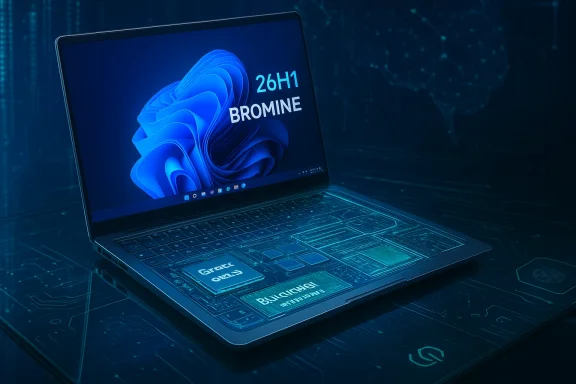
Windows has long been architected around x86/x64 silicon, but the last five years have rewritten the rules: Arm-based PCs proved viable in form factors and battery life with early Snapdragon Windows devices, Apple’s M‑series demonstrated a compelling SoC-first approach, and an array of AI-first designs — NPUs, unified memory, and GPU-CPU coherence — have become central to vendors’ roadmapps. Microsoft’s response is to decouple platform enablement from the mainstream consumer feature cadence, producing a device-targeted Windows baseline intended to let OEMs ship new classes of silicon without destabilizing the broad installed base. That baseline appears in Insider channels as Windows 11, version 26H1 (Canary Build 28000) and is being discussed internally and in the community under the cMicrosoft explicitly frames 26H1 as a platform release to “support specific silicon,” not a consumer feature update, which explains why OEMs are preparing factory images that pair with the new chips. Two chipset narratives converge on 2026: Qualcomm’s public Snapdragon X2 family — a polished and vendor-announced refresh of its Windows-on‑Arm push — and NVIDIA’s more speculative but increasingly corroborated N1/N1X program, which aspires to bring Blackwell GPU and Grace CPU technology into unified SoC products for notebooks and desktops. Qualcomm’s roadma make X2 a near-term, supported arrival for OEM laptops in early 2026. NVIDIA’s effort shows the architectural ambition of merging high-performance GPU compute with Arm CPU cores and large coherent memory pools; however, the N1/N1X timeline has been more fluid and subject to leaks and reports of engineering respins. This feature synthesizes the public, community, and vendor signals: official product pages and announcements where available, independent trade reporting and supply‑chain leaks where vendors have not publicly disclosed details, and the practical engineering implications for OEMs, enterprise IT, and developers. Where claims remain unverified — particularly the most eye‑catching performance numbers for unreleased N1/N1X silicon — the analysis flags those as provisional and subject to change when vendors publish official specifications or retail products ship.What Microsoft’s 26H1 (Bromine) Really Is — and Why It Matters
Platform-first, not feature-first
Microsoft’s Canary build that carries the 26H1 label is unusual to deliver platform plumbing rather than consumer-facing features. The primary purpose of that work is to enable new SoC topologies: hybrid CPU clusters, large on‑die NPUs, new memory/coherence models, and device‑specific firmware/attestation flows. Shipping a separate platform baseline allows Microsoft to hand OEMs a validated RTM image for factory flashing, avoiding the peril of pushing deep kernel/driver changes to millions of existing devices. That approach reduces risk for mainstream users while letting OEMs ship devices with day‑one support for features tied to their silicon.Bromine: the engineering rationale
New Arm SoCs are not drop‑in replacements for x86 designs. They introduce:- Heterogeneous CPU clusters requiring scheduler and affinity changes.
- Large NPUs that need secure runtime.
- Memory topologies (on‑package LPDDR5x, unified coherent memory) that change driver and DMA behavior.
- Power, thermal, and ACPI semantics that affect long‑running workloads and battery life.
Practical implications for IT and consumers
- Enterprises: treat 26H1 devices as vendor images with unique servicing paths. Validate drivers, management tooling (Intune/SCCM), and security controls before wide deployment.
- OEMs: need the Bromine RTM image months before retail to tune drivers, image signing, and factory provisioning.
- Consumers: no forced migration — existing Intel/AMD laptops remain on the usual update cadence; early Arm devices will ship with 26H1 to enable silicon‑specific features out of the box.
NVIDIA’s N1 / N1X Push: Ambition, Architecture, and the Reality Check
What N1 and N1X are reported to be
Industry coverage and multiple leak streams describe two families:- N1 — the desktop/desktop‑class variant aimed at higher thermal budgets and N1X — the notebook-optimized SoC tuned for laptop power/thermal constraints and Windows-on‑Arm compatibility.
Public precedents: GB10 and DGX Spark
NVIDIA has already shipped desktop-class Grace‑Blackwell hardware in the form of the DGX Spark / GB10 superchip family, which couples a Grace CPU cluster and Blackwell GPU with NVLink‑C2C coherence and large pooled memory. That product validates the architectural building blocks (coherent unified memory, tight CPU/GPU coupling) that rumors say N1/N1X aim to repurpose for client devices at lower power/thermal envelopes. GB10’s commercial listings and vendor-confirmed specs (128 GB coherent memory, NVLink-C2C interconnect) make the architectural story plausible. However, moving from a desktop AI workstation to a thin‑and‑light laptop SoC brings packaging, power, and thermal engineering challenges that historically drive delays and multiple SKU iterations.The leaks, benchmarks, and the timeline problem
Throughout 2025, the N1/N1X story surfaced as benchmark traces, supply‑chain reports, and leaks. Some early engineering traces multi-core and GPU throughput; other reports estimated very large TOPS figures for the Blackwell NPU blocks. Yet these figures are inconsistent across outlets and, crucially, are based on engineering samples, prototype firmware, or incomplete driver stacks.Multiple independent reports since mid‑2025 indicate engineering setbacks that pushed the earliest consumer availability into 2026 or later. The nature of reported problems ranges from signal‑integrity and thermal issues to the need for a silicon respin, which can add months to validation timelines. In short: N1/N1X exist as active engineering programs with high potential, but their consumer launch timetable has shifted and remains uncertain. Treat performance claims from leaks as provisional until NVIDIA, MediaTek (a reported partner), or OEMs publish final specifications or ship products.
Why NVIDIA’s entry mhard
NVIDIA’s proposed value proposition is powerful: unify CPU and GPU address spaces, place large AI compute close to data, and ship devices that can run local models with reduced latency and privacy exposure. If achieved in client form factors, that could materially change how Windows delivers on‑device AI (Copilot+ features, local LLM inference, and creative tool acceleration).But the engineering obstacles are real:
- Packaging and thermals: Blackwell GPUs draw power; cooling that in thin laptops without sacrificing battery life is nontrivial.
- Memory economics: Unified on‑package memory at 64–128 GB can be costly and supply-constrained.
- Driver and OS maturity: Windows’ x86‑centred stack needs careful bridging for high-performance Arm GPU drivers, NPUs, and secure runtime attestation.
- OEM priorities: many OEMs will hedge — offering thicker workstation SKUs first, then slimming toward thin designs in later silicon generations.
Where Qualcomm’s Snapdragon X2 Fits In
Qualcomm is not a spectator. The company publicly unveiled the Snapdragon X2 family (branded X2 Elite and X2 Elite Extreme), with vendor-provided specifications that include up to 18 CPU cores on high-end bins, beefed Adreno X2 GPUs, and an emphasis on a large Hexagon NPU (rated as high as 80 TOPS on marketing materials). Qualcomm explicitly schedules systems for the first half of 2026 and has positioned X2 as the immediate beneficiary of Microsoft’s Bromiine. The practical upshot is that Microsoft’s platform work has a close, verifiable pairing in X2: Qualcomm’s public product timelines, OEM confirmations (some ZenBook lines were signaled as early partners), and documented NPU/CPU topologies make X2 the near-term target for Bromine device enablement. That contrasts with NVIDIA’s more speculative N1/N1X rollout, which still depends on engineering closure and OEM productization.Technical and Market Risks — a Critical Assessment
This section drills into the central technical and commercial risks that will determine whether Arm‑based Windows PCs backed by NVIDIA, Qualcomm, or others succeed.1) Memory and BOM economics
Large unified-memory implementations — the headline capability of GB10-like designs — materially increase BOM cost. LPDDR5x capacity and on‑package memory controllers add both unit cost and supply pressure. For consumer notebooks, where price elasticity and battery life matter, high memory costs can push these devices into premium price bands that limit mainstream adoption. Industry trackers and DRAM vendors’ pricing dynamics are therefore material to launch plans.2) Thermals and battery tradeoffs
Delivering GPU-clati‑TOPS NPU throughput in laptop envelopes requires either thicker chassis or aggressive throttling. Early devices will likely favor thicker mobile workstations or ultra‑capable clamshells rather than ultra-thin fanless laptops. That positioning narrows the market and slows mainstream penetration. Prototype and leaked benchmarks frequently show the difference between short burst performance and sustained throughput, and design wins will hinge on how OEMs partition product lines across chassis types.3) Software stack and driver maturity
Windows’ ecosystem — drivers, DRM, anti‑cheat, and enterprise management tooling — was built with x86 dominance in mind. Porting or rebuilding drivers, ensuring anti‑cheat compatibility, and supporting virtualization and workload migration are nontrivial. Microsoft’s 26H1 moves the kernel and driver ABI forward in ways that help, but third‑party ISVs and AV/anti‑cheat vendors also need time to adapt. Real-world compatibility will be a gating factor for broad adoption in both prosumer gaming and enterprise deployment.4) Fragmentation risk and confusing messaging
Splitting the Windows platform into a device‑specific Bromine branch and a mainstream H2 branch creates the risk of consumer confusion — users may misinterpret version numbers or expect new features to be broadly available when they lear OEM and Microsoft communication will be essential to avoid support churn and help desks flooded with misaligned upgrade requests.5) Supply‑chain and timeline uncertainty
NVIDIA’s N1/N1X program shows how silicon projects can slip for any number of reasons — design fixes, packaging changes, or OS dependencies. Public reporting since mid‑2025 shows multiple pusr N1/N1X, with some outlets now projecting mass availability in late 2026. That uncertainty is a real market risk: OEMs do not want to commit factory lines without predictable supply and validated OS images. Meanwhile, Qualcomm’s X2 — being a public, vendor-supported product — creates a nearer-term path to Arm PCs.OEM and Enterprise Considerations: How Device Makers and IT Teams Should Prepare
For OEMs and system integrators:- Prioritize a staged approach: ship thicker, thermally unconstrained pro/creator SKUs first to validate drivers and power profiles.
- Secure early access to Microsoft’s Bromine RTM image, driver signing windows, and WHQL/Windows Hardware Compatibility Program (WHCP) timelines.
- Model memory BOM scenarios carefully; an SKU configured with 64–128 GB of LPDDR5x will present inventory and price volatility.
- Treat early Arm devi — isolate them in a lab ring.
- Validate endpoint agents, VPN, DRM, and anti‑cheat for targeted workloads.
- Confirm vendor servicing paths and driver lifecycle support — Bromine-based devices may have different servicing tokens and image-management expectations.
- Prioritize native Arm64 builds for critical apps and test NPU-accelerated paths where applicable.
- Use the Windows Insider channels to validate behavior on 26H1 early, but avoid Canary images in production.
- Where compatibility is crucial, demand kernel-mode drivers and user-mode runtimes be available early in partner coengineering windows.
Competitive Landscape: Where Arm Windows Fits Versus Apple and x86
Apple’s M‑series demonstrated that a vertically integrated SoC with focusa tuned OS can redefine platform expectations. NVIDIA’s architectural aim — close CPU/GPU coherence with large local memory and Blackwell compute — seeks to bring some of that same advantage to Windows PCs while retaining Windows’ broad software base.But the competitive question is whether multiple vendors (Qualcomm, NVIDIA, MediaTek partners, Intel’s own hybrid roadmap) can coalesce around consistent driver models, developer tooling, and OEM reference designs. In the near term, expect segmented competition:
- Qualcomm X2: nearer‑term, broad OEM support, and tighter Microsoft partnership for Bromine.
- NVIDIA N1/N1X: aspirational performance and AI capability, but more uncertain timing and higher product complexity.
- Intel/AMD: will respond with x86 alternatives that emphasize AI accelerators and optimized CPU performance.
Concrete Milestones to Watch (2026–2027)
- OEM announcements and product pages that explicitly list N1/N1X or Snapdragon X2 SKUs with Windows 11, version 26H1 factory images.
- Microsoft’s servicing timeline for 26H1 beyond Canary: when does Bromine move to Release Preview or RTM for OEMs?
- NVIDIA product briefs and developer releases for N1/N1X (driver SDKs, WHQL/driver signing, and media/AI SDK support).
- Independent reviews measuring sustained performance, battery life, and thermal behavior for early devices (these reveal the real-world tradeoffs obscured by short bursts and synthetic leaks).
- TSMC node ramps and memory price indices: TSMC N3/N3B/N2 availability and LPDDR5x price trends materially affect product feasibility for unified-memory designs in 2026–2027.
Realistic Timelines and Scenarios
- Best‑case (fast convergence): Qualcomm X2 ships broadly in H1 2026 with OEMs offering polished laptops; Microsoft’s 26H1 is the validated platform. NVIDIA’s N1X ships in late 2026 or early 2027 in thicker workstation designs, followed by thinner SKUs in 2027 as N2/N2X process nodes mature.
- Middle ground (staggered rollout): X2 dominates early Arm Windows adoption in 2026; NVIDIA delivers enthusiast/workstation SKUs in er N1X laptops arrive later. Software compatibility takes several quarters to stabilize.
- Slower adoption (fragmented/limited): Memory costs, thermal and driver challenges limit N1/N1X to a niche set of workstation devices; X2 achieves moderate success but x86 incumbents and Apple continue to dominate mainstream laptop sales.
Final Analysis: Strengths, Risks, and What It Means for Windows Users
The strengths of the emerging Arm‑based Windows era are clear:- On‑device AI potential: large NPUs and unified memory can deliver low-latency local inference for Copilot+ and creative workflows.
- Architectural innovation: tight CPU/GPU coherence (GB10/Grace‑Blackwell) is a potent platform design that unlocks new performance classes.
- Platform enablement: Microsoft’s 26H1/Bromine strategy reduces broad‑base risk while enabling OEMs to ship new silicon.
- Execution risk: complex SoC packaging, thermal design, and driver maturity can and have delayed launches.
- Economic risk: high memory BOMs and TSMC node reliance can raise prices and constrain availability.
- Ecosystem risk: ISV/driver/anti‑cheat/management stacks need time to catch up for mainstream, consumer use cases.
Takeaway: What to Watch and When to Act
- If you need on‑device AI and can accept a premium and a workstation chassis, consider piloting or buying early Arm‑based devices when OEM SKUs and review coverage appear in 2026.
- If you manage enterprise fleets, treat 26H1 devices as vendor‑specific images: pilot aggressively, validate management stacks, and wait for driver maturity before broad rollouts.
- For most consumers, wait for independent reviews that test sustained performance, battery life, and compatibility before committing to an Arm Windows laptop.
Conclusion
Arm‑based Windows PCs, accelerated by NPUs and designed around unified memory architectures, are moving from concept to engineering reality. Microsoft has prepared the plumbing (26H1/Bromine) so OEMs and silicon vendors can ship devices that require new low‑level OS behavior, Qualcomm has a public roadmap with Snapdragon X2 for early 2026 deployment, and NVIDIA’s N1/N1X program brings a high‑ambition architectural play that could reshape client AI compute — provided it clears the engineering, thermal, and economic hurdles that have delayed the program in the past year. The coming months will reveal whether the industry can synchronize silicon, firmware, and OS work at the scale needed to make Arm‑based Windows a widely adopted platform or whether these first-wave devices will remain specialized tools for AI‑centric professionals.
Source: Windows Report https://windowsreport.com/nvidia-plans-arm-based-chips-for-windows-pcs-starting-in-2026/
