

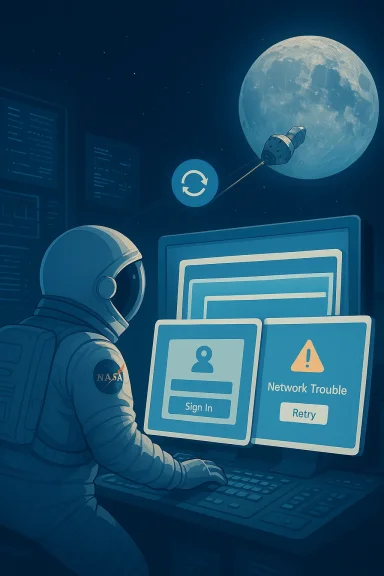
NASA’s Artemis II crew may be headed around the Moon, but even in 2026 the oldest rule of IT still applies: if something is broken, the first fix is often to turn it off and back on again. According to the live mission chatter that The Register highlighted, one astronaut reported network trouble and then said, “I have two Microsoft Outlooks, and neither one of those are working.” That line is funny because it is absurdly ordinary, and because it lands at the intersection of deep-space engineering and the everyday pain of enterprise software. It is also a reminder that the most ambitious missions on Earth still depend on the same digital plumbing, user interfaces, and support workflows as the rest of us.
The Artemis II mission is NASA’s first crewed flight of the Artemis program, and the agency has made clear that it is intended to send four astronauts on an approximately 10-day journey around the Moon before returning to Earth. NASA’s current mission materials describe Artemis II as a crucial test flight that will validate systems and hardware needed for future human lunar exploration, while also proving out the human-rated configuration of Orion and the Space Launch System. NASA’s own coverage pages say the mission is slated for April 2026, with live mission tracking and briefing coverage spread across YouTube and NASA’s other media channels.
What makes the Outlook anecdote so effective is that it compresses two truths into one joke. First, space missions are built on relentless systems engineering, not mystique; second, software still fails in ludicrously mundane ways, even when the surrounding platform is a spacecraft. NASA has been explicit that communications, voice, video, and mission data for Artemis II must traverse thousands of miles through the agency’s communications systems, including traditional radio support and the Orion Artemis II Optical Communications System. In other words, the mission is about cutting-edge space networking, but the crew still has to live with the practical realities of account configuration, connectivity, and application behavior.
The Register’s framing works because Outlook has become a cultural shorthand for workplace friction. Microsoft itself has spent the past two years pushing users toward the new Outlook for Windows, which it says became generally available in August 2024 and is now part of a gradual migration away from classic Outlook for many customers. Microsoft’s support pages also note that some accounts and features still differ between the classic and new experiences, which is another way of saying the product family remains in transition. That gives the “two Microsoft Outlooks” line an extra layer of accidental comedy: the astronaut was not only describing a software problem, but also a product category that many users already think is confusing.
There is a deeper point here, too. NASA’s communications and mission-control infrastructure is among the most sophisticated in the world, yet the crew still needs ordinary end-user software for daily coordination, messaging, and paperwork. Spaceflight has always been a mix of the extraordinary and the banal, and the banality matters because it is where human error, usability friction, and support processes usually show up. A mission can be designed to survive vacuum, radiation, and lunar flybys, yet still be vulnerable to the same category of problem that plagues any office: confusing account states, inconsistent network access, and the subtle difference between “installed” and “actually usable.”
That makes the Outlook story more than a gag. In a program defined by verification, any software issue becomes a miniature case study in how humans interact with systems under pressure. A spacecraft crew is not immune to the same time sink that hits a corporate employee staring at a spinning icon. If anything, the environment magnifies the cost of ambiguity, because support channels are slower, bandwidth is limited, and every operational task must be triaged around mission timelines.
This is why the joke resonates with engineers. They understand that user-facing applications are the tip of a much larger iceberg, and that a failure in a simple app can reflect anything from account provisioning to transient connectivity. In a mission context, that distinction is critical. A problem that sounds trivial may still need careful diagnosis, because the wrong assumption can waste time or obscure a broader comms issue. Simple symptoms rarely mean simple causes.
That transition is exactly why “I have two Microsoft Outlooks” is funny in a way only Windows users fully appreciate. The phrase suggests multiplicity, uncertainty, and version overlap — the same conditions many people face on a daily basis when one Outlook window opens, another sign-in flow appears, and a different mailbox behavior shows up depending on account type. Microsoft’s own feature comparison page underscores that the two experiences are not identical, and that feature support varies.
In the consumer world, this confusion becomes a meme because it is relatable. In enterprise settings, it becomes a help desk ticket. In mission operations, it becomes a reminder that software rationalization is hard even when the stakes are high. The same product family can present as two apps, two identities, or two user experiences, depending on who is signed in and which feature set is active. That is not a bug in the joke; it is the joke.
That backdrop matters because it shows how much infrastructure sits behind the astronaut’s complaint. The issue was not “space internet” in the abstract. It was likely a local or mission-specific usability problem occurring inside a communications regime designed to move data across vast distances, then compress and prioritize that data on the way back to Earth. If a crew member can’t get mail or network access, it is not because the Moon has weak Wi-Fi. It is because a very complicated chain of systems has to line up correctly.
But higher bandwidth does not automatically solve user-facing software problems. A spacecraft can have remarkable backhaul and still suffer from app-level authentication issues, synchronization lag, or account confusion. In that sense, the Outlook joke is a useful corrective to over-romanticized space coverage. Even the most advanced network is only as usable as the software sitting on top of it. The stack still has a top layer.
That is why the line became instantly shareable. It is technically a space story, but emotionally it is a workplace story. Anyone who has been told to “try restarting it” while staring at an app that refuses to cooperate will recognize the tone. The difference is that most of us are not calling Houston from a lunar mission while doing it. That little detail sharpens the absurdity.
NASA’s astronauts are not normal users, but their tooling is still part of the same universe of friction. If a support interaction starts with a network question and ends with “both Outlooks are broken,” the sequence is instantly recognizable to anyone who has lived through an enterprise software incident. That recognizability is what turned the moment into a joke. The laughter comes from identification, not from ignorance.
What matters is the difference between an isolated nuisance and mission impact. In the Artemis II case, the Outlook problem appears to have been a temporary operational issue rather than a safety concern. NASA has been clear that the mission’s flight systems, communications architecture, and command structures are built to support crewed lunar operations. A mail client failure is embarrassing, but it is not a spacecraft anomaly.
The result is a recurring pattern: the spacecraft is a marvel, the app is a nuisance, and the human being at the center of it all is just trying to get work done. That pattern has not changed much since the earliest days of crewed spaceflight. The difference now is that the jokes are routed through Microsoft products instead of mission-specific squawk boxes.
This matters because email is no longer just email. In many organizations, Outlook is the front end for identity, meeting coordination, calendaring, and workflow approval. When it misbehaves, users do not think “mail client issue”; they think “my day is broken.” On a spacecraft, the context is stranger, but the user psychology is the same.
The Artemis II anecdote also highlights how software reputations travel through culture. People outside the Microsoft ecosystem may not know the fine distinctions between classic Outlook and new Outlook, but they understand the basic idea of having two versions of the same thing and neither one cooperating. Once a product category becomes a punchline, every additional incident keeps the joke alive.
NASA’s own public communications reinforce that balance. The agency has leaned into live coverage, mission briefings, and multimedia storytelling so that the public can follow Artemis II in real time, including Orion views as bandwidth allows. That approach invites exactly this kind of incidental human moment into the broader public narrative. The agency gets the attention it wants, and the audience gets the reminder that astronauts are still people who wrestle with software.
That kind of relatability is valuable. It keeps space coverage from becoming sterile, and it gives journalists a clean entry point into deeper themes about reliability, support, and operational reality. In that sense, one small software complaint can do a lot of communicative work.
Microsoft, meanwhile, will continue the long migration between old and new Outlook experiences, and that process will keep generating edge cases, complaints, and moments of confusion. The more the company simplifies the story on paper, the more it will need to prove that the lived experience is similarly straightforward. Space or desktop, that is the same test.
Source: theregister.com NASA sends Outlook around Moon, immediately needs IT help
 Overview
The Artemis II mission is NASA’s first crewed flight of the Artemis program, and the agency has made clear that it is intended to send four astronauts on an approximately 10-day journey around the Moon before returning to Earth. NASA’s current mission materials describe Artemis II as a crucial test flight that will validate systems and hardware needed for future human lunar exploration, while also proving out the human-rated configuration of Orion and the Space Launch System. NASA’s own coverage pages say the mission is slated for April 2026, with live mission tracking and briefing coverage spread across YouTube and NASA’s other media channels.What makes the Outlook anecdote so effective is that it compresses two truths into one joke. First, space missions are built on relentless systems engineering, not mystique; second, software still fails in ludicrously mundane ways, even when the surrounding platform is a spacecraft. NASA has been explicit that communications, voice, video, and mission data for Artemis II must traverse thousands of miles through the agency’s communications systems, including traditional radio support and the Orion Artemis II Optical Communications System. In other words, the mission is about cutting-edge space networking, but the crew still has to live with the practical realities of account configuration, connectivity, and application behavior.
The Register’s framing works because Outlook has become a cultural shorthand for workplace friction. Microsoft itself has spent the past two years pushing users toward the new Outlook for Windows, which it says became generally available in August 2024 and is now part of a gradual migration away from classic Outlook for many customers. Microsoft’s support pages also note that some accounts and features still differ between the classic and new experiences, which is another way of saying the product family remains in transition. That gives the “two Microsoft Outlooks” line an extra layer of accidental comedy: the astronaut was not only describing a software problem, but also a product category that many users already think is confusing.
There is a deeper point here, too. NASA’s communications and mission-control infrastructure is among the most sophisticated in the world, yet the crew still needs ordinary end-user software for daily coordination, messaging, and paperwork. Spaceflight has always been a mix of the extraordinary and the banal, and the banality matters because it is where human error, usability friction, and support processes usually show up. A mission can be designed to survive vacuum, radiation, and lunar flybys, yet still be vulnerable to the same category of problem that plagues any office: confusing account states, inconsistent network access, and the subtle difference between “installed” and “actually usable.”
The Artemis II Mission Is Built on Reliability, Not Drama
Artemis II is not a stunt flight; it is a systems-validation mission. NASA has repeatedly described it as a roughly 10-day crewed journey around the Moon designed to prove out Orion’s life-support systems and other mission-critical hardware before deeper lunar operations begin. The agency’s launch pages and briefing materials emphasize that the mission is the first crewed test under Artemis, which gives it a very specific role: reduce uncertainty, surface failures early, and build confidence in the path to sustained lunar exploration.That makes the Outlook story more than a gag. In a program defined by verification, any software issue becomes a miniature case study in how humans interact with systems under pressure. A spacecraft crew is not immune to the same time sink that hits a corporate employee staring at a spinning icon. If anything, the environment magnifies the cost of ambiguity, because support channels are slower, bandwidth is limited, and every operational task must be triaged around mission timelines.
Why mundane software matters in a lunar mission
A modern crewed spacecraft is not just propulsion and life support. It is also a digital workplace with mail, communications, document handling, telemetry displays, and support utilities. That means the astronaut experience is shaped by the same logic that governs enterprise IT on Earth: identity, synchronization, network reachability, device state, and service availability. When one of those layers fails, the visible symptom is often just “Outlook doesn’t open” or “mail won’t sync,” even if the root cause lives much deeper in the stack.This is why the joke resonates with engineers. They understand that user-facing applications are the tip of a much larger iceberg, and that a failure in a simple app can reflect anything from account provisioning to transient connectivity. In a mission context, that distinction is critical. A problem that sounds trivial may still need careful diagnosis, because the wrong assumption can waste time or obscure a broader comms issue. Simple symptoms rarely mean simple causes.
- Artemis II is a validation mission, not a demonstration flight for public amusement.
- NASA’s comms architecture has to support crew voice, video, and mission data.
- User applications still depend on account and network state.
- A visible app failure may be a symptom rather than the actual fault.
- The support process matters as much as the software itself.
Outlook’s Identity Crisis Keeps Fueling the Joke
Microsoft has made Outlook a moving target. Its support documentation says new Outlook for Windows has been generally available since August 2024 and explains that users may switch from classic Outlook via the in-app toggle when their accounts are supported. Microsoft also notes that some customers can still encounter restrictions, and that the company is continuing a staged migration across personal and business users.That transition is exactly why “I have two Microsoft Outlooks” is funny in a way only Windows users fully appreciate. The phrase suggests multiplicity, uncertainty, and version overlap — the same conditions many people face on a daily basis when one Outlook window opens, another sign-in flow appears, and a different mailbox behavior shows up depending on account type. Microsoft’s own feature comparison page underscores that the two experiences are not identical, and that feature support varies.
The classic-versus-new problem
The classic-versus-new split is not just branding. It affects workflow, compatibility, and user expectations. Microsoft’s support articles describe the new Outlook as the modern default for many users while still acknowledging practical differences, including account support limitations and feature variation. That means “which Outlook am I actually using?” is a real question, not an academic one. For a user in low Earth orbit, that ambiguity is not charming; it is operational noise.In the consumer world, this confusion becomes a meme because it is relatable. In enterprise settings, it becomes a help desk ticket. In mission operations, it becomes a reminder that software rationalization is hard even when the stakes are high. The same product family can present as two apps, two identities, or two user experiences, depending on who is signed in and which feature set is active. That is not a bug in the joke; it is the joke.
- Outlook naming and migration have been confusing for many users.
- Microsoft is actively steering customers toward new Outlook for Windows.
- Feature gaps and account support differences still exist.
- The “two Outlooks” problem is culturally familiar for Windows users.
- Product transitions can create support friction even when the underlying platform is stable.
NASA’s Communications Stack Is More Impressive Than the Meme
NASA’s published Artemis II communications material makes clear that the mission’s networking environment is far from ordinary. The agency says Orion will carry the Orion Artemis II Optical Communications System, a laser communications terminal intended to transmit science and crew data over infrared links, alongside traditional radio support. NASA also says that during part of the mission the spacecraft will experience a planned communications blackout of roughly 41 minutes while passing behind the Moon.That backdrop matters because it shows how much infrastructure sits behind the astronaut’s complaint. The issue was not “space internet” in the abstract. It was likely a local or mission-specific usability problem occurring inside a communications regime designed to move data across vast distances, then compress and prioritize that data on the way back to Earth. If a crew member can’t get mail or network access, it is not because the Moon has weak Wi-Fi. It is because a very complicated chain of systems has to line up correctly.
Deep-space networking is not consumer broadband
NASA’s communications architecture for Artemis is explicitly engineered for resilience, redundancy, and mission continuity. That includes radio frequency links, the Deep Space Network, and optical communications demonstrations that are meant to increase bandwidth for future missions. NASA says laser communications can carry more data than comparable radio networks and that the Artemis II optical terminal could help pave the way for future lunar and Mars communications.But higher bandwidth does not automatically solve user-facing software problems. A spacecraft can have remarkable backhaul and still suffer from app-level authentication issues, synchronization lag, or account confusion. In that sense, the Outlook joke is a useful corrective to over-romanticized space coverage. Even the most advanced network is only as usable as the software sitting on top of it. The stack still has a top layer.
- Artemis II uses both radio and optical communications technologies.
- NASA expects brief lunar communications blackouts as part of the mission profile.
- Mission data is prioritized and compressed after reaching Earth.
- App-level problems can exist even in highly advanced networks.
- The crew’s day-to-day tools still rely on ordinary software logic.
Why the Crew’s Complaint Hits So Close to Home
Most Windows users do not need to imagine life aboard Orion to understand the frustration of “two Outlooks, neither working.” It sounds like the sort of problem that appears after an update, a profile migration, a corrupted cache, or a sign-in state mismatch. Microsoft’s own support materials around new Outlook emphasize switching behavior and account eligibility, which confirms that even a normal desktop user can end up with multiple Outlook experiences depending on what was installed and how accounts were configured.That is why the line became instantly shareable. It is technically a space story, but emotionally it is a workplace story. Anyone who has been told to “try restarting it” while staring at an app that refuses to cooperate will recognize the tone. The difference is that most of us are not calling Houston from a lunar mission while doing it. That little detail sharpens the absurdity.
The universal language of helpdesk pain
The most effective jokes usually rely on shared experience, and Outlook is one of the most widely shared pain points in modern computing. It sits at the junction of email, calendar, identity, and organizational policy, which means it can fail in ways that feel both technical and administrative. If a user has multiple accounts, multiple versions, or multiple policies in play, the result often looks like chaos even when the system is behaving exactly as designed.NASA’s astronauts are not normal users, but their tooling is still part of the same universe of friction. If a support interaction starts with a network question and ends with “both Outlooks are broken,” the sequence is instantly recognizable to anyone who has lived through an enterprise software incident. That recognizability is what turned the moment into a joke. The laughter comes from identification, not from ignorance.
- Email clients often fail in ways that feel bigger than the root cause.
- Multiple accounts can create contradictory app states.
- Calendar and mail tooling are central to mission and office coordination.
- Restarting a device remains an iconic first troubleshooting step.
- The joke works because it mirrors real user experience.
Space History Is Full of Mundane Software Failures
There is precedent for all of this. NASA and other space agencies have long dealt with software that behaves badly under mission conditions. The Register’s piece nods to the International Space Station era, when first ISS commander Bill Shepherd reportedly complained about repeated failures with an application called “Crew Squawk,” which was used to log comments and complaints. The broader lesson is not that space software is fragile in a sensational way; it is that any software used by humans under operational pressure will eventually reveal its rough edges.What matters is the difference between an isolated nuisance and mission impact. In the Artemis II case, the Outlook problem appears to have been a temporary operational issue rather than a safety concern. NASA has been clear that the mission’s flight systems, communications architecture, and command structures are built to support crewed lunar operations. A mail client failure is embarrassing, but it is not a spacecraft anomaly.
The old lesson: space is hard, software is harder
A long tradition in human spaceflight says that the environment is unforgiving, but software is where the edge cases pile up. Crew interfaces must be simple enough for rapid use, yet powerful enough to support complex operations. That tension creates room for tiny failures to feel disproportionately large, because astronauts have less tolerance for delay and fewer fallback paths than office workers do.The result is a recurring pattern: the spacecraft is a marvel, the app is a nuisance, and the human being at the center of it all is just trying to get work done. That pattern has not changed much since the earliest days of crewed spaceflight. The difference now is that the jokes are routed through Microsoft products instead of mission-specific squawk boxes.
- Space programs have always depended on software reliability.
- Human factors matter as much as hardware performance.
- Operational nuisance can look dramatic even when it is not dangerous.
- Mission crews rely on practical internal tools, not only flight systems.
- The underlying problem is often supportability, not spectacle.
The Enterprise Lesson for Microsoft Is Uncomfortable
For Microsoft, the Artemis II joke is harmless on the surface, but it lands in a sensitive area: public perception of Outlook reliability. The company is already in the middle of a product transition, and its own support pages show that it is actively guiding users toward the new Outlook experience while managing exceptions, feature gaps, and migration differences. That means any story involving “two Outlooks” reinforces an existing narrative of confusion, not a fresh one.This matters because email is no longer just email. In many organizations, Outlook is the front end for identity, meeting coordination, calendaring, and workflow approval. When it misbehaves, users do not think “mail client issue”; they think “my day is broken.” On a spacecraft, the context is stranger, but the user psychology is the same.
Consumer trust versus enterprise dependence
Consumer users can tolerate some confusion as long as the app eventually works. Enterprises, by contrast, care about predictability, compatibility, and admin control. Microsoft’s migration strategy for new Outlook attempts to balance modernization against continuity, but that balancing act is inherently messy because it asks users to trust a transition while still depending on the old system. That is a difficult sales pitch in any environment.The Artemis II anecdote also highlights how software reputations travel through culture. People outside the Microsoft ecosystem may not know the fine distinctions between classic Outlook and new Outlook, but they understand the basic idea of having two versions of the same thing and neither one cooperating. Once a product category becomes a punchline, every additional incident keeps the joke alive.
- Outlook remains central to enterprise productivity.
- Migration between classic and new Outlook creates friction.
- Support trust depends on predictable behavior.
- Public jokes can reinforce existing brand perceptions.
- User confidence is often shaped by everyday failure modes.
The Space Community Has Its Own Pragmatic Humor
Spaceflight culture has always mixed awe with self-deprecation. Engineers, flight controllers, and astronauts know that the only way to stay sane around high-stakes systems is to laugh at the small things without losing respect for the big ones. The Outlook incident fits that tradition perfectly: it is funny precisely because everyone in the chain still did the serious work. The joke does not undermine the mission; it humanizes it.NASA’s own public communications reinforce that balance. The agency has leaned into live coverage, mission briefings, and multimedia storytelling so that the public can follow Artemis II in real time, including Orion views as bandwidth allows. That approach invites exactly this kind of incidental human moment into the broader public narrative. The agency gets the attention it wants, and the audience gets the reminder that astronauts are still people who wrestle with software.
Why human moments matter in mission coverage
High-profile missions are easier to connect with when they include friction. Perfect telemetry and polished narration are informative, but they can feel abstract. A line about Outlook, by contrast, collapses the distance between the public and the crew. It says: these are professionals, but they are still doing office work in an impossible place.That kind of relatability is valuable. It keeps space coverage from becoming sterile, and it gives journalists a clean entry point into deeper themes about reliability, support, and operational reality. In that sense, one small software complaint can do a lot of communicative work.
- Humor makes complex missions more accessible to the public.
- Astronauts are supported by real people solving real problems.
- Incident-level anecdotes can humanize technical coverage.
- Public engagement benefits from recognizable everyday frustration.
- Mission storytelling works best when it includes lived experience.
Strengths and Opportunities
The obvious strength of this moment is that it makes a highly technical mission instantly relatable, which can deepen public interest in Artemis II without cheapening the science. It also gives Microsoft an accidental reminder that product naming, migration strategy, and support clarity matter as much as feature lists. More broadly, it underscores that even the most advanced systems still depend on boring, ordinary software layers.- The story is highly relatable to non-specialists.
- It reinforces public interest in Artemis II.
- It highlights the importance of software usability in mission systems.
- It gives Microsoft a real-world example of user confusion.
- It shows how humor can improve science communication.
- It demonstrates that operational transparency can build trust.
- It reminds enterprise IT teams that clear transitions matter.
Risks and Concerns
The downside is that jokes can harden into reputation, especially when they reinforce a preexisting narrative about complexity or confusion. For Microsoft, “two Outlooks” is funny once; repeated often enough, it becomes shorthand for product incoherence. For NASA, the risk is more subtle: public audiences can over-index on a trivial app issue and miss the fact that the mission itself is executing serious, high-value work.- The joke could reinforce negative perceptions of Outlook.
- Simplified coverage can obscure mission significance.
- Public audiences may misunderstand the severity of the problem.
- Product-transition confusion can erode user confidence.
- Media shorthand can overemphasize novelty over substance.
- Any failure story in space can invite exaggerated conclusions.
- Routine troubleshooting may look worse when quoted out of context.
Looking Ahead
The real story is not whether Outlook misbehaved for a few minutes in space. It is whether Artemis II continues to demonstrate that NASA’s crewed lunar architecture can handle the ugly, real-world mix of operations, communications, and human workflow that any long-duration mission requires. That includes the ability to solve ordinary software problems quickly, without distracting from the larger mission.Microsoft, meanwhile, will continue the long migration between old and new Outlook experiences, and that process will keep generating edge cases, complaints, and moments of confusion. The more the company simplifies the story on paper, the more it will need to prove that the lived experience is similarly straightforward. Space or desktop, that is the same test.
Key things to watch
- Whether NASA’s Artemis II communications remain stable through the rest of the mission.
- How often mission coverage surfaces ordinary software or workflow issues.
- Whether Microsoft’s new Outlook transition reduces or increases user confusion.
- How enterprise customers react to continued product overlap.
- Whether public commentary around Artemis II stays focused on mission success.
- How much the astronaut anecdote amplifies debate about Outlook’s usability.
- Whether NASA continues to foreground crewed mission transparency through live coverage.
Source: theregister.com NASA sends Outlook around Moon, immediately needs IT help

