

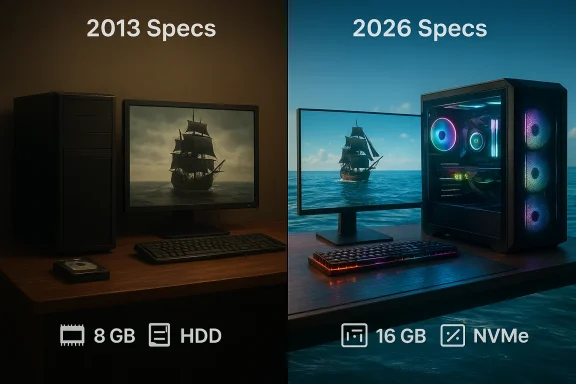
Black Flag has always been one of the most beloved Assassin’s Creed games, but Ubisoft’s new remake makes one thing painfully clear: PC gaming has changed beyond recognition in just 13 years. What once passed for a demanding release in 2013 now looks modest beside a 2026 remake that expects ray tracing, SSD storage, and hardware generations that barely existed when Edward Kenway first sailed the Caribbean. The contrast is not just about prettier water or shinier lighting; it is about how quickly the PC baseline has moved, and how aggressively publishers now target features that were once aspirational.
Ubisoft’s Assassin’s Creed Black Flag Resynced is scheduled for July 9, 2026, and the company is presenting it as a faithful recreation of the 2013 classic built on the latest version of the Anvil Engine. The official messaging emphasizes new content, visual upgrades, and a modernized technical foundation, with Ubisoft Singapore leading the project and original developers returning to help shape the experience
What makes the announcement interesting is not simply that a remake exists. It is that Ubisoft has published system requirements that read like a live demonstration of how much PC gaming has advanced since Black Flag first launched in November 2013. The original game was designed around 2GB of RAM, 30GB of storage, and graphics cards that predate the modern ray-tracing era by many years. The remake, by contrast, assumes 16GB of RAM, an SSD, Windows 10 or 11, and GPUs ranging from the GTX 1660 class at minimum to the RTX 4090 or RX 7900 XTX for 4K ultra settings
That gap tells a larger story about the state of PC gaming in 2026. The last decade and a half has brought real-time upscaling, frame generation, faster NVMe storage, more capable CPUs, and physically based rendering pipelines that make older games look and feel like they belong to another era. Some of that progress is invisible to players when everything works. But the Black Flag remake makes it impossible to ignore because the hardware delta is so stark.
It is also a reminder that “remake” no longer means the same thing it did in the past. A remake used to imply improved textures, widescreen support, and maybe a few quality-of-life changes. Today it can mean rebuilt lighting, water simulation, new quests, new combat tuning, and a target audience split between longtime fans on older rigs and enthusiasts chasing 4K60 with full modern effects enabled
The old PC requirements look almost comically small now. Ubisoft listed a Core 2 Quad Q8400 or Athlon II X4 620 for minimum CPU performance, 2GB of RAM, and 30GB of storage, with a GeForce GTX 470 or Radeon HD 5850 recommended for smoother play. Those were respectable specs in their day, but they belonged to a period before SSDs became standard, before upscaling was a mainstream feature, and before hardware-accelerated ray tracing was part of the conversation
By contrast, Resynced is built around a different philosophy. Ubisoft says it has rebuilt the game on the latest evolution of Anvil, added raytraced lighting with global illumination and reflections, modernized water rendering, and redesigned core assets around a micropolygon and physically based rendering pipeline. That means this is not just a texture pass or a resolution bump. It is a complete technical re-authoring aimed at current-gen hardware and current expectations
The result is a useful snapshot of where the industry has gone. In 2013, a player could reasonably ask, “Can my PC run it at 30 or 60 FPS?” In 2026, the question becomes more layered: can your machine handle the preset, the upscaler mode, the ray tracing setting, the storage requirement, and the resolution target all at once? That shift is central to the modern PC experience, and Black Flag Resynced illustrates it better than most releases.
A remake like this also preserves one of Ubisoft’s most commercially recognizable worlds. Black Flag’s pirate setting has lasting appeal, and revisiting it with modern rendering and animation systems gives the publisher an opportunity to repackage a fan favorite for players who missed it the first time. That is especially relevant now that subscription services and digital storefronts keep older games in circulation, even as their underlying technology ages.
The GPU leap is even more telling. A GTX 1660 at minimum and an RTX 4090 for ultra 4K are not symmetrical choices; they map to entirely different eras of rendering design. When a remake leans on ray tracing and modern lighting models, it is effectively asking the player’s hardware to do work that the original game never imagined.
That is a dramatic difference from the 2013 version, which could run on CPUs that were already old when the game launched. The original recommended processor list included a Core i5-2400S or Phenom II X4 940, while the minimum graphics cards were as low as a Radeon HD 4870 or GeForce GTX 260 family part. Even the game’s memory requirement was just 2GB, which feels almost quaint by today’s standards
The important takeaway is that the remake does not merely “look better.” It is built for a different performance envelope. If you want the modern version of Black Flag to feel native to 2026, you need hardware that can support higher texture density, more complex shadows, heavier post-processing, and the overhead of ray-traced illumination. This is a design choice, not an accident.
The tiering matters because it reveals that the game is not designed around one “correct” experience. Instead, it is being tuned for a ladder of acceptable outcomes, each one shaped by the player’s hardware budget. That is a very modern approach, and it also highlights how much configuration complexity PC gaming has absorbed over time.
That change is a direct sign of the industry’s shift toward mixed rendering strategies. Native resolution is still important, but many modern games are calibrated around upscalers as a first-class feature. For PC players, that can be a blessing when performance is tight and a frustration when image quality depends too heavily on reconstruction.
The biggest technical headline is ray tracing. Ubisoft highlights raytraced global illumination and reflections, which immediately raises the GPU cost of the game. GI is one of the most visually dramatic upgrades a remake can get, but it also tends to be among the most expensive features to compute. This is why the same game can feel like two different products depending on whether ray tracing is enabled.
Water simulation is another subtle but important sign of ambition. Black Flag is a game where the ocean is not background scenery; it is one of the defining features of the experience. Modernized water rendering changes not only visual fidelity but also the perception of motion, weather, and scale. For a pirate game, that matters immensely.
That alignment has strategic value. It creates a more coherent internal pipeline, makes asset reuse more plausible, and helps the publisher establish a consistent look across its flagship franchise. The downside is that any new engine baseline can push older hardware out of the comfort zone, especially when features like RTGI are treated as standard rather than optional embellishments.
The fact that the original game is still accessible through services such as Ubisoft+ Classics, Game Pass, and PlayStation Plus Extra also changes the economic backdrop. When an older game remains available through subscriptions, a remake must justify itself with more than nostalgia. It has to earn its place by delivering technical improvements, new content, or a meaningfully different feel.
That dual availability can be healthy. It gives players choice, and it preserves the older design for people who prefer the original controls and pacing. It also creates a natural comparison point for modernized combat systems, new lighting, and revised mission flow.
For longtime fans, that can be a mixed blessing. Better responsiveness and smoother traversal are welcome, but altered timing can make a beloved game feel strange for several hours. Familiarity is one of the most underestimated assets in any remake.
That balancing act is the heart of every remake debate. Ubisoft appears to be betting that Black Flag’s core fantasy is strong enough to survive a thorough technical rebuild, even if some of the tactile feel changes in the process.
There is also a cultural shift embedded in these numbers. In 2013, a mid-range PC could often play the latest blockbuster at a respectable setting. In 2026, “mid-range” means something very different, and publishers increasingly design around the idea that players will rely on upscalers, frame generation, or carefully chosen presets to reach target frame rates.
That does not mean PC gaming has become worse. It means the ceiling has risen sharply, and so has the complexity. The average player now has access to spectacular image quality that would have seemed impossible a decade ago. But the tradeoff is that hardware choices matter more than ever.
There is a network effect here. When major publishers normalize advanced features, they nudge the entire market toward those baselines. That helps move the ecosystem forward, but it also risks widening the gap between enthusiast-grade and budget-conscious PC setups.
The timing is also notable. The industry has spent several years leaning on remasters, director’s editions, and rebuilds of classic titles because they are lower-risk than entirely new IP. A successful Black Flag remake could encourage even more publishers to revisit beloved games from the PS3 and Xbox 360 era, especially those with strong visual identities and a proven fan base.
It also raises the bar for rivals. If Ubisoft can convincingly justify a full rebuild of a 2013 game with new lighting, new content, and modern systems, then future remakes from other publishers will be measured against that template. Players now expect a remake to feel like a present-day release, not a museum piece with prettier shaders.
There is also a broader industry lesson here. As PC gaming continues to evolve, the definition of “standard” hardware keeps shifting upward. A game like Black Flag Resynced reminds us that the gap between the software of 2013 and the expectations of 2026 is not a small step; it is an entire generational leap. That is thrilling for enthusiasts, but it can be intimidating for everyone else.
Source: htxt.co.za Black Flag Resynced shows just how crazy PC gaming has become - Hypertext
 Overview
Ubisoft’s Assassin’s Creed Black Flag Resynced is scheduled for July 9, 2026, and the company is presenting it as a faithful recreation of the 2013 classic built on the latest version of the Anvil Engine. The official messaging emphasizes new content, visual upgrades, and a modernized technical foundation, with Ubisoft Singapore leading the project and original developers returning to help shape the experienceWhat makes the announcement interesting is not simply that a remake exists. It is that Ubisoft has published system requirements that read like a live demonstration of how much PC gaming has advanced since Black Flag first launched in November 2013. The original game was designed around 2GB of RAM, 30GB of storage, and graphics cards that predate the modern ray-tracing era by many years. The remake, by contrast, assumes 16GB of RAM, an SSD, Windows 10 or 11, and GPUs ranging from the GTX 1660 class at minimum to the RTX 4090 or RX 7900 XTX for 4K ultra settings
That gap tells a larger story about the state of PC gaming in 2026. The last decade and a half has brought real-time upscaling, frame generation, faster NVMe storage, more capable CPUs, and physically based rendering pipelines that make older games look and feel like they belong to another era. Some of that progress is invisible to players when everything works. But the Black Flag remake makes it impossible to ignore because the hardware delta is so stark.
It is also a reminder that “remake” no longer means the same thing it did in the past. A remake used to imply improved textures, widescreen support, and maybe a few quality-of-life changes. Today it can mean rebuilt lighting, water simulation, new quests, new combat tuning, and a target audience split between longtime fans on older rigs and enthusiasts chasing 4K60 with full modern effects enabled
Background
The original Assassin’s Creed IV: Black Flag arrived in 2013 and quickly became one of Ubisoft’s most celebrated entries. It leaned into naval exploration, pirate fantasy, and a more freewheeling tone than many other Assassin’s Creed games, which helped it stand out even among a crowded action-adventure field. Ubisoft’s store still lists the game as a 2013 release, underlining just how long ago the original version debutedThe old PC requirements look almost comically small now. Ubisoft listed a Core 2 Quad Q8400 or Athlon II X4 620 for minimum CPU performance, 2GB of RAM, and 30GB of storage, with a GeForce GTX 470 or Radeon HD 5850 recommended for smoother play. Those were respectable specs in their day, but they belonged to a period before SSDs became standard, before upscaling was a mainstream feature, and before hardware-accelerated ray tracing was part of the conversation
By contrast, Resynced is built around a different philosophy. Ubisoft says it has rebuilt the game on the latest evolution of Anvil, added raytraced lighting with global illumination and reflections, modernized water rendering, and redesigned core assets around a micropolygon and physically based rendering pipeline. That means this is not just a texture pass or a resolution bump. It is a complete technical re-authoring aimed at current-gen hardware and current expectations
The result is a useful snapshot of where the industry has gone. In 2013, a player could reasonably ask, “Can my PC run it at 30 or 60 FPS?” In 2026, the question becomes more layered: can your machine handle the preset, the upscaler mode, the ray tracing setting, the storage requirement, and the resolution target all at once? That shift is central to the modern PC experience, and Black Flag Resynced illustrates it better than most releases.
Why the remake matters
The game is not being revived just because nostalgia sells. It is being rebuilt because modern audiences expect richer worlds, better image quality, and smoother performance across a wider range of hardware. Ubisoft is also clearly positioning Resynced as a prestige release inside the Assassin’s Creed brand, not merely a side project or anniversary cash-inA remake like this also preserves one of Ubisoft’s most commercially recognizable worlds. Black Flag’s pirate setting has lasting appeal, and revisiting it with modern rendering and animation systems gives the publisher an opportunity to repackage a fan favorite for players who missed it the first time. That is especially relevant now that subscription services and digital storefronts keep older games in circulation, even as their underlying technology ages.
Why PC requirements tell the story
Hardware requirements are often treated as boring boilerplate, but they are one of the clearest signals of how a game has been built. The jump from 2GB to 16GB of RAM is not just numerical inflation; it reflects changes in asset density, background streaming, animation complexity, and system overhead. The shift from HDD-era assumptions to mandatory SSD use reflects how much more data modern games push at runtime.The GPU leap is even more telling. A GTX 1660 at minimum and an RTX 4090 for ultra 4K are not symmetrical choices; they map to entirely different eras of rendering design. When a remake leans on ray tracing and modern lighting models, it is effectively asking the player’s hardware to do work that the original game never imagined.
The PC Spec Gap
The most eye-catching aspect of the new requirements is just how much the minimum bar has risen. Ubisoft says the game needs an i7-8700K or Ryzen 5 3600 at minimum, paired with a GTX 1660, RX 5500 XT, or Arc A580, plus 16GB of dual-channel memory and an SSD. For 4K/60 at ultra settings, the target jumps to an i7-12700K or Ryzen 7 5700X3D and either an RTX 4090 or RX 7900 XTXThat is a dramatic difference from the 2013 version, which could run on CPUs that were already old when the game launched. The original recommended processor list included a Core i5-2400S or Phenom II X4 940, while the minimum graphics cards were as low as a Radeon HD 4870 or GeForce GTX 260 family part. Even the game’s memory requirement was just 2GB, which feels almost quaint by today’s standards
The important takeaway is that the remake does not merely “look better.” It is built for a different performance envelope. If you want the modern version of Black Flag to feel native to 2026, you need hardware that can support higher texture density, more complex shadows, heavier post-processing, and the overhead of ray-traced illumination. This is a design choice, not an accident.
Minimum, recommended, high, ultra
Ubisoft’s tiered specs are a tidy lesson in how publishers now think about player segmentation. The minimum target is 1080p at 30 FPS on low settings, while the recommended tier is 1080p at 60 FPS on medium settings. The high tier aims for 1440p at 60 FPS, and ultra pushes toward 4K at 60 FPS with the strongest visual preset availableThe tiering matters because it reveals that the game is not designed around one “correct” experience. Instead, it is being tuned for a ladder of acceptable outcomes, each one shaped by the player’s hardware budget. That is a very modern approach, and it also highlights how much configuration complexity PC gaming has absorbed over time.
- Minimum now means playable, not merely functional.
- Recommended is the new “good enough” baseline.
- High is where many enthusiasts used to aim by default.
- Ultra has become a prestige mode rather than the practical norm.
- SSD required is no longer a luxury feature.
- 16GB RAM is now treated as the floor for serious releases.
- Ray tracing has become a mainstream checkbox rather than a tech demo novelty.
The role of upscaling
Ubisoft also specifies upscaler presets alongside its resolution targets, with Balanced for the lower tiers and Quality for the higher ones. That is important because it shows how standard upscaling has become in modern rendering pipelines. Players are not just choosing raw resolution anymore; they are selecting how the game reconstructs image quality from a lower internal render target.That change is a direct sign of the industry’s shift toward mixed rendering strategies. Native resolution is still important, but many modern games are calibrated around upscalers as a first-class feature. For PC players, that can be a blessing when performance is tight and a frustration when image quality depends too heavily on reconstruction.
The Technology Behind the Upgrade
Ubisoft says Resynced is built on the latest version of Anvil, and that alone explains much of the system requirement leap. Engines evolve in tandem with hardware generations, and once a project is rebuilt on a newer foundation, the assumptions about rendering, asset streaming, and animation all shift. What ran comfortably on 2013-era hardware may no longer be a realistic target once modern lighting and simulation features are part of the designThe biggest technical headline is ray tracing. Ubisoft highlights raytraced global illumination and reflections, which immediately raises the GPU cost of the game. GI is one of the most visually dramatic upgrades a remake can get, but it also tends to be among the most expensive features to compute. This is why the same game can feel like two different products depending on whether ray tracing is enabled.
Water simulation is another subtle but important sign of ambition. Black Flag is a game where the ocean is not background scenery; it is one of the defining features of the experience. Modernized water rendering changes not only visual fidelity but also the perception of motion, weather, and scale. For a pirate game, that matters immensely.
Why Anvil matters
Anvil is more than a brand name here. It is Ubisoft’s current technical backbone, and using the latest version of that engine means the remake can benefit from the company’s newer toolchain, workflows, and rendering paths. It also means the project is likely designed to align visually and structurally with Ubisoft’s other recent Assassin’s Creed work rather than the older generation of titles.That alignment has strategic value. It creates a more coherent internal pipeline, makes asset reuse more plausible, and helps the publisher establish a consistent look across its flagship franchise. The downside is that any new engine baseline can push older hardware out of the comfort zone, especially when features like RTGI are treated as standard rather than optional embellishments.
What changed from the original
The original Black Flag was impressive for 2013, but it lived in a much simpler rendering era. Its job was to deliver a convincing open world, strong naval combat, and a memorable story within the constraints of the time. Resynced is trying to do that again, but with an expectation of richer materials, denser environments, more realistic lighting, and a more cinematic presentation.- Old Black Flag focused on scale and pacing.
- Resynced focuses on image fidelity and systemic polish.
- 2013 hardware was measured in megabytes and modest core counts.
- 2026 hardware is measured in ray tracing throughput and high-bandwidth storage.
- Texture and shading quality are now designed to hold up at 4K and beyond.
Why the Original Still Matters
One of the more interesting aspects of Ubisoft’s remake strategy is that the original game remains available. That matters because it prevents Resynced from replacing Black Flag outright. Instead, players can compare two eras of design side by side, which turns the remake into a kind of living benchmark for how much PC gaming has changedThe fact that the original game is still accessible through services such as Ubisoft+ Classics, Game Pass, and PlayStation Plus Extra also changes the economic backdrop. When an older game remains available through subscriptions, a remake must justify itself with more than nostalgia. It has to earn its place by delivering technical improvements, new content, or a meaningfully different feel.
That dual availability can be healthy. It gives players choice, and it preserves the older design for people who prefer the original controls and pacing. It also creates a natural comparison point for modernized combat systems, new lighting, and revised mission flow.
Controls and expectations
Ubisoft says controls in the remake will be different from the older version, and that is likely to matter more than casual observers think. In a remake of this kind, “better” controls are not always the same as “familiar” controls. Modern Assassin’s Creed systems tend to be more fluid, more contextual, and more animation-driven than the more rigid mechanics of older entries.For longtime fans, that can be a mixed blessing. Better responsiveness and smoother traversal are welcome, but altered timing can make a beloved game feel strange for several hours. Familiarity is one of the most underestimated assets in any remake.
Preservation versus reinvention
There is always tension between preserving a classic and modernizing it. The original Black Flag’s charm came partly from its identity as a product of its era. If Resynced becomes too slick or too systemically different, it risks losing the rough edges that made the old game memorable. If it stays too close to the old design, it may feel outdated next to modern expectations.That balancing act is the heart of every remake debate. Ubisoft appears to be betting that Black Flag’s core fantasy is strong enough to survive a thorough technical rebuild, even if some of the tactile feel changes in the process.
What the Specs Say About PC Gaming
The PC requirements for Resynced are almost more revealing than the game itself. They show a platform that has grown more capable, but also more demanding. The days of one-size-fits-all settings are long gone. Today, the experience of playing a game often depends on whether your system can support the right combination of CPU throughput, GPU features, storage speed, and memory capacityThere is also a cultural shift embedded in these numbers. In 2013, a mid-range PC could often play the latest blockbuster at a respectable setting. In 2026, “mid-range” means something very different, and publishers increasingly design around the idea that players will rely on upscalers, frame generation, or carefully chosen presets to reach target frame rates.
That does not mean PC gaming has become worse. It means the ceiling has risen sharply, and so has the complexity. The average player now has access to spectacular image quality that would have seemed impossible a decade ago. But the tradeoff is that hardware choices matter more than ever.
Consumer impact
For consumers, the upside is obvious. A game like Resynced can offer a much richer visual experience than the original ever could, with lighting and environmental detail that better suit the pirate fantasy. The downside is that newer features can make budget systems feel increasingly strained, even when those systems are still perfectly capable of handling most current games.- Better image quality comes with higher hardware costs.
- The performance conversation now includes upscalers and presets.
- Old “good enough” rigs are aging out faster.
- Storage upgrades are becoming mandatory rather than optional.
- Higher fidelity raises expectations for all future remakes.
Enterprise and ecosystem impact
For the broader ecosystem, these requirements also signal how much the industry depends on hardware vendors and software stack coordination. GPU makers want games to showcase their newest features. CPU vendors want their latest chips to appear in recommended lists. Storage vendors benefit when SSD use becomes a hard requirement. That makes big remakes useful not only as entertainment products but as de facto technology showcases.There is a network effect here. When major publishers normalize advanced features, they nudge the entire market toward those baselines. That helps move the ecosystem forward, but it also risks widening the gap between enthusiast-grade and budget-conscious PC setups.
Market Implications
Assassin’s Creed is one of Ubisoft’s most important brands, so the remake’s launch strategy matters beyond one game. By tying Black Flag Resynced to a premium visual overhaul, the publisher is signaling confidence that nostalgia-driven remakes can still be major commercial events when they are packaged as technical upgrades rather than simple rereleasesThe timing is also notable. The industry has spent several years leaning on remasters, director’s editions, and rebuilds of classic titles because they are lower-risk than entirely new IP. A successful Black Flag remake could encourage even more publishers to revisit beloved games from the PS3 and Xbox 360 era, especially those with strong visual identities and a proven fan base.
It also raises the bar for rivals. If Ubisoft can convincingly justify a full rebuild of a 2013 game with new lighting, new content, and modern systems, then future remakes from other publishers will be measured against that template. Players now expect a remake to feel like a present-day release, not a museum piece with prettier shaders.
Competitive pressure
Competition in this space is not just about sales. It is about perception. A remake that lands well can reinforce a publisher’s reputation for care and ambition. A remake that feels skimpy or overly monetized can damage trust, especially when players know the original is still available elsewhere. That makes execution unusually important.Business logic behind the remake
There is also a simple business reason for doing this now. Black Flag remains one of the most recognizable Assassin’s Creed entries, and its pirate theme has enduring appeal. Revisiting it in a modern engine allows Ubisoft to monetize nostalgia while keeping the brand active between larger franchise releases. That is a very Ubisoft move, but it is also a very industry-wide one.Strengths and Opportunities
Black Flag Resynced has several clear advantages. It combines a beloved setting, a technically ambitious rebuild, and a hardware story that is easy to understand even for non-enthusiasts. The remake could become a showcase for what modern PC and console hardware can do when a publisher is willing to rebuild rather than merely remaster.- The pirate fantasy remains one of Assassin’s Creed’s strongest hooks.
- Ray tracing and modern rendering should make the Caribbean world look dramatically richer.
- The original game’s reputation gives the remake instant recognition.
- The tiered PC specs make the game accessible to a wide range of systems.
- The continued availability of the original supports comparison and preserves choice.
- New content gives longtime fans more than a simple visual upgrade.
- The release can help Ubisoft reinforce confidence in the Anvil engine.
Risks and Concerns
The biggest risk is that modernizing the game too aggressively could flatten some of the character that made Black Flag special. There is also the danger that the new technical baseline will create frustration for players who want the remake’s visuals but do not have the hardware to sustain them smoothly. That tension is the whole challenge of modern remakes.- Higher requirements may exclude many older but still capable PCs.
- Ray tracing could become a performance burden rather than a visual win for some players.
- Control changes may alienate fans of the original combat and traversal feel.
- New content could clash with the pacing of the classic storyline.
- The remake must justify itself while the original remains available.
- Ubisoft will be judged harshly if performance is inconsistent at launch.
- The project may intensify remake fatigue if it feels too familiar.
Looking Ahead
The most important thing to watch next is how Resynced performs in practice, not just on paper. Specifications are a promise, but player experience is the final verdict. If Ubisoft can deliver stable frame pacing, convincing visual upgrades, and a respectful modernization of the original systems, Black Flag could become one of the year’s standout remake stories.There is also a broader industry lesson here. As PC gaming continues to evolve, the definition of “standard” hardware keeps shifting upward. A game like Black Flag Resynced reminds us that the gap between the software of 2013 and the expectations of 2026 is not a small step; it is an entire generational leap. That is thrilling for enthusiasts, but it can be intimidating for everyone else.
- Watch for final performance reports on mid-range GPUs.
- Compare the remake’s water, lighting, and combat changes to the original.
- Track whether the game ships with strong scaling options on PC.
- See how much the new content affects the pacing of the core story.
- Pay attention to whether Ubisoft optimizes for Steam Deck and handheld-style play.
- Note whether console performance matches the promised 60 FPS modes.
Source: htxt.co.za Black Flag Resynced shows just how crazy PC gaming has become - Hypertext
