

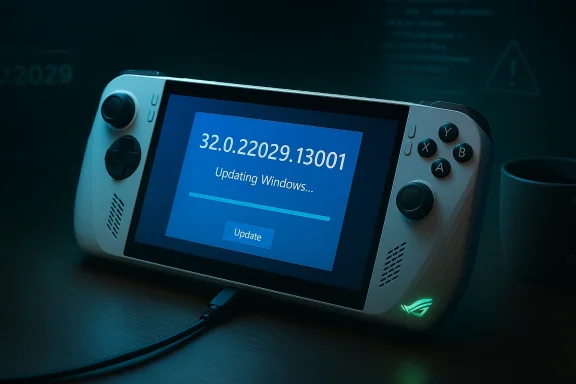
Asus' decision to ship a fresh GPU driver for the ROG Ally — tagged 32.0.22029.13001 and appearing on users' update channels in late February 2026 — has landed at an awkward moment for the handheld market: it arrives amid widespread reports that AMD may have quietly moved the Ryzen Z1 Extreme APU into a lower-priority support lane, leaving owners of multiple Windows 11 handhelds unsure about future GPU driver cadence and day‑one game optimizations.
The ROG Ally line, and other high‑end Windows handhelds that use the AMD Ryzen Z1 Extreme APU, have been central to a broader conversation that began when OEM and community signals suggested updates were slowing or stopping for certain Z1 Extreme devices. Outlets and forum posts report that Lenovo’s Korea customer‑support channels told at least one user there were “no more plans” to issue further drivers for the original Legion Go — a claim that, if representative, prompted follow‑on reporting that AMD had ceased active driver development for the Z1 Extreme. Those reports coincided with community frustration at long gaps between validated OEM driver packages.
At its simplest: Asus has published a new packaged GPU driver for the ROG Ally in late February 2026, while larger questions remain unresolved about whether AMD is formally ending day‑to‑day driver development for the Z1 Extreme platform — and whether OEMs will continue to validate and publish updates for their specific handheld configurations.
It is important to be precise: at the time of reporting, AMD had not published an official statement confirming an end‑of‑life for Z1 Extreme driver development, and OEMs have not issued a public, platform‑wide deprecation notice. The signals appear to be a mix of OEM support messaging, slower packaging cadence, and the realignment of AMD’s public driver resources to newer branches — not a formally published end‑of‑support declaration from AMD. That nuance matters for owners deciding whether to panic, plan mitigations, or wait for formal clarification.
In the end, the Asus driver drop is a welcome — if cautious — sign that vendors can and will still push fixes. But it also underlines a broader industry truth: handheld Windows gaming is a high‑touch product category where continued functionality depends on cooperation between silicon vendors and OEMs. When that cooperation frays, users often find themselves patching through community workarounds, switching operating systems, or making tough hardware upgrade decisions to stay current.
Source: Tom's Hardware Asus ROG Ally receives timely GPU driver update despite rumors of AMD Ryzen Z1 Extreme deprecation — new release follows recent speculation that driver support for some Windows 11 handhelds had ended
 Background / Overview
The ROG Ally line, and other high‑end Windows handhelds that use the AMD Ryzen Z1 Extreme APU, have been central to a broader conversation that began when OEM and community signals suggested updates were slowing or stopping for certain Z1 Extreme devices. Outlets and forum posts report that Lenovo’s Korea customer‑support channels told at least one user there were “no more plans” to issue further drivers for the original Legion Go — a claim that, if representative, prompted follow‑on reporting that AMD had ceased active driver development for the Z1 Extreme. Those reports coincided with community frustration at long gaps between validated OEM driver packages.At its simplest: Asus has published a new packaged GPU driver for the ROG Ally in late February 2026, while larger questions remain unresolved about whether AMD is formally ending day‑to‑day driver development for the Z1 Extreme platform — and whether OEMs will continue to validate and publish updates for their specific handheld configurations.
What just shipped: driver details and what they likely mean
The package: version and branch
The new ROG Ally driver package is identified as 32.0.22029.13001. Observers note that the package remains on the same middle branch number — 22029 — as the November 2025 OEM release that carried version 32.0.22029.1019, rather than jumping to the newer public driver branch used in AMD’s Adrenalin releases earlier in 2026. That suggests this is an incremental OEM package, not an upstream branch migration.- What "22029" means: OEMs commonly repackage AMD driver components onto a validated branch for a specific device, and the branch number (22029 here) identifies that family. Staying on 22029 while the public Adrenalin tree moved forward indicates Asus shipped a vendor‑validated build rather than the latest AMD public branch.
Release timing and visibility
Multiple outlets and community trackers observed the package rolling out on or around February 24–25, 2026. In practice, OEM driver releases for the ROG Ally historically appear through Asus’ support site, Armoury Crate, and MyASUS channels before they surface on third‑party trackers; users report seeing the build through those same channels. The lack of an accompanying change log (Asus published no public release notes for this build) creates ambiguity about whether the update addresses specific game compatibility issues, security fixes, or just packaging/bugfix regressions.Why the timing matters: the Z1 Extreme support story
The rumor chain and OEM confirmations
In the last several days, a cluster of stories — driven by community reports, OEM forum replies, and mainstream tech coverage — suggested that AMD may have deprioritized or stopped issuing new driver updates for the Z1 Extreme. Lenovo’s community representatives were reported to have told a customer that there were “no more plans” for new drivers for the original Legion Go model; that statement, amplified by forum and news coverage, crystallized community fears that the Z1 Extreme platform had been placed into maintenance‑only status. Multiple outlets covered that development, and community threads documented users stuck on older validated packages for months.It is important to be precise: at the time of reporting, AMD had not published an official statement confirming an end‑of‑life for Z1 Extreme driver development, and OEMs have not issued a public, platform‑wide deprecation notice. The signals appear to be a mix of OEM support messaging, slower packaging cadence, and the realignment of AMD’s public driver resources to newer branches — not a formally published end‑of‑support declaration from AMD. That nuance matters for owners deciding whether to panic, plan mitigations, or wait for formal clarification.
Why OEM packaging complicates things
AMD supplies base driver builds, and OEMs validate and repackage them for device‑specific profiles, thermal/power limits, and companion software. That validation process creates a lag between AMD’s public Adrenalin branch and the OEM’s packaged driver. When OEMs stop pushing new validated packages for a device, it can look like AMD has “stopped” updates even if upstream branches still exist — because users rely on the OEM‑validated builds that include specific power/clock tuning and compatibility testing. The ROG Ally’s new package staying on branch 22029 is a textbook example: Asus pushed a vendor build, but it is not the same as the then‑current public Adrenalin releases.What this means for ROG Ally owners (short and long term)
Immediate user impact
- You still can use the ROG Ally. The hardware continues to function, and existing validated drivers will keep running installed titles.
- Expect less chance of day‑one optimization for brand‑new releases if the Z1 Extreme stops receiving regular upstream or validated OEM patches. New AAA titles often rely on driver updates for stability or performance improvements at launch.
- There is a non‑zero risk that future game updates or Windows subsystem upgrades could expose compatibility regressions that won’t be resolved without driver fixes. Owners of Z1 Extreme devices should treat any new major game or platform update with caution and keep rollback plans ready.
Practical mitigation steps for owners
- Always keep a tested rollback driver saved. When a new OEM driver lands, create a system restore point and export the current driver package so you can revert quickly if games break.
- Test new drivers on a small set of your most‑important titles before adopting them widely.
- If you run into persistent crashes with an OEM driver, try the last known stable vendor package offered by Asus (users have reported reverting from 32.0.22029.1019 back to 32.0.21013.11001 to resolve regressions). Asus forum posts and user reports have documented this pattern.
- Consider alternate OS options as a contingency (see the Linux section below).
The technical angle: branch numbers, Adrenalin trees, and what actually gets updated
Branch identifiers and what they signal
AMD’s public Adrenalin releases are currently in the 26.x series (Adrenalin Edition 26.2.1 and related builds were published in early 2026), while OEMs may continue to ship device‑specific packages built from older branches. The Adrenalin 26.x release notes and security bulletins illustrate that AMD is still shipping broad GPU updates; however, OEM repackaging and device certification are separate efforts that may not apply to every smaller handheld SKU. In short: AMD’s upstream tree has moved forward, but OEM‑validated handheld packages can remain on an older branch for months.Why staying on an older branch matters
- New game titles often require driver changes that fix engine‑specific issues or add launch‑time optimizations. If your device’s validated package remains on a branch that pre‑dates those fixes, you may miss those benefits.
- Conversely, the OEM‑validated package includes specific power and thermal tuning for the handheld. Using an unvalidated public Adrenalin driver can introduce stability problems or break integration with Armoury Crate and other vendor utilities. Community members repeatedly warn against blindly installing AMD’s generic packages on OEM handhelds for that reason.
Community reaction and the trust deficit
Relief, skepticism, and the fragility of trust
When Asus pushed the incremental ROG Ally package, many owners expressed relief that the device had not been entirely abandoned. At the same time, the lack of release notes and the fact the package did not move to a more current public branch left a residue of skepticism: owners worry the update is cosmetic or a stopgap, not proof of sustained long‑term support. Reddit and OEM forums show a mix of gratitude and continued unease.Past behavior colors expectations
Communities pointed to prior periods where ROG Ally and Legion Go owners waited months for validated packages, and in some cases OEM pages temporarily removed driver files or rolled back releases after issues. Those historical patterns shape how owners interpret silence from AMD or OEMs today: the absence of an official statement plus a history of slow OEM packaging amplifies fear.Alternatives: can Linux save the handheld?
Open‑source drivers and SteamOS/Bazzite options
One commonly suggested contingency is a switch to a Linux‑based OS — Valve’s SteamOS or community distributions like Bazzite — which rely on the open‑source AMD driver stack (AMDGPU, Mesa). That stack is updated independently of AMD’s Windows driver cadence and is maintained by a broad open‑source community, which can extend useful life for older hardware. For many users, the Linux stack already delivers competitive performance and frequent fixes that can offset the lack of OEM Windows driver support.Tradeoffs and reality checks
- Moving to Linux solves the driver‑availability problem, but not without cost: you may lose Windows‑only games, DRM‑restricted titles, or certain mods and utilities that have no Linux equivalent. Compatibility layers like Proton, Wine, and Lutris mitigate many gaps, but no one‑to‑one guarantees exist.
- OEM features such as Armoury Crate, custom power profiles, and Windows‑only utilities may not port cleanly. That can change the handheld’s behavior, battery life, or thermal characteristics compared to the vendor‑validated Windows experience.
- If you rely on specific Windows‑only workflows or titles, Linux is an imperfect workaround — albeit a strong option for users who prioritize continued driver updates over Windows feature parity.
Where the responsibilities lie: AMD, OEMs, and consumers
AMD’s role
AMD develops the core Adrenalin drivers and publishes release notes and security bulletins for broad hardware lines. The company’s public driver stream has continued to release Adrenalin 26.x updates as of early 2026, including security advisories and game compatibility updates. That shows AMD is still investing in its public Windows stack, even if specific handheld SKUs are not prioritized in every release.OEM responsibilities
OEMs must validate, repackage, and distribute drivers for particular devices, incorporating custom power limits and integration with vendor software. When OEMs deprioritize a device, that validation pipeline dries up; even if AMD continues to publish upstream fixes, those fixes do not automatically become OEM‑signed or recommended for handheld owners. The Lenovo Korea response and varied messaging across OEM support forums underscore how much of the end user experience depends on OEM follow‑through.Consumer expectations and realistic lifecycles
The handheld market is still comparatively young and fragmented, with many vendors balancing limited engineering resources across product families. Owners should reasonably expect at least a couple of years of active driver support for mainstream platforms, but the reality today shows that lifecycle decisions can be made rapidly as vendors and silicon partners reallocate resources to newer SKUs. That mismatch between expectation and practice is the root of the current frustration.Risk analysis: potential scenarios and recommended responses
Scenario 1 — Short term maintenance continues
- Risk profile: Low. OEMs ship occasional validated builds (like the February Asus package) to fix critical regressions or security issues, while AMD continues upstream development.
- Best response: Keep devices updated, save rollback drivers, and monitor OEM forums for errata.
Scenario 2 — OEMs shift to maintenance‑only posture
- Risk profile: Medium. OEMs stop regular validation, issuing drivers only for critical security issues or major regressions.
- Best response: Plan contingencies: maintain rollback drivers, test new games in a sandbox environment, and explore Linux builds if new Windows patches fail.
Scenario 3 — Platform is formally deprecated
- Risk profile: High. OEMs and AMD stop issuing driver updates and validation entirely for Z1 Extreme devices.
- Best response: Prepare to migrate to Linux for continued graphics driver improvements, or consider hardware refresh options if you need ongoing Windows day‑one compatibility. Preserve device backups and document working driver configurations.
What journalists and buyers should watch next
- Official statements from AMD or OEMs (Asus, Lenovo) clarifying support policy for the Z1 Extreme. At time of writing, AMD had not publicly confirmed platform deprecation.
- Whether future Asus packages move the ROG Ally off the 22029 branch and onto a later validated branch aligned with AMD’s Adrenalin 26.x series. A migration would indicate renewed validation investment by Asus.
- OEM support page behavior: additions, removals, or rollback notices on official driver pages and in Armoury Crate release logs — these are the operational signals that matter most to owners. Community threads and forum moderators commonly document these changes as they happen.
Final analysis — context, caution, and practical guidance
The Asus ROG Ally’s late‑February driver package is good news for owners in the immediate sense: it demonstrates that at least one OEM still delivers validated updates when required. However, the character of the update — an incremental package on the older 22029 branch with no public release notes — does not by itself disprove the broader pattern of reduced attention to the Z1 Extreme family that many observers documented in recent days. This moment is best understood as a partial reassurance, not a guarantee.- Strengths: Asus continues to distribute device‑specific packages; AMD’s upstream Adrenalin releases remain active and continue to address security and game‑compatibility issues across its product range. Those facts mean there is still a path for fixes to reach devices if OEMs choose to validate them.
- Risks: The split between AMD’s public branch and OEM packaging, combined with OEM statements and long update gaps, raises a credible risk that Z1 Extreme handhelds will lack regular driver optimizations for upcoming game launches — particularly if OEM priorities shift further toward newer APUs such as Z2 family variants. Owners should treat claims of “end of support” with caution unless confirmed directly by AMD, but they should also prepare for the practical implications of a reduced update cadence.
In the end, the Asus driver drop is a welcome — if cautious — sign that vendors can and will still push fixes. But it also underlines a broader industry truth: handheld Windows gaming is a high‑touch product category where continued functionality depends on cooperation between silicon vendors and OEMs. When that cooperation frays, users often find themselves patching through community workarounds, switching operating systems, or making tough hardware upgrade decisions to stay current.
Source: Tom's Hardware Asus ROG Ally receives timely GPU driver update despite rumors of AMD Ryzen Z1 Extreme deprecation — new release follows recent speculation that driver support for some Windows 11 handhelds had ended
