

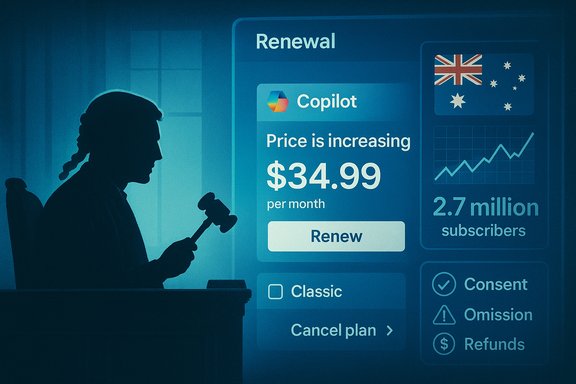
Microsoft’s rapid Copilot rollout has collided with Australia’s consumer law: the company has apologised to affected Microsoft 365 subscribers and begun offering refunds after the Australian Competition and Consumer Commission (ACCC) launched Federal Court proceedings alleging millions were misled by renewal communications that obscured a lower‑cost, non‑AI alternative.
Background
The dispute centres on Microsoft’s integration of Copilot, its generative‑AI assistant, into consumer Microsoft 365 plans and the manner in which that integration — and the associated price rises — were communicated to customers in Australia. According to the ACCC, the company introduced Copilot into Microsoft 365 Personal and Family plans in late 2024 and applied material price increases that took effect on renewal. The regulator’s initiating materials cite an annual Microsoft 365 Personal increase from A$109 → A$159 (≈ +45%) and Microsoft 365 Family from A$139 → A$179 (≈ +29%). Microsoft responded this week by emailing affected Australian subscribers, apologising for not being clearer about subscription alternatives and offering refunds to eligible customers who switch to the Microsoft 365 Personal/Family Classic plans — non‑Copilot SKUs that preserve the pre‑increase pricing and functionality. Microsoft’s customer message says refunds will apply from the first renewal after 30 November 2024 for subscribers who switch before 31 December 2025. These core facts — the ACCC’s court action, the 2.7‑million affected figure the regulator uses, Microsoft’s apology and the refund offer — are reported by multiple independent outlets and reflected in the ACCC’s materials. The number of subscribers and the pricing deltas are central to the ACCC’s economic‑harm case.What the ACCC says: the legal theory and evidence
The allegation in plain language
The ACCC’s concise statement lodged in the Federal Court alleges Microsoft told subscribers with auto‑renew enabled that to continue their subscription they had to either accept Copilot (and the higher renewal price) or cancel — a binary message that omitted a contemporaneous, materially different option: the Classic plans at prior pricing. The regulator says the Classic option only appeared in the account UI after a subscriber initiated the cancellation flow, meaning many auto‑renewing customers would not have seen it at the decision point. The ACCC quantifies the cohort at roughly 2.7 million Australians and is seeking declarations, injunctions, consumer redress and civil penalties.How omission can be misleading under Australian law
Under the Australian Consumer Law, a business may be liable not only for actively false statements but also for omissions of material information that are likely to mislead a reasonable consumer. The ACCC frames Microsoft’s conduct as an omission that materially altered the choice architecture — essentially, the way options were presented — in a way that nudged customers toward the higher‑priced, AI‑enabled plan. The regulator has attached screenshots and described the subscriber experience in its initiating materials to support that claim.Evidence the ACCC relies on
- Two targeted renewal emails to auto‑renewing subscribers and a public Microsoft blog post that announced Copilot’s integration and price changes.
- Screenshots and account flow captures showing the Classic plans surfacing only after a cancellation flow began.
- Complaints from customers and internal timelines tying the communications to renewal dates.
Microsoft’s response: apology, refund mechanics and reservations
The apology and refund offer
Microsoft’s consumer message acknowledges that it “fell short of our standards” and says the company “could have been clearer” about the availability of non‑AI options. It sets out three practical options for affected subscribers: stay on the Copilot‑enabled Microsoft 365 plan, switch to Microsoft 365 Personal/Family Classic at the prior price, or switch to other non‑Copilot alternatives. Microsoft says it will refund eligible customers the difference in price for renewals dating from after 30 November 2024 if they switch to Classic before 31 December 2025, with refunds processed to the payment method used to subscribe within 30 days of eligibility.What Microsoft admits — and what it does not
Microsoft admits a communications failure in tone and placement: that it “could have been clearer” about subscription alternatives. That is a material concession for a company facing regulatory scrutiny because it acknowledges the customer‑facing UX and messaging were not, in the company’s view, optimal. However, Microsoft’s message does not concede legal liability; it frames the action as a customer‑service remediation pending the Court’s consideration. The company emphasises cooperation with regulators and promises internal improvements.Verifiable and unverifiable elements
- Verifiable: Microsoft’s apology email text and the refund eligibility window are publicly accessible on Microsoft’s regional newsroom for Asia Pacific.
- Verifiable: The ACCC’s initiation of Federal Court proceedings and the regulator’s core allegations are publicly reported and summarised by major news organisations.
- Cautionary: precise counts of how many subscribers have actually been switched, refunded or will ultimately be eligible are not yet in the public record; the 2.7 million figure is an ACCC estimate that anchors its claim but Microsoft has not verified that exact number publicly. Consumers should treat that figure as the regulator’s estimate pending judicial inquiry.
Legal stakes: penalties, remedies and precedent
Statutory penalties and remedies sought
The ACCC seeks a mix of remedies typical in consumer protection enforcement: declarations that the conduct contravened the Australian Consumer Law, injunctions to prevent recurrence, orders for consumer redress (refunds and compensation), and civil penalties. Australian law sets substantial ceilings: for corporations, the penalty for each contravention can be the greater of A$50 million, three times any benefit obtained from the conduct, or 30% of adjusted turnover for the relevant period when benefit cannot be readily quantified. That framework places very high potential exposure for large multinationals if the Court finds systemic contraventions.Why this case matters beyond Australia
This is not only about Microsoft or one product change. Regulators globally are watching how major technology companies monetise AI within subscription products. If the ACCC wins a significant penalty or obtains robust injunctive relief, it could constrain how vendors roll AI features into existing tiers and require more conspicuous, contemporaneous disclosure of alternatives — especially for auto‑renewing subscribers. The case will therefore be referenced by regulators, consumer‑rights groups and product teams designing subscription UX for AI features.Choice architecture, subscription UX and the ethics of monetising AI
Why placement and timing of information matter
The ACCC’s case is, at its heart, an indictment of choice architecture: how product choices are framed and when alternatives are shown. Auto‑renewing subscribers rely heavily on renewal notices and default settings; when a company makes a major change to price and feature set, the moment of renewal is the most salient time to present all realistic options clearly.UX patterns that bury alternatives deep in a cancellation flow or in obscure support articles create friction that benefits the seller and disadvantages consumers. Regulators increasingly view that kind of design as a material business decision, not merely a product design quirk.
The commercial logic — and why Microsoft did it
From Microsoft’s perspective, bundling Copilot into consumer plans and charging higher retail prices converts a large user base into an AI monetisation cohort and simplifies billing. AI features are expensive to build and operate; subscription price increases are a direct mechanism to capture value and fund ongoing R&D and cloud costs. But the commercial logic must be balanced against clear disclosure obligations and fair‑market principles — especially where millions of consumers are involved. Microsoft’s apology indicates the company recognises the communication shortfall, even as it defends the availability of Classic SKUs in published documentation.Risks of opaque monetisation
- Reputational damage at scale when millions feel surprised or tricked.
- Regulatory action that can impose large financial penalties and obligations to change UX.
- Customer churn and migration to free or cheaper alternatives (e.g., local office suites, competitors).
- A chilling effect on experimentation with paid AI features if regulators demand overly prescriptive disclosures.
Critical analysis — strengths and weaknesses of each side
The ACCC’s strengths
- Evidence‑forward approach: The ACCC filed a concise statement with screenshots of the cancellation flow and produced the emails it alleges were sent to auto‑renewing customers. That gives the regulator a concrete record to argue that the Classic option was not presented contemporaneously.
- Clear statutory framework: Australian Consumer Law is well‑established on omission and misleading conduct, giving the ACCC a robust legal pathway to seek remedies.
- Public interest and political salience: Consumer protection enforcement plays well with voters and helps set a regulatory tone for AI monetisation globally.
Microsoft’s strengths and likely defences
- Public documentation of alternatives: Microsoft published support pages and product blog posts that describe Classic SKUs and other opt‑out routes, which it can argue were reasonable and adequate disclosures.
- Complexity of rollout: Microsoft can argue that subscription ecosystems are complex and that varied account flows, localisation differences and timing differences made some communication paths different for some customers. Proving systemic, deliberate concealment is harder than proving an omission in one channel.
- Remedial action: The immediate apology and refund offer can blunt urgent reputational harm and reduce the practical harm to consumers, which could be a factor the Court considers in mitigation.
Weaknesses on both sides
- The ACCC’s large headline number (2.7 million) is an estimate and the regulator will need to show a sufficient causal connection between Microsoft’s communications and the economic harm alleged. Microsoft will contest the scale and the way renewals occurred in practice.
- Microsoft’s public documentation is not necessarily decisive if the core targeted renewal emails — the messages most likely to be read by auto‑renewing customers — omitted the Classic option. The Court will weigh the impression created by those renewal notices.
Broader implications for product teams and regulators
For product and UX teams
- Presenting alternatives at the time a user faces a billing decision is essential. UX teams must treat renewal notices as legal touchpoints, not mere marketing messages.
- Design patterns that nudge customers toward higher prices by hiding alternatives in cancellation flows are now regulatory flashpoints. Product managers should be ready to defend the why of any default that materially affects costs.
For regulators and policy makers
- This case will test whether regulators will require proactive, prominent disclosure of subscription alternatives when AI capabilities — and price increases tied to them — are introduced.
- Expect more scrutiny of auto‑renew flows, default opt‑ins/outs, and the placement of alternatives in account management experiences.
For the industry
- Large vendors will likely reassess how they monetise AI features and may either:
- create clearer, explicit opt‑in pathways for paid AI; or
- move to grandfathering or price‑protection approaches for legacy customers to avoid regulatory blowback.
Practical advice for affected subscribers
If you are an Australian Microsoft 365 subscriber who renewed on or after late 2024 and received a renewal notice or charge you consider affected, take these steps:- Check your email for the Microsoft message titled along the lines of “Your Microsoft 365 Options” and follow the link it provides to view refund eligibility and switching mechanics. Microsoft’s regional message details the Classic option and the refund window.
- If you believe you were charged at the higher Copilot price and want to remain on the older price, switch to Microsoft 365 Personal/Family Classic before the deadline Microsoft has announced (31 December 2025) and track the refund timeline.
- If switching is unclear or you encounter problems, record screenshots and correspondence — that documentation will be helpful if the ACCC or court orders redress or if you pursue your own complaint.
- Keep records of payment dates and amounts; the refund eligibility depends on renewal dates (Microsoft cites refunds starting from the first renewal after 30 November 2024).
What to watch in the Federal Court process
- The ACCC will need to prove that the renewal communications were likely to mislead a reasonable consumer — the Court will scrutinise the exact text of the targeted emails and the user journey screenshots showing when the Classic option appeared.
- Judges will consider whether Microsoft’s published documentation (blog posts and support pages) constituted adequate contemporaneous disclosure, or whether placing Classic in the cancellation flow was an omission that materially misled consumers.
- Remedies: beyond refunds for individuals, the Court may order compliance steps, enhanced disclosure requirements, or substantial penalties depending on the findings.
Final assessment — strengths, risks and a path forward
This dispute is a pivotal test of how the law treats the monetisation of AI features in subscription services. The ACCC has advanced a focused, evidence‑driven theory: that Microsoft’s renewal communications created a false binary choice that omitted a materially relevant option. Microsoft’s swift apology and refund offer are a pragmatic attempt to reduce consumer harm while contesting legal liability.- Strengths of the ACCC case: documented renewal communications and UX screenshots that demonstrate the timing and placement of alternatives; a statutory framework that treats omissions as actionable; and a clear public interest narrative.
- Microsoft’s practical mitigation: an apology, published instructions to switch to Classic plans and a refund offer that, if implemented smoothly, can limit practical harm and possibly blunt a harsher penalty.
Conclusion
Microsoft’s apology and refund offer mark a quick operational response to a high‑stakes regulatory action in Australia. The ACCC’s lawsuit asks the Federal Court to determine whether the company’s renewal communications misled roughly 2.7 million Australians by effectively burying a lower‑cost, no‑AI alternative. What happens next will shape expectations for transparency around AI upgrades in subscription products, influence how product teams design renewal and cancellation flows, and signal how vigorously regulators will police choice architecture in the AI era. For affected customers, the immediate practical step is to follow Microsoft’s published refund and switching instructions, preserve documentation, and monitor the Federal Court proceedings for the final legal outcome.(Note: this article synthesises Microsoft’s customer message and publicly reported details of the ACCC’s court action; the regulator’s 2.7‑million‑customer figure is the ACCC’s estimate, and some granular operational numbers (exact counts of refunds paid to date) are not publicly verifiable at this time. Readers should treat those operational metrics as subject to update as the case and remediation process proceed.
Source: WAtoday Microsoft apologises, offers refunds to 2.7 million Australians
