

Australia’s accelerating data centre build-out is being sold as the physical foundation of the AI economy: a network of vast, highly secure facilities that keeps cloud services, enterprise software, search engines, Microsoft Copilot, streaming platforms, online banking and generative AI available around the clock. Yet as communities confront the real costs in electricity, water, land and grid capacity, the promise of “jobs” deserves much closer scrutiny.
The short answer is that data centres do create jobs, often very well-paid and technically demanding ones. But they do not create employment at the scale that their construction budgets, land footprints or power requirements might suggest. Their workforce story is defined by a sharp divide: a substantial, temporary construction surge followed by a comparatively lean, permanent operating team.
That distinction matters. A hyperscale data centre can cost billions of dollars, occupy an enormous industrial site and draw enough power to reshape regional infrastructure planning, while employing only dozens—or, in some cases, a few hundred—people once it is operational. For Australia, where housing construction, electricity infrastructure and skilled trades are all under pressure, policymakers need to assess data centres not merely as job creators, but as competitors for scarce labour and public resources.
A data centre is not simply a building full of computers. It is a specialised industrial facility designed to operate digital systems continuously, securely and with minimal interruption.
Inside are servers, storage arrays, networking equipment, backup power systems, high-voltage electrical infrastructure, cooling plant, fire suppression equipment and extensive physical-security controls. The purpose is to process, store, distribute and protect data for cloud platforms, businesses, governments and consumers.
Modern data centres support an enormous range of familiar Windows and cloud workloads, including:
That has turned data centres into a major planning issue in Australia’s largest cities. Sydney and Melbourne remain especially attractive because they combine population density, network connectivity, business demand, existing cloud regions and access to skilled technical workers. But these advantages also place new facilities in direct competition with homes, manufacturers and other essential infrastructure for electricity, water, industrial land and specialist labour.
Data centre electricity demand in Australia is already material, and forecasts point to rapid growth as AI infrastructure expands. The exact share of national electricity use varies by methodology, geography and whether forecasts count proposed projects or only connected facilities. However, the direction of travel is not in doubt: data centres are becoming a major new source of electricity demand, particularly in constrained metropolitan grids.
For grid planners, the challenge is not just annual consumption. It is also:
This is why the federal expectation that AI and data centre developers minimise energy demand and emissions—and secure additional clean generation or storage to offset demand—is important. The key word is additional. The goal should not be for data centres simply to claim existing clean electricity that would otherwise support households and other businesses.
There is no single universal figure for data centre water consumption. Estimates based on a one-megawatt facility can be useful for illustrating scale, but they should be treated carefully. Water use can vary enormously between an air-cooled facility, a water-cooled facility and a newer installation designed around recycled water or alternative cooling strategies.
The larger issue is cumulative demand. A single facility may be manageable for a city water network. Dozens of large facilities in the same growth corridor can become a different proposition entirely.
Sydney Water and broader infrastructure planning assessments have identified data centres as a potentially significant future source of demand. Current consumption and long-term projections should not be confused: present-day data centre water use is far below the most dramatic projections, but planned capacity could create a serious call on supply if large numbers of proposals proceed.
That is the core policy problem. Communities are being asked to assess facilities based on what they could require at scale, not merely what is being used today.
This means a responsible data centre policy cannot focus exclusively on one metric. It needs to consider:
The important point is that environmental performance should be measured, disclosed and independently verified—not assumed from marketing language.
Both statements can be true.
At peak construction, a major facility can support hundreds or even thousands of workers across a broad supplier network. The workforce may include:
But it is not permanent employment. Once a data centre is completed, the project workforce disperses to the next site, the next sector or the next region.
A development proposal that announces thousands of “jobs created” should therefore make clear:
The ongoing workforce is real and increasingly skilled, but modest compared with the scale of capital invested.
Permanent roles typically include:
Even so, the underlying pattern remains clear: the long-term jobs footprint is low relative to the physical and resource footprint.
A large warehouse-sized data centre can run with a permanent workforce that would be considered small for a factory, hospital, university campus or major retail complex. That does not make the jobs unimportant. It does mean the public should not evaluate these developments as conventional employment engines.
This creates potential career pathways into:
For workers already trained in high-voltage electrical work, industrial cooling or mission-critical facilities management, the data centre sector can be an excellent employment market.
A credible local-employment plan should include:
The strongest data centre projects will not merely recruit from the existing pool of scarce specialists. They will help expand that pool.
There is also some overlap with housing construction, particularly in electrical, mechanical, project-management and supply-chain roles. The overlap is not perfect—data centres need much more high-voltage and mission-critical expertise—but even partial overlap can matter when labour markets are tight.
A hyperscale project able to offer premium wages for a defined construction period may attract experienced workers away from residential construction or infrastructure work. This does not mean the data centre should never be built. It means governments should not treat every private construction project as a net gain without considering opportunity cost.
If a region lacks electricians, the relevant question is not simply, “How many data centre jobs will this create?” It is also, “What work will those electricians be unable to do instead?”
New substations, transmission upgrades, batteries, renewable projects and grid-scale electrical equipment need engineers, electricians, planners, civil contractors and commissioning specialists. The faster data centre demand grows, the more pressure it can place on the workforce needed to expand clean electricity supply.
That makes the case for coordinated planning stronger. Data centres should not be approved as isolated private developments whose infrastructure consequences are discovered later. They should be integrated into regional plans for power, water, transport, land use and workforce development.
Potential wider benefits include:
However, these spillovers depend on the project’s design and local ecosystem. A facility that mainly serves global cloud traffic may create fewer local technology opportunities than one linked to training programs, internet exchanges, research institutions, sovereign-cloud services or local enterprise customers.
The conversation should include:
A better approach would treat data centres as critical digital infrastructure with industrial-scale obligations.
Useful measures include:
For major projects, operators should publish:
Operators should be encouraged—or required, where appropriate—to support:
But the typical data centre is not a large, enduring employer relative to its cost, land use or consumption of electricity and water. Its long-term on-site workforce is usually modest because the facilities are designed to be automated, standardised and remotely monitored.
That does not make data centres a bad investment. Australia needs resilient digital infrastructure, and the AI economy will not operate without physical computing capacity. The error is in presenting a data centre as though it were a conventional job-rich factory, hospital or university campus.
The most honest case for data centre development is more nuanced. These facilities can provide essential infrastructure, specialised high-wage work, construction activity, digital resilience and potential economic spillovers. In return, they should meet a higher standard: transparent water reporting, additional clean-energy investment, credible workforce training, local procurement, accountable tax arrangements and realistic employment claims.
Australia’s data centre boom should be judged on whether it delivers a durable public return—not simply on how impressive the construction-job headline appears on the day a project is announced.
The short answer is that data centres do create jobs, often very well-paid and technically demanding ones. But they do not create employment at the scale that their construction budgets, land footprints or power requirements might suggest. Their workforce story is defined by a sharp divide: a substantial, temporary construction surge followed by a comparatively lean, permanent operating team.
That distinction matters. A hyperscale data centre can cost billions of dollars, occupy an enormous industrial site and draw enough power to reshape regional infrastructure planning, while employing only dozens—or, in some cases, a few hundred—people once it is operational. For Australia, where housing construction, electricity infrastructure and skilled trades are all under pressure, policymakers need to assess data centres not merely as job creators, but as competitors for scarce labour and public resources.
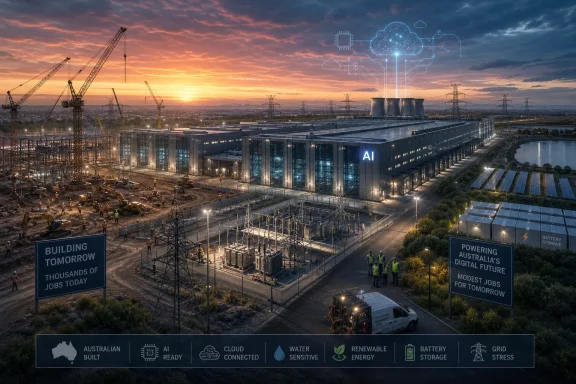 The infrastructure behind the AI boom
A data centre is not simply a building full of computers. It is a specialised industrial facility designed to operate digital systems continuously, securely and with minimal interruption.Inside are servers, storage arrays, networking equipment, backup power systems, high-voltage electrical infrastructure, cooling plant, fire suppression equipment and extensive physical-security controls. The purpose is to process, store, distribute and protect data for cloud platforms, businesses, governments and consumers.
Modern data centres support an enormous range of familiar Windows and cloud workloads, including:
- Microsoft Azure virtual machines, storage and AI services
- Microsoft 365 collaboration, identity and productivity platforms
- Enterprise applications running on Windows Server and Linux
- AI model training and inference workloads
- Online gaming, streaming and content delivery
- Banking, retail, health and government systems
- Backup, disaster recovery and cybersecurity services
- Internet exchanges and telecommunications networks
That has turned data centres into a major planning issue in Australia’s largest cities. Sydney and Melbourne remain especially attractive because they combine population density, network connectivity, business demand, existing cloud regions and access to skilled technical workers. But these advantages also place new facilities in direct competition with homes, manufacturers and other essential infrastructure for electricity, water, industrial land and specialist labour.
Why data centres are unusually resource-intensive
The employment debate cannot be separated from the resource debate. Data centres are not factories in the traditional sense, but their continuous power requirements and thermal output make them industrial-scale consumers of infrastructure.Electricity demand is the central constraint
Every watt consumed by a server is ultimately converted into heat. As computing capacity expands, operators must not only secure electricity for IT equipment but also power cooling systems, pumps, fans, switchgear, lighting, security systems and resiliency infrastructure.Data centre electricity demand in Australia is already material, and forecasts point to rapid growth as AI infrastructure expands. The exact share of national electricity use varies by methodology, geography and whether forecasts count proposed projects or only connected facilities. However, the direction of travel is not in doubt: data centres are becoming a major new source of electricity demand, particularly in constrained metropolitan grids.
For grid planners, the challenge is not just annual consumption. It is also:
- The timing of demand during heatwaves and peak periods
- The location of facilities relative to substations and transmission networks
- The need for firm capacity when renewable generation is low
- The capital required for grid upgrades
- The pressure on decarbonisation targets if demand is met with fossil generation
- The pace at which new renewable energy, storage and transmission can be built
This is why the federal expectation that AI and data centre developers minimise energy demand and emissions—and secure additional clean generation or storage to offset demand—is important. The key word is additional. The goal should not be for data centres simply to claim existing clean electricity that would otherwise support households and other businesses.
Water use is highly variable—but increasingly important
Water use attracts especially strong public concern because many data centres rely on water-based cooling systems. The quantity used depends on the facility’s design, local climate, equipment density, cooling technology, operating patterns and use of recycled water.There is no single universal figure for data centre water consumption. Estimates based on a one-megawatt facility can be useful for illustrating scale, but they should be treated carefully. Water use can vary enormously between an air-cooled facility, a water-cooled facility and a newer installation designed around recycled water or alternative cooling strategies.
The larger issue is cumulative demand. A single facility may be manageable for a city water network. Dozens of large facilities in the same growth corridor can become a different proposition entirely.
Sydney Water and broader infrastructure planning assessments have identified data centres as a potentially significant future source of demand. Current consumption and long-term projections should not be confused: present-day data centre water use is far below the most dramatic projections, but planned capacity could create a serious call on supply if large numbers of proposals proceed.
That is the core policy problem. Communities are being asked to assess facilities based on what they could require at scale, not merely what is being used today.
The trade-off between water and energy
Cooling is not a simple environmental equation. In many cases, technologies that reduce electricity use can consume more water, while systems designed to minimise water use can require more electricity.This means a responsible data centre policy cannot focus exclusively on one metric. It needs to consider:
- Water Usage Effectiveness (WUE)
- Power Usage Effectiveness (PUE)
- Local water scarcity and drought risk
- The source of water: potable, recycled, stormwater or other supplies
- The carbon intensity of electricity used for cooling
- Peak electricity and water demand
- The ability to shift or curtail non-critical workloads
The important point is that environmental performance should be measured, disclosed and independently verified—not assumed from marketing language.
The jobs question: construction versus operations
Data centre employment claims are often technically correct but incomplete. Developers can legitimately point to large workforces during construction, while critics can accurately observe that the finished facility may employ relatively few people.Both statements can be true.
Construction creates a large but temporary workforce
Building a modern hyperscale data centre is a complex, high-value construction project. It requires civil works, structural trades, electrical systems, mechanical services, cooling infrastructure, fibre connectivity, security systems, generators, battery systems, testing and commissioning.At peak construction, a major facility can support hundreds or even thousands of workers across a broad supplier network. The workforce may include:
- Civil construction crews
- Concrete and structural specialists
- High-voltage electricians
- Electrical engineers and switchboard technicians
- Mechanical engineers
- HVAC installers and refrigeration technicians
- Cooling-tower specialists
- Plumbers and pipefitters
- Fire-suppression contractors
- Security and access-control installers
- Network and fibre technicians
- Commissioning engineers
- Project managers, site supervisors and safety specialists
- Equipment suppliers and logistics workers
But it is not permanent employment. Once a data centre is completed, the project workforce disperses to the next site, the next sector or the next region.
A development proposal that announces thousands of “jobs created” should therefore make clear:
- How many jobs are direct construction roles.
- How long those jobs are expected to last.
- How many workers will be employed at peak.
- How many are expected to be local hires.
- How many permanent roles will remain after commissioning.
- Whether job totals include indirect or induced economic modelling.
Operational headcount is much smaller
Once a data centre goes live, it becomes a highly automated facility. Servers are monitored remotely, physical access is controlled, systems are designed with redundancy, and many maintenance functions are scheduled, contracted or performed by specialist teams serving multiple sites.The ongoing workforce is real and increasingly skilled, but modest compared with the scale of capital invested.
Permanent roles typically include:
- Data centre technicians
- Electrical technicians
- Facilities technicians
- Critical-environment engineers
- Mechanical and HVAC specialists
- Network operations staff
- Security personnel
- Site managers
- Health, safety and compliance workers
- Customer-support and service-delivery staff
- Vendor and contractor management roles
Even so, the underlying pattern remains clear: the long-term jobs footprint is low relative to the physical and resource footprint.
A large warehouse-sized data centre can run with a permanent workforce that would be considered small for a factory, hospital, university campus or major retail complex. That does not make the jobs unimportant. It does mean the public should not evaluate these developments as conventional employment engines.
Why the permanent jobs still matter
The case for data centre employment should not be dismissed simply because the numbers are lower than construction claims imply. These roles are technically valuable, often well paid and closely connected to the skills needed for Australia’s digital economy.High-value technical pathways
Data centre operations sit at the intersection of IT, electrical engineering, mechanical systems and critical infrastructure. A technician may work with power-distribution equipment one day and monitoring systems, server hardware or cooling alarms the next.This creates potential career pathways into:
- Cloud infrastructure operations
- Enterprise IT and network engineering
- Industrial automation
- Energy management
- Electrical infrastructure
- Cooling and refrigeration systems
- Cybersecurity and physical security
- Facilities management
- Critical-environment design and commissioning
For workers already trained in high-voltage electrical work, industrial cooling or mission-critical facilities management, the data centre sector can be an excellent employment market.
Training must be more than a promise
The problem is that a demand signal is not the same as a workforce strategy. A new facility cannot simply assume that qualified technicians, electricians and mechanical specialists will appear when needed.A credible local-employment plan should include:
- Funded apprenticeships and traineeships
- Partnerships with TAFEs, universities and training providers
- Recognised technical certifications
- Paid work placements
- Transition programs for workers from adjacent industries
- Clear targets for local hiring and workforce diversity
- Support for Indigenous employment and regional training pathways
- Transparent reporting on hiring outcomes after facilities open
The strongest data centre projects will not merely recruit from the existing pool of scarce specialists. They will help expand that pool.
The hidden risk: competing with housing and energy projects
The most serious employment concern is not that data centres create no jobs. It is that they may redirect workers from projects that produce greater long-term social benefit or employ larger permanent workforces.The skilled-trades bottleneck
Data centres rely heavily on specialised electrical and mechanical trades. So do transmission projects, battery installations, renewable-energy developments, public infrastructure and advanced manufacturing facilities.There is also some overlap with housing construction, particularly in electrical, mechanical, project-management and supply-chain roles. The overlap is not perfect—data centres need much more high-voltage and mission-critical expertise—but even partial overlap can matter when labour markets are tight.
A hyperscale project able to offer premium wages for a defined construction period may attract experienced workers away from residential construction or infrastructure work. This does not mean the data centre should never be built. It means governments should not treat every private construction project as a net gain without considering opportunity cost.
If a region lacks electricians, the relevant question is not simply, “How many data centre jobs will this create?” It is also, “What work will those electricians be unable to do instead?”
Infrastructure construction competes for the same people
There is a further irony in the data centre boom. The facilities themselves increase demand for the electricity infrastructure required to serve them, and building that infrastructure requires many of the same skilled workers.New substations, transmission upgrades, batteries, renewable projects and grid-scale electrical equipment need engineers, electricians, planners, civil contractors and commissioning specialists. The faster data centre demand grows, the more pressure it can place on the workforce needed to expand clean electricity supply.
That makes the case for coordinated planning stronger. Data centres should not be approved as isolated private developments whose infrastructure consequences are discovered later. They should be integrated into regional plans for power, water, transport, land use and workforce development.
Economic benefits beyond direct employment
A narrow job count also misses some genuine economic advantages. Data centres can support broader digital activity, though those benefits are less automatic than industry advocates sometimes suggest.Better digital infrastructure can attract investment
Reliable, low-latency infrastructure can help support cloud adoption, digital services, cybersecurity operations, research workloads and software development. Businesses that need local data residency, high availability or fast access to cloud services may benefit from additional regional capacity.Potential wider benefits include:
- Improved cloud-service availability
- Greater data-residency options
- Stronger telecommunications and fibre networks
- More resilient disaster-recovery capability
- Support for digital exports and software businesses
- Local spending on maintenance, security and specialist suppliers
- Tax and rate revenue, depending on the jurisdiction
However, these spillovers depend on the project’s design and local ecosystem. A facility that mainly serves global cloud traffic may create fewer local technology opportunities than one linked to training programs, internet exchanges, research institutions, sovereign-cloud services or local enterprise customers.
Tax revenue requires transparency
Local governments often see data centres as valuable ratepayers because the facilities are high-value assets. But public confidence depends on transparent accounting of what a community receives in exchange for accommodating major energy, water and land demand.The conversation should include:
- Property taxes, rates and infrastructure contributions
- Costs of power and water-network upgrades
- Public subsidies or incentives
- Long-term maintenance obligations
- Local procurement requirements
- Community-benefit agreements
- Performance conditions for water and energy efficiency
What responsible data centre development should look like
Australia does not need to choose between digital infrastructure and resource security. It needs stronger conditions for development.A better approach would treat data centres as critical digital infrastructure with industrial-scale obligations.
Set measurable resource standards
Planning approvals should require clear, public reporting of electricity and water performance. Developers should disclose design targets and actual operating outcomes rather than relying on broad sustainability statements.Useful measures include:
- Annual electricity consumption
- Peak-demand contribution
- Renewable-energy and storage arrangements
- PUE targets and performance
- Water source by category
- WUE targets and performance
- Potable-water consumption
- Recycled-water use
- Drought-contingency plans
- Backup-generator testing and emissions controls
Demand local workforce commitments
Government expectations that data centre operators support fair, safe and well-paid Australian jobs are sensible. But expectations should become measurable commitments.For major projects, operators should publish:
- Construction workforce estimates by trade and duration
- Expected operational headcount
- Apprenticeship and trainee places
- Local hiring targets
- Training partnerships
- Procurement goals for local suppliers
- Annual employment outcomes after commissioning
Plan data centres with the grid, not after it
Data centre approvals should be coordinated with network planning and clean-energy investment. The objective should be to prevent a rush of new load from increasing fossil dependence or delaying connections for housing, manufacturing and other essential users.Operators should be encouraged—or required, where appropriate—to support:
- New renewable generation
- Grid-scale batteries and long-duration storage
- On-site or near-site energy resilience
- Load flexibility where workloads allow it
- Demand-response participation
- Transparent peak-demand management
- Regional rather than purely metropolitan development where infrastructure permits
The verdict: jobs, but not a jobs bonanza
Data centres absolutely create jobs. During construction, they can employ substantial workforces and generate strong demand for contractors, trades and suppliers. In operation, they support valuable technical careers in facilities management, electrical systems, cooling, networking, security and cloud infrastructure.But the typical data centre is not a large, enduring employer relative to its cost, land use or consumption of electricity and water. Its long-term on-site workforce is usually modest because the facilities are designed to be automated, standardised and remotely monitored.
That does not make data centres a bad investment. Australia needs resilient digital infrastructure, and the AI economy will not operate without physical computing capacity. The error is in presenting a data centre as though it were a conventional job-rich factory, hospital or university campus.
The most honest case for data centre development is more nuanced. These facilities can provide essential infrastructure, specialised high-wage work, construction activity, digital resilience and potential economic spillovers. In return, they should meet a higher standard: transparent water reporting, additional clean-energy investment, credible workforce training, local procurement, accountable tax arrangements and realistic employment claims.
Australia’s data centre boom should be judged on whether it delivers a durable public return—not simply on how impressive the construction-job headline appears on the day a project is announced.
References
- Primary source: ABC News & Headlines – Australian Broadcasting Corporation
Published: 2026-07-24T19:06:51+00:00
AI data centre advocates accused of overstating employment benefits - ABC News
Data centres are in development across Australia, but how many jobs will these big, thirsty facilities actually support? www.abc.net.au
- Related coverage: techradar.com
UK AI data centers could be given water priority during heatwaves and hosepipe bans — trade body warns that usage hasn’t been factored into AI growth zone projections | TechRadar
UK government failed to include water projections in AI policywww.techradar.com - Related coverage: sydneywater.com.au
Data centres
Data centres have high water demands. We're planning infrastructure, prioritising recycled water and implementing fair pricing principles. www.sydneywater.com.au
- Related coverage: industry.gov.au
- Related coverage: climatecouncil.org.au
cc-brand-symbol-transparent-white
Serious young Asian IT engineer standing at server cabinet and using tablet while providing technical support at data centerwww.climatecouncil.org.au
- Related coverage: cdc.com