

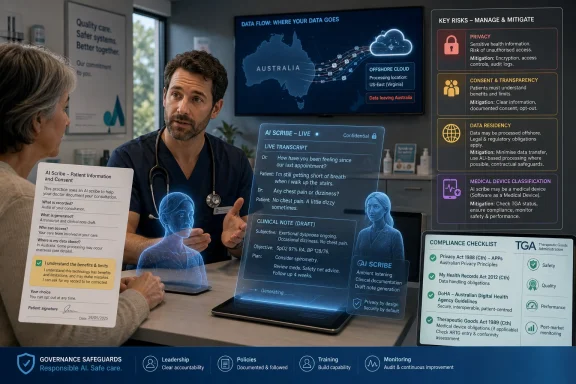
Australian health officials have warned in 2026 that doctors’ rapidly growing use of AI scribes may be outpacing privacy, consent, and medical-device safeguards, after Guardian Australia obtained federal briefing documents raising concerns about opaque vendors, offshore data handling, and inconsistent patient consent.
The warning is not an anti-AI broadside. It is more awkward than that: the technology appears genuinely useful, clinicians are adopting it quickly, and the regulatory system is discovering that a tool sold as administrative convenience can still touch the most sensitive parts of healthcare. As first reported by Guardian Australia, the Australian government’s concern is that AI scribes have moved from novelty to infrastructure before patients, regulators, and even some suppliers have fully agreed what they are.
For all the theatrical promises attached to generative AI, the medical scribe is one of the few use cases that has escaped the demo stage. The pitch is simple: a doctor speaks with a patient, software records or listens to the consultation, and an AI system turns the encounter into clinical notes, summaries, referrals, or letters. In a system where doctors often spend hours documenting work after the human part of the appointment is over, that is not a futuristic fantasy. It is a very practical attack on a very boring problem.
That is why adoption has moved so quickly. According to the Royal Australian College of General Practitioners poll cited by Guardian Australia, use of AI scribes among Australian doctors nearly doubled from 22 percent in August 2024 to 40 percent in November 2025. Those figures are not the same as a national census, but they are enough to show momentum. In less than a year and a half, AI note-taking went from early-adopter experiment to something approaching normal clinical workflow.
The vendors have every incentive to accelerate that shift. The technology can be marketed as a relief valve for burnout, a productivity enhancer, and a way to let doctors look at patients rather than keyboards. Some companies say their systems have been used hundreds of millions of times globally in the past 18 months, according to Guardian Australia’s reporting. That scale matters because each use is not merely a productivity event. It is a medically intimate conversation being processed by software.
The privacy problem begins precisely where the product pitch is strongest. AI scribes are useful because they sit close to the consultation itself. They capture context, nuance, symptoms, medication histories, worries, family details, mental health disclosures, and the ordinary messiness of speech. In other words, they are not handling generic office chatter. They are handling the raw material of care.
The Therapeutic Goods Administration has already tried to draw a line. Its guidance says digital scribes are regulated as medical devices under the Therapeutic Goods Act if they have a therapeutic purpose and meet the legal definition of a medical device. A scribe that merely transcribes or translates a consultation into written records without analysis or interpretation is generally not treated as a medical device. A product that generates a diagnosis, differential diagnosis, treatment recommendation, or other clinical interpretation may cross the line.
That distinction is tidy on paper and messy in practice. Modern AI scribes rarely feel like tape recorders. They summarize, structure, omit, emphasize, convert speech into clinical language, and may produce drafts that look authoritative enough to slide into a patient record. Even if a vendor insists the tool is not diagnosing anyone, the output can still shape what a doctor notices, what the record preserves, and what another clinician later reads.
This is the regulatory gap that should worry IT professionals as much as healthcare lawyers. Software does not need to make an explicit treatment recommendation to affect downstream decisions. A bad summary, missing caveat, misattributed symptom, or hallucinated detail can become part of the record. Once there, it can influence future care, insurance processes, referrals, audits, and national digital health infrastructure.
The department’s April AI advisory material reportedly acknowledged the productivity upside while warning that scribes share the limitations of other large language models in quality and accuracy. That is the crux. AI scribes are being sold as clerical helpers, but the clinical note is not just paperwork. It is a memory system for medicine.
That is a higher bar than a checkbox. A patient cannot meaningfully consent to an AI scribe if they are merely told that “software will help take notes.” They need to know whether audio is recorded, whether it is retained, whether transcripts are stored, where data is processed, whether subcontractors are involved, whether the vendor uses data to improve models, and what happens if they refuse.
This is not an abstract concern. Guardian Australia previously reported complaints from patients about doctors not seeking adequate consent, and it reported that one Melbourne psychiatrist refused to accept patients who would not consent to AI note-taking. The Consumer Health Forum’s chief executive, Dr Elizabeth Deveny, told Guardian Australia that patients have increasingly reported being told they may need to find a different provider if they do not agree to AI scribes.
That flips consent into coercion by workflow. In theory, a patient has a choice. In practice, the choice may be between accepting a technology they do not understand or losing access to a clinician. In healthcare, where continuity, urgency, geography, cost, and power imbalance already constrain patient choice, that is not a trivial distinction.
The privacy commissioner, Carly Kind, has also been watching the rollout. In a May speech, she said the Office of the Australian Information Commissioner had been tracking AI scribe technology closely, including discussions with the RACGP ethics committee and scribe providers. She also pointed to concerns from civil society about consent protocols and gaps in privacy-policy disclosure. That is regulator-speak for a familiar pattern: deployment first, governance later.
AI products often sit on layered infrastructure. A local vendor may use a speech-to-text provider, a cloud storage service, a large language model API, analytics tooling, logging infrastructure, support platforms, and monitoring services. Each layer may create its own data flows. A vendor can sincerely advertise privacy compliance while still relying on technical dependencies that complicate where data goes and who can access it.
For healthcare, that is explosive. Medical information is among the most sensitive categories of personal data. It includes diagnoses, medications, sexual health, mental health, family history, disability, addiction, trauma, and other details people may not disclose anywhere else. If a cloud service processes that data offshore, the practical risks are not limited to whether a statute technically permits it. The risks include jurisdiction, breach response, contractual enforceability, auditability, and patient trust.
This is also where AI scribes become a WindowsForum story rather than only an Australian health-policy story. Enterprise IT has seen this movie in other sectors. A useful SaaS tool enters through a departmental need, spreads because it saves time, and only later does someone ask where the data lives, what logs are retained, which subprocessors are involved, and whether the procurement process ever saw a real architecture diagram.
In healthcare, “shadow AI” is not just employees pasting text into a chatbot. It can be a practice-wide ambient documentation system introduced because it makes clinicians’ days more manageable. The intent may be benign, but the data exposure can be enormous. Privacy risk is not measured by malice. It is measured by access, retention, and failure modes.
If a scribe helps a doctor produce more complete documentation, it may support more accurate billing. That is not inherently improper. Healthcare systems often depend on documentation to justify complexity, time, chronic disease management, and follow-up. Under-documentation can be a real problem.
But a revenue-increase pitch creates a different incentive structure. It suggests that the AI system is not merely removing administrative friction but potentially helping clinicians capture more billable activity from the same consultations. The health department reportedly noted implications for Medicare Benefits Schedule costs, which is exactly the kind of downstream effect regulators should be studying before deployment becomes too entrenched to unwind.
The harder question is whether time saved becomes time returned to patients. Deveny put it well in Guardian Australia’s report: if scribes save clinicians time, the public deserves to know whether that means better care, better access, or simply more billable activity. That is not cynicism. It is a demand to measure outcomes rather than assume them.
Healthcare technology often arrives wrapped in the language of efficiency. Efficiency for whom is the missing clause. A tool can reduce a doctor’s paperwork, increase a clinic’s revenue, expand vendor margins, and still leave patients with less control over their data. The public interest depends on which of those gains is real, which is measurable, and which is merely redistributed risk.
The RACGP has advised doctors to carefully review AI scribe output for false positives and false negatives and to edit text as required. That is sensible guidance, but it also reveals the operational burden hidden inside the product. The tool saves time only if review is faster than writing. It improves safety only if the clinician catches errors. It improves documentation only if the final note reflects what happened rather than what the model inferred.
The difficulty is that AI-generated prose can be fluent even when it is wrong. That is the now-familiar large language model trap: the output looks finished. In a busy clinic, polished text may invite lighter review than a rough transcript. A doctor who is already overloaded may trust the software more than they should, especially after dozens of acceptable outputs.
There is also the risk of subtle clinical framing. A scribe may turn a patient’s hesitant description into a crisp medical phrase. It may compress uncertainty into apparent fact. It may remove emotional context that matters in mental health or chronic pain. It may normalize the doctor’s interpretation while underrepresenting the patient’s own words.
None of this means AI scribes cannot be safe. It means safety depends on workflow design, training, auditing, and accountability. “The doctor remains responsible” is legally neat but operationally incomplete. If a system predictably produces certain classes of error, responsibility cannot stop at the clinician’s mouse click.
Patchwork regulation is not always bad. Complex systems often require multiple watchdogs. But it becomes a problem when vendors, clinics, and patients cannot easily tell which rule applies to which part of the workflow. If a scribe is “not a medical device,” that does not mean it is safe. If it is “privacy compliant,” that does not mean patients gave informed consent. If a doctor remains clinically accountable, that does not mean the software’s design is irrelevant.
The TGA’s current review of digital scribes is therefore important, but it is unlikely to solve the entire problem by itself. The agency can clarify when a scribe crosses into medical-device territory, especially when it analyses or interprets clinical conversations. It can push industry to understand regulatory requirements. It can publish review outcomes. But the core issue is broader than classification.
AI scribes sit at the intersection of medical software, cloud procurement, professional ethics, privacy law, patient communication, and billing incentives. A regulatory answer that only asks whether the product has a therapeutic purpose will miss the broader governance question: what obligations attach to any system that listens to care and helps write the record?
This is where Microsoft, Google, Amazon, and the wider enterprise software ecosystem loom in the background even when they are not named in every clinic contract. The healthcare AI stack is built on cloud, identity, storage, APIs, endpoint security, and compliance tooling. The same questions IT departments ask about Microsoft 365 Copilot, Teams transcription, or cloud data residency now apply in miniature to a GP consultation room.
The best version of the AI scribe is not hard to imagine. The patient is clearly told what the tool does. Consent is optional and refusal does not compromise access to care. Audio is not retained unless necessary. Data stays in approved jurisdictions. The clinician reviews every note carefully. The vendor is transparent about subprocessors, model behavior, retention, and security. The practice audits errors and updates policies as the tool changes.
That version is not science fiction. It is procurement discipline. It is the difference between treating AI scribes as clinical infrastructure and treating them as a clever app subscription.
Doctors also have legitimate complaints about the status quo. Manual notes are not magically safe or complete. Human clinicians forget details, write ambiguously, copy forward errors, and document under pressure. Human scribes introduce their own privacy and accuracy issues. The comparison should not be between AI and perfection. It should be between AI-enabled workflow and the messy reality it replaces.
Still, usefulness does not erase consent. A tool can be beneficial and still require stricter guardrails. In fact, the more useful a tool is, the more likely it is to spread — and the more urgent governance becomes.
The social contract of medicine has always included confidentiality. Patients disclose sensitive information because they trust the clinician and the clinical setting. AI scribes complicate that trust relationship by adding actors whose role is not obvious. Even if every actor is bound by contract, the patient experience changes.
The danger is that healthcare normalizes ambient recording before patients have had a chance to object meaningfully. Once a practice builds its workflow around scribes, opting out can become burdensome. Staff may have to switch modes, doctors may lose time, and patients may be made to feel difficult. That is how optional technology becomes default infrastructure.
A good consent process must therefore be more than a form. It should be conversational, specific, and repeatable. It should explain that the AI output may contain errors. It should explain what data is captured and where it goes. It should make refusal ordinary. Most importantly, it should not make care conditional on surrendering privacy except in genuinely exceptional circumstances.
The Melbourne psychiatrist example reported by Guardian Australia is significant because it exposes the pressure point. If specialists can refuse patients who decline AI note-taking, then consent becomes entangled with access. Regulators will need to decide whether that is acceptable professional practice, and under what conditions.
If an AI scribe is on by default, patients will rarely challenge it. If consent is bundled into intake paperwork, many will sign without understanding it. If refusal slows the appointment or irritates the provider, patients will learn to comply. If the generated note drops into the record with minimal friction, clinicians will learn to trust it.
That is why the government’s warning should not be dismissed as bureaucratic caution. The deployment model matters as much as the model accuracy. A flawed tool used rarely and carefully is one kind of risk. A mostly good tool used constantly, opaquely, and by default is another.
Enterprise technology history is full of systems that became unavoidable before governance caught up. Email retention, cloud storage, mobile device management, telemetry, workplace chat, and meeting transcription all followed some version of the same arc. First came convenience. Then came scale. Then came the painful discovery that convenience had quietly rewritten policy.
Healthcare has less room for that kind of improvisation. A botched meeting summary is annoying. A botched medical note can follow a patient for years.
That starts with procurement. Clinics should know the vendor’s data flows, retention settings, subprocessors, security certifications, breach procedures, model-training policies, and data-residency guarantees before the tool touches a patient consultation. “Privacy compliant” should not be accepted as a magic phrase. It should be unpacked into testable claims.
It also requires technical controls. Practices need configurable retention, audit logs, access controls, encryption, role-based permissions, and clear deletion processes. They need a way to disable model training on patient data where appropriate. They need templates that record consent status without burying it. They need integration that preserves review as a required step rather than a polite suggestion.
Regulators can help by standardizing expectations. A national baseline for AI scribe consent would reduce variation between practices. A plain-language patient notice could become as routine as financial consent or privacy collection notices. A public register of products that meet certain health-data and transparency standards could help smaller clinics that lack enterprise procurement teams.
The hard part is enforcement. Guidance alone will not stop bad workflows if revenue and convenience point the other way. Regulators need complaint pathways patients can use, audit powers that reach vendors as well as clinicians, and consequences for misleading claims about privacy or medical-device status.
That shift matters because records are power. They define what happened, what was considered, what was ruled out, what follow-up is needed, and what can be billed. They travel between providers and institutions. They may be used in complaints, litigation, insurance, research, and government systems. If AI changes the record, AI changes medicine’s institutional memory.
The department’s warning about the integrity of data held within national digital health infrastructure is therefore not bureaucratic overreach. It is the central issue. Once AI-generated notes enter large health systems, their errors and biases can compound. They can be copied, summarized again, searched, analyzed, and used to train future systems. Bad data does not stay local.
That is the nightmare version. The optimistic version is also plausible: better structured notes, more complete histories, less clinician fatigue, and more consistent documentation. The difference between those futures will not be decided by the abstract quality of generative AI. It will be decided by governance, incentives, and whether patients retain real agency in the consultation room.
That is enough to justify action now, before every practice has normalized its own ad hoc policy.
The warning is not an anti-AI broadside. It is more awkward than that: the technology appears genuinely useful, clinicians are adopting it quickly, and the regulatory system is discovering that a tool sold as administrative convenience can still touch the most sensitive parts of healthcare. As first reported by Guardian Australia, the Australian government’s concern is that AI scribes have moved from novelty to infrastructure before patients, regulators, and even some suppliers have fully agreed what they are.
 The Clinic Has Found Its Killer App for Generative AI
For all the theatrical promises attached to generative AI, the medical scribe is one of the few use cases that has escaped the demo stage. The pitch is simple: a doctor speaks with a patient, software records or listens to the consultation, and an AI system turns the encounter into clinical notes, summaries, referrals, or letters. In a system where doctors often spend hours documenting work after the human part of the appointment is over, that is not a futuristic fantasy. It is a very practical attack on a very boring problem.That is why adoption has moved so quickly. According to the Royal Australian College of General Practitioners poll cited by Guardian Australia, use of AI scribes among Australian doctors nearly doubled from 22 percent in August 2024 to 40 percent in November 2025. Those figures are not the same as a national census, but they are enough to show momentum. In less than a year and a half, AI note-taking went from early-adopter experiment to something approaching normal clinical workflow.
The vendors have every incentive to accelerate that shift. The technology can be marketed as a relief valve for burnout, a productivity enhancer, and a way to let doctors look at patients rather than keyboards. Some companies say their systems have been used hundreds of millions of times globally in the past 18 months, according to Guardian Australia’s reporting. That scale matters because each use is not merely a productivity event. It is a medically intimate conversation being processed by software.
The privacy problem begins precisely where the product pitch is strongest. AI scribes are useful because they sit close to the consultation itself. They capture context, nuance, symptoms, medication histories, worries, family details, mental health disclosures, and the ordinary messiness of speech. In other words, they are not handling generic office chatter. They are handling the raw material of care.
The Government Is Worried About the Space Between “Admin Tool” and “Medical Device”
The most revealing phrase in the health department documents, as reported by Guardian Australia, is that AI scribes have “little oversight.” That does not mean there is no law at all. It means Australia’s current oversight is split between different regimes that were not designed around a cloud-based assistant listening to a private clinical encounter and generating medical records from it.The Therapeutic Goods Administration has already tried to draw a line. Its guidance says digital scribes are regulated as medical devices under the Therapeutic Goods Act if they have a therapeutic purpose and meet the legal definition of a medical device. A scribe that merely transcribes or translates a consultation into written records without analysis or interpretation is generally not treated as a medical device. A product that generates a diagnosis, differential diagnosis, treatment recommendation, or other clinical interpretation may cross the line.
That distinction is tidy on paper and messy in practice. Modern AI scribes rarely feel like tape recorders. They summarize, structure, omit, emphasize, convert speech into clinical language, and may produce drafts that look authoritative enough to slide into a patient record. Even if a vendor insists the tool is not diagnosing anyone, the output can still shape what a doctor notices, what the record preserves, and what another clinician later reads.
This is the regulatory gap that should worry IT professionals as much as healthcare lawyers. Software does not need to make an explicit treatment recommendation to affect downstream decisions. A bad summary, missing caveat, misattributed symptom, or hallucinated detail can become part of the record. Once there, it can influence future care, insurance processes, referrals, audits, and national digital health infrastructure.
The department’s April AI advisory material reportedly acknowledged the productivity upside while warning that scribes share the limitations of other large language models in quality and accuracy. That is the crux. AI scribes are being sold as clerical helpers, but the clinical note is not just paperwork. It is a memory system for medicine.
Privacy Compliance Is Not the Same as Patient Understanding
The consent issue is where the technology collides most directly with patient autonomy. The health department noted significant variation in how clinicians and practices obtained consent, according to Guardian Australia. The department’s position was blunt: informed consent requires consumers to understand the benefits and limitations of the technology they are agreeing to use.That is a higher bar than a checkbox. A patient cannot meaningfully consent to an AI scribe if they are merely told that “software will help take notes.” They need to know whether audio is recorded, whether it is retained, whether transcripts are stored, where data is processed, whether subcontractors are involved, whether the vendor uses data to improve models, and what happens if they refuse.
This is not an abstract concern. Guardian Australia previously reported complaints from patients about doctors not seeking adequate consent, and it reported that one Melbourne psychiatrist refused to accept patients who would not consent to AI note-taking. The Consumer Health Forum’s chief executive, Dr Elizabeth Deveny, told Guardian Australia that patients have increasingly reported being told they may need to find a different provider if they do not agree to AI scribes.
That flips consent into coercion by workflow. In theory, a patient has a choice. In practice, the choice may be between accepting a technology they do not understand or losing access to a clinician. In healthcare, where continuity, urgency, geography, cost, and power imbalance already constrain patient choice, that is not a trivial distinction.
The privacy commissioner, Carly Kind, has also been watching the rollout. In a May speech, she said the Office of the Australian Information Commissioner had been tracking AI scribe technology closely, including discussions with the RACGP ethics committee and scribe providers. She also pointed to concerns from civil society about consent protocols and gaps in privacy-policy disclosure. That is regulator-speak for a familiar pattern: deployment first, governance later.
Offshore Data Is the Quiet Risk in the Room
One of the department’s sharper concerns was that some suppliers may not even know their cloud platforms send data outside Australia. That line should make every sysadmin sit up straight. If accurate, it suggests not merely a paperwork failure but a supply-chain visibility problem inside a healthcare workflow.AI products often sit on layered infrastructure. A local vendor may use a speech-to-text provider, a cloud storage service, a large language model API, analytics tooling, logging infrastructure, support platforms, and monitoring services. Each layer may create its own data flows. A vendor can sincerely advertise privacy compliance while still relying on technical dependencies that complicate where data goes and who can access it.
For healthcare, that is explosive. Medical information is among the most sensitive categories of personal data. It includes diagnoses, medications, sexual health, mental health, family history, disability, addiction, trauma, and other details people may not disclose anywhere else. If a cloud service processes that data offshore, the practical risks are not limited to whether a statute technically permits it. The risks include jurisdiction, breach response, contractual enforceability, auditability, and patient trust.
This is also where AI scribes become a WindowsForum story rather than only an Australian health-policy story. Enterprise IT has seen this movie in other sectors. A useful SaaS tool enters through a departmental need, spreads because it saves time, and only later does someone ask where the data lives, what logs are retained, which subprocessors are involved, and whether the procurement process ever saw a real architecture diagram.
In healthcare, “shadow AI” is not just employees pasting text into a chatbot. It can be a practice-wide ambient documentation system introduced because it makes clinicians’ days more manageable. The intent may be benign, but the data exposure can be enormous. Privacy risk is not measured by malice. It is measured by access, retention, and failure modes.
The Revenue Claim Gives the Game Away
The department also flagged another uncomfortable detail: some suppliers advertised a 30 percent revenue increase for health professionals with no additional hours or patient consultations, according to Guardian Australia. That claim deserves more attention than it has received. It changes the story from “AI reduces burnout” to “AI may alter billing behavior.”If a scribe helps a doctor produce more complete documentation, it may support more accurate billing. That is not inherently improper. Healthcare systems often depend on documentation to justify complexity, time, chronic disease management, and follow-up. Under-documentation can be a real problem.
But a revenue-increase pitch creates a different incentive structure. It suggests that the AI system is not merely removing administrative friction but potentially helping clinicians capture more billable activity from the same consultations. The health department reportedly noted implications for Medicare Benefits Schedule costs, which is exactly the kind of downstream effect regulators should be studying before deployment becomes too entrenched to unwind.
The harder question is whether time saved becomes time returned to patients. Deveny put it well in Guardian Australia’s report: if scribes save clinicians time, the public deserves to know whether that means better care, better access, or simply more billable activity. That is not cynicism. It is a demand to measure outcomes rather than assume them.
Healthcare technology often arrives wrapped in the language of efficiency. Efficiency for whom is the missing clause. A tool can reduce a doctor’s paperwork, increase a clinic’s revenue, expand vendor margins, and still leave patients with less control over their data. The public interest depends on which of those gains is real, which is measurable, and which is merely redistributed risk.
Accuracy Is a Safety Problem Wearing an Office-Product Costume
AI scribes are often described as if they are in the same family as meeting transcription tools. That comparison is comforting and wrong. A corporate meeting transcript can be embarrassing if it misses a nuance. A clinical note can be dangerous if it misstates a medication, invents a symptom, or omits uncertainty.The RACGP has advised doctors to carefully review AI scribe output for false positives and false negatives and to edit text as required. That is sensible guidance, but it also reveals the operational burden hidden inside the product. The tool saves time only if review is faster than writing. It improves safety only if the clinician catches errors. It improves documentation only if the final note reflects what happened rather than what the model inferred.
The difficulty is that AI-generated prose can be fluent even when it is wrong. That is the now-familiar large language model trap: the output looks finished. In a busy clinic, polished text may invite lighter review than a rough transcript. A doctor who is already overloaded may trust the software more than they should, especially after dozens of acceptable outputs.
There is also the risk of subtle clinical framing. A scribe may turn a patient’s hesitant description into a crisp medical phrase. It may compress uncertainty into apparent fact. It may remove emotional context that matters in mental health or chronic pain. It may normalize the doctor’s interpretation while underrepresenting the patient’s own words.
None of this means AI scribes cannot be safe. It means safety depends on workflow design, training, auditing, and accountability. “The doctor remains responsible” is legally neat but operationally incomplete. If a system predictably produces certain classes of error, responsibility cannot stop at the clinician’s mouse click.
The Patchwork Regulator Model Is Showing Its Age
Australia’s oversight of AI scribes sits across the Therapeutic Goods Administration, the Australian Health Practitioner Regulation Agency, and the Office of the Australian Information Commissioner. Each regulator sees a different part of the elephant. The TGA looks at whether a product is a medical device. Ahpra looks at professional conduct. The OAIC looks at privacy obligations. None alone owns the full patient experience of an AI-mediated consultation.Patchwork regulation is not always bad. Complex systems often require multiple watchdogs. But it becomes a problem when vendors, clinics, and patients cannot easily tell which rule applies to which part of the workflow. If a scribe is “not a medical device,” that does not mean it is safe. If it is “privacy compliant,” that does not mean patients gave informed consent. If a doctor remains clinically accountable, that does not mean the software’s design is irrelevant.
The TGA’s current review of digital scribes is therefore important, but it is unlikely to solve the entire problem by itself. The agency can clarify when a scribe crosses into medical-device territory, especially when it analyses or interprets clinical conversations. It can push industry to understand regulatory requirements. It can publish review outcomes. But the core issue is broader than classification.
AI scribes sit at the intersection of medical software, cloud procurement, professional ethics, privacy law, patient communication, and billing incentives. A regulatory answer that only asks whether the product has a therapeutic purpose will miss the broader governance question: what obligations attach to any system that listens to care and helps write the record?
This is where Microsoft, Google, Amazon, and the wider enterprise software ecosystem loom in the background even when they are not named in every clinic contract. The healthcare AI stack is built on cloud, identity, storage, APIs, endpoint security, and compliance tooling. The same questions IT departments ask about Microsoft 365 Copilot, Teams transcription, or cloud data residency now apply in miniature to a GP consultation room.
Doctors Are Not Wrong to Want This
It would be easy to frame the story as reckless doctors embracing shiny AI at patients’ expense. That would be unfair. Clinical documentation is a genuine burden, and burnout is not a slogan. If AI scribes can reduce after-hours charting, improve note completeness, and help doctors focus on patients during appointments, the technology deserves serious consideration.The best version of the AI scribe is not hard to imagine. The patient is clearly told what the tool does. Consent is optional and refusal does not compromise access to care. Audio is not retained unless necessary. Data stays in approved jurisdictions. The clinician reviews every note carefully. The vendor is transparent about subprocessors, model behavior, retention, and security. The practice audits errors and updates policies as the tool changes.
That version is not science fiction. It is procurement discipline. It is the difference between treating AI scribes as clinical infrastructure and treating them as a clever app subscription.
Doctors also have legitimate complaints about the status quo. Manual notes are not magically safe or complete. Human clinicians forget details, write ambiguously, copy forward errors, and document under pressure. Human scribes introduce their own privacy and accuracy issues. The comparison should not be between AI and perfection. It should be between AI-enabled workflow and the messy reality it replaces.
Still, usefulness does not erase consent. A tool can be beneficial and still require stricter guardrails. In fact, the more useful a tool is, the more likely it is to spread — and the more urgent governance becomes.
Patients Are Being Asked to Trust a System They Cannot See
For patients, the AI scribe may feel like an invisible third party in the room. That is not paranoia. It is a reasonable description of the architecture. A consultation that once involved doctor and patient may now involve a device microphone, an app, a vendor, cloud infrastructure, model providers, logs, support access, and data-processing agreements no patient will ever read.The social contract of medicine has always included confidentiality. Patients disclose sensitive information because they trust the clinician and the clinical setting. AI scribes complicate that trust relationship by adding actors whose role is not obvious. Even if every actor is bound by contract, the patient experience changes.
The danger is that healthcare normalizes ambient recording before patients have had a chance to object meaningfully. Once a practice builds its workflow around scribes, opting out can become burdensome. Staff may have to switch modes, doctors may lose time, and patients may be made to feel difficult. That is how optional technology becomes default infrastructure.
A good consent process must therefore be more than a form. It should be conversational, specific, and repeatable. It should explain that the AI output may contain errors. It should explain what data is captured and where it goes. It should make refusal ordinary. Most importantly, it should not make care conditional on surrendering privacy except in genuinely exceptional circumstances.
The Melbourne psychiatrist example reported by Guardian Australia is significant because it exposes the pressure point. If specialists can refuse patients who decline AI note-taking, then consent becomes entangled with access. Regulators will need to decide whether that is acceptable professional practice, and under what conditions.
The Windows Lesson Is That Defaults Become Policy
Readers of this site understand the power of defaults. Microsoft can describe a setting as optional, but if it is enabled by default, integrated into setup, or required for the smooth path, it becomes the real policy for most users. The same logic applies in clinics.If an AI scribe is on by default, patients will rarely challenge it. If consent is bundled into intake paperwork, many will sign without understanding it. If refusal slows the appointment or irritates the provider, patients will learn to comply. If the generated note drops into the record with minimal friction, clinicians will learn to trust it.
That is why the government’s warning should not be dismissed as bureaucratic caution. The deployment model matters as much as the model accuracy. A flawed tool used rarely and carefully is one kind of risk. A mostly good tool used constantly, opaquely, and by default is another.
Enterprise technology history is full of systems that became unavoidable before governance caught up. Email retention, cloud storage, mobile device management, telemetry, workplace chat, and meeting transcription all followed some version of the same arc. First came convenience. Then came scale. Then came the painful discovery that convenience had quietly rewritten policy.
Healthcare has less room for that kind of improvisation. A botched meeting summary is annoying. A botched medical note can follow a patient for years.
The Safeguards Have to Move From Advice to Infrastructure
The obvious answer is not to ban AI scribes. A ban would be disproportionate, probably unenforceable, and likely harmful if the tools genuinely reduce administrative overload. The better answer is to make safe deployment the easy deployment.That starts with procurement. Clinics should know the vendor’s data flows, retention settings, subprocessors, security certifications, breach procedures, model-training policies, and data-residency guarantees before the tool touches a patient consultation. “Privacy compliant” should not be accepted as a magic phrase. It should be unpacked into testable claims.
It also requires technical controls. Practices need configurable retention, audit logs, access controls, encryption, role-based permissions, and clear deletion processes. They need a way to disable model training on patient data where appropriate. They need templates that record consent status without burying it. They need integration that preserves review as a required step rather than a polite suggestion.
Regulators can help by standardizing expectations. A national baseline for AI scribe consent would reduce variation between practices. A plain-language patient notice could become as routine as financial consent or privacy collection notices. A public register of products that meet certain health-data and transparency standards could help smaller clinics that lack enterprise procurement teams.
The hard part is enforcement. Guidance alone will not stop bad workflows if revenue and convenience point the other way. Regulators need complaint pathways patients can use, audit powers that reach vendors as well as clinicians, and consequences for misleading claims about privacy or medical-device status.
The AI Scribe Fight Is Really About Who Controls the Medical Record
The medical record used to be a clinician-authored artifact. Imperfect, sometimes illegible, often rushed — but clearly produced by the healthcare provider. AI scribes introduce a new authorial layer. The note becomes a collaboration between patient speech, clinician prompts, model interpretation, template design, and vendor choices.That shift matters because records are power. They define what happened, what was considered, what was ruled out, what follow-up is needed, and what can be billed. They travel between providers and institutions. They may be used in complaints, litigation, insurance, research, and government systems. If AI changes the record, AI changes medicine’s institutional memory.
The department’s warning about the integrity of data held within national digital health infrastructure is therefore not bureaucratic overreach. It is the central issue. Once AI-generated notes enter large health systems, their errors and biases can compound. They can be copied, summarized again, searched, analyzed, and used to train future systems. Bad data does not stay local.
That is the nightmare version. The optimistic version is also plausible: better structured notes, more complete histories, less clinician fatigue, and more consistent documentation. The difference between those futures will not be decided by the abstract quality of generative AI. It will be decided by governance, incentives, and whether patients retain real agency in the consultation room.
The Warning Signs Are Already Specific Enough to Act
The most important point in Guardian Australia’s reporting is that the concerns are no longer theoretical. The government has identified limited oversight, inconsistent consent, possible offshore data transfers, accuracy limitations, and billing implications. The TGA is reviewing the sector. The privacy commissioner is engaging with providers and civil society. Consumer advocates are hearing from patients who feel pressured.That is enough to justify action now, before every practice has normalized its own ad hoc policy.
- Doctors should treat AI scribe output as a draft clinical document that requires active review, correction, and accountability before it enters the record.
- Clinics should make refusal of AI scribe use a practical option that does not punish patients or quietly degrade access to care.
- Vendors should disclose data residency, subprocessors, retention, model-training practices, and whether any feature could move the product toward medical-device regulation.
- Regulators should align privacy, professional conduct, billing, and medical-device guidance so practices cannot hide in the gaps between agencies.
- Patients should be told plainly when an AI scribe is in use, what it captures, what happens to the data, and what risks remain even when the system works as intended.
References
- Primary source: The Guardian
Published: Sat, 04 Jul 2026 20:00:00 GMT
Doctors’ soaring use of AI scribes prompts Australian government warning over privacy | Health | The Guardian
<strong>Exclusive:</strong> With the technology fast becoming popular in GP surgeries, regulators are monitoring its implementation and potential pitfallswww.theguardian.com - Related coverage: tga.gov.au
- Related coverage: consultations.tga.gov.au
- Related coverage: ai-pulse-ashen.vercel.app
40% of Australian GPs Now Use AI Scribes — But Consent and Care Quality Hang in the Balance | AI Pulse
AI medical scribes, which record and summarize doctor-patient consultations, have surged in adoption among Australian GPs — nearly doubling from 22% to 40% b…ai-pulse-ashen.vercel.app
- Related coverage: racgp.org.au
RACGP - Artificial intelligence (AI) scribes
An artificial intelligence (AI) scribe is a tool that can automate parts of the clinical documentation process for a medical practitionerwww.racgp.org.au - Related coverage: lyrebirdhealth.com
TGA Regulation and AI Scribes | Lyrebird Health
The Therapeutic Goods Administration published guidance on digital scribes in August 2025, consolidating a regulatory position that had been developing across 2024 and 2025. The TGA's digital scribes guidance page addresses when a digital scribe is regulated as a medical device under the...www.lyrebirdhealth.com
- Related coverage: medicalrepublic.com.au
How did AI scribes slip through the TGA loophole? - Medical Republic
The TGA has admitted it’s reviewing all 200 AI scribes in the market. A key question is whether the scribes replace a clinical function. www.medicalrepublic.com.au
- Related coverage: www1.racgp.org.au
