

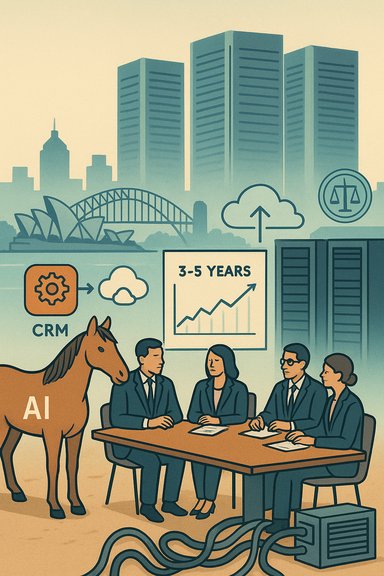
Artificial intelligence is not an overnight revolution for Australian workplaces — it is proving, by the evidence, to be a slow horse that businesses are saddling carefully and unevenly, with most firms expecting the peak effect on staffing to arrive years from now rather than tomorrow.
The Reserve Bank of Australia’s recent liaison with a broad cross-section of firms finds AI adoption is widespread in name but shallow in practice: while around two-thirds of surveyed firms report using AI in some form, nearly 40 percent describe their use as minimal, typically limited to off‑the‑shelf digital assistants such as Copilot or ChatGPT for discrete tasks like email summarisation and ad hoc research. Firms report that embedding AI across workflows — and reaping meaningful productivity gains — will require substantial complementary investment in systems, staff training and managerial change. As a result, many firms expect a lag before AI materially affects headcount, often estimating a three‑to‑five‑year timeline for peak staffing impacts from AI deployment.
At the same time, an unmistakable wave of data‑centre construction and capacity expansion is underway worldwide and in Australia. Hyperscalers and cloud providers are committing large capital outlays to host AI workloads, pushing data‑centre operators and industrial real‑estate players into expansion mode. In Australia, major players that dominate the listed data‑centre and infrastructure exposure — firms such as NextDC and Goodman Group — have been central to that build‑out, reflecting rising demand signals for compute, storage and connectivity that AI applications require.
Those two strands — cautious, gradual AI adoption inside firms and outsized infrastructure investment outside them — shape the current economic narrative: companies are preparing for a heavier AI future, but most practical, day‑to‑day change still lies ahead.
Key characteristics of the AI infrastructure cycle:
Policy makers, business leaders and workers should treat the current moment as an opportunity to align investments in data, power and skills with responsible governance. The slow‑horse reality means there is time to manage the transition — but it is also a call to act deliberately, because the benefits of getting the foundations right will be reaped over the medium term by those who do.
(Where commentary repeats specific monetary or employment statistics beyond central bank survey findings, those figures should be cross‑checked with the original company filings, ABS releases or central bank bulletins before being used as definitive benchmarks.
Source: Switzer Daily Artificial intelligence proving to be a slow horse - Switzer Daily
 Background: what the latest firm-level evidence shows
The Reserve Bank of Australia’s recent liaison with a broad cross-section of firms finds AI adoption is widespread in name but shallow in practice: while around two-thirds of surveyed firms report using AI in some form, nearly 40 percent describe their use as minimal, typically limited to off‑the‑shelf digital assistants such as Copilot or ChatGPT for discrete tasks like email summarisation and ad hoc research. Firms report that embedding AI across workflows — and reaping meaningful productivity gains — will require substantial complementary investment in systems, staff training and managerial change. As a result, many firms expect a lag before AI materially affects headcount, often estimating a three‑to‑five‑year timeline for peak staffing impacts from AI deployment.At the same time, an unmistakable wave of data‑centre construction and capacity expansion is underway worldwide and in Australia. Hyperscalers and cloud providers are committing large capital outlays to host AI workloads, pushing data‑centre operators and industrial real‑estate players into expansion mode. In Australia, major players that dominate the listed data‑centre and infrastructure exposure — firms such as NextDC and Goodman Group — have been central to that build‑out, reflecting rising demand signals for compute, storage and connectivity that AI applications require.
Those two strands — cautious, gradual AI adoption inside firms and outsized infrastructure investment outside them — shape the current economic narrative: companies are preparing for a heavier AI future, but most practical, day‑to‑day change still lies ahead.
Overview: key facts and verifications
What firms actually told the RBA
- Around two‑thirds of surveyed firms report some form of AI adoption; adoption intensity varies widely.
- Adoption intensity is "shallow to date" for many firms, with nearly 40% indicating minimal use — mostly off‑the‑shelf tools for isolated tasks rather than integrated AI systems.
- Firms generally expect technology investments to lift productivity only after organisational changes, retraining and process re‑engineering.
- For most technologies the expected employer‑side effect on headcount is within one to three years; for AI specifically the anticipated lag to peak headcount impact is longer — roughly three to five years.
These are direct findings from the RBA’s firm liaison work and represent employers’ own expectations and reported behaviours.
Data‑centre expansion and capex dynamics
- Globally, hyperscalers (the largest cloud/AI platform operators) have signalled large capital expenditure programmes to scale AI‑capable infrastructure. That expansion is creating demand for new, AI‑ready data centres and heavy infrastructure spending on power, cooling and networking layers.
- In Australia, industrial property and specialist data‑centre developers are reporting sizable work‑in‑progress pipelines and capital‑raising programmes tied to data‑centre development. Several large listed players have publicly described multi‑billion‑dollar development pipelines and strategic shifts toward data‑centre products.
- Independent industry research and advisory reports underscore the same trend: data‑centre capacity and investment are accelerating, driven by cloud growth and AI workloads with high power and floor‑space density requirements.
Where claims required extra checking
- The RBA survey statements quoted above come directly from the Bank’s liaison summary and have been verified against the Bank’s published bulletin material.
- Industry claims about the “surge” in data‑centre construction and its macroeconomic impact are supported by multiple industry and advisory reports showing rising hyperscaler capex and data‑centre development pipelines.
- A specific line sometimes repeated in commentary — that technology companies’ investment in “machinery and equipment” rose to a record $1.4 billion in June — could not be confirmed against a single clear public statistic in government capital‑expenditure releases at the time of writing; that precise figure should be treated as unverified until reconciled with the ABS or company filings. Where specific monetary figures are quoted outside of primary releases, they require cross‑checking with company financial statements or official ABS capex releases.
Why adoption is shallow: barriers and business realities
Legacy systems, integration friction and managerial effort
Most firms still operate on legacy platforms — long‑running CRM, ERP and back‑end systems — that are not plug‑and‑play with frontier AI models. Upgrading those foundations has been a major driver of recent IT spend, but those upgrades are often positioned as risk‑management and continuity projects (cybersecurity, reliability), not immediate productivity multipliers.- Replacing or modernising legacy systems is costly and disruptive.
- AI’s real value often depends on clean, structured data and connected workflows; many firms lack that plumbing.
- Implementing AI across business lines implies workflow redesign and managerial change — an organisational challenge that takes time and leadership.
Skills bottlenecks and competition for talent
Firms repeatedly cite shortages of data engineers, machine‑learning engineers and experienced AI product managers. The global competition for these skills raises wage pressure and slows diffusion because firms without in‑house capability find it harder to move beyond pilot projects.- Labour markets for AI talent are tight; hiring is uneven and expensive.
- Smaller firms are particularly constrained; larger firms are more likely to push substantive AI projects because they can attract talent and absorb upfront costs.
Uncertainty over ROI and regulatory environment
There is genuine uncertainty about where AI will deliver a competitive return and how regulation — privacy, model governance, intellectual property — will evolve. That uncertainty makes many firms cautious about heavy upfront investment until clearer business cases or regulatory frameworks emerge.Productivity expectations: why gains are expected but deferred
Most firms see AI as an augmenting force rather than a simple automation tool. That is, companies expect AI to change job content — taking over routine tasks and accelerating decision cycles — but not to immediately shrink headcount in a linear way.- Short‑term: embedding AI typically raises demand for implementation staff (IT, project management), and headcount may temporarily increase during the transition.
- Medium to long term: firms expect role reshaping, redeployment and selective reductions where tasks are automated, with the peak effect on headcount expected several years after initial investment.
- The process resembles other major technology adoptions historically: an adjustment phase — sometimes with a J‑curve effect — where short‑term disruption precedes longer‑term productivity improvements.
Winners and losers: where job risk actually lies
Jobs most exposed in the near term
The RBA and labour‑market research converge on a common list of occupations with higher exposure to automation and AI in the near term:- Routine finance roles: bookkeeping, basic loan assessment, payroll processing.
- Administrative and clerical support: standard data entry, scheduling, document processing.
- Contact centre jobs: scripted support and first‑line customer queries.
- Junior professional roles that largely involve repetitive information‑processing tasks.
Jobs likely to grow or transform
Skills and roles that are complementary to AI adoption are in growing demand:- Engineers with AI and systems expertise (data engineers, ML engineers).
- Data architects and platform engineers who build and maintain AI‑ready infrastructure.
- Customer experience specialists and domain experts who can apply AI outputs to business decisions.
- Compliance, security and ethics professionals who manage the responsible deployment of AI.
Infrastructure and the data‑centre paradox
Why data centres are booming while firm‑level AI adoption stalls
The infrastructure market responds to long‑lead signals and hyperscaler capacity commitments rather than a firm’s immediate internal adoption cycle. Hyperscalers and cloud providers are scaling capacity to host AI workloads for global customers, creating demand for new data centre capacity even as many individual firms are still experimenting.Key characteristics of the AI infrastructure cycle:
- AI workloads are energy‑intensive and require special racks, networking, and cooling solutions.
- Hyperscalers make long‑dated capital commitments, which drive construction and long lead times for power and grid access.
- Data‑centre construction and the related power and transmission work often move ahead of enterprise application adoption because they are capacity bets that must be in place for demand to scale.
Operational constraints: power, water and community friction
Rapid expansion of data centres raises practical constraints:- Electricity supply and grid interconnection are the dominant bottlenecks in many jurisdictions.
- Cooling and water use create environmental and community impacts that can slow development.
- Local permitting and community acceptance are non‑trivial hurdles, especially for large hyperscale campuses.
Financial markets: why AI hype has a backside
Recent periods of negative sentiment toward AI‑centric equities reflect a classic mismatch between expectations and near‑term cash flow realities. Several dynamics explain the market correction in AI stocks:- Valuation compression: expectations baked into prices often outran plausible near‑term revenue growth.
- Capex strain: data‑centre and compute providers report accelerating capex needs to be AI‑ready, pressuring margins and balance sheets.
- Uncertain monetisation: enterprise customers are cautious — many are experimenting without immediately increasing cloud spend proportionately.
Risks and downside scenarios
- Over‑investment and under‑utilisation
- If demand softens or hyperscalers slow capex, newly built capacity risks long gestation periods and poor returns. This is the classic infrastructure‑boom hazard.
- Talent scarcity becomes a choke point
- Shortages in AI engineering and data talent could slow adoption, increase costs and create uneven competitive outcomes across firms and regions.
- Energy and environmental constraints
- Grid inadequacies, rising energy prices or sustainability rules could materially raise the cost of running AI workloads and slow the deployment curve.
- Regulatory shocks
- Stricter rules on AI model use, data privacy, or algorithmic accountability could increase compliance costs and delay projects.
- Uneven distribution of benefits and labour displacement
- If retraining and labour market adjustment policies lag, the social cost of displacement for some workers and communities could be significant.
Practical takeaways for enterprises, workers and policymakers
For enterprises
- Treat AI adoption as a multi‑year transformation, not a short sprint. Plan for a three‑to‑five‑year integration horizon for meaningful workforce and productivity impacts.
- Prioritise data hygiene and platform modernisation before deploying mission‑critical AI. Clean, accessible data materially reduces implementation time and risk.
- Invest in complementary capabilities: hiring or upskilling data engineers, product managers, and change leaders will accelerate conversion from pilots to production.
For workers
- Focus on uniquely human skills that complement AI: problem formulation, domain expertise, interpersonal relationships and judgement.
- Seek retraining opportunities in data literacy, automation tooling and customer experience design. Employers increasingly value hybrid skill sets (domain + data).
For policymakers
- Address skills mismatches with targeted reskilling programmes and incentives for firms to invest in on‑the‑job retraining.
- Ensure energy and grid planning anticipates data‑centre growth while protecting community and environmental outcomes.
- Create clear regulatory guardrails for AI governance that reduce uncertainty without stifling legitimate innovation.
A realistic scenario roadmap: three phases for AI’s impact on the Australian economy
- Capacity and capability build (now–2 years)
- Firms continue experiments and pilots; hyperscalers and data‑centre developers expand infrastructure; cybersecurity and legacy modernisation dominate spend.
- Embedding and role reshaping (2–5 years)
- Firms move from pilots to embedded AI in targeted workflows; demand for skilled technical roles rises; early workforce adjustments and retraining programmes scale up.
- Productivity realisation and structural adjustment (5+ years)
- Gains in output and process efficiency begin to materialise at scale; certain routine roles decline while higher‑value tasks and roles increase; labour markets adjust, with geographic and sectoral reallocation.
Conclusion: measured optimism, not panic
The empirical picture is one of tempered expectations. AI’s promise is real, but the path to broad, economy‑level productivity gains — and any large‑scale headcount effects — is uneven and measured in years, not months. That is important for workers worried about immediate job loss and for investors weighing AI‑themed assets: the transition will reward those who prepare infrastructure, train workers, and adapt business models, but it will also punish those who chase hype without addressing the foundational work required.Policy makers, business leaders and workers should treat the current moment as an opportunity to align investments in data, power and skills with responsible governance. The slow‑horse reality means there is time to manage the transition — but it is also a call to act deliberately, because the benefits of getting the foundations right will be reaped over the medium term by those who do.
(Where commentary repeats specific monetary or employment statistics beyond central bank survey findings, those figures should be cross‑checked with the original company filings, ABS releases or central bank bulletins before being used as definitive benchmarks.
Source: Switzer Daily Artificial intelligence proving to be a slow horse - Switzer Daily
