Microsoft has been ordered by Austria’s data protection authority to stop deploying tracking cookies on a pupil’s devices after a regulator found the cookies were installed without valid consent and were being used for purposes that go beyond purely educational needs. The ruling — the latest in a string of regulatory confrontations over how Big Tech handles school data — names specific cookie identifiers, rejects Microsoft’s attempt to shift responsibility to its European subsidiary, and gives the company a strict timeframe to cease the contested processing for the affected child.
Microsoft 365 Education is one of the dominant cloud suites used in schools across Europe, combining cloud-hosted Office apps, email, Teams, OneDrive and a raft of telemetry and analytics features intended to improve reliability and product development. During the pandemic, many schools adopted cloud platforms rapidly, and some deployed Microsoft 365 Education at scale to enable remote learning. That swift rollout created, in some jurisdictions, an under-specified relationship between school authorities who contract the service and the vendor who operates it.
Austrian privacy campaigners launched formal challenges in 2024 to clarify whether Microsoft’s educational offering respected students’ rights under the General Data Protection Regulation (GDPR). The complaints focused on two core issues: (1) whether Microsoft 365 Education deployed tracking cookies and other telemetry on pupil devices without lawful basis, and (2) whether data subjects (or their guardians) were being denied full access to the personal data processed about them. The Austrian regulator (Datenschutzbehörde, DSB) has now issued two decisive rulings: an earlier decision addressing transparency and the right of access, and a subsequent order that specifically targets the use of tracking cookies in a pupil’s browser session.
Together these decisions sharpen the legal and practical obligations for technology vendors, national ministries, and schools when processing children’s personal data in an educational setting.
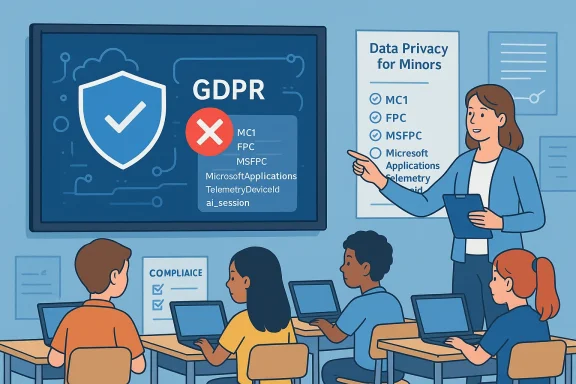
The authority identified a set of cookie identifiers and telemetry pieces that it considered to fall outside the “strictly necessary” category. Key items listed by the regulator include cookies such as MC1, FPC, MSFPC, MicrosoftApplicationsTelemetryDeviceId and ai-session. These were treated as not technically necessary when used for tracking/advertising and therefore required separate justification which the DSB found lacking.
This distinction is legally important: it prevents vendors from relying on a “technical necessity” claim to avoid consent when the same identifier is also used for tracking.
This approach has two consequences: first, it closes a common strategic defence used by multinational vendors; second, it affects which supervisory authority should be considered competent in cross-border enforcement scenarios.
The decision also built on an earlier DSB finding that Microsoft had not met data subjects’ access rights (Article 15 GDPR) when users — or their guardians — requested information about the data processed by Microsoft 365 Education. That prior ruling required Microsoft to provide complete information about what data it collects and how it uses it, including explanations for terms such as “internal reporting,” “business modelling,” and “improvement of core functionality.” The regulator demanded transparency on whether data was transmitted to third parties referenced in telemetry logs and vendor documents.
Technically, the remedy options include:
At present, the regulator’s order requires Microsoft to disclose whether data was transmitted to third parties and to clarify the role of any recipients. The presence of stakeholders such as advertising intermediaries — even if only visible in telemetry logs — triggers stricter transfer scrutiny under GDPR.
Caveat: the ruling orders clarification and, in some earlier findings, identifies that telemetry logs contain references to third parties, but it does not conclusively establish in public text that a full set of student personal data was forwarded to each named vendor. That remains an area where the DSB demanded explicit disclosure.
Policy and procurement teams should expect:
However, the broader transformation needed to render cloud education platforms fully privacy-compliant is technical, contractual, and organisational. Vendors must make product choices that reflect legal constraints; schools must demand clear inventories and protective defaults; and regulators across Europe will need to coordinate to prevent shop‑floor inconsistency.
The DSB’s approach demonstrates how privacy law can intersect with product engineering to protect vulnerable users. For administrators, parents, and policymakers, the practical takeaway is clear: stop assuming vendor defaults are lawful, insist on transparency that a parent or pupil can understand, and treat consent and telemetry settings as first‑class elements of any school cloud deployment.
The ruling is a win for enforceable student privacy — and a warning that where education, cloud software, and advertising overlap, regulators will expect firms to bake protection into the product, not bolt it on as an afterthought.
Source: theregister.com Ruling: Microsoft illegally placed cookies on child's tech
 Background
Microsoft 365 Education is one of the dominant cloud suites used in schools across Europe, combining cloud-hosted Office apps, email, Teams, OneDrive and a raft of telemetry and analytics features intended to improve reliability and product development. During the pandemic, many schools adopted cloud platforms rapidly, and some deployed Microsoft 365 Education at scale to enable remote learning. That swift rollout created, in some jurisdictions, an under-specified relationship between school authorities who contract the service and the vendor who operates it.Austrian privacy campaigners launched formal challenges in 2024 to clarify whether Microsoft’s educational offering respected students’ rights under the General Data Protection Regulation (GDPR). The complaints focused on two core issues: (1) whether Microsoft 365 Education deployed tracking cookies and other telemetry on pupil devices without lawful basis, and (2) whether data subjects (or their guardians) were being denied full access to the personal data processed about them. The Austrian regulator (Datenschutzbehörde, DSB) has now issued two decisive rulings: an earlier decision addressing transparency and the right of access, and a subsequent order that specifically targets the use of tracking cookies in a pupil’s browser session.
Together these decisions sharpen the legal and practical obligations for technology vendors, national ministries, and schools when processing children’s personal data in an educational setting.
What the DSB found: key facts of the cookie ruling
The unlawful deployment of cookies
The DSB concluded that Microsoft placed multiple cookies on a pupil’s device while the child used Microsoft 365 Education — including when editing a Word document in the browser — and that these cookies were not strictly necessary for the educational service. Under GDPR the deployment of tracking, advertising, or analytics cookies that are not technically essential requires a valid legal basis, generally consent for browser cookies. The regulator found that no such consent had been obtained for the pupil.The authority identified a set of cookie identifiers and telemetry pieces that it considered to fall outside the “strictly necessary” category. Key items listed by the regulator include cookies such as MC1, FPC, MSFPC, MicrosoftApplicationsTelemetryDeviceId and ai-session. These were treated as not technically necessary when used for tracking/advertising and therefore required separate justification which the DSB found lacking.
Dual-purpose cookies and consent complexity
A recurrent technical detail in the ruling is the problem of dual-purpose cookies: cookies that Microsoft’s documentation acknowledges can be used both for necessary operational tasks and for optional analytics or advertising purposes depending on configuration. The regulator stressed that where a cookie has at least one purpose that requires consent (for example, behavioural advertising), consent must be collected for that purpose before it is used in that way — even if the cookie also has a functional purpose in other contexts.This distinction is legally important: it prevents vendors from relying on a “technical necessity” claim to avoid consent when the same identifier is also used for tracking.
Who is responsible?
Microsoft tried to argue that its European subsidiary (commonly Microsoft Ireland Operations Limited) was the relevant responsible entity for the Microsoft 365 Education product in the European Economic Area. The DSB rejected this claim in substance and emphasized that the parent company in the United States had ultimate product control and decision-making authority relevant to the case. As a result, the regulator treated Microsoft’s global group as responsible for aspects of the processing and did not accept a simplistic jurisdictional shield based on an Irish corporate presence.This approach has two consequences: first, it closes a common strategic defence used by multinational vendors; second, it affects which supervisory authority should be considered competent in cross-border enforcement scenarios.
Orders and timeframes
The DSB ordered Microsoft to cease the contested tracking of the complainant within a short statutory timeframe and to provide clearer, concrete disclosures about the purposes of processing. In the specific case it gave Microsoft a compliance window to stop the processing tied to the identified cookies — a timeframe the regulator described as appropriate given the child data involved.The decision also built on an earlier DSB finding that Microsoft had not met data subjects’ access rights (Article 15 GDPR) when users — or their guardians — requested information about the data processed by Microsoft 365 Education. That prior ruling required Microsoft to provide complete information about what data it collects and how it uses it, including explanations for terms such as “internal reporting,” “business modelling,” and “improvement of core functionality.” The regulator demanded transparency on whether data was transmitted to third parties referenced in telemetry logs and vendor documents.
Why this matters: legal and practical implications
Strengthening children's data protection under GDPR
Children occupy a sensitive category under the GDPR, and supervisory guidance has repeatedly emphasized the need for clearer, child-appropriate information and heightened protections. The DSB’s finding reinforces three core legal principles:- Strict interpretation of consent for non-essential cookies — schools and vendors cannot treat behavioural or advertising-related cookies as technically necessary to provide the service.
- Higher transparency standards for minors — the explanations must be concrete, precise and understandable for children and their guardians.
- No “pass-the-buck” to schools — vendors cannot evade obligations by shifting the burden of compliance entirely onto local educational institutions.
Operational exposure for schools and ministries
The rulings make clear that ministries of education and school administrators cannot hide behind contractual framing and must ensure that products deployed in classrooms actually comply with data protection law. In practice, many institutions that adopted cloud suites quickly may now face three operational demands:- Audit deployed cookie footprints on pupil devices and school-managed browsers.
- Verify contractual guarantees and technical controls provided by vendors match what is actually implemented.
- Provide parents and pupils with accurate, granular information about what data is collected and whom it is shared with.
Pressure on vendors to re-examine telemetry defaults
For vendors such as Microsoft, default product behaviour matters. The combination of default telemetry and self-described “dual-purpose” cookies creates legal risk. Cloud providers must:- Segregate strictly necessary functionality from optional telemetry.
- Ensure telemetry that can be used for advertising or profiling is either disabled by default in education tenants or requires explicit consent and clear opt-in flows.
- Improve documentation so that institutions can give precise data subject information and respond to access requests.
Technical analysis: what the ruling reveals about cookies and telemetry
Names and functions flagged by the regulator
The DSB’s decision names cookie IDs and telemetry elements that product documentation links to user identification, analytics and advertising. Among the identifiers cited are:- MUID, MC1, MSFPC — identifiers historically associated with Microsoft’s cross-site browser identifiers and session controls, which may be used for analytics and advertising.
- MicrosoftApplicationsTelemetryDeviceId and ai-session — telemetry identifiers used for application and AI/telemetry sessions.
The problem with “dual-purpose” identifiers
Dual-purpose cookies are a recurring thorn. Vendors may design identifiers that are used for necessary technical functions (load balancing, session stability) but are also optionally used to measure usage and feed into product analytics or advertising stacks. The regulator highlighted that the presence of tracking uses transforms the legal analysis: the potentially privacy-invasive purpose requires separate legal justification and, typically for cookies, consent.Technically, the remedy options include:
- Splitting cookies into strictly necessary and optional categories with separate lifetimes and scoping.
- Offering admin-level toggles that by default turn off non-essential telemetry in education tenants.
- Maintaining an auditable cookie inventory that maps identifiers to precise, purpose-bound processing.
Transfers to third parties — unclear but flagged
During proceedings the regulator requested clarification on whether any pupil data was transferred to third parties or vendors such as advertising or analytics platforms. The earlier decision explicitly asked Microsoft to clarify if telemetry reached parties referenced in logs (the regulator used redacted references in its findings).At present, the regulator’s order requires Microsoft to disclose whether data was transmitted to third parties and to clarify the role of any recipients. The presence of stakeholders such as advertising intermediaries — even if only visible in telemetry logs — triggers stricter transfer scrutiny under GDPR.
Caveat: the ruling orders clarification and, in some earlier findings, identifies that telemetry logs contain references to third parties, but it does not conclusively establish in public text that a full set of student personal data was forwarded to each named vendor. That remains an area where the DSB demanded explicit disclosure.
Critical appraisal: strengths and limitations of the ruling
Notable strengths
- Child-focused protection: The DSB’s insistence on child-appropriate clarity and stricter scrutiny for minors reflects robust application of GDPR principles to a high-impact context.
- Technical specificity: By naming cookie identifiers and calling out dual-purpose cookies, the regulator offers useful technical guidance that IT administrators can act on immediately.
- Countering jurisdictional buck-passing: The rejection of a simplistic “Irish subsidiary” shield limits corporate strategies that use internal corporate structures to avoid substantive EU scrutiny.
- Concrete remedial measures: The orders include concrete steps — stop the tracking for the complainant within a prescribed timeframe and provide precise disclosures — which increase the ruling’s practical enforceability.
Potential limitations and open questions
- Scope and precedent: The decision applies to the specific facts of the complaint: one pupil’s account and the configurations found on the date of the incident. How universally this will apply to every school deployment across Europe depends on fact-specific audits and whether other DPAs follow suit.
- Technical complexity of telemetry: Modern cloud systems emit vast telemetry streams where metadata, performance metrics, and identifiers intermix. Distinguishing strictly necessary telemetry from optional analytics requires careful engineering work that may be time-consuming for vendors and customers.
- Unclear third-party flow outcomes: Although the DSB demanded clarity on third-party transfers, public summaries do not yet disclose whether definitive data transfers to specific external advertising or AI vendors occurred and, if so, on what legal basis.
- Enforcement asymmetry: Even if the DSB’s orders are strong, the practical enforcement and remediation across millions of seats and different national procurement contracts will be uneven — and some schools may be slow to respond or lack technical resources to change client-side behavior.
Practical advice: what schools, administrators and parents should do now
For school IT teams and procurement
- Conduct an immediate cookie and telemetry audit on school-managed devices and school tenant configurations. Identify any non-essential cookies set during normal classroom use of Microsoft 365 Education.
- Review administrative settings in the education tenancy to disable optional telemetry and behavioural tracking where feasible by default.
- Demand a clear cookie inventory from vendors that directly maps cookie identifiers to purposes, retention, and recipients — and insist on child-friendly explanations suitable for students and parents.
- Update privacy notices and consent flows presented to guardians to reflect actual telemetry and any third-party data flows.
- Maintain an incident log and demonstrate remediation steps taken should a regulator ask for evidence.
For parents and guardians
- Request a formal data access and processing description from your child’s school — under GDPR you and your child have rights to access the personal data being processed.
- Ask the school which administrative measures and vendor settings are used to minimise non-essential tracking for pupils.
- If you suspect unlawful processing, you can lodge a complaint with your national data protection authority.
For vendors (including Microsoft)
- Re-examine product defaults for education tenants and implement “privacy-by-default” settings that minimise optional telemetry in child accounts.
- Provide a machine-readable cookie inventory and a concise, child-appropriate privacy summary that schools can reuse directly in their communications.
- Separate and isolate telemetry channels used for operations from those used for marketing or profiling, and provide administrators with granular on/off controls.
Wider consequences for cloud software, advertising and AI
The ruling is a clear signal that regulators will not accept opaque telemetry ecosystems in sensitive contexts like education. Vendors that depend on downstream data for advertising, profiling or AI training will need to demonstrate lawful bases and granular controls — particularly for minors.Policy and procurement teams should expect:
- Increased regulatory scrutiny across the EU for other widely used education platforms.
- Pressure on vendors to adopt segregation of data flows and stricter defaults for education tenants.
- More litigation and complaints from privacy groups seeking to expand the legal boundaries around telemetry and advertising in non-commercial environments.
Final assessment: a turning point for student privacy — but not the last word
The Austrian regulator’s decision is significant because it pairs legal reasoning about children’s rights under GDPR with concrete technical markers (cookie names and telemetry identifiers). That combination makes the ruling both defensible in law and actionable in IT departments. It also narrows the ability of multinational vendors to hide behind corporate structures or abstract documentation.However, the broader transformation needed to render cloud education platforms fully privacy-compliant is technical, contractual, and organisational. Vendors must make product choices that reflect legal constraints; schools must demand clear inventories and protective defaults; and regulators across Europe will need to coordinate to prevent shop‑floor inconsistency.
The DSB’s approach demonstrates how privacy law can intersect with product engineering to protect vulnerable users. For administrators, parents, and policymakers, the practical takeaway is clear: stop assuming vendor defaults are lawful, insist on transparency that a parent or pupil can understand, and treat consent and telemetry settings as first‑class elements of any school cloud deployment.
The ruling is a win for enforceable student privacy — and a warning that where education, cloud software, and advertising overlap, regulators will expect firms to bake protection into the product, not bolt it on as an afterthought.
Source: theregister.com Ruling: Microsoft illegally placed cookies on child's tech