

AvePoint’s push to deepen Azure data protection inside its AvePoint Elements MSP platform is a clear signal that the company intends to make managed Azure protection a channel-first capability, adding misconfiguration detection, Azure environment monitoring, and enhanced anomaly detection to its multi-tenant MSP stack—an update that reshapes partner opportunity models, raises technical questions about detection scope and recoverability, and spotlights governance and AI-risk trade-offs every MSP should evaluate before operationalizing these features.
AvePoint has been expanding Elements—its multi-tenant MSP services layer that sits on the broader AvePoint Confidence Platform—through a series of 2025 updates, acquisitions, and marketplace integrations designed to simplify partner operations and monetize managed services in Microsoft ecosystems. The company publicly states that the Confidence Platform supports more than 25,000 organizations and that Elements is available through some 100 cloud marketplaces, positioning Elements as a channel-friendly conduit for procurement, license management, billing, and service delivery. Those figures are company-provided and repeated across press materials. The latest tranche of functionality—announced in late October and amplified by ChannelE2E reporting in November—was framed explicitly as a channel play: AvePoint added Azure-focused protection capabilities and simultaneously announced a global partnership with the International Association of Microsoft Channel Partners (IAMCP) to drive adoption among MSPs, VARs, and system integrators. AvePoint’s channel executive, Scott Sacket, emphasized that these capabilities let partners “expand managed services around Azure” and position partners as “trusted advisors” rather than pure resellers.
For MSPs in the Microsoft channel, AvePoint’s moves are a timely reminder that platform-minded product design, paired with partner enablement, can create a defensible managed-service offering—but only when technical capability, human processes, and contractual protections are all aligned before the first customer goes live.
Source: ChannelE2E AvePoint Brings Deeper Azure Data Protection Capabilities to its Elements MSP Platform
 Background
AvePoint has been expanding Elements—its multi-tenant MSP services layer that sits on the broader AvePoint Confidence Platform—through a series of 2025 updates, acquisitions, and marketplace integrations designed to simplify partner operations and monetize managed services in Microsoft ecosystems. The company publicly states that the Confidence Platform supports more than 25,000 organizations and that Elements is available through some 100 cloud marketplaces, positioning Elements as a channel-friendly conduit for procurement, license management, billing, and service delivery. Those figures are company-provided and repeated across press materials. The latest tranche of functionality—announced in late October and amplified by ChannelE2E reporting in November—was framed explicitly as a channel play: AvePoint added Azure-focused protection capabilities and simultaneously announced a global partnership with the International Association of Microsoft Channel Partners (IAMCP) to drive adoption among MSPs, VARs, and system integrators. AvePoint’s channel executive, Scott Sacket, emphasized that these capabilities let partners “expand managed services around Azure” and position partners as “trusted advisors” rather than pure resellers. What was announced — a technical summary
New Azure protection capabilities in AvePoint Elements
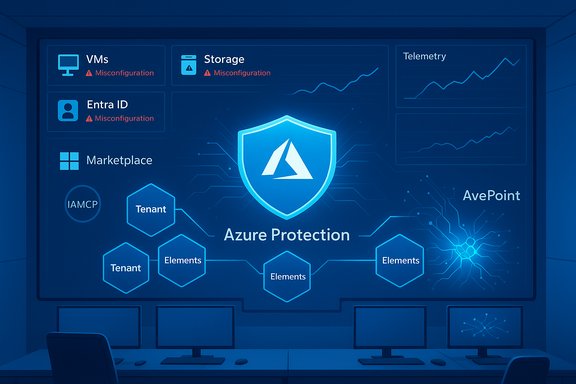
The Elements updates advertised by AvePoint and covered by ChannelE2E include:- Misconfiguration detection for Azure resources—aimed at spotting risky or nonstandard settings that could expose data or services.
- Azure environment monitoring—continuous telemetry collection intended to surface drift, policy violations, and operational health indicators.
- Improved anomaly detection—AI-enabled analytics tuned to detect unusual activity patterns across Azure workloads and storage.
Platform context: Elements and the Confidence Platform
Elements is not a standalone product; it is a channel-focused layer of the AvePoint Confidence Platform, which AvePoint positions as a data security, governance, and resilience suite for Microsoft 365, Azure, Google Workspace, Salesforce and other collaboration services. The integration between Elements and the Confidence Platform is intended to let MSPs centralize multi-tenant operations—license management, billing, and technical service delivery—while leveraging AvePoint’s detection, governance, and recovery capabilities. AvePoint’s public marketing materials repeat the “25,000 customers / 100 marketplaces / 5,000 partners” metrics as part of this narrative. Those counts are reported by the vendor.Why this matters to MSPs and channel partners
1) Expandable, repeatable Azure managed services
AvePoint is selling more than features—it's selling a partner motion. By packaging Azure protection and governance into Elements, MSPs can more readily productize:- Managed Azure hardening and configuration-as-a-service.
- Continuous data protection for cloud storage and VMs (where supported).
- Anomaly detection and incident triage offered as a retainer or per-incident service.
2) Procurement and monetization through marketplaces
Elements’ marketplace footprint—AvePoint promotes availability across roughly 100 cloud marketplaces—lowers friction for procurement and recurring-billing, a practical advantage when MSPs position managed Azure protection as a subscription SKU. This enables faster procurement cycles for customers that prefer marketplace purchasing and centralizes billing reconciliation for MSPs. Again, these marketplace numbers come from AvePoint’s public materials.3) Marketing and partner enablement via IAMCP
The IAMCP partnership gives AvePoint—and in turn, its channel partners—access to a broad partner network. AvePoint’s announcement cites IAMCP’s reach in the Microsoft channel (representing thousands of partners and chapters across regions), and the vendor positions the relationship as a route to accelerate partner recruitment, training, and go-to-market enablement. MSPs who already participate in IAMCP chapters gain a faster on-ramp to trialing Elements, while others can use IAMCP resources to validate technical and commercial approaches.Critical technical analysis — strengths and real-world value
Strength: Channel-first design reduces operational friction
Elements is architected to let MSPs manage many tenants from a single pane, incorporating billing and marketplace provisioning. For MSPs focused on scale, that design is a pragmatic strength: it reduces the amount of custom integration work required to onboard customers and keeps licensing and billing predictable—two practical blockers many MSPs report when launching new managed services.Strength: Native Azure telemetry and misconfiguration detection addresses a common gap
Cloud misconfiguration remains a leading cause of data exposures. Embedding misconfiguration detection and monitoring into an MSP-facing control plane means providers can surface drift and policy violations to customers automatically, reducing the chance that an unmanaged setting becomes an incident. This is a well-understood risk in Azure environments and a sensible place for an MSP to invest engineering effort.Strength: Marketplace distribution and partner enablement amplify GTM
Marketplace availability and IAMCP distribution create scalable go-to-market (GTM) pathways. MSPs that take a packaged offering to market (pre-priced, pre-configured runbooks) often close faster than those selling bespoke engagements—Elements helps standardize that packaging.Key risks, limitations, and implementation caveats
Detection and coverage: not all "anomalies" are equal
- Detection scope: Vendor announcements typically describe capabilities (misconfiguration detection, anomaly detection) without publishing exhaustive coverage matrices or detection logic. MSPs should demand clarity: which Azure services, API surfaces, and telemetry sources are covered? Are Azure role assignments, storage ACLs, network rules, and Kubernetes settings included, or is coverage limited to basic resource config? The announcement does not publish a formal coverage map; that level of detail must come from product documentation or vendor briefings.
- False positives / tuning: AI-and-rule-based anomaly detection requires tuning to tenant baselines. Out-of-the-box thresholds often generate noise; MSPs need to plan for a tuning phase and measure mean time to repair (MTTR) versus time lost in chasing false positives. Industry experience shows that vendors who integrate human-in-the-loop processes and allow policy-level exceptions reduce operational fatigue.
Recovery guarantees and RTO/RPO trade-offs
Announcements commonly describe “better resilience” and “rapid anomaly detection,” but MSP buyers must verify recovery SLAs. Important questions to validate in procurement:- What are the stated Restore Time Objective (RTO) and Restore Point Objective (RPO) guarantees for Azure VMs and storage?
- Are backups immutable and geographically redundant to survive a tenant-level compromise?
- Is restore automation identity-aware (i.e., does it respect conditional access and privileged identity management during the restore process)?
Data residency, compliance, and vendor lock-in
Centralizing backups or telemetry in a vendor platform is convenient but raises questions around data residency, contractual audit rights, and egress cost. MSPs in regulated industries must ensure that:- The platform supports region-specific storage or customer-managed key models.
- Contracts provide audit evidence, clear egress terms, and portability for data on termination.
AI governance, model explainability, and regulatory risk
AvePoint and other vendors increasingly embed AI into detection and governance. AI-driven detections raise model-governance questions:- What telemetry is used to train models?
- Does the platform provide explainability or context for alerts (why an event was flagged)?
- Who owns the alert telemetry and model outputs—customer or vendor?
Competitive and market context
AvePoint’s move mirrors broader industry dynamics: backup, detection, and governance vendors are converging features to offer “cyber resilience” rather than discrete backup or CSPM products. The market has several notable trends:- Vendors are adding Azure-specific protections (VM and Blob protection) in response to rising cloud-native risk and AI-related data growth. AvePoint’s updates are consistent with this trend.
- Service providers increasingly expect integrated procurement, billing, and marketplace delivery models to reduce commercial friction. Elements’ marketplace integrations answer that need.
- Competitive offerings in 2025 stress identity-aware restores, agentless backups for cloud-native storage, and restore-time malware scanning—features that aim to lower reinfection risk during recoveries. When assessing Elements, MSPs should compare its restore verification capabilities and ransomware hygiene features against industry peers.
Evaluating AvePoint Elements for your MSP practice — recommended due diligence
MSPs should run a disciplined evaluation that includes technical, operational, and commercial checks. Suggested steps:- Technical validation (lab pilot)
- Test detection coverage across a sample Azure landing zone: VMs, Managed Disks, Blob Storage, Entra ID configurations, and AKS (if applicable).
- Validate misconfiguration findings against a trusted baseline (Azure Security Benchmark/CIS).
- Measure telemetry ingestion rates and alert latency.
- Operational readiness (process and people)
- Run a 30–60 day pilot across 3–5 customer tenants to tune detection thresholds.
- Build playbooks for incident triage, escalation, and restoration that include break-glass procedures for Conditional Access or PIM lockouts.
- Include restore drills with malware scanning and quarantine steps to observe RTO impacts.
- Commercial and contractual negotiation
- Clarify SLAs for detection efficacy, backup retention, restore speed, and data egress.
- Insist on data portability clauses and export tooling for customer-owned archives.
- Negotiate marketplace billing terms and margins for recurring managed services.
- Governance and compliance
- Verify data residency controls and key management options (BYOK, customer-managed keys).
- Request evidence of independent audits (SOC 2/ISO) and pen-test summaries for the Elements control plane.
- Go-to-market planning
- Build standardized SKUs, onboarding flows, and runbooks to keep service delivery predictable.
- Use IAMCP chapters and AvePoint partner enablement to source case studies and reference customers before public launches.
Practical recommendations and MSP playbook (concise)
- Start small with a defined pilot: Limit scope to non-production tenants and a handful of customers before scaling.
- Document recovery RPO/RTO expectations up-front: Integrate restore verification time into SLAs so customers understand the security vs. speed trade-off.
- Treat detection tuning as billable: Offer a “tuning period” retainer that covers initial calibration and false-positive reduction.
- Lock down identity and emergency access: Define break-glass processes for restores in environments with strict Conditional Access policies.
What the IAMCP tie-in really means
AvePoint’s IAMCP relationship is both a signal and a channel multiplier. The IAMCP network provides partner outreach, training channels, and local chapter validation—useful for MSPs that want peer-validated references and local-market GTM support. That said, IAMCP membership counts and reach metrics quoted by vendors should be treated as marketing-level indicators; MSPs should still validate interest and local chapter activity during go-to-market planning.Final assessment — who benefits, and when to adopt
AvePoint Elements’ Azure protection expansion is a pragmatic, channel-focused move that will be most valuable to:- MSPs already selling Microsoft tenant and identity services who want to add Azure protection without integrating multiple point tools.
- MSPs with established marketplace procurement and billing operations that can exploit Elements’ procurement integrations.
- Partners in regulated or compliance-heavy industries that need more consistent governance and marketplace-friendly procurement.
Conclusion
AvePoint’s announced expansion of Azure data protection inside AvePoint Elements and its IAMCP partnership mark a deliberate pivot toward channel-led, multi-tenant Azure resilience. The vendor’s claims—marketplace reach, 25,000 Confidence Platform customers, and expanded Azure detection—are consistent across AvePoint press materials and independent trade reporting, and the vendor’s own research underscores the real and growing risks associated with rapid AI rollouts (AvePoint reports more than 75% of organizations experienced AI-related security breaches in a 2025 study). Those market signals create commercial urgency for MSPs. At the same time, the promise of bundled detection and recovery must be validated in practice: MSPs should run controlled pilots, demand coverage matrices and SLAs, and build operational runbooks that balance verification with acceptable RTOs. Properly validated and positioned, Elements could be a compelling vehicle for MSPs to sell differentiated Azure protection bundles; unmanaged, however, it risks being another vendor tool that generates alerts without the operational glue needed to convert detection into dependable customer outcomes.For MSPs in the Microsoft channel, AvePoint’s moves are a timely reminder that platform-minded product design, paired with partner enablement, can create a defensible managed-service offering—but only when technical capability, human processes, and contractual protections are all aligned before the first customer goes live.
Source: ChannelE2E AvePoint Brings Deeper Azure Data Protection Capabilities to its Elements MSP Platform
