

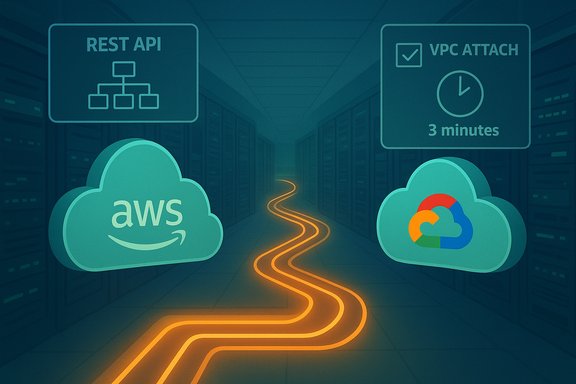
Google Cloud and Amazon Web Services have quietly taken a rare step from rivalry toward cooperation by launching a jointly engineered multicloud networking solution that promises private, encrypted cloud-to-cloud links provisioned in minutes — an offering aimed squarely at enterprises that run critical workloads across multiple hyperscalers and want deterministic connectivity without the weeks‑long slog of carrier contracts and colo coordination.
Major enterprises increasingly run “best‑of‑breed” stacks across more than one public cloud. That operational reality — illustrated by firms that mix compute, data and AI primitives across providers to match cost, performance or feature needs — has created repeated friction in intercloud networking. Setting up private circuits, coordinating colocation points, managing routing and ensuring encryption between cloud providers traditionally required carriers, months of ordering and bespoke engineering. The new AWS–Google collaboration explicitly targets that friction by offering a managed, cloud‑native interconnect that abstracts physical provisioning into APIs and console flows.
The announcement was positioned as “a step toward a more open cloud environment” in the partners’ communications and a move away from customers owning the physical underlay, toward providers pre‑staging capacity and owning the operational monitoring of the interconnect fabric. The vendors claim links can be established in minutes and that link‑level encryption (MACsec) and provider‑side monitoring offer improved confidentiality and resilience.
Enterprises are not seeking multicloud as a philosophical stance; they are doing it to leverage unique vendor strengths (for example, vendor A’s managed database and vendor B’s ML accelerators) and to keep bargaining power in procurement. The new managed interconnect lowers one of the biggest operational barriers to multicloud adoption — network unpredictability and the long lead times of physical provisioning.
At the same time, the move will be watched closely by policymakers. The European Union’s ongoing assessment of major cloud providers under competition frameworks is relevant to how such cooperative interconnects are regulated and whether ‘gatekeeper’ designations or interoperability mandates are applied in ways that shape the economics of cross‑cloud connectivity. Private interconnects can ease portability friction in practice, but they are not a substitute for regulatory safeguards that ensure fair access and pricing.
However, it is not a systemic cure for cloud concentration risk. The offering reduces transport fragility but leaves service‑level heterogeneity, API lock‑in and control‑plane coupling intact. Organisations should treat the interconnect as one tool in a layered resilience strategy: adopt it where value is clearly justified, demand contractual transparency and observability, and continue to invest in identity redundancy, tested runbooks and legal protections that cover post‑incident transparency and remediation.
Source: Silicon Republic Google Cloud, AWS launch linked cloud experience
 Background
Major enterprises increasingly run “best‑of‑breed” stacks across more than one public cloud. That operational reality — illustrated by firms that mix compute, data and AI primitives across providers to match cost, performance or feature needs — has created repeated friction in intercloud networking. Setting up private circuits, coordinating colocation points, managing routing and ensuring encryption between cloud providers traditionally required carriers, months of ordering and bespoke engineering. The new AWS–Google collaboration explicitly targets that friction by offering a managed, cloud‑native interconnect that abstracts physical provisioning into APIs and console flows.The announcement was positioned as “a step toward a more open cloud environment” in the partners’ communications and a move away from customers owning the physical underlay, toward providers pre‑staging capacity and owning the operational monitoring of the interconnect fabric. The vendors claim links can be established in minutes and that link‑level encryption (MACsec) and provider‑side monitoring offer improved confidentiality and resilience.
What exactly was announced
The product pairing and open‑spec signal
- AWS is offering an Interconnect – multicloud capability that maps into its networking portfolio (VPC, Transit Gateway, Cloud WAN constructs).
- Google Cloud offers Partner Cross‑Cloud Interconnect for AWS as an extension of its Cloud Interconnect family.
- The two pieces are engineered to work together so a customer can request a private attachment from one cloud to the other via a console or API, relying on pre‑staged capacity in paired points‑of‑presence.
Technical claims and initial capacities
- Preview bandwidth is advertised starting at 1 Gbps with a roadmap toward 100 Gbps at general availability, giving enterprises a path from pilot links to high‑capacity production lines for data replication and AI training/inference traffic.
- Link‑level encryption using MACsec between provider edge routers is part of the security posture, reducing exposure on the physical underlay (customers remain responsible for end‑to‑end application encryption and key management).
- Providers pre‑stage capacity pools and expose a single logical “attachment” representing the cross‑cloud capacity, which removes much of the manual circuit wiring historically needed.
Why now: outages, multicloud reality and rising expectations
Two large, high‑visibility outages in 2025 sharpened enterprise sensitivity to systemic cloud risks and helped create the momentum for this partnership. A disruption at Google Cloud in June and a significant AWS region outage in October disrupted many downstream services and exposed how dependent internet and enterprise services are on a handful of hyperscalers. The timing of the multicloud interconnect announcement — months after those incidents — is not accidental: resilience, determinism and deterministic failover are now procurement priorities for large customers.Enterprises are not seeking multicloud as a philosophical stance; they are doing it to leverage unique vendor strengths (for example, vendor A’s managed database and vendor B’s ML accelerators) and to keep bargaining power in procurement. The new managed interconnect lowers one of the biggest operational barriers to multicloud adoption — network unpredictability and the long lead times of physical provisioning.
How the solution works (concise technical walkthrough)
Architecture and control model
- Providers pre‑stage physical capacity in paired edge POPs/colocation sites.
- Customers request an interconnect via cloud console or API, selecting the destination VPC/region and an attachment bandwidth SKU.
- The provider fabric maps the logical attachment to the underlying capacity pool and configures routing constructs on behalf of the customer (Transit Gateway / Cloud WAN on AWS; Cross‑Cloud Network primitives on Google Cloud).
Security and resilience primitives
- MACsec encrypts the link between provider edge routers to provide confidentiality and integrity for traffic on the underlay, a material improvement versus public‑internet paths for regulated or sensitive workloads.
- Providers describe quad‑redundant underlay topologies and continuous monitoring to proactively detect and resolve issues; however, customers must validate redundancy for the specific POPs they will use. Provider claims of redundancy are design goals that require verification in contractual terms.
Notable strengths and immediate opportunities
- Speed to provision: Turning weeks or months of manual carrier coordination into API‑driven provisioning reduces project timelines and enables shorter development/experiment cycles for data migration and model training.
- Deterministic performance: Lower jitter and controlled bandwidth are attractive for asynchronous database replication, hybrid AI training/inference pipelines, and latency‑sensitive remote desktop or VDI workloads.
- Reduced operational error surface: Consolidating interconnect ownership with cloud providers reduces the human handoffs (carrier, colo, cloud) that historically create misconfiguration risk.
- Commercial signal for multicloud: The partnership normalises multicloud as an enterprise pattern and may accelerate procurement models that accept multi‑vendor stacks. This could lower migration friction for organisations that want to use a specific vendor’s AI accelerators or data services without wholesale vendor lock‑in.
Principal risks, caveats and unknowns
1) Control‑plane coupling remains the primary systemic risk
Private, deterministic links improve transport reliability but do not change vendor‑specific control‑plane behavior (DNS services, managed API semantics, quota systems, or global orchestration). If a provider’s managed service or control plane fails, a private underlay does not prevent those higher‑order outages. The October AWS disruption remains a vivid example: network determinism cannot by itself eliminate risks tied to internal service orchestration.2) Pricing, billing and procurement complexity
Faster provisioning does not equal lower total cost of ownership. Egress charges, partner/resale fees and cross‑cloud billing rules can materially change economics. Vendor promotional language on preview offers and sample billing scenarios must be validated with worked examples and contractual commitments. Expect procurement teams to demand worked billing examples and to negotiate pilot discounts and explicit capacity commitments.3) False sense of security and operational complacency
There is a risk that organisations interpret private links as a panacea for resilience and reduce investment in control‑plane failovers, runbooks and offline admin access. The right posture is layered: deterministic networking should be combined with identity redundancy, token caching, emergency administrative paths and tested runbooks.4) Regional availability and preview limitations
Initial availability is preview‑focused, with capacity and POP coverage that will vary by geography. Customers must insist on proof of capacity for the exact POPs and colocation facilities they rely on before committing production traffic. Preview bandwidth SKUs and POP coverage do not guarantee global parity at GA.5) Regulatory, competition and national‑security scrutiny
The consolidation of cross‑cloud interconnect controls into cooperative vendor arrangements will attract regulator attention. The EU and other authorities are actively reviewing whether a small set of cloud firms constitutes structural gatekeepers; actions or designations under competition rules could force additional interoperability, transparency, or behaviour mandates in future procurement frameworks. Expect regulators to inspect how openness is implemented and whether pricing remains transparent.What this means for Windows administrators and enterprise architects
For Windows‑centric enterprises, the announcement has practical implications across identity, replication and hybrid application design.- Active Directory / Azure AD: When fronting services across Google Cloud via a private interconnect, test token lifetimes, conditional access policies and federated authentication flows under failover scenarios to ensure users can authenticate if a single provider’s control plane is impaired.
- SQL Server / Replication: Deterministic low‑latency links can materially reduce RPO and RTO for cross‑cloud database replication. Pilot representative replication workloads (log shipping, Always On Availability Groups) to measure replication lag and jitter under production loads.
- VDI and RDP/Remote Desktop: Controlled bandwidth and reduced jitter improve user experience for latency‑sensitive VDI sessions routed across clouds; benchmark real‑user performance before cutover.
Procurement and pilot checklist (practical, actionable)
- Validate physical POP coverage and prove capacity for the exact colo sites you use.
- Time a provisioning demo in your target region and record end‑to‑end provisioning latency to verify the “minutes” claim.
- Request worked billing examples that include egress, partner fees and measuring points for traffic.
- Insist on runbook exchange and post‑incident reporting clauses in contracts.
- Test failover drills that simulate control‑plane failure (not just network outage) and exercise identity and cert renewal workflows.
- Ensure observability: verify that logs and metrics from the joint fabric are accessible to your SIEM and alerting stacks.
Competitive and policy implications
The AWS–Google cooperative model signals a strategic shift: hyperscalers are acknowledging that multicloud is an operational reality and that removing friction can increase overall cloud consumption. For Google, this cooperation reduces sales friction when customers treat it as a specialist AI or analytics cloud alongside AWS. For AWS, it’s an implicit recognition that enabling hybrid deployments broadens enterprise comfort with mixed vendor architectures. This model pressures smaller cloud providers and network operators to adopt compatible APIs or risk procurement exclusion.At the same time, the move will be watched closely by policymakers. The European Union’s ongoing assessment of major cloud providers under competition frameworks is relevant to how such cooperative interconnects are regulated and whether ‘gatekeeper’ designations or interoperability mandates are applied in ways that shape the economics of cross‑cloud connectivity. Private interconnects can ease portability friction in practice, but they are not a substitute for regulatory safeguards that ensure fair access and pricing.
Balanced verdict: practical step forward, not a cure
The joint AWS–Google multicloud interconnect is a meaningful, pragmatic advance for enterprise cloud strategy. It removes a real and costly operational barrier — manual carrier coordination and bespoke router choreography — and delivers tangible wins for latency‑sensitive replication, hybrid AI pipelines and deterministic disaster‑recovery scenarios. The technical primitives (pre‑staged capacity pools, MACsec encryption, logical attachments) are sensible and address concrete pain points.However, it is not a systemic cure for cloud concentration risk. The offering reduces transport fragility but leaves service‑level heterogeneity, API lock‑in and control‑plane coupling intact. Organisations should treat the interconnect as one tool in a layered resilience strategy: adopt it where value is clearly justified, demand contractual transparency and observability, and continue to invest in identity redundancy, tested runbooks and legal protections that cover post‑incident transparency and remediation.
Final recommendations for IT leaders
- Prioritise pilots that measure replication latency, throughput and failover behaviour with representative workloads rather than accepting vendor claims at face value.
- Negotiate procurement clauses that include capacity proofs, post‑incident reports and clear billing scenarios.
- Treat private interconnect as part of an architectural resilience approach — combine it with control‑plane fallbacks, offline admin procedures and routine disaster drills.
- Keep regulatory and compliance teams close: ensure cross‑border routing, data sovereignty and lawful access obligations are explicitly mapped and contractually addressed.
Source: Silicon Republic Google Cloud, AWS launch linked cloud experience
