• Thread Author
Amazon Web Services suffered a broad regional outage early on October 20 that knocked dozens of widely used apps and platforms offline — from team collaboration tools and video calls to social apps, bank services and smart-home devices — with early evidence pointing to DNS-resolution problems with the DynamoDB API in the critical US‑EAST‑1 region.

AWS cloud map shows US DynamoDB latency and retry options.Overview​

The incident unfolded as a high‑impact availability event for one of the internet’s most relied‑upon clouds. AWS posted status updates describing “increased error rates and latencies” for multiple services in the US‑EAST‑1 region, and within minutes outage trackers and customer reports showed a cascade of failures affecting consumer apps, enterprise SaaS, payment rails and IoT services. Early operator signals and AWS’s own status text pointed to DNS resolution failures for the DynamoDB endpoint as the proximate problem, and AWS reported applying initial mitigations that produced early signs of recovery. This feature unpacks what we know now, verifies the technical claims reported by vendors and community telemetry, analyzes why a single regional failure created broad downstream disruption, and outlines concrete, pragmatic steps Windows admins and enterprise operators should take to reduce risk from cloud concentration. This account cross‑checks reporting from multiple outlets and community traces and flags which conclusions remain tentative pending AWS’s formal post‑incident analysis.

Background: why US‑EAST‑1 matters and what DynamoDB does​

The strategic role of US‑EAST‑1​

US‑EAST‑1 (Northern Virginia) is one of AWS’s largest and most heavily used regions. It hosts control planes, identity services and many managed services that customers treat as low‑latency primitives. Because of this scale and centrality, operational issues in US‑EAST‑1 have historically produced outsized effects across the internet. The region’s role as a hub for customer metadata, authentication and database endpoints explains why even localized problems there can cascade widely.

What is DynamoDB and why its health matters​

Amazon DynamoDB is a fully managed NoSQL database service used for session stores, leaderboards, metering, user state, message metadata and many other high‑throughput operational uses. When DynamoDB instances or its API endpoints are unavailable — or when clients cannot resolve the service’s DNS name — applications that depend on it for writes, reads or metadata lookups can fail quickly. Many SaaS front ends and real‑time systems assume DynamoDB availability; that assumption is a major reason this outage spread beyond pure database workloads.

What happened (timeline and verified status updates)​

  • Initial detection — AWS reported “increased error rates and latencies” for multiple services in US‑EAST‑1 in the early hours on October 20. Customer monitoring and public outage trackers spiked immediately afterward.
  • Root‑cause identification (provisional) — AWS posted follow‑ups indicating a potential root cause related to DNS resolution of the DynamoDB API endpoint in US‑EAST‑1. Community mirrors of AWS’s status text and operator posts contained that language. That message explicitly warned customers that global features relying on the region (for example IAM updates and DynamoDB Global Tables) could be affected.
  • Mitigations applied — AWS’s status updates show an initial mitigation step and early recovery signals; a later status note said “We have applied initial mitigations and we are observing early signs of recovery for some impacted AWS Services,” while cautioning that requests could continue to fail and that service backlogs and residual latency were to be expected.
  • Ongoing roll‑forward — As the morning progressed, various downstream vendors posted partial recoveries or degraded‑performance advisories even as some services remained intermittently impacted; full normalization awaited AWS completing backlog processing and full DNS/control‑plane remediation.
Important verification note: these time stamps and the DNS root‑cause language were published by AWS in near‑real time and echoed by operator telemetry and media outlets; however, the definitive root‑cause narrative and engineering details will be contained in AWS’s post‑incident report. Any inference beyond the explicit AWS text — for example specific code bugs, config changes, or hardware faults that triggered the DNS issues — is speculative until that official analysis is published.

Who and what was affected​

The outage’s secondary impacts hit an unusually broad cross‑section of online services because of how many fast‑moving apps use AWS managed services in US‑EAST‑1.
  • Collaboration and communications: Slack, Zoom and several team‑centric tools saw degraded chat, logins and file transfers. Users reported inability to sign in, messages not delivering, and reduced functionality.
  • Consumer apps and social platforms: Snapchat, Signal, Perplexity and other consumer services experienced partial or total service loss for some users. Real‑time features and account lookups were most commonly affected.
  • Gaming and entertainment: Major game back ends such as Fortnite were affected, as game session state and login flows often rely on managed databases and identity APIs in the region.
  • IoT and smart‑home: Services like Ring and Amazon’s own Alexa had degraded capabilities (delayed alerts, routines failing) because device state and push services intersect with the impacted APIs.
  • Financial and commerce: Several banking and commerce apps reported intermittency in login and transaction flows where a backend API could not be reached. Even internal AWS features such as case creation in AWS Support were impacted during the event.
Downdetector and similar outage trackers recorded sharp spikes in user reports across these categories, confirming the real‑world footprint beyond a handful of isolated customer complaints.

Technical analysis: how DNS + managed‑service coupling can escalate failures​

DNS resolution as a brittle hinge​

DNS is the internet’s name‑to‑address mapping; services that cannot resolve a well‑known API hostname effectively lose access even if the underlying servers are healthy. When clients fail to resolve the DynamoDB endpoint, they cannot reach the database cluster, and higher‑level application flows — which expect low latencies and consistent responses — begin to fail or time out. This outage included status language that specifically called out DNS resolution for the DynamoDB API, which aligns with operator probing and community DNS diagnostics.

Cascading retries, throttles and amplification​

Modern applications implement optimistic retries when an API call fails. But when millions of clients simultaneously retry against a stressed endpoint, the load amplifies and error rates climb. Providers then apply throttles or mitigations to stabilize the control plane, which can restore service but leave a temporary backlog and uneven recovery. In managed‑service ecosystems, the control plane and many customer‑facing APIs are interdependent; a problem in one subsystem can ripple outward quickly.

Why managed NoSQL matters more than you might think​

DynamoDB is frequently used for small, high‑frequency metadata writes (session tokens, presence, message indices). Those workloads are latency‑sensitive and deeply embedded across stacks. When that service behaves unexpectedly — even if only for DNS — the visible symptom is often immediate user‑facing failure rather than graceful degradation, because code paths expect database confirmation before completing operations. This pattern explains why chat markers, meeting links, real‑time notifications and game logins were prominent failures during this event. Caveat: community telemetry and status page language point to DNS and DynamoDB as central problem areas, but the precise chain of internal AWS system events (for example whether a latent configuration change, an autoscaling interaction, or an internal network translation issue precipitated the DNS symptom) is not yet public. Treat any detailed cause‑and‑effect narrative as provisional until AWS’s post‑incident report.

How AWS responded (what they published and what operators did)​

  • AWS issued near‑real‑time status updates and engaged engineering teams; the provider posted that it had identified a potential root cause and recommended customers retry failed requests while mitigations were applied. The status text explicitly mentioned affected features like DynamoDB Global Tables and case creation.
  • At one stage AWS reported “initial mitigations” and early signs of recovery, while warning about lingering latency and backlogs that would require additional time to clear. That wording reflects a standard operational pattern: apply targeted mitigations (routing changes, cache invalidations, temporary throttles) to restore API reachability, then process queued work.
  • Many downstream vendors posted their own status updates acknowledging AWS‑driven impact and advising customers on temporary workarounds — for example retry logic, fallbacks to cached reads, and use of desktop clients with offline caches. These vendor posts helped blunt user confusion by clarifying the AWS dependency and expected recovery behaviors.
Verification note: AWS’s public timeline and mitigation notes are the canonical near‑term record; as is standard practice, the deeper forensic analysis and corrective action list will be published later in a post‑incident review. Until that document appears, any narrative about internal configuration, specific DNS servers, or software faults remains provisional.

Practical guidance for Windows admins and IT teams (immediate and short term)​

This event is an operational wake‑up call. The following steps focus on immediate hardening that can reduce user pain during similar cloud incidents.
  • Prioritize offline access:
  • Enable Cached Exchange Mode and local sync for critical mailboxes.
  • Encourage users to use desktop clients (Outlook, local file sync) that retain recent content offline.
  • Prepare alternative communication channels:
  • Maintain pre‑approved fallbacks (SMS, phone bridges, an external conferencing provider or a secondary chat tool).
  • Publish a runbook that includes contact points and a short template message to reach staff during outages.
  • Harden authentication and admin access:
  • Ensure there’s an out‑of‑band administrative path for identity providers (an alternate region or provider for emergency admin tasks).
  • Verify that password and key vaults are accessible independently of a single cloud region where feasible.
  • Implement graceful degradation:
  • Add timeouts and fallback content in user flows so reads can continue from cache while writes are queued for later processing.
  • For collaboration tools, ensure local copies of meeting agendas and attachments are available for offline viewing.
  • Monitor independently:
  • Combine provider status pages with third‑party synthetic monitoring and internal probes; don’t rely solely on the cloud provider’s dashboard for detection or escalation.
  • Run exercises:
  • Test failover to a secondary region (or cloud) for read‑heavy workloads.
  • Validate cross‑region replication for critical data stores.
  • Simulate control‑plane boredom by throttling key APIs in test environments and exercising recovery playbooks.
These steps are practical, immediately actionable and tailored to reduce the operational pain Windows‑focused organizations experience during cloud provider incidents.

Strategic takeaways: architecture, procurement and risk​

Don’t confuse convenience with resilience​

Managed cloud services are powerful, but convenience comes with coupling. Many organizations optimize to a single region for latency and cost reasons; that real‑world optimization creates concentrated failure modes. Architects should treat the cloud provider as a third‑party dependency rather than a guaranteed utility and plan accordingly.

Multi‑region and multi‑cloud are complements, not silver bullets​

  • Multi‑region replication can reduce single‑region risk but is operationally complex and expensive.
  • Multi‑cloud strategies reduce dependency on a single vendor but add integration and identity complexity.
  • The practical strategy for many organizations is a layered approach: critical control planes and keys replicated across regions; business continuity services that can run in a second region or a second provider; and tested runbooks that specify when to trigger failover.

Demand better transparency and SLAs​

Large, repeated incidents push customers to demand clearer, faster telemetry from cloud providers and better post‑incident breakdowns with concrete timelines and remediation commitments. Procurement teams should bake incident reporting and transparency obligations into vendor contracts where business continuity is material.

Strengths and weaknesses observed in the response​

Strengths​

  • AWS engaged teams quickly and issued status updates that flagged the likely affected subsystem (DynamoDB DNS), which helps downstream operators diagnose impacts. Real‑time vendor updates are crucial and mitigated confusion.
  • The ecosystem’s resiliency features — fallbacks, cached clients and vendor status pages — allowed many services to restore partial functionality rapidly once DNS reachability improved. Vendors who had offline capabilities or queuing in place saw less user impact.

Weaknesses​

  • Concentration risk remains acute: critical dependencies condensed in one region turned a localized AWS problem into many customer outages. This is a systemic weakness of cloud economies and application design assumptions.
  • Public dashboards and communications can be opaque during fast‑moving incidents; customers sometimes rely on community telemetry (for example, outage trackers and sysadmin posts) to understand immediate impact. That information gap fuels confusion and slows coordinated remediation.

What we don’t know yet (and why caution is required)​

The public signals — AWS status entries, operator reports and news coverage — strongly implicate DNS resolution issues for the DynamoDB API in US‑EAST‑1. That is a specific, actionable clue. However, it does not by itself explain why DNS became faulty (software change, cascading control‑plane load, internal routing, or a hardware/network event). Until AWS publishes a detailed post‑incident analysis, any narrative beyond the DNS symptom is hypothesis rather than confirmed fact. Readers should treat root‑cause stories published before that formal post‑mortem with appropriate skepticism.

Longer‑term implications for Windows shops and enterprises​

For organizations operating in the Windows ecosystem — where Active Directory, Exchange, Microsoft 365 and many line‑of‑business apps are central — the outage is a reminder that cloud outages are not limited to “internet companies.” They affect business continuity, compliance windows and regulated processes. Key actions for those organizations include:
  • Maintain offline or cached access to critical mail and documents.
  • Validate that identity and admin recovery paths work outside the primary cloud region.
  • Ensure incident communication templates are pre‑approved and that employees know which alternate channels to use during provider outages.

Conclusion​

The October 20 AWS incident shows the downside of deep dependency on a limited set of managed cloud primitives and a handful of geographic regions. Early indications point to DNS resolution problems for the DynamoDB API in US‑EAST‑1, which cascaded into broad, real‑world disruptions for collaboration apps, games, bank apps and IoT platforms. AWS applied mitigations and reported early recovery signs, but the full technical narrative and corrective measures will only be clear after AWS releases a formal post‑incident report. For IT teams and Windows administrators, the practical takeaway is straightforward: treat cloud outages as inevitable edge cases worth engineering for. Prioritize offline access, alternate communication channels, independent monitoring, and tested failover playbooks. Those investments may feel expensive until the day they prevent a full business stoppage. The industry should also press for clearer, faster operational telemetry and more robust architectures that limit the blast radius when a single managed service or region fails.
(This article used real‑time reporting, vendor status posts and community telemetry to verify the major factual claims above; detailed technical attributions beyond AWS’s public status messages remain tentative until AWS’s full post‑incident report is published.
Source: TechRadar AWS down - Zoom, Slack, Signal and more all hit
 

Amazon says the outage that knocked large swathes of the internet offline has been resolved, but the incident exposed brittle dependencies and non‑trivial business risk in modern cloud architectures.

A security operator monitors US East 1 with warnings and degradation indicators.Background / Overview​

The disruption began in AWS’s US‑EAST‑1 (Northern Virginia) region and unfolded as a multi‑hour incident that produced elevated error rates, DNS failures for critical API endpoints, and cascading impairments across compute, networking and serverless subsystems. Public and operator telemetry during the incident repeatedly pointed to DNS resolution failures for the Amazon DynamoDB API in US‑EAST‑1 as the proximate symptom, and AWS’s status updates described engineers’ work to mitigate those DNS issues while also handling backlogged requests and throttled operations.
US‑EAST‑1 is one of AWS’s oldest and most heavily used regions; it hosts numerous global control‑plane endpoints and many customers’ production workloads. Because of that role, regional incidents there tend to have outsized effects on services worldwide. The October 20 outage is a reminder that geographic concentration of control‑plane primitives — DNS, managed databases, identity services — remains a systemic vulnerability for the internet as a whole.

What happened: clear chronology​

Early detection and public signals​

  • Initial monitoring spikes and user complaints surfaced in the early hours local time, with companies and outage trackers reporting degraded logins, API errors and timeouts across many consumer and enterprise services. AWS posted an initial advisory reporting “increased error rates and latencies” in US‑EAST‑1 and began triage.

Root‑cause signals and mitigation actions​

  • Multiple independent traces and AWS updates converged on DNS resolution for the DynamoDB regional API hostname as the observable failure mode: client libraries and some internal subsystems could not reliably translate the DynamoDB endpoint name into reachable addresses. Restoring DNS reachability was the immediate priority.
  • As engineers mitigated the DNS symptom, secondary impairments appeared in internal EC2 subsystems, Network Load Balancer health checks, and in the processing of queued asynchronous workloads. To stabilize the platform, AWS deliberately throttled some internal operations (for example, EC2 launches and certain asynchronous invocations) to prevent retry storms and to allow backlogs to drain safely.

Recovery window​

  • AWS reported that DNS issues were “fully mitigated” and that services returned to normal over a staged period; many customer‑facing services regained functionality by mid‑afternoon and evening local time. However, the company cautioned that backlogs and throttles would cause a long tail of residual errors for some customers as queued messages and delayed operations were processed.

Technical anatomy: why a DNS issue cascaded so widely​

DNS is not just name lookup in the cloud​

In hyperscale clouds, DNS is tightly integrated with service discovery, control‑plane APIs and SDK behavior. Managed services — notably DynamoDB — are used as lightweight control stores for session tokens, feature flags, small metadata writes and other high‑frequency operations that gate user flows. When the DNS resolution for a widely used API becomes unreliable, client SDKs, load balancers and internal monitoring systems can no longer locate or validate the services they rely on. The visible result looks like a service outage even if server capacity remains.

Retry storms and saturation​

Client libraries typically implement retry and backoff logic. When DNS failures return transient errors, large fleets of clients retry aggressively. Those retries can saturate connection pools, exhaust internal resource quotas, and amplify load on control‑plane paths. That amplification is a common mechanism by which a localized failure balloons into a systemic outage. AWS’s incident followed this pattern: DNS problems → retries → overloaded control plane → secondary subsystem failures (EC2, NLBs, Lambda).

Internal coupling and control plane concentration​

US‑EAST‑1 hosts many global control‑plane endpoints. Some customers and AWS services treat that region as authoritative for identity, global tables or default feature sets. That implicit centralization means that a regional outage can break flows beyond the region’s immediate compute footprint — global services that depend on regional control primitives may fail to authenticate, authorize, or write metadata. The incident underscored how tightly coupled modern cloud systems remain despite the rhetoric of “global cloud.”

Who and what was affected​

The outage was broad and industry‑spanning. Public outage trackers and vendor status pages recorded incidents across social media apps, gaming platforms, streaming services, fintech apps, productivity suites and even parts of Amazon’s own retail and device ecosystems.
Notable categories impacted during the event included:
  • Consumer platforms: Amazon.com storefront and Prime services experienced interruptions for some users.
  • Streaming and entertainment: Prime Video and several other streaming services reported degraded behavior.
  • Social and messaging: Snapchat, Reddit and other messaging tools logged login and feed failures.
  • Gaming platforms: Login and matchmaking failures affected major multiplayer games and platforms.
  • Finance and payments: Certain UK bank portals and payment apps experienced intermittent outages or slowdowns.
  • IoT and device ecosystems: Ring doorbells, Alexa and other smart‑home services lost command/control connectivity for segments of their user base.
  • Developer and enterprise tooling: CI/CD, build agents, and some SaaS services reported degraded operations when underlying cloud control paths failed.
The breadth of impacts highlights a key point: when foundational cloud primitives fail, effects are indiscriminate. Businesses small and large felt consequences, and for many companies the incident translated into customer support surges, lost transactions, and operational triage.

Business and economic impact: estimates and caveats​

Early modelling attempts circulated widely, suggesting very large hourly losses for commerce and transaction‑based services — figures sometimes cited in the tens of millions of dollars per hour. Those headline numbers are useful to illustrate scale, but they are model estimates that depend on simplistic assumptions (e.g., proportion of revenue affected, time‑sensitivity of transactions) and should be treated with caution. The real economic impact varies by sector, architecture and contingency plans in place.
Operational costs were immediate and measurable:
  • Customer support and incident response teams were put into fire‑fighting mode.
  • Some businesses that rely on just‑in‑time payments or real‑time authorization saw failed transactions and reconciliation headaches.
  • Companies with active disaster recovery and multi‑region failover plans were able to reduce customer‑visible impact but still incurred extra operational expense and engineering hours to enact those plans.

AWS’s mitigation timeline and public messaging​

AWS’s public timeline followed a familiar incident‑management cadence: detection → identification of proximate symptom → parallel mitigation → staged recovery → backlog processing and cautious lifting of throttles. The company emphasized that the immediate signal was related to DNS resolution abnormalities for DynamoDB endpoints and that there was no indication the outage was caused by an external attack. Engineers applied mitigations to restore DNS reachability and then worked through the long tail of queued operations while avoiding actions that might destabilize recovery (for example, aggressive unthrottling).
AWS reported that the DNS symptom was “fully mitigated” after several hours and that services were returning to normal. The company also warned that some services — notably those with large backlogs or those that needed to launch new EC2 instances — would take additional time to return to full capacity. That staged, cautious approach is typical in complex distributed systems where aggressive recovery can sometimes worsen instability.

Critical analysis — strengths and notable operational choices​

What AWS did well​

  • Rapid detection and transparent public updates: AWS’s status dashboard and repeated updates helped customers understand the scope of the issue and guided remediation steps. The company identified the DNS symptom early and focused engineering effort where it mattered most.
  • Tactical throttling to prevent retry storms: Rather than attempting blunt, immediate restoration that might trigger uncontrolled retries or saturated backplanes, the operators employed measured throttles and queue‑draining — a conservative approach that reduces the risk of relapse.
  • Gradual, staged recovery to protect system stability: AWS prioritized platform stability over instant feature restoration, which is often the correct call in hyperscale operations where a misstep can worsen an outage.

Operational tradeoffs and weaknesses​

  • Depth of internal coupling: The outage made clear that too many control‑plane primitives remain coupled to a single region, increasing systemic exposure for many customers. AWS’s scale is a strength — and a risk — when architectural defaults point at US‑EAST‑1.
  • Customer default patterns: A large share of customers still default to single‑region deployments or rely on global features anchored in US‑EAST‑1. That vendor and architectural inertia increases blast radius when incidents occur.
  • Post‑mortem transparency and timelines: The immediate mitigation sequence is public, but definitive root‑cause reports and exact trigger details (for example whether a config change, software bug, or monitoring failure initiated the chain) are typically delayed until a formal post‑incident analysis is completed. That delay leaves some uncertainty and complicates learning for customers and regulators. Treat preliminary root‑cause narratives as provisional until AWS publishes its formal findings.

Practical lessons and actionable guidance for Windows administrators and IT leaders​

The outage should prompt Windows admins, SREs and cloud architects to reassess design assumptions and to invest in concrete, testable resilience measures. Recommendations below are practical and prioritized.

1. Map dependencies and identify single points of failure​

  • Create an inventory of control‑plane dependencies (DynamoDB, identity, feature‑flag stores, DNS names) and annotate which are single‑region or single‑provider anchors.
  • Flag high‑frequency, small‑write primitives (sessions, tokens, leader election) that are critical to login/authorization flows. Plan fallback behaviors for these paths.

2. Implement graceful degradation​

  • Ensure that user‑facing flows tolerate temporary loss of non‑essential primitives. For example:
  • Serve cached content or read‑only pages instead of failing outright.
  • Defer non‑critical background tasks until control plane stabilizes.
  • For Windows‑centric services, ensure domain authentication or SSO fallbacks (cached credentials, local AD replicas) deliver continuity during cloud control‑plane interruptions.

3. Harden DNS and service discovery​

  • Use resilient DNS configurations: multiple resolvers, conservative TTL strategies, and client‑side caching where appropriate.
  • Monitor name‑resolution success as a first‑class signal and include it in runbooks.

4. Adopt multi‑region or multi‑cloud failover for mission‑critical services​

  • For workloads that cannot tolerate outages, design active‑active or active‑passive multi‑region deployments with tested failover playbooks.
  • Beware of “single‑region control plane” traps: ensure global features or identity anchors have failover paths.

5. Practice failure scenarios — in production if possible​

  • Run game‑day exercises that simulate DNS, managed database, or control‑plane failures and rehearse recovery steps.
  • Validate that throttles, backpressure and graceful degradation behave as expected when underlying services are impaired.

6. Contracts, SLAs and procurement​

  • Revisit vendor contracts and SLAs with cloud providers and SaaS vendors. Assess what commitments exist for regional failures and what financial or operational remedies are available.
  • Ensure third‑party providers expose clear incident and recovery playbooks and that you require post‑incident root‑cause reports for major events.

7. Monitoring and alerting enhancements​

  • Add distributed, independent probes for DNS resolution, end‑to‑end login flows, and feature‑flag checks from multiple geographies.
  • Correlate DNS failures with application‑level errors so runbooks can escalate the right teams quickly.
These are practical, testable steps that improve resilience and reduce customer‑impact when the next hyperscaler incident occurs.

Broader implications: market, policy and architecture​

Market and vendor concentration​

AWS retains a dominant market share among cloud providers. That concentration delivers efficiency and scale, but also systemic exposure: outages in a major region create outsized consequences across industries. The incident will likely accelerate enterprise conversations about multi‑cloud strategies, but multi‑cloud is not a panacea — it introduces complexity and operational cost. The smarter shift is toward explicit decoupling of control‑plane dependencies and investment in resilient patterns for critical paths.

Regulatory and public‑sector concerns​

When public services and banking portals are affected, outages become a public policy issue. Governments and regulators may press for clearer resilience plans for critical services and for more transparency from hyperscalers about dependencies and post‑incident reporting. Expect increased scrutiny on how critical national infrastructure depends on a handful of cloud regions.

Architecture lessons for platform builders​

  • Avoid treating managed primitives as unbreakable defaults. Design for eventual failure of any single service.
  • Invest in observable, auditable control planes and make failover paths explicit in code and configuration.
  • Encourage cloud providers to offer better primitives for resilient global control planes (for example, more robust cross‑region replicated control services or explicit “control‑plane availability zones”).

Risks and lingering unknowns​

  • Final root cause: While public signals heavily implicate DNS resolution failures for DynamoDB endpoints, the precise triggering event (configuration error, software bug, cascading internal failure) will be established only after AWS’s formal post‑mortem. Until then, treat elements of the narrative as provisional.
  • Residual impacts: Even after a surface‑level “full restoration,” some customers can face multi‑hour delays as queues clear and throttles are lifted. These residual impacts are operationally expensive and can create downstream reconciliation headaches.
  • Over-reliance on vendor messaging: Large providers communicate incident progress, but customers should not rely solely on provider messaging to evaluate their own risk. Independent instrumentation and cross‑checks matter.

How enterprises should respond immediately after such an incident​

  • Execute business continuity playbooks focused on customer communication and mitigation.
  • Triage and prioritize systems for restoration based on customer impact and regulatory obligations.
  • Preserve logs, capture timelines and collect artifact snapshots to support root‑cause analysis and SLA claims.
  • Update post‑mortem documentation to reflect what worked, what failed, and which improvements will be implemented.
  • If the business experienced financial loss traceable to the outage, follow contractual escalation and legal review processes while preparing evidence and timelines.

Conclusion​

The outage that struck AWS’s US‑EAST‑1 region and affected hundreds — possibly thousands — of services worldwide is a sober reminder that the cloud’s convenience and scale come with concentrated fragility. AWS’s engineers identified a DNS‑related symptom tied to the DynamoDB API, applied measured mitigations and staged recovery, and reported full restoration after several hours; nevertheless, the episode exposed systemic coupling, business risk and the need for durable architectural changes.
For Windows administrators, platform engineers and IT leaders, the takeaways are practical: map dependencies, harden DNS and control‑plane paths, practice failure scenarios, and treat graceful degradation as a first‑class design goal. The next major cloud incident is not a question of if but when; the teams that invest now in resilient architectures and verified recovery playbooks will be best positioned to protect users, preserve revenue and reduce operational stress when the inevitable failures occur again.

Source: Reuters https://www.reuters.com/business/re...orts-outage-several-websites-down-2025-10-20/
 

Amazon Web Services suffered a widespread, day‑long disruption on October 20, 2025 that knocked major consumer apps, payment platforms and enterprise services offline — and the incident has renewed a hard‑nosed conversation about resilience that goes far beyond traditional threat prevention.

Team analyzes a cloud network diagram featuring DNS, NLB, EC2 and DynamoDB.Background​

The incident originated in AWS’s US‑EAST‑1 (Northern Virginia) footprint and produced cascading failures across DNS resolution, managed database endpoints and load‑balancing subsystems. AWS’s own status updates trace the proximate trigger to DNS resolution issues for regional DynamoDB endpoints; subsequent impairments of an EC2 internal subsystem and Network Load Balancer health checks amplified the impact and extended recovery time. By mid‑afternoon AWS reported services had returned to normal after roughly 15 hours of widespread errors and elevated latencies. This outage is not an abstract technical footnote. It affected daily workflows and commerce: social apps, messaging platforms, gaming backends, fintech and retail services all reported user‑facing failures during the disruption. Independent reporters and real‑time monitors documented outages at dozens of recognizable brands and hundreds of downstream services. That breadth explains why resilience conversations are now moving from engineering teams up to boards and regulators.

What happened: a concise technical timeline​

Early symptom — DNS and DynamoDB​

  • Between late evening Pacific Time on October 19 and the early hours of October 20, AWS detected increased error rates and latencies concentrated in US‑EAST‑1.
  • At 12:26 AM PDT, AWS identified DNS resolution problems for the regional DynamoDB API endpoints; those failures prevented clients — including other AWS services and customer applications — from resolving hostnames used to reach critical APIs.

Cascade — EC2 control‑plane and NLB health checks​

  • After initial mitigation of the DynamoDB DNS issue, an internal EC2 subsystem that depends on DynamoDB experienced impairments, limiting instance launches and other control‑plane operations.
  • Network Load Balancer (NLB) health‑monitoring became impaired as the teams worked through control‑plane dependencies, creating routing and connectivity issues that hit Lambda, CloudWatch and other managed primitives. Recovery of NLB health checks was reported later in the morning.

Recovery and residual effects​

  • AWS applied staged mitigations (temporary throttles, reroutes, and backlogs processing) and gradually reduced restrictions as subsystems stabilized.
  • By mid‑afternoon Pacific Time most services were declared restored, but several services had message backlogs or delayed processing that took additional hours to clear. The public status timeline and subsequent reporting put the broad disruption at roughly 15 hours from first reports to general restoration.

Why this outage matters — systemic risk in plain terms​

Concentration amplifies impact​

A small number of hyperscale cloud providers host a dominant share of global infrastructure. Market trackers estimate the “Big Three” — AWS, Microsoft Azure and Google Cloud — control roughly 60–65% of the cloud infrastructure market, with AWS alone holding around 30% by many measures. That concentration means a single regional fault at a major provider can ripple through countless independent services and industries.

Simple failures become systemic​

DNS resolution is a deceptively small piece of the internet’s plumbing, but it’s foundational: when DNS or endpoint discovery fails for a widely used managed service, healthy compute and storage nodes may appear unreachable. The DynamoDB DNS symptom in this incident is a textbook example of how a single dependency can make large portions of the stack unusable in short order.

Operational assumptions were exposed​

Many business continuity plans assume attacks are the main risk and prioritize prevention and detection. The October event shows that non‑malicious faults — configuration missteps, control‑plane regressions or internal monitoring failures — can inflict damage comparable to coordinated cyberattacks. As Keeper Security CEO Darren Guccione noted, resilience needs to account equally for cyber and non‑cyber disruptions and ensure privileged access, authentication and backup systems remain usable even when core infrastructure is affected.

What enterprises must treat as non‑negotiable now​

The outage sharpens a practical checklist for IT leaders, SREs and boards. Below are prioritized actions that meaningfully reduce exposure.

Immediate (days)​

  • Validate out‑of‑band administrative paths. Ensure identity providers, password vaults and emergency admin tools can be accessed via independent networks or alternate DNS paths.
  • Add DNS resolution and endpoint‑latency metrics to core alerts; alerting solely on service‑level errors is too late.
  • Prepare communications templates for rapid, clear customer and employee updates that explain functionality degradation and expected timelines.

Tactical (weeks to months)​

  • Harden client retry logic: use exponential backoff, idempotent operations and circuit breakers to avoid retry storms that worsen degradation.
  • Audit and inventory critical managed services (for example, DynamoDB, IAM, SQS) and map which of them are single‑region dependencies for core flows.
  • Implement multi‑region replication for mission‑critical stateful services and practice cross‑region failover regularly. For DynamoDB this means testing Global Tables and failover semantics under real‑world load.

Strategic (quarterly and ongoing)​

  • Introduce chaos engineering exercises that simulate DNS and control‑plane failures and validate runbooks under stress.
  • Negotiate procurement clauses that require timely, detailed post‑incident reports and transparency commitments from cloud providers.
  • For the highest‑value control planes (authentication, payment token vaults, license servers), consider selective multi‑cloud or secondary provider arrangements rather than shifting everything away at once.

Privileged access, Zero Trust and outage resilience — a nuanced role​

Security controls such as Privileged Access Management (PAM) and Zero‑Trust frameworks are often presented solely as defenses against attackers. That framing is incomplete.
  • PAM and robust credential management create clear, auditable out‑of‑band paths to restore administrative control during infrastructure failures. When control planes are impaired, having hinged, tested access paths to critical systems can be the difference between a controlled degradation and a multi‑hour outage.
  • Zero‑Trust principles — least privilege, strong authentication, service‑to‑service authorization — also reduce the blast radius of failures by limiting broad dependencies and minimizing implicit trust clusters that fail together.
Keeper Security’s point is explicit: firms must architect identity, privileged access and backup systems to remain functional during infrastructure outages, not just during intrusions. Those systems are part of continuity, not just security posture.

Practical playbook for Windows‑centric environments​

Windows administrators and enterprise architects face specific, actionable steps:
  • Ensure Active Directory (AD) and federated identity failovers are tested across regions and that replication windows meet recovery objectives.
  • Verify cached credentials and fallback authentication modes on essential workstations and server endpoints.
  • Use Outlook Cached Exchange Mode and local copies for productivity apps where read availability during short outages is valuable.
  • Keep local copies of critical runbooks and on‑prem admin tooling that are not dependent on cloud DNS or APIs.
  • Automate synthetic DNS checks and external service probes in monitoring stacks so whether the cloud provider’s status page lags, your ops teams know what’s really happening.
These actions preserve essential work and administration while other teams work through cloud provider recovery steps.

Trade‑offs and limits: why resilience is not free​

Designing for high‑assurance multi‑region or multi‑cloud resilience introduces cost and complexity.
  • Engineering overhead: Multi‑region replication and cross‑cloud portability require design discipline — not all workloads are easily portable without architectural redesign.
  • Economic cost: Cold or warm standbys, egress charges and duplicated infrastructure increase operating expense. Many SMBs will find multi‑cloud uneconomical for everything.
  • Operational burden: Multi‑cloud adds an extra layer of testing, observability and skill requirements that many teams must budget for.
Decision makers must therefore prioritize: protect the few control‑plane primitives that would otherwise stop commerce, customer access or regulatory obligations. For everything else, accept a measured level of shared risk and plan graceful degradation.

Policy and market implications​

Regulatory pressure and critical‑third‑party debate​

Large outages that affect banking, government and public health services tend to trigger policy responses. Expect renewed arguments for designating certain cloud services as critical third‑party infrastructure with mandatory reporting, resilience testing and transparency obligations for regulators. The public interest in infrastructure continuity is now plainly visible.

Market signals​

AWS remains the largest cloud provider by revenue and market share — roughly 30% using Synergy/Statista‑style measures — and that market position is why single‑region disruptions have outsized effects. Yet these incidents also create opportunities for specialized providers and regional clouds to position themselves as resilience partners for customers that need compensating controls. Expect procurement and architecture conversations to shift, incrementally, in favor of diversity for high‑value control flows.

What vendors — including AWS — should do next​

  • Publish a detailed, timestamped post‑incident analysis that enumerates the root cause chain, mitigations applied and specific engineering fixes planned. Customers and regulators will expect this level of transparency.
  • Offer practical, low‑cost templates and tools that make multi‑region failovers easier for smaller customers — for instance, supported fallback endpoints or simplified Global Table replication wizards.
  • Improve the independence and reliability of status channels so customers aren’t blind when a control‑plane‑adjacent system falters.
  • Provide prescriptive guidance for DNS hardening, client backoff strategies and identity failover patterns tied to real product defaults and automation.
These are feasible operational improvements that preserve the scale benefits of hyperscalers while reducing the odds of repeat systemic disruptions.

What remains uncertain — and what should be treated cautiously​

AWS and independent reporting agree on the proximate DNS/DynamoDB symptom and the recovery timeline, but deeper causal assertions about exact configuration changes, software regressions, or human errors remain provisional until a formal AWS post‑mortem is published. Analysts, customers and regulators should avoid definitive naming of single root causes until AWS provides the full timeline and forensic detail. In other words: the observed symptom is verified; the deep trigger chain is still subject to confirmation.

Balanced verdict: fixes, not fear​

Hyperscale cloud platforms still deliver enormous value — global reach, pay‑as‑you‑grow economics, and managed services that accelerate product development. This outage does not overturn that calculus. But it does change the practical responsibilities of engineers and executives: resilience must be funded, exercised and verified like any other explicit business capability.
  • Short‑term: implement tactical mitigations and validate out‑of‑band admin controls.
  • Medium‑term: prioritize multi‑region replication and hardened DNS strategies for the narrow set of control planes that matter most.
  • Long‑term: demand transparency and resilience guarantees from vendors and treat critical cloud dependencies as board‑level risk matters.

Conclusion​

The October 20 AWS disruption is a clear, contemporary case study in how modern IT risk extends beyond malicious actors. When foundational primitives such as DNS or regional control planes falter, the effects can be just as devastating as a coordinated cyberattack. The right response is neither abandonment of cloud nor blind trust: it is deliberate engineering, contractual clarity and practiced operations that assume the rare “bad day” will occur.
That combination — tested runbooks, resilient identity and privileged access paths, selective multi‑region redundancy, and vendor transparency — is the practical, repeatable work that will limit future outages’ blast radii. Firms that take those steps will transform this event from a headline into a durable gain in operational maturity.
Source: Zee News Firms Need Resilience That Goes Beyond Threat Prevention: Experts On AWS Outage
 

On Monday morning the internet hiccupped in a way that felt, for many businesses and users, like a global hangover: a major Amazon Web Services (AWS) region suffered a control‑plane failure that produced elevated error rates, DNS resolution problems, and cascading outages across dozens of high‑profile apps and services — a reminder that the cloud’s convenience carries concentrated risk.

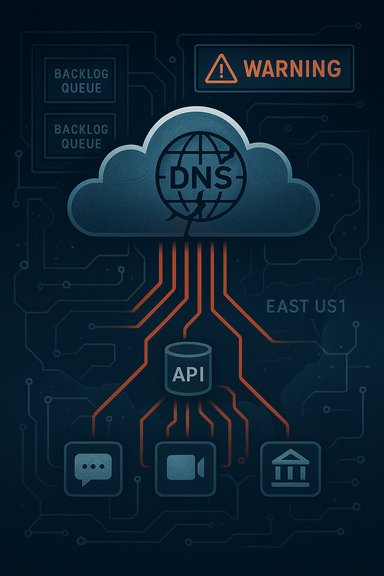
Cloud DNS hub routing API calls to apps and services amid a warning.Background / Overview​

The incident began in AWS’s US‑EAST‑1 region (Northern Virginia), a long‑standing hub for the company’s global control‑plane features and a default region for many workloads. AWS’s public status updates and independent monitoring traced the proximate symptom to DNS resolution failures affecting the DynamoDB API endpoint in US‑EAST‑1, which then amplified into throttled EC2 launches, delayed asynchronous processing, and observable service interruptions across a wide set of consumer and enterprise platforms. Major outlets and real‑time observability tools reported that the outage began in the early hours of October 20, 2025, and that mitigations restored DNS functionality within hours while backlog processing and other recovery steps extended visible effects into the afternoon. This was not a denial‑of‑service or an external intrusion: public reporting and vendor notices uniformly described the event as an internal infrastructure/control‑plane failure rather than a cyberattack. That distinction matters technically, but it does not blunt the operational lesson: when a highly reused managed primitive (in this case DynamoDB and its DNS entries) is impaired, seemingly small failures can cascade through the stacks of countless dependent services.

Why this outage mattered (and why your organization felt it)​

The cloud’s economics and developer ergonomics encourage defaulting to managed services: identity, session stores, small‑state databases, and global control planes are often easier and cheaper to consume than to run yourself. That convenience explains why a single vendor’s regional problem can produce broad collateral damage.
  • Market concentration — Industry trackers show the “Big Three” hyperscalers (AWS, Microsoft Azure, Google Cloud) control roughly two‑thirds of the global cloud infrastructure market. Independent market research groups put AWS’s share at about 30% in 2025, with Azure and Google Cloud following at roughly 20% and 12–13% respectively. Those figures mean that a major AWS outage has systemic reach simply because so many organizations rely, implicitly or explicitly, on the provider’s primitives.
  • Single‑region criticality — US‑EAST‑1 is one of AWS’s largest, oldest and most feature‑rich regions; many global control‑plane functions and default integrations have historically been anchored there. When a control‑plane primitive in that region fails, the blast radius is oversized compared with a failure in a smaller or less central region.
  • Control‑plane dependencies — Managed database services like DynamoDB often store session tokens, feature flags, authentication metadata, and other small pieces of state that sit on the critical path for user logins and real‑time features. If DNS prevents clients from resolving the service hostname, healthy compute nodes can still be functionally unreachable. The result is immediate and visible user‑facing failure.

What happened — a concise technical timeline​

The public narrative is consistent across vendor status posts, observability data and media coverage. The following timeline synthesizes those reports:
  • Early morning (local US‑East time) — monitoring and user reports spike as multiple services show increased error rates and timeouts. AWS posts an initial investigation notice citing “increased error rates and latencies” in US‑EAST‑1.
  • Within the first hour — AWS identifies DNS resolution abnormalities affecting the DynamoDB regional API endpoint as a proximate symptom; third‑party DNS probes corroborate inconsistent resolution to dynamodb.us‑east‑1.amazonaws.com.
  • Mitigation phase — engineers apply parallel mitigations: restore name resolution paths, throttle specific operations to avoid retry storms, and reroute where possible. Early signs of recovery appear, but throttles and backlogs persist.
  • Recovery tail — although name resolution was reported as mitigated within hours, asynchronous queues and throttled subsystems required additional time to clear, producing a long tail of residual errors for some customers. AWS emphasised there was no evidence of a cyberattack.
That sequence — detection, DNS symptom, mitigations, backlog‑driven tail — matches the standard incident‑handling cadence for large distributed systems, but it underscores how a DNS symptom can immediately disable control‑plane semantics across dozens or hundreds of services.

How DNS + a managed database became a systemic choke point​

It helps to strip the technical explanation down to essentials:
  • DNS is the internet’s phonebook. In cloud platforms DNS does more than map names to IPs — it enables service discovery, SDK endpoint selection, and health checks. If a frequently used API hostname fails to resolve, clients simply cannot make requests even if the backend compute exists. That failure mode is particularly brittle because it prevents reachability at the outset.
  • DynamoDB is a widely used low‑latency primitive. Many applications use DynamoDB for authentication tokens, leader election state, feature flags and other small but critical data. Those writes/reads are on the critical path for user actions. When they fail, the observable effect is often immediate (login failures, stalled transactions, broken feeds).
  • Retry storms amplify faults. Most SDKs feature retry logic. When a large cohort of clients simultaneously retry a failed endpoint, they increase load against already stressed systems — a feedback loop that can turn a small DNS glitch into a much larger outage. Robust client libraries mitigate this with conservative retry policies and circuit breakers; not every app implements those protections.
These technical building blocks explain why the outage did not feel like an isolated “database problem” to end users; instead it translated into login failures, interrupted streams, failed payments, and other visible symptoms.

Who and what were affected​

Live outage trackers and media recorded widespread consumer and enterprise impact. The list of affected services is long and varied — social and messaging apps, gaming backends, streaming services, banking portals, and even parts of Amazon’s own consumer product surface reported interruptions at various points.
  • Notable consumer impacts included Snapchat and several multiplayer gaming platforms experiencing login and matchmaking failures; Ring doorbells and Alexa had intermittent issues; Prime Video and other streaming experiences stuttered for some users.
  • Enterprise and financial services saw degraded authentication and payment processing; several banks in the UK and payment platforms reported spikes in errors. Slack, Zoom, Canva and other productivity tools experienced degraded performance in affected geographies.
The episode was conspicuous not just because of which services were affected, but also because outages touched services users rely on for both commerce and critical workflows — raising the stakes for resilience planning inside enterprises and the public sector.

Market context: AWS is large — but not the whole internet​

When the Lifehacker piece observed that AWS is “the largest cloud infrastructure servicer” and quantified its dominance, it was pointing to a structural truth: hyperscalers command a large slice of the market. Independent market analysts show consistent results:
  • Canalys reported that in Q1 and Q2 of 2025 the top three providers (AWS, Microsoft Azure, Google Cloud) accounted for roughly 65% of global cloud spending, with AWS typically cited around 30–32% market share in 2025.
  • Synergy Research Group’s data and industry summaries corroborate the ~30% figure for AWS and a combined Big‑Three share north of 60% in recent 2025 quarters. Those independent sources give confidence that the hyperscalers’ dominance is accurately described, even if exact percentages vary slightly by quarter and methodology.
That concentration explains why outages at any of the Big Three — especially in critical regions or control‑plane primitives — have industry‑wide consequences. At the same time, the remaining ~35–40% of the market is dispersed among many providers (regional players, specialist GPU/AI clouds, and niche infrastructure vendors), which does offer meaningful diversity for organizations that choose to pursue it. Caveat on specific user counts: a frequently repeated claim — that “over four million businesses with a physical address use AWS” — is difficult to verify from public vendor statements and independent filings. AWS commonly reports “millions of active customers” in aggregate, and third‑party reports sometimes conflate different counts (customers vs. hosted resources vs. databases). That specific “four million with a physical address” formulation could not be confirmed from public, verifiable sources at the time of reporting and should be treated with caution until a primary source is provided. Flagged as unverifiable.

AWS alternatives and why they matter for resilience​

No single provider can wholly substitute for another, but diversification of critical control‑plane primitives and data paths reduces correlated risk. Common alternatives and complements include:
  • Microsoft Azure — enterprise‑oriented features, strong Microsoft‑stack integrations, and broad global footprint. Azure is the second largest hyperscaler and often cited as AWS’s strongest competitor.
  • Google Cloud (GCP) — notable for data/AI services and developer‑friendly tooling; GCP has been aggressive on AI infrastructure and region expansion.
  • Alibaba Cloud — a major provider in Asia with global ambitions; relevant for organizations targeting China and APAC.
  • Oracle Cloud, IBM Cloud — enterprise legacy strengths, sometimes attractive for specific regulated workloads or enterprise migrations.
  • Neocloud / GPU specialists (CoreWeave, Lambda Labs, etc. — focused on AI/GPU workloads; they are increasingly important for high‑compute AI tasks and can act as capacity complements.
  • Regional / sovereign clouds (OVH, Hetzner, local providers) — useful for data sovereignty, cost control, and as non‑correlated backups.
The operational reality: a multi‑provider strategy can reduce systemic exposure, but it comes with increased complexity (data replication, cross‑provider networking, different SLAs and APIs). For many organizations the right trade‑off is a hybrid approach: use hyperscalers where they provide clear value, and extract critical controls (identity recovery paths, admin escapes, DNS fallbacks) into less correlated systems.

Practical resilience playbook for Windows administrators, SREs and IT leaders​

The outage offers concrete, implementable steps — many of which are low overhead and high value.

Short‑term operational hygiene (days to weeks)​

  • Map dependencies. Inventory which services, libraries, and third‑party APIs depend on specific cloud primitives (for example, DynamoDB, IAM, or regionally anchored endpoints). Knowing the dependency graph is the first step to mitigation.
  • Harden DNS and caching logic. Ensure client libraries and SDKs implement conservative retry policies, exponential backoff, circuit breakers, and TTL‑aware caching. Consider local resilient resolvers for critical flows.
  • Create admin escape routes. Maintain out‑of‑band administrative access to critical accounts and ensure failover credentials and recovery paths do not themselves rely solely on the same affected control plane.

Architectural strategies (weeks to months)​

  • Multi‑region for critical control planes. Avoid single‑region authoritative stores for identity and small‑state primitives where operationally feasible. Use cross‑region replication with canonical failover procedures.
  • Multi‑cloud or provider diversification for highest‑value flows. For systems where downtime is existential, replicate critical read/write flows across distinct providers or run a lightweight local fallback.
  • Graceful degradation patterns. Design user experiences that allow read‑only or cached modes when downstream writes fail; avoid blocking user flows on non‑critical writes.
  • Practice and test runbooks. Regularly rehearse failover, backlogs clearance, and DNS flushing procedures; automate recovery steps where safe.

Governance and procurement​

  • Update procurement checklists to include demonstrable resilience features (multi‑region guarantees, control‑plane transparency, incident reporting timelines).
  • Negotiate contractual remedies and clearer SLAs for control‑plane availability on critical managed primitives.
Those steps move organizations from reactive to proactive postures and are practical to implement incrementally.

Policy, regulatory and industry consequences​

High‑impact outages like this trigger questions beyond engineering:
  • Regulatory scrutiny. Governments and financial regulators increasingly view hyperscalers as critical third‑party infrastructure. Expect renewed conversations about mandatory reporting thresholds for outages that affect public services and critical financial infrastructure.
  • Supplier risk management. Boards and procurement teams will press for clearer vendor transparency, contractual commitments, and proof of tested recovery capabilities for services that underpin public‑facing and mission‑critical applications.
  • Market incentives. The AI infrastructure race is driving massive hyperscaler investment — which increases supply but also concentrates scale. Regulators will need to balance incentives for innovation with measures that ensure continuity for essential services. Canalys and Synergy reports show the hyperscalers expanding capacity to meet AI demand, but those investments do not remove the need for diversified resilience strategies.

Notable strengths and weaknesses revealed by the incident​

Strengths​

  • Rapid mitigation and transparency. AWS published near‑real‑time status updates and applied staged mitigations that allowed many services to recover within hours, limiting what could have been a far longer period of disruption.
  • Hyperscaler scale and feature breadth. The hyperscalers’ massive scale, global footprint and rich feature sets remain compelling for most workloads; the cloud model continues to provide unmatched agility and efficiency. Market data confirm robust, continued growth in cloud spending driven by AI and scale usage.

Weaknesses / risks​

  • Concentration of control‑plane primitives. When foundational primitives like DNS and widely used managed APIs become single points of failure, the convenience of managed services becomes correlated fragility.
  • Operational opacity and backlog tail risk. Even when the proximate fault is mitigated, throttles and queued backlogs can keep residual outages alive — a behavioral characteristic of large distributed systems that requires explicit customer planning and vendor communication.

What to expect next​

  • AWS will publish a detailed post‑incident report that should enumerate the trigger, timeline, mitigations and engineering fixes. Enterprises will use that report to update runbooks and contractual terms.
  • Expect short‑term vendor responses: guidance on DynamoDB replication patterns, recommended DNS best practices, and prescriptive architectures for high‑availability control‑plane designs. Organizations will likely accelerate vendor risk reviews and multi‑region failover tests.
  • The wider industry response will include renewed debate about concentration risk and the economics of redundancy. Market data show hyperscaler dominance is not about to evaporate, so the practical focus will be on better architecture rather than wholesale abandonment of the cloud.

Conclusion​

Monday’s AWS disruption was a stark, operationally painful illustration of a modern truth: the cloud has centralized incredible power and capability, and with that concentration comes correlated fragility. The technical proximate cause — DNS resolution problems affecting a widely used managed database endpoint in a major region — is small in concept but large in consequence. Organizations and public institutions now face a clear imperative: keep the cloud’s productivity benefits, but treat resilience as a built‑in architecture requirement rather than an afterthought.
Actionable takeaways are simple and urgent: map your dependencies, harden DNS and retry logic, codify admin escape routes, and test failover playbooks. For risk‑averse workloads, diversify where it matters and accept that multi‑provider and multi‑region strategies carry complexity but materially reduce the odds of being taken offline by the next regional control‑plane fault. The cloud’s efficiencies remain compelling — the work ahead is to make those efficiencies robust enough to withstand the inevitable outage.
If a precise, sourced breakdown of which services were affected, the exact AWS status updates, or vendor‑by‑vendor mitigation guidance is required, those items are available in the provider’s and industry post‑incident postings and will be helpful to operationalize the resilience steps outlined above. Note: any numerical claims about exact customer counts (for example, “four million businesses with a physical address use AWS”) could not be verified from primary vendor statements or independent datasets at the time of writing and should be treated with caution.

Source: Lifehacker AWS Isn't the Only Company Holding Up the Internet
 

The internet blinked hard on October 20, 2025 — and for roughly a workday, huge swathes of the web felt the consequences: login failures, frozen checkout flows, interrupted streaming and gaming sessions, and devices that stopped responding. The outage originated inside Amazon Web Services’ US‑EAST‑1 region and, according to public reports and operator telemetry, began as DNS resolution problems for DynamoDB endpoints before cascading into traffic throttles, impaired load‑balancer health checks and long processing backlogs that extended visible recovery across the day.

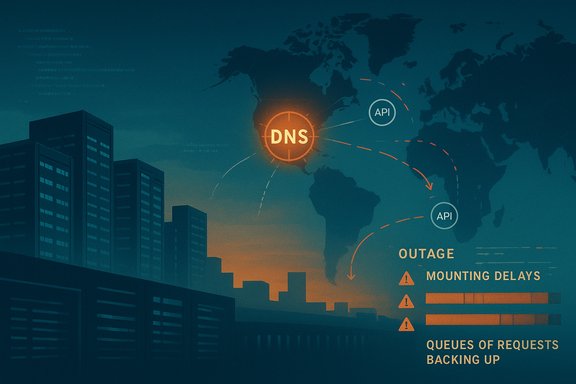
Global DNS outage affecting API routes, with mounting delays and request queues.Background​

Modern cloud adoption favours managed primitives — databases, identity, messaging, and auto‑scaling control planes — because they drastically shorten time to market. Those conveniences are the same reasons a regional control‑plane or DNS issue can become a global outage: many systems default to a single provider and, often, a single primary region. US‑EAST‑1 (Northern Virginia) is one of AWS’s oldest, largest and most heavily used regions; when a control‑plane primitive there falters, the blast radius is outsized. Cloud concentration amplifies the problem. Independent industry trackers estimate the top three providers (AWS, Microsoft Azure and Google Cloud) control roughly two‑thirds of global cloud infrastructure spend, with AWS alone around the 29–32% band in 2025 — a market structure that explains why a failure in a single hyperscaler region is felt by millions.

What happened: a concise technical account​

The proximate trigger​

AWS’s operational timeline and multiple observability vendors indicate the first publicly visible symptom was DNS resolution issues affecting DynamoDB regional endpoints in US‑EAST‑1. Because DynamoDB and similar managed services are deeply embedded into many service control flows — session stores, configuration lookups, and authentication token stores — DNS failures to resolve DynamoDB API hostnames prevented healthy compute nodes from reaching critical state and control services.

How the failure amplified​

After DNS mitigations began, residual impairments surfaced in EC2 internal subsystems responsible for instance launches and in Network Load Balancer health checks. Those impaired health checks caused throttles and slowed recovery actions, producing long tails of queued work that took many hours to clear. AWS publicly described staged mitigations, temporary throttling of sensitive operations (for example, EC2 launches and asynchronous Lambda invocations), and a progressive restoration of services through the afternoon. Observability timelines indicate the visible window of disruption began in the pre‑dawn hours in the U.S. and extended into the afternoon and early evening in other time zones.

Who and what were affected​

The outage touched a broad cross‑section of consumer and enterprise services: social apps, online games, payment apps, IoT device platforms, national government portals and parts of Amazon’s own retail and device ecosystems reported degraded or unavailable services. High‑profile brand interruptions served as headline examples, but the largest impact was economic and operational: thousands of smaller SaaS products, fintech systems and public services experienced partial degradation or cascading errors.

Why this outage matters beyond the memes​

DNS is not a “nice to have” — it is a control plane​

DNS in cloud platforms is more than host‑name lookup; it is a critical part of service discovery, authorization flows and regional routing. When that name resolution fails at scale for a widely used managed API, applications that depend on those APIs often cannot proceed even if raw compute and storage remain healthy. The October incident underscores that control‑plane primitives — DNS, identity, managed DB endpoints and global replication mechanisms — are single points of failure unless explicitly architected otherwise.

The economics of convenience create systemic fragility​

Hyperscalers provide scale and developer velocity that are challenging to replicate. But the standard recipes, SDK defaults, and managed services that make developer life easier also encourage concentration. Enterprises frequently default to a single provider or region for lower latency, cheaper egress, or simpler operations. Those default choices convert convenience into correlated risk: the same convenience that speeds features also multiplies outage impact across ecosystems.

Policy and market implications​

Large outages tend to convert technical pain into policy pressure. Expect renewed scrutiny from regulators and critical‑infrastructure authorities about whether hyperscalers should be designated “critical third parties” for sectors like finance, healthcare and public administration. That could bring mandatory reporting, resilience audits, and stricter procurement expectations for services that depend on cloud providers. The insurance industry will also press for clearer scenario modelling — correlated cloud failures are challenging to underwrite without demonstrable resilience investments.

Strengths revealed — what the cloud model still does well​

  • Rapid detection and coordinated mitigation. Hyperscalers have mature incident response tooling and can mobilize large engineering teams quickly. The staged mitigations and frequent status updates reduced uncertainty and helped downstream teams apply mitigations.
  • Resilience where engineered. Services and applications explicitly designed for graceful degradation, multi‑region failover, and caching suffered substantially less impact — demonstrating that resilient architecture works when applied deliberately.
  • Operational scale that few organizations can replicate. The ability to process backlogs, throttle operations safely and restore connectivity at global scale is a capability only the hyperscalers possess today. That capability matters when recovery requires replaying queued events and reconciling state at global scale.

Weaknesses exposed — hard lessons​

  • Concentrated control‑plane dependency. Defaulting to a single region or a single managed primitive for authentication and session state creates fragile single points of failure. The DynamoDB/DNS symptom was narrow technically but systemic in effect.
  • Recovery friction and long tails. When recovery actions themselves depend on partially impaired subsystems (for example, instance launches depending on a degraded control plane), remediation requires careful throttles and queue replaying — lengthening visible outage windows.
  • Transparency and contractual clarity. Customers and regulators demand timely, detailed post‑incident forensic reports. The faster and more complete those post‑mortems, the more effectively customers can validate vendor claims and update their own mitigations. The industry’s public appetite for forensic detail will not abate.

Practical checklist: what every WindowsForum reader — admins, SREs, and IT managers — should do now​

These steps prioritize low‑friction, high‑leverage actions that reduce the risk that a single provider outage becomes an organizational crisis.
  • Map your dependency graph.
  • Identify the small set of managed services that are existential for login, payments or control flows.
  • Prioritize those services for redundancy or defensive fallbacks.
  • Harden DNS and client fallback logic.
  • Implement multiple resolvers with sensible TTLs, conservative retry policies and exponential backoff.
  • Add in‑process or local caches for critical configuration data to avoid hard failures on transient DNS errors.
  • Design for graceful degradation.
  • Keep core user flows alive in read‑only or delayed modes (for example, allow browsing but delay purchases).
  • Use cached tokens for short windows to permit logins when session stores are impaired.
  • Rehearse failovers and runbooks.
  • Conduct tabletop exercises and at least one live cross‑region failover annually for mission‑critical services.
  • Validate rollback plans, and exercise tracing and observability so you can quickly find where control‑plane calls fail.
  • Negotiate vendor commitments.
  • Add post‑incident forensic disclosures, response SLAs and realistic escape clauses to procurement documents for critical services.
  • Require a minimum level of operational transparency for services classified as essential.
  • Consider multi‑region or multi‑cloud for high‑value slices only.
  • Full multi‑cloud active‑active is expensive and operationally complex. Instead, protect the smallest subset of flows that would be existential if unavailable (authentication, payments, emergency alerts).
  • Monitor costs and understand trade‑offs.
  • Resilience decisions carry economic costs. Model the business impact of downtime and match costlier architectural investments to the flows that matter most.

Architectural patterns that make sense now​

Defensive client libraries and retry logic​

Applications should treat remote managed services as unreliable resources and implement deterministic fallback behaviour. Defensive client libraries that include jittered exponential backoff, circuit breakers and local caches reduce retry storms and retry amplification during provider incidents.

Localized essential state​

When feasible, maintain a compact, write‑through local cache or replicated store for the most essential pieces of state (session tokens, feature flags, short‑lived configuration). That local copy permits critical flows to continue in a degraded mode for a bounded period.

Multi‑region active‑passive with golden‑path failover​

Rather than full active‑active multi‑cloud, many organizations will benefit most from a golden‑path secondary region: asynchronous replication, warmed standby services and automated cutover playbooks that are exercised regularly. This balances cost and resilience.

Regulatory and insurance realities to watch​

  • Expect regulators to renew discussions about classifying major cloud providers as critical service vendors for sectors with systemic obligations (finance, health, tax). That would change vendor oversight and reporting requirements.
  • Insurers will require demonstrable resilience investments and scenario testing to cover correlated cloud losses. If coverage is to remain available at scale, insureds must show meaningful mitigation.

Risks in the proposed responses​

  • Multi‑cloud myths. Multi‑cloud is often promoted as a silver bullet, but it brings operational complexity, licensing headaches and data egress costs. Many teams can’t execute a full provider escape quickly, so partial mitigations and intentional architecture choices are the realistic path.
  • Operational burden and drift. Investing in redundancy without discipline leads to undependable redundancy — configurations that look replicated on paper but break in a real failover. Rehearsal, observability and governance are required.
  • Cost vs. resilience trade‑offs. Excessive resilience spending on low‑value flows is wasteful; under‑investing in mission‑critical flows is catastrophic. Organizations must quantify business impact and prioritize accordingly.

What to expect next from cloud vendors and the market​

  • Technical changes and guardrails. Hyperscalers will likely publish mitigation playbooks for DNS and control‑plane isolation, make safer defaults easier to adopt, and offer explicit support for cross‑region primitives designed for high resilience.
  • More forensic post‑mortems. AWS and peers typically publish detailed post‑incident analyses that enumerate triggers, timelines and corrective actions. Read those reports carefully and translate vendor recommendations into your own runbooks.
  • Competitive and procurement shifts. Large customers may demand greater portability, lower egress penalties and stronger resilience guarantees; a subset will accelerate multi‑region investments, while most will adopt pragmatic mitigations rather than full migration.

A short operational plan for the next 90 days​

  • Run a dependency audit and identify the top five primitives whose failure would break your product.
  • Harden DNS: add secondary resolvers, reduce single‑point reliance, and instrument DNS health metrics.
  • Add a cached read‑only mode for essential customer journeys where feasible.
  • Update runbooks: include DNS resolution failures and control‑plane degradation scenarios.
  • Schedule a live cross‑region failover drill for a high‑value flow and document lessons learned.
These are pragmatic steps that provide measurable risk reduction without necessitating full cloud migration.

Conclusion​

The October 20 outage was a textbook demonstration of a wider truth: scale creates fragility. Hyperscale cloud platforms deliver capabilities that democratize global services and accelerate innovation, but their convenience comes with systemic exposure when control‑plane primitives fail. The right answer is not to abandon the cloud but to professionalize resilience — treating DNS, regional defaults and managed primitives as first‑class risks in architecture, procurement and governance.
Organizations that convert this outage into funded resilience programs, rehearsed runbooks, and contractual clarity will be measurably safer the next time a major provider’s control plane falters. The technical mitigations are known; the organizational work — budgets, governance, and disciplined operational practice — is what determines whether the next failure is an expensive afternoon or a business‑critical crisis.
Source: The EastAfrican The EastAfrican
 

Back
Top