

The three hyperscalers — AWS, Microsoft Azure, and Google Cloud — remain the dominant choices for businesses planning cloud deployments in 2026, but the decision today is less about a single winner and more about matching workloads, cost models, and operational discipline to a provider’s strengths. Recent market telemetry shows the big three still control roughly two‑thirds of cloud infrastructure spending, while independent forecasts project sustained, rapid growth for the overall cloud market through 2032. This feature unpacks the Channel Insider comparison and updates it with cross‑checked, vendor and analyst data; it evaluates core capabilities, AI/ML and hybrid strengths, and the practical pricing levers you must master in 2026. The goal is an actionable decision framework: when to pick AWS, when Azure makes sense, when Google Cloud leads — and how to avoid common pricing and lock‑in traps.
AWS, Azure, and Google Cloud together account for roughly 62–63% of global cloud infrastructure spend, with Synergy Research Group reporting Q3 2025 shares near AWS 29% / Azure 20% / Google Cloud 13% — a useful market snapshot that captures relative scale and momentum. These shares are dynamic: AWS remains the largest by revenue, Azure benefits from deep Microsoft seat and enterprise reach, and Google Cloud is the fastest‑growing major provider on several recent quarters. At a macro level the cloud market is forecast to expand aggressively: Fortune Business Insights projects the global cloud computing market growing from about USD 676.3B in 2024 to roughly USD 2,291.59B by 2032, implying high sustained CAGR driven by AI, analytics, and digital transformation. Treat these long‑range forecasts as directional; they matter because they shape vendor capex, pricing tactics, and capacity availability.
Governance checklist for hybrid/multi‑cloud:
End of analysis and guidance.
Source: Channel Insider AWS vs Azure vs Google Cloud: 2026 Key Features and Pricing
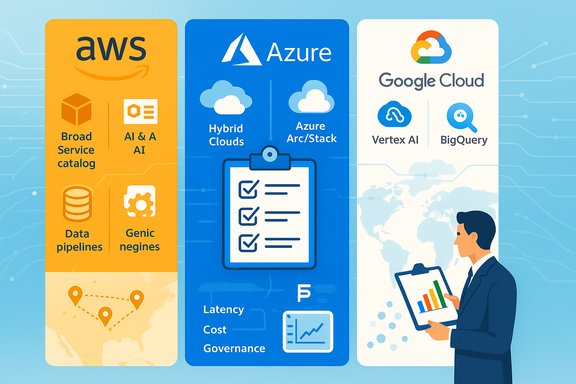 Background / Overview
AWS, Azure, and Google Cloud together account for roughly 62–63% of global cloud infrastructure spend, with Synergy Research Group reporting Q3 2025 shares near AWS 29% / Azure 20% / Google Cloud 13% — a useful market snapshot that captures relative scale and momentum. These shares are dynamic: AWS remains the largest by revenue, Azure benefits from deep Microsoft seat and enterprise reach, and Google Cloud is the fastest‑growing major provider on several recent quarters. At a macro level the cloud market is forecast to expand aggressively: Fortune Business Insights projects the global cloud computing market growing from about USD 676.3B in 2024 to roughly USD 2,291.59B by 2032, implying high sustained CAGR driven by AI, analytics, and digital transformation. Treat these long‑range forecasts as directional; they matter because they shape vendor capex, pricing tactics, and capacity availability. Market snapshot: scale, regions, and growth signals
Scale and regional footprints
- AWS publishes a global infrastructure footprint of 38 geographic regions and 120 Availability Zones (with announced additional regions/AZs), plus a large edge network — among the largest public counts available. These region/AZ counts are central planning inputs for latency, compliance and disaster recovery design.
- Microsoft continues to emphasize breadth of regional coverage and datacenter presence — Microsoft public communications and product blogs reference 70+ Azure regions and hundreds of datacenters, supporting Azure’s hybrid and sovereign‑cloud positioning. Count metrics vary over time as new regions come online; always confirm the current region map in the vendor console.
- Google Cloud lists 42 regions and an expanding set of zones and PoPs optimized for data/ML workflows, with developer‑centric routing between BigQuery, Vertex AI, and TPU‑backed infrastructure. Region and zone counts are foundational when you architect distributed ML workloads.
Growth drivers and what they mean for buyers
Generative AI, model training and inference at scale, and enterprise SaaS modernization are the dominant demand drivers in 2025–2026. That demand changes the economics of cloud procurement: commitments, reserved capacity, dedicated AI racks, and negotiated GPU/TPU supply arrangements matter more than ever because capacity constraints translate to time‑to‑market for model launches.Core strengths: breakdown by provider
Amazon Web Services (AWS)
AWS is the broadest catalog and the most mature global infrastructure provider.- Strengths:
- Breadth of services (200+ services across compute, storage, networking, DB, analytics, AI/ML, serverless).
- Global reach and availability zones that enable low latency and compliance configurations at scale.
- Pricing mechanics that support granular cost‑optimization (Spot, Savings Plans, Reserved Instances) and a mature partner ecosystem for specialized workloads.
- Custom silicon and AI stack investments (Trainium/Inferentia/Graviton) aimed at improving price‑performance for ML workloads and reducing external GPU dependency.
- Practical fit:
- High‑scale global applications, high‑throughput data pipelines, and organizations that want maximal service choice and the deepest set of managed primitives.
- Caveats:
- Service breadth increases architectural complexity; getting optimal price/performance usually requires experienced architects and a strong FinOps practice.
Microsoft Azure
Azure’s principal advantage is enterprise integration and hybrid posture.- Strengths:
- Seamless integration with Microsoft products (Windows Server, SQL Server, Microsoft 365, Entra ID), which reduces migration friction for Microsoft‑centric estates.
- Hybrid and on‑prem parity via Azure Arc, Azure Stack, and consistent management tools — a material advantage for regulated industries and slow‑move modernization programs.
- Productized AI in productivity stacks (Copilot integrations across Microsoft 365 and Dynamics) enabling seat‑based monetization models for AI features.
- Practical fit:
- Enterprises with heavy Windows/.NET/SAP/SQL Server estates, organizations prioritizing employee productivity integrations, and those needing strong hybrid governance.
- Caveats:
- Licensing complexity and porting costs for non‑Microsoft workloads can surprise budgets; careful licensing modeling (Azure Hybrid Benefit, SA entitlements) is essential.
Google Cloud Platform (GCP)
Google Cloud excels at data, ML, and developer ergonomics.- Strengths:
- Vertex AI and BigQuery deliver high‑quality managed MLOps and analytics workflows; GCP is often the fastest path for data‑centric AI projects.
- TPU and custom ML stack provide compelling training/inference economics for large models.
- Developer‑first tooling and container/Kubernetes leadership (GKE) make it attractive for modern cloud‑native teams.
- Practical fit:
- Data engineering teams, ML research labs, and startups building generative AI products that need integrated data pipelines and low‑friction model versioning.
- Caveats:
- Smaller absolute enterprise market share than AWS/Azure can mean fewer third‑party integrations and a smaller partner network in some geographies.
Pricing in 2026 — models, levers, and how to compare
Pricing remains the single most misunderstood and mis‑estimated element of cloud selection. All three providers use pay‑as‑you‑go pricing, but the savings mechanisms and purchase constructs differ materially.Core purchasing models (how providers discount compute and storage)
- Pay‑as‑you‑go (on‑demand): flexible, no commitment, highest unit costs.
- Reserved/committed discounts: commit 1–3 years or fixed $/hour commitments in exchange for steep discounts.
- AWS: Savings Plans (Compute and Instance‑level) and Reserved Instances; Savings Plans offer flexibility across families/regions and up to ~66–72% depending on plan and term. Spot instances provide up to ~90% discounts for interruptible capacity.
- Azure: Reserved VM Instances and the Azure Savings Plan for Compute (1 or 3 year) plus the Azure Hybrid Benefit for reusing Windows/SQL Server licenses; savings vary widely by instance family and commitment.
- Google Cloud: Committed Use Discounts (CUDs) and Sustained Use Discounts (SUDs) that automatically apply based on monthly usage; preemptible VMs (equivalent to Spot) can give very large discounts for batch jobs. Flexible “compute flexible CUDs” now cover multiple VM families and container workloads.
Five pricing rules every buyer should follow
- Model real workloads, not hypothetical instances — include storage IOPS, network egress, logging/monitoring costs, and snapshot frequency. Estimates that skip egress or backup charges are routinely wrong by 20–40%.
- Use spot/preemptible capacity for non‑critical and batch jobs to cut inference and training costs by 60–90%. Include automation for re‑submission and checkpointing.
- Commit intelligently: savings plans/committed discounts pay back quickly for predictable baseline compute, but avoid over‑commitment where scale or architecture will change. Monitor with Cost Explorer/Cost Management tools.
- Factor in licensing: Windows Server and SQL Server license models and migration entitlements (Azure Hybrid Benefit, AWS License Mobility) have large TCO effects — validate entitlements early.
- Negotiate enterprise agreements and include capacity/price protection for AI acceleration — large customers should build GPU/TPU capacity guarantees into contracts to avoid price shocks and capacity constraints.
AI/ML, accelerators and vendor differences
AI workloads are reshaping both product roadmaps and pricing.- AWS: emphasis on choice (Bedrock for managed foundation models, SageMaker for full ML lifecycle) and custom silicon (Trainium/Inferentia) that promises better price/performance for some training/inference patterns. AWS also partners broadly with third‑party foundation model vendors.
- Azure: productized AI experiences via Microsoft 365 Copilot, Azure OpenAI Service, and a deep enterprise channel; Microsoft’s heavy capex on AI data centers supports large model hosting but raises the importance of contractual commitments for capacity.
- Google Cloud: Vertex AI and TPUs give a clear path for high‑performance model training and large dataset analytics; BigQuery integration simplifies production analytics pipelines tied to model workflows.
Hybrid, multi‑cloud and governance
Azure continues to lead on hybrid features (Azure Arc, Azure Stack) by design; AWS and Google offer hybrid options but Azure’s Microsoft enterprise channel and licensing dynamics often make hybrid transitions less disruptive for Windows shops. For multi‑cloud, Kubernetes (EKS/AKS/GKE) and Terraform remain the portability layer most organizations rely on, but multi‑cloud increases operational overhead and multiplies security and compliance surfaces.Governance checklist for hybrid/multi‑cloud:
- Centralized identity (Entra ID/IdP bridging, Identity Platform).
- Unified logging and observability across providers.
- Cost governance (tagging discipline + chargeback).
- Data residency mapping and contractual DPAs per provider.
Use‑case decision guide — which provider for which primary need
- Best for breadth & global scale: AWS — choose for the largest service catalog, mature global edge, and highly granular price/performance tuning.
- Best for hybrid enterprise & Microsoft stacks: Azure — choose if you rely heavily on Windows Server, SQL Server, Microsoft 365, or need a unified on‑prem + cloud management plane.
- Best for data analytics & model training: Google Cloud — choose for Vertex AI, BigQuery, TPUs, and developer‑friendly ML pipelines.
Risks, caveats and unverifiable claims
- Region and AZ counts, market shares and forecast numbers are time sensitive. The figures cited in this article reflect vendor and analyst reporting through late 2025 and public vendor pages; confirm counts in the provider consoles before final region selection. Numbers like “38 AWS regions” or “70+ Azure regions” can change as new regions launch.
- Vendor‑provided performance or savings claims (e.g., “Aurora is up to 5x faster than MySQL” or “Savings Plans save up to X%”) are conditional on workload and region; treat vendor numbers as directional and validate with benchmarks and proofs‑of‑concept.
- Long‑term market forecasts (e.g., Fortune Business Insights’ 2032 projection) reflect a set of assumptions about adoption and CAGR — useful for strategic planning but not a guarantee of outcome. Plan for sensitivity to slower or faster adoption scenarios.
Practical migration and procurement steps (actionable)
- Inventory and classify apps: data gravity, compliance profile, modernization potential.
- Run three pilot migrations: one Microsoft‑stack lift‑and‑shift, one stateless microservice on containers, one data/ML pipeline on GCP/AWS to compare TCO and performance.
- Build FinOps baseline: tagging, budgets, alerts, and a recommended commitment strategy (spot for batch, savings plans for steady compute).
- Negotiate enterprise terms that include GPU/accelerator supply guarantees, egress protections, and committed capacity SLAs where model training is business‑critical.
- Create runbooks for preemption, failover, and multi‑region recovery; test them. Document licensing entitlements and BYOL paths if you have Microsoft server licensing.
Conclusion — balancing feature fit, price, and operational maturity
The practical answer to “AWS vs Azure vs Google Cloud” in 2026 is: it depends. Each provider leads in distinct vectors:- AWS: unrivaled breadth and global scale; choose for scale, advanced managed services, and complex multi‑region architectures.
- Azure: the pragmatic choice for Microsoft‑first enterprises, hybrid continuity, and bundled productivity/AI monetization.
- Google Cloud: the fastest path for data‑centric AI and developer‑friendly MLOps pipelines.
End of analysis and guidance.
Source: Channel Insider AWS vs Azure vs Google Cloud: 2026 Key Features and Pricing
