

The cloud infrastructure market is entering a new phase in which raw capacity is no longer enough to win enterprise workloads. As AI agents move from pilot projects into production, hyperscalers are being forced to spend heavily on compute, storage, networking, tooling and global delivery just to stay differentiated. That shift is reshaping competition among AWS, Microsoft Azure and Google Cloud, while raising the stakes for customers that want AI-ready infrastructure without destabilizing existing operations.
The latest read from Omdia paints a market that is still expanding at speed, but with a more complex set of demands than the first wave of generative AI. Global cloud infrastructure services spending reached $110.9 billion in the final quarter of 2025, up 29% year on year, according to the analysis cited by Computer Weekly. That performance reflects a market no longer driven only by experimentation, but by a broader move from proofs of concept toward operational AI deployments.
The most striking feature of the quarter is how broad the demand has become. Buyers are not simply chasing GPUs and specialized accelerators; they are also consuming more CPUs, storage and networking, while memory shortages add another layer of constraint. In other words, AI is no longer a niche capacity problem. It is becoming a whole-stack infrastructure problem, and that is changing the economics of cloud competition.
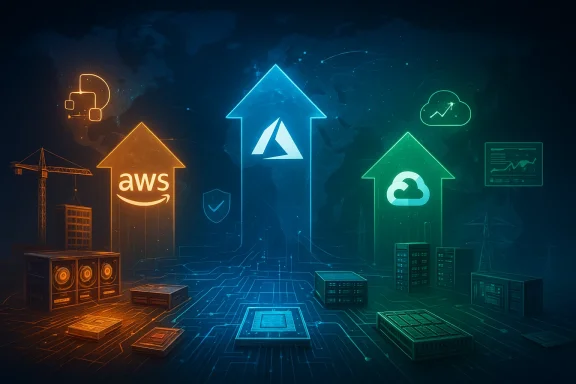
That helps explain why the three dominant hyperscalers all posted strong growth in Q4 2025. Omdia says AWS grew 24%, Azure 39% and Google Cloud 50%, with the trio continuing to dominate the market’s center of gravity. The figures suggest that demand is high enough to lift all boats, but not high enough to eliminate differentiation pressure; vendors still have to prove they can deliver scale efficiently and with enough operational discipline to serve enterprise AI at production quality.
The spending backdrop is equally important. Amazon told investors it expects to invest about $200 billion in capital expenditures across 2026, with management tying that outlay to AI, chips, robotics and other long-term bets. Alphabet, meanwhile, said it expects $175 billion to $185 billion in capital expenditures for full-year 2026, while Microsoft has been reporting quarterly capital expenditure at roughly $37.5 billion in the period referenced by the article. Those numbers are not just spending headlines; they are evidence that cloud leadership is increasingly determined by infrastructure build-out and execution speed.
For enterprises, the question is no longer whether cloud providers can host AI. It is whether those providers can support AI agents reliably inside real systems, with governance, deployment tooling and workflow orchestration strong enough to survive production use. That is a much harder problem than creating a demo, and it is where the next round of cloud differentiation will be decided.
The hyperscaler model has been built on a simple promise: pool enough global infrastructure that customers can scale without building their own data centers. For years, the differentiators were breadth of services, geographic footprint and enterprise relationships. AI changed the mix by making access to accelerators, model services and data pipelines more important, but the current phase shows that those are only the first-order requirements. The second-order requirements are now taking center stage.
That evolution matters because AI agents are more operationally demanding than earlier AI use cases. They tend to interact with multiple systems, query more data, invoke more tools and create a larger blast radius if something breaks. Omdia’s analyst Yi Zhang highlighted exactly this issue, noting that enterprises want capabilities embedded into existing systems and scaled reliably in production. That is why cloud vendors are spending not just on compute, but on governance, orchestration and deployment capabilities.
The historical pattern is familiar, even if the technology stack is newer. In every major cloud cycle, the winning providers have been those able to spend ahead of demand without losing control of unit economics. What is different now is that the investments are broader and more interdependent: chips, memory, cooling, region expansion, back-end networking, model services and developer tools all reinforce each other. This is not merely a capex race; it is an ecosystem race.
That is why the market is beginning to reward vendors that can support both performance and operational control. For cloud providers, this means building not just larger data centers, but also more sophisticated management layers. It also means serving customers who are budget-conscious and risk-averse even when they are eager to adopt AI.
More importantly, the market is increasingly concentrated around the three largest vendors. AWS, Azure and Google Cloud together remain the dominant force, and their combined strength creates a flywheel effect: the largest customers want the largest platforms, while the largest platforms can justify the largest investment programs. That pattern can be self-reinforcing, but it also means the competitive gap between the top tier and the rest can widen quickly.
The key takeaway is that growth rates are now being used as a proxy for strategic momentum. In a market where customers are seeking AI-ready capacity and operational support, faster growth often reflects stronger perceived fit for the next wave of workloads. That does not automatically mean a vendor is “better,” but it does suggest the market is rewarding those with clearer AI narratives and enough infrastructure to back them up.
That matters for cloud vendors because agents blur the line between infrastructure and application. Customers do not just want a GPU instance or a hosted model endpoint; they want a production environment in which the agent can operate across applications, data stores and workflows. The platform becomes part of the product, and that raises the bar for every provider in the market.
It also creates an enterprise trust problem. If an agent can make decisions, trigger actions or interact with business systems, then failures are no longer just technical glitches. They can become financial, compliance or customer-experience incidents. That is why governance is moving from a nice-to-have to a core product feature.
Microsoft’s quarterly capex pace, cited in the source article at $37.5 billion, shows similar seriousness. Even when exact quarterly figures vary over time, the direction is unmistakable: the hyperscalers are plowing more capital into servers, data centers and networking because the AI demand curve remains steep. The companies are effectively betting that customers will keep converting AI experiments into long-lived workloads.
The hyperscalers also face a less glamorous but equally serious challenge: supply chain volatility. Amazon’s earnings materials explicitly mention resource and supply volatility, including memory chips, among the factors that can affect results. In a world where AI infrastructure depends on constrained components, the ability to secure supply may matter as much as the ability to fund spend.
This is where the competitive dynamics become more interesting. AWS retains the deepest portfolio and the broadest installed base. Azure benefits from its enterprise software footprint and its relationship with Microsoft’s productivity stack. Google Cloud has the strongest AI-native brand narrative, which increasingly resonates with customers trying to operationalize machine learning and generative AI quickly.
It also explains why the cloud market is becoming more crowded around the edges. Smaller AI infrastructure players, sovereign cloud providers and specialized neoclouds can compete on niche use cases, but hyperscalers still have advantages in breadth, compliance and global reach. The result is a market that is simultaneously consolidating at the top and fragmenting around specialized demand. That tension will likely define the next two to three years.
The enterprise case also depends on time to value. Many organizations have already spent 2024 and 2025 testing AI in bounded environments. In 2026, the pressure is to produce measurable operational gains. That means cloud vendors must help customers move from experimentation to production faster, with fewer integration headaches and clearer operational controls.
It also suggests that vendor lock-in may become a more accepted trade-off if the cloud provider reduces operational risk. Many enterprises will happily pay for a more integrated stack if it means fewer surprises in production. In that sense, differentiation is not just about performance; it is about confidence.
For consumers, the changes are mostly indirect but still important. Better cloud capacity enables more responsive AI products, more regionally available services and faster rollout of features embedded into everyday software. At the same time, higher infrastructure costs can pressure vendors to price AI features more aggressively or keep some capabilities behind premium tiers.
At the same time, more abstraction can hide complexity rather than eliminate it. As vendors add layers for governance, orchestration and security, developers may get convenience but lose some transparency into costs and performance. That trade-off will matter more as AI workloads move into production and budgets tighten.
The immediate question is whether the current pace of spending produces the right kind of capacity fast enough to meet customer demand. The answer will depend on execution across regions, on the resilience of supply chains and on how effectively hyperscalers convert infrastructure into usable services. The winners will not simply be the biggest spenders; they will be the best operators.
Source: Computer Weekly Hyperscalers spending to differentiate their cloud services | Microscope
 Overview
The latest read from Omdia paints a market that is still expanding at speed, but with a more complex set of demands than the first wave of generative AI. Global cloud infrastructure services spending reached $110.9 billion in the final quarter of 2025, up 29% year on year, according to the analysis cited by Computer Weekly. That performance reflects a market no longer driven only by experimentation, but by a broader move from proofs of concept toward operational AI deployments.The most striking feature of the quarter is how broad the demand has become. Buyers are not simply chasing GPUs and specialized accelerators; they are also consuming more CPUs, storage and networking, while memory shortages add another layer of constraint. In other words, AI is no longer a niche capacity problem. It is becoming a whole-stack infrastructure problem, and that is changing the economics of cloud competition.
That helps explain why the three dominant hyperscalers all posted strong growth in Q4 2025. Omdia says AWS grew 24%, Azure 39% and Google Cloud 50%, with the trio continuing to dominate the market’s center of gravity. The figures suggest that demand is high enough to lift all boats, but not high enough to eliminate differentiation pressure; vendors still have to prove they can deliver scale efficiently and with enough operational discipline to serve enterprise AI at production quality.
The spending backdrop is equally important. Amazon told investors it expects to invest about $200 billion in capital expenditures across 2026, with management tying that outlay to AI, chips, robotics and other long-term bets. Alphabet, meanwhile, said it expects $175 billion to $185 billion in capital expenditures for full-year 2026, while Microsoft has been reporting quarterly capital expenditure at roughly $37.5 billion in the period referenced by the article. Those numbers are not just spending headlines; they are evidence that cloud leadership is increasingly determined by infrastructure build-out and execution speed.
Why this matters now
The cloud market has always rewarded scale, but AI is changing the definition of scale. Vendors need capacity in the right regions, enough networking headroom to move data quickly, and service layers that can orchestrate complex workflows rather than simply rent servers. That is why Omdia’s framing around discipline, resource allocation and global operational efficiency is so relevant to the current competitive cycle.For enterprises, the question is no longer whether cloud providers can host AI. It is whether those providers can support AI agents reliably inside real systems, with governance, deployment tooling and workflow orchestration strong enough to survive production use. That is a much harder problem than creating a demo, and it is where the next round of cloud differentiation will be decided.
Background
The cloud infrastructure market has been on a long growth trajectory, but the acceleration in 2025 and early 2026 reflects a different kind of demand shock. Omdia’s earlier quarterly updates showed that cloud spending was already rising sharply through 2025, with Q3 spending at $102.6 billion and year-on-year growth of 25% before the even stronger Q4 result. That momentum indicates that enterprises were steadily moving from exploration into broader deployment well before the end of the year.The hyperscaler model has been built on a simple promise: pool enough global infrastructure that customers can scale without building their own data centers. For years, the differentiators were breadth of services, geographic footprint and enterprise relationships. AI changed the mix by making access to accelerators, model services and data pipelines more important, but the current phase shows that those are only the first-order requirements. The second-order requirements are now taking center stage.
That evolution matters because AI agents are more operationally demanding than earlier AI use cases. They tend to interact with multiple systems, query more data, invoke more tools and create a larger blast radius if something breaks. Omdia’s analyst Yi Zhang highlighted exactly this issue, noting that enterprises want capabilities embedded into existing systems and scaled reliably in production. That is why cloud vendors are spending not just on compute, but on governance, orchestration and deployment capabilities.
The historical pattern is familiar, even if the technology stack is newer. In every major cloud cycle, the winning providers have been those able to spend ahead of demand without losing control of unit economics. What is different now is that the investments are broader and more interdependent: chips, memory, cooling, region expansion, back-end networking, model services and developer tools all reinforce each other. This is not merely a capex race; it is an ecosystem race.
The shift from experimentation to production
The biggest structural change is the movement from AI pilots to enterprise rollouts. During the pilot phase, customers can tolerate slower provisioning, limited regional availability and uneven integration. Once AI agents are embedded into business workflows, those tolerances collapse. Availability, latency and reliability become non-negotiable.That is why the market is beginning to reward vendors that can support both performance and operational control. For cloud providers, this means building not just larger data centers, but also more sophisticated management layers. It also means serving customers who are budget-conscious and risk-averse even when they are eager to adopt AI.
- Cloud demand is being driven by production AI, not just experimentation.
- Buyers now care about CPUs, storage and networking as much as GPUs.
- Memory shortages are affecting the wider infrastructure stack.
- Agentic AI raises the bar for governance and orchestration.
- Capacity alone is no longer a sufficient competitive advantage.
The Q4 2025 market signal
The headline figure of $110.9 billion in quarterly cloud infrastructure spending is important because it shows that growth is not coming off a low base. A market expanding at 29% year over year at this size is already absorbing enormous capital and operational effort. That level of growth signals both strong demand and serious pressure on providers to keep up.More importantly, the market is increasingly concentrated around the three largest vendors. AWS, Azure and Google Cloud together remain the dominant force, and their combined strength creates a flywheel effect: the largest customers want the largest platforms, while the largest platforms can justify the largest investment programs. That pattern can be self-reinforcing, but it also means the competitive gap between the top tier and the rest can widen quickly.
What the growth rates say
AWS’s 24% growth still matters because of its scale. On a base as large as AWS, that is a substantial absolute increase in revenue, and it signals that the market leader is still benefiting from broad demand rather than losing share in a meaningful way. Azure’s 39% growth and Google Cloud’s 50% growth, however, show that challengers are converting AI urgency into faster top-line expansion.The key takeaway is that growth rates are now being used as a proxy for strategic momentum. In a market where customers are seeking AI-ready capacity and operational support, faster growth often reflects stronger perceived fit for the next wave of workloads. That does not automatically mean a vendor is “better,” but it does suggest the market is rewarding those with clearer AI narratives and enough infrastructure to back them up.
- AWS is still the scale leader.
- Azure is translating enterprise entrenchment into faster growth.
- Google Cloud is leveraging AI-native positioning.
- The market is large enough that all three can grow strongly.
- Share shifts can still happen even in a concentrated market.
AI agents as the new workload driver
The article’s most interesting point is not simply that AI is driving demand, but that AI agents are now becoming the trigger for a new spending phase. Agents require more persistent access to systems, more data movement and more orchestration than many earlier AI use cases. That makes them expensive to run, difficult to govern and highly dependent on cloud platform quality.That matters for cloud vendors because agents blur the line between infrastructure and application. Customers do not just want a GPU instance or a hosted model endpoint; they want a production environment in which the agent can operate across applications, data stores and workflows. The platform becomes part of the product, and that raises the bar for every provider in the market.
From prompts to pipelines
Traditional AI usage often centered on prompts, inference and isolated tasks. Agentic AI shifts the model toward pipelines, loops and decision trees. That creates new infrastructure demands in logging, observability, guardrails and rollback capabilities.It also creates an enterprise trust problem. If an agent can make decisions, trigger actions or interact with business systems, then failures are no longer just technical glitches. They can become financial, compliance or customer-experience incidents. That is why governance is moving from a nice-to-have to a core product feature.
- Agents need persistent integration with enterprise systems.
- Workflow orchestration is now a cloud differentiator.
- Logging and observability become more important at scale.
- Guardrails are essential for business-grade deployment.
- Failures can have operational and compliance consequences.
The capex race intensifies
The spending commitments from the biggest hyperscalers make it clear that AI capacity is being treated as a strategic moat. Amazon’s expected $200 billion capex program for 2026 is extraordinary even by hyperscaler standards, while Alphabet’s $175 billion to $185 billion guidance suggests another year of aggressive infrastructure investment. Those plans reinforce the idea that cloud leadership is being decided by who can finance and absorb the biggest build-outs.Microsoft’s quarterly capex pace, cited in the source article at $37.5 billion, shows similar seriousness. Even when exact quarterly figures vary over time, the direction is unmistakable: the hyperscalers are plowing more capital into servers, data centers and networking because the AI demand curve remains steep. The companies are effectively betting that customers will keep converting AI experiments into long-lived workloads.
Why spending alone is not enough
However, capex is only half the story. If a company spends heavily but fails to deploy capacity in the right locations or cannot bring new services online efficiently, that spending may not translate into competitive advantage. This is why Omdia’s emphasis on resource allocation and operational efficiency is so important.The hyperscalers also face a less glamorous but equally serious challenge: supply chain volatility. Amazon’s earnings materials explicitly mention resource and supply volatility, including memory chips, among the factors that can affect results. In a world where AI infrastructure depends on constrained components, the ability to secure supply may matter as much as the ability to fund spend.
- Capex is rising across all three major cloud vendors.
- Memory and component supply remain potential bottlenecks.
- Efficiency now matters as much as raw spending power.
- Regional execution can determine whether capital becomes capacity.
- The winners will be those who convert spend into usable service faster.
Differentiation in a crowded market
When every major cloud vendor is investing at scale, differentiation shifts from “who has the most infrastructure” to “who can package it best.” That means better AI tooling, smoother deployment pathways, stronger governance and more credible enterprise integration. In practice, the cloud market is moving from a pure infrastructure contest to a platform and workflow contest.This is where the competitive dynamics become more interesting. AWS retains the deepest portfolio and the broadest installed base. Azure benefits from its enterprise software footprint and its relationship with Microsoft’s productivity stack. Google Cloud has the strongest AI-native brand narrative, which increasingly resonates with customers trying to operationalize machine learning and generative AI quickly.
The platform layer matters more
The platform layer is where vendors can create stickiness beyond raw compute. Tooling for orchestration, model management, security and observability can make a cloud harder to leave. That helps explain why cloud vendors are spending so aggressively on features that might once have seemed secondary.It also explains why the cloud market is becoming more crowded around the edges. Smaller AI infrastructure players, sovereign cloud providers and specialized neoclouds can compete on niche use cases, but hyperscalers still have advantages in breadth, compliance and global reach. The result is a market that is simultaneously consolidating at the top and fragmenting around specialized demand. That tension will likely define the next two to three years.
- AWS wins on breadth and scale.
- Azure wins on enterprise integration.
- Google Cloud wins on AI credibility.
- Tooling and workflow support create switching costs.
- Specialized competitors can still win targeted workloads.
Enterprise implications
For enterprise buyers, the most important issue is not hype but fit. AI agents and other advanced workloads must slot into existing identity systems, data environments and compliance frameworks. That creates a very practical buying checklist: can the cloud support the workload, can it be governed, and can it scale without forcing a platform overhaul?The enterprise case also depends on time to value. Many organizations have already spent 2024 and 2025 testing AI in bounded environments. In 2026, the pressure is to produce measurable operational gains. That means cloud vendors must help customers move from experimentation to production faster, with fewer integration headaches and clearer operational controls.
Governance is now a purchase criterion
A cloud platform that makes AI deployment easy but governance difficult will struggle in regulated or risk-sensitive industries. Finance, healthcare, public sector and critical infrastructure users need tooling that can enforce policy, trace actions and support auditability. That makes enterprise AI more dependent on the cloud vendor’s software layer than its marketing layer.It also suggests that vendor lock-in may become a more accepted trade-off if the cloud provider reduces operational risk. Many enterprises will happily pay for a more integrated stack if it means fewer surprises in production. In that sense, differentiation is not just about performance; it is about confidence.
- Buyers want integration, not just infrastructure.
- Governance and auditability are essential for regulated sectors.
- Time to value is becoming a decisive factor.
- Production reliability matters more than prototype speed.
- Enterprises may accept more platform coupling for lower risk.
Consumer and developer impacts
Although the article focuses on enterprise cloud, the effects will spill into the developer and consumer layers as well. Developers will see more AI-native services, more managed orchestration tools and likely more bundled features designed to simplify agent deployment. That can be productive, but it can also create a steeper learning curve as platforms become more feature-rich.For consumers, the changes are mostly indirect but still important. Better cloud capacity enables more responsive AI products, more regionally available services and faster rollout of features embedded into everyday software. At the same time, higher infrastructure costs can pressure vendors to price AI features more aggressively or keep some capabilities behind premium tiers.
The developer experience becomes strategic
Cloud vendors increasingly compete on the speed and quality of the developer experience. If the platform makes it easy to deploy agents, manage workflows and monitor behavior, it becomes more attractive to startups and enterprise teams alike. That convenience is not trivial; it is a competitive moat.At the same time, more abstraction can hide complexity rather than eliminate it. As vendors add layers for governance, orchestration and security, developers may get convenience but lose some transparency into costs and performance. That trade-off will matter more as AI workloads move into production and budgets tighten.
- Better capacity should improve service responsiveness.
- New AI features may arrive faster across cloud ecosystems.
- Premium pricing could rise as infrastructure costs rise.
- Developer tooling will be a major battleground.
- More abstraction may simplify deployment but obscure costs.
Strengths and Opportunities
The market still looks structurally favorable for the hyperscalers because demand is rising, AI adoption is broadening and the largest providers have the resources to keep investing. The opportunity is not just to sell more infrastructure, but to define the default operating environment for enterprise AI. That gives the leading vendors a chance to expand their platforms deeper into customer workflows.- Strong enterprise demand for AI infrastructure.
- Large installed bases that support upsell and expansion.
- Ability to fund massive capex programs.
- Opportunity to bundle governance, orchestration and deployment tools.
- Global scale that smaller rivals cannot easily match.
- Growing need for production-grade agent support.
- Potential to lock in customers through platform integration.
Risks and Concerns
The same dynamics that create opportunity also create risk. Heavy spending raises the bar for return on investment, while supply constraints, power availability and regional execution can all disrupt the economics of expansion. If AI demand cools faster than expected, the industry could be left with expensive overbuild and sharper scrutiny from investors.- Capex intensity could pressure margins.
- Memory and supply-chain shortages may delay deployments.
- Power and data-center constraints remain real bottlenecks.
- AI demand could prove uneven across sectors.
- Customers may resist lock-in as platforms become more integrated.
- Smaller specialized competitors can undercut on niche workloads.
- Governance failures could damage trust in AI platforms.
Looking Ahead
The next phase of cloud competition will be defined less by whether vendors can provide AI infrastructure and more by whether they can make that infrastructure operationally trustworthy. That means tighter integration across compute, data, security and orchestration, plus better controls for enterprises that want AI agents in production without losing oversight. In that environment, cloud vendors that combine speed with discipline will have the best chance of turning current momentum into durable advantage.The immediate question is whether the current pace of spending produces the right kind of capacity fast enough to meet customer demand. The answer will depend on execution across regions, on the resilience of supply chains and on how effectively hyperscalers convert infrastructure into usable services. The winners will not simply be the biggest spenders; they will be the best operators.
- Watch how quickly AI capacity turns into production-grade services.
- Track whether Microsoft, Google and AWS maintain growth momentum.
- Monitor memory, power and data-center supply constraints.
- Look for more investment in orchestration and governance tooling.
- Follow whether enterprise buyers diversify beyond the top three providers.
Source: Computer Weekly Hyperscalers spending to differentiate their cloud services | Microscope
