

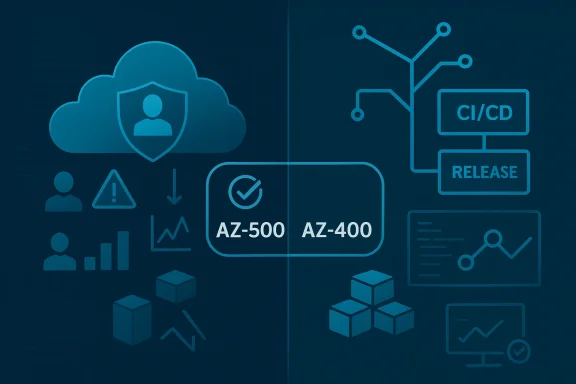
Cloud computing certifications have become a practical shorthand for trust, and AZ-500 and AZ-400 remain two of the most career-relevant Microsoft Azure credentials for professionals who want to prove security and DevOps expertise. Microsoft’s current exam guidance shows that both certifications are still active, still role-based, and still mapped to clearly defined job outcomes: AZ-500 for Azure security engineers and AZ-400 for DevOps engineers. The timing matters, too, because Microsoft updated the AZ-500 skills guide as of January 22, 2026, and the English-language AZ-400 exam blueprint was updated on July 26, 2024, which means candidates need current study materials rather than stale exam dumps or generic cloud notes.
Azure certification has evolved from a nice-to-have credential into a visible signal of operational readiness. Employers increasingly want people who can secure identities, govern access, automate pipelines, and monitor systems under pressure, not just define cloud terms on a whiteboard. That is why AZ-500 and AZ-400 are so often discussed together: one validates the defensive side of cloud operations, while the other validates the delivery and automation side.
Microsoft’s role-based certification model is also important because it ties the exams to actual responsibilities rather than abstract theory. The AZ-500 certification targets the Azure security engineer who works across Azure, multi-cloud, and hybrid environments, while AZ-400 targets the DevOps engineer responsible for continuous delivery, security, testing, monitoring, and feedback loops. In other words, these are not introductory badges; they are operational credentials aimed at professionals already working in or moving toward real cloud delivery roles.
The distinction also helps explain why preparation is more demanding than many candidates expect. Security professionals must understand Microsoft Entra ID, Microsoft Defender for Cloud, Microsoft Sentinel, and secure configuration patterns across compute, storage, networking, and databases. DevOps candidates must understand source control strategy, CI/CD, dependency management, release patterns, instrumentation, and security/compliance controls inside delivery pipelines.
That means the best preparation strategy is rarely a single book, a single course, or a single practice test set. Candidates need a blend of official documentation, hands-on labs, and realistic practice questions that mirror Microsoft’s changing exam objectives. Microsoft itself now offers Practice Assessments for both AZ-400 and AZ-500, and those assessments are explicitly described as being updated in step with the certifications.
For job seekers, that makes these certifications powerful differentiators. For employers, they provide a quick filter for candidates who are likely to understand cloud-native responsibilities. And for practitioners already in the field, they offer a structured way to close knowledge gaps that may not show up in day-to-day ticket work. That combination is what keeps the exams relevant even as cloud tooling keeps changing.
The 2026 skills guide makes the exam structure especially clear. The major areas are secure identity and access, secure networking, secure compute, storage, and databases, and secure Azure using Microsoft Defender for Cloud and Microsoft Sentinel. The heaviest weighting sits on Defender for Cloud and Sentinel, which tells candidates where Microsoft sees the modern Azure security center of gravity.
Candidates should expect questions that connect identity with conditional access, PIM, managed identities, and application access. They should also expect scenario-based decisions around network security, storage encryption, secure compute posture, and incident response workflows in Microsoft Sentinel. Microsoft’s study materials and Exam Readiness Zone sessions reinforce that the exam is built around practical security operations, not memorization alone.
A stronger preparation plan would focus on these practical themes:
The current skills blueprint highlights five areas: processes and communications, source control strategy, build and release pipelines, security and compliance, and instrumentation strategy. The largest share still goes to build and release pipelines, which reflects how central pipeline design remains to modern DevOps work. Microsoft also explicitly expects familiarity with both GitHub and Azure DevOps, which means candidates need to know more than one toolchain.
Microsoft’s training content reinforces this broader view. The official AZ-400 course covers planning for DevOps, scaling Git for the enterprise, consolidating artifacts, designing dependency management, managing secrets, implementing CI, container build strategy, release strategy, deployment patterns, and feedback optimization. That is a clue that the exam rewards systems thinking, not just tool familiarity.
For enterprise candidates, this matters because the exam reflects real-world governance pressure. Pipeline security is no longer optional in large organizations, and the ability to combine operational velocity with traceability and policy enforcement is now a core DevOps skill. AZ-400 is therefore as much about operational discipline as it is about automation.
Practice questions matter because certification exams are not just knowledge checks. They are format checks, time checks, and scenario checks. A candidate may know the material but still fail because they are not used to multi-step questions, nuanced “best answer” choices, or trade-offs between two technically correct options.
It should also reveal weak spots early. A candidate who consistently misses identity governance questions on AZ-500, for example, knows to revisit Microsoft Entra ID documentation and access control patterns. A candidate who struggles with release strategies on AZ-400 knows to spend more time on pipeline design, artifacts, and deployment patterns.
Candidates should think in layers rather than topics. First, understand what Azure is trying to protect. Then understand how controls are applied, monitored, and audited. Finally, understand how those controls support incident response and compliance outcomes. That sequence is more realistic than trying to memorize features in isolation.
The other common stumbling block is Microsoft Defender for Cloud and Sentinel. These tools appear across many Azure security discussions, but exam candidates need to know what each one contributes, how they integrate, and how they support posture management and threat response. The exam’s weighting makes that knowledge especially important.
Because pipelines carry the heaviest weight, candidates should expect to spend significant time on build and release design. But ignoring source control strategy or telemetry would be a mistake, because Microsoft’s exam blueprint is structured to test the whole delivery lifecycle. The best way to prepare is to build and improve something real rather than to memorize concepts in a vacuum.
Candidates should also spend time on security and compliance as part of DevOps, not as a separate afterthought. Microsoft’s official learning path explicitly includes secrets management, vulnerability scanning, dependency management, Azure Policy, resource locks, and Defender for Cloud integration. That makes AZ-400 a strong DevSecOps credential as much as a delivery credential.
This is also where many candidates over-focus on syntax and under-focus on design. The exam is not simply asking whether you can write YAML; it is asking whether you can choose the right workflow, approval mechanism, artifact strategy, or release pattern for a given organization. That distinction is central to passing the exam and succeeding on the job.
The value of official materials is not just accuracy; it is alignment. Third-party resources may be useful supplements, but they can drift away from Microsoft’s current service behavior and exam wording. For Azure certification, alignment with the current objective set is often more important than the sheer volume of material.
For individual professionals, the certifications can expand mobility across teams. An AZ-500-certified engineer may be better positioned for cloud security, governance, or platform security roles. An AZ-400-certified engineer may be better positioned for platform engineering, release management, SRE-adjacent work, or DevOps leadership.
There is also a team-level benefit. Certification study often exposes gaps in how teams actually operate, especially around secret handling, access control, deployment approvals, or monitoring discipline. In that sense, certification prep can produce value even before the exam is passed.
That means future candidates should expect a steady premium on hands-on experience and official learning material. As Azure services, Defender capabilities, GitHub integrations, and security governance patterns continue to evolve, the most successful candidates will be those who keep learning in step with the platform rather than studying from static notes. In a fast-moving cloud market, relevance decays quickly.
Source: mynewsgh.com Mastering Azure Certifications: A Complete Guide to AZ-500 and AZ-400 Success
 Overview
Azure certification has evolved from a nice-to-have credential into a visible signal of operational readiness. Employers increasingly want people who can secure identities, govern access, automate pipelines, and monitor systems under pressure, not just define cloud terms on a whiteboard. That is why AZ-500 and AZ-400 are so often discussed together: one validates the defensive side of cloud operations, while the other validates the delivery and automation side.Microsoft’s role-based certification model is also important because it ties the exams to actual responsibilities rather than abstract theory. The AZ-500 certification targets the Azure security engineer who works across Azure, multi-cloud, and hybrid environments, while AZ-400 targets the DevOps engineer responsible for continuous delivery, security, testing, monitoring, and feedback loops. In other words, these are not introductory badges; they are operational credentials aimed at professionals already working in or moving toward real cloud delivery roles.
The distinction also helps explain why preparation is more demanding than many candidates expect. Security professionals must understand Microsoft Entra ID, Microsoft Defender for Cloud, Microsoft Sentinel, and secure configuration patterns across compute, storage, networking, and databases. DevOps candidates must understand source control strategy, CI/CD, dependency management, release patterns, instrumentation, and security/compliance controls inside delivery pipelines.
That means the best preparation strategy is rarely a single book, a single course, or a single practice test set. Candidates need a blend of official documentation, hands-on labs, and realistic practice questions that mirror Microsoft’s changing exam objectives. Microsoft itself now offers Practice Assessments for both AZ-400 and AZ-500, and those assessments are explicitly described as being updated in step with the certifications.
Why these exams still matter
The market value of AZ-500 and AZ-400 comes from how organizations are reorganizing work. Security can no longer be treated as a separate post-deployment checkpoint, and DevOps can no longer be treated as “just automation.” Modern teams need people who understand how policy, identity, code, infrastructure, and telemetry all interact in the same delivery lifecycle.For job seekers, that makes these certifications powerful differentiators. For employers, they provide a quick filter for candidates who are likely to understand cloud-native responsibilities. And for practitioners already in the field, they offer a structured way to close knowledge gaps that may not show up in day-to-day ticket work. That combination is what keeps the exams relevant even as cloud tooling keeps changing.
Understanding the AZ-500 Track
AZ-500 is the better-known path for security-focused Azure professionals because it maps directly to the day-to-day work of securing cloud environments. Microsoft describes the role around managing security posture, implementing threat protection, and identifying and remediating vulnerabilities. That framing is important because it shows the exam is not just about security theory; it is about applied defense across identity, network, compute, storage, and governance layers.The 2026 skills guide makes the exam structure especially clear. The major areas are secure identity and access, secure networking, secure compute, storage, and databases, and secure Azure using Microsoft Defender for Cloud and Microsoft Sentinel. The heaviest weighting sits on Defender for Cloud and Sentinel, which tells candidates where Microsoft sees the modern Azure security center of gravity.
What the exam is really testing
The exam is not asking whether you can define MFA or RBAC in the abstract. It is asking whether you can decide when to use those controls, configure them correctly, and understand their implications in a real environment. That difference matters because Azure security is increasingly about policy design, identity governance, and layered controls rather than isolated features.Candidates should expect questions that connect identity with conditional access, PIM, managed identities, and application access. They should also expect scenario-based decisions around network security, storage encryption, secure compute posture, and incident response workflows in Microsoft Sentinel. Microsoft’s study materials and Exam Readiness Zone sessions reinforce that the exam is built around practical security operations, not memorization alone.
Security domains that matter most
The most visible mistake candidates make is treating AZ-500 as a product list rather than a security architecture exam. Knowing the names of Azure security services is not enough if you cannot explain how they fit together in an enterprise control framework. That is why Microsoft’s emphasis on the Microsoft Cloud Security Benchmark and Defender for Cloud is so important.A stronger preparation plan would focus on these practical themes:
- Identity governance and privileged access control.
- Network segmentation and perimeter reduction.
- Encryption, key management, and data protection.
- Continuous security posture management.
- Detection, alerting, and response with Microsoft Sentinel.
- Governance through Azure Policy and Defender for Cloud.
Understanding the AZ-400 Track
AZ-400 is the DevOps counterpart to AZ-500, but it is not merely a CI/CD exam. Microsoft positions the certification around continuous delivery of value, which means the test spans collaboration, code, infrastructure, source control, security, compliance, monitoring, and feedback. That breadth makes it one of the more demanding role-based Azure exams because it expects candidates to connect engineering practices with organizational process.The current skills blueprint highlights five areas: processes and communications, source control strategy, build and release pipelines, security and compliance, and instrumentation strategy. The largest share still goes to build and release pipelines, which reflects how central pipeline design remains to modern DevOps work. Microsoft also explicitly expects familiarity with both GitHub and Azure DevOps, which means candidates need to know more than one toolchain.
Why AZ-400 is more than “DevOps basics”
Many candidates underestimate AZ-400 because they assume it is mostly about YAML pipelines or a handful of DevOps buzzwords. In reality, the exam assumes you can design systems that scale across teams, protect secrets, manage artifacts, handle dependencies, and create feedback loops that improve reliability over time. That is a much more strategic skill set than simple automation scripting.Microsoft’s training content reinforces this broader view. The official AZ-400 course covers planning for DevOps, scaling Git for the enterprise, consolidating artifacts, designing dependency management, managing secrets, implementing CI, container build strategy, release strategy, deployment patterns, and feedback optimization. That is a clue that the exam rewards systems thinking, not just tool familiarity.
The security angle inside DevOps
One of the biggest changes in DevOps certification expectations is the rise of DevSecOps. AZ-400 now places explicit weight on security and compliance planning, and Microsoft’s learning paths call out secrets management, vulnerability scanning, software composition analysis, resource locks, Azure Policy, Microsoft Defender for Cloud, and GitHub Advanced Security. That makes the exam especially relevant for teams trying to embed security controls earlier in the delivery process.For enterprise candidates, this matters because the exam reflects real-world governance pressure. Pipeline security is no longer optional in large organizations, and the ability to combine operational velocity with traceability and policy enforcement is now a core DevOps skill. AZ-400 is therefore as much about operational discipline as it is about automation.
Why Practice Assessments Matter
Microsoft now provides Practice Assessments for both AZ-400 and AZ-500, and that should be taken seriously by any candidate. These assessments are free, official, and maintained alongside the certification content, which makes them a far better signal than random third-party dumps. Microsoft says the assessments are updated with the certifications to keep them relevant and up to date.Practice questions matter because certification exams are not just knowledge checks. They are format checks, time checks, and scenario checks. A candidate may know the material but still fail because they are not used to multi-step questions, nuanced “best answer” choices, or trade-offs between two technically correct options.
What good practice material should do
Good practice material should force the candidate to reason, not recite. It should ask them to choose between policy options, pipeline structures, access models, or monitoring strategies in a way that resembles how Microsoft frames its exams. That is why the official practice assessment is useful even when it does not perfectly predict the actual exam questions.It should also reveal weak spots early. A candidate who consistently misses identity governance questions on AZ-500, for example, knows to revisit Microsoft Entra ID documentation and access control patterns. A candidate who struggles with release strategies on AZ-400 knows to spend more time on pipeline design, artifacts, and deployment patterns.
- Practice tests expose blind spots before the real exam.
- They improve pacing under timed conditions.
- They build familiarity with Microsoft’s wording.
- They help candidates distinguish between similar features.
- They reduce surprise on exam day.
The risk of relying on low-quality resources
The internet is full of exam content that promises shortcuts, but shortcuts often create false confidence. Candidates who depend on outdated braindumps may memorize answer patterns without understanding the underlying Azure behavior, and that can backfire badly when the exam version changes. Since both AZ-500 and AZ-400 have recent updates, freshness is not a luxury — it is the whole game.Building a Better AZ-500 Study Plan
The smartest AZ-500 study plan starts with the official skills guide, then moves outward to Microsoft Learn modules, Exam Readiness Zone videos, and hands-on Azure practice. Microsoft’s current guide is clear that the exam centers on identity, networking, compute, storage, and Defender for Cloud/Sentinel. A study plan that ignores any of those major domains is likely to leave dangerous gaps.Candidates should think in layers rather than topics. First, understand what Azure is trying to protect. Then understand how controls are applied, monitored, and audited. Finally, understand how those controls support incident response and compliance outcomes. That sequence is more realistic than trying to memorize features in isolation.
A practical AZ-500 prep sequence
A disciplined approach is usually more effective than marathon studying. One workable structure is:- Read the official AZ-500 study guide and note each weighted domain.
- Map each domain to Microsoft Learn modules and product documentation.
- Build small labs around identity, policy, networking, and logging.
- Take a practice assessment to identify weak areas.
- Revisit the weakest domains with targeted labs and review.
Where candidates often stumble
Identity is often easier to describe than to design. Candidates may understand conditional access in general but not how it interacts with guest access, privileged role assignment, or service principals. Similarly, network security questions often hinge on practical decisions around private access, segmentation, and inspection rather than on pure terminology.The other common stumbling block is Microsoft Defender for Cloud and Sentinel. These tools appear across many Azure security discussions, but exam candidates need to know what each one contributes, how they integrate, and how they support posture management and threat response. The exam’s weighting makes that knowledge especially important.
Building a Better AZ-400 Study Plan
AZ-400 rewards candidates who understand delivery systems end to end. That means you should study the flow of work first, then the tooling. Microsoft’s exam guide and training content show that the exam covers collaboration, source control, pipelines, security, compliance, and instrumentation as one connected system.Because pipelines carry the heaviest weight, candidates should expect to spend significant time on build and release design. But ignoring source control strategy or telemetry would be a mistake, because Microsoft’s exam blueprint is structured to test the whole delivery lifecycle. The best way to prepare is to build and improve something real rather than to memorize concepts in a vacuum.
What to practice first
Start with the fundamentals of branching, pull requests, and repository governance. Then move into pipeline design, artifact handling, secrets, variable management, and environment promotion. After that, build monitoring and feedback into the pipeline so that you can see how deployment decisions affect runtime outcomes.Candidates should also spend time on security and compliance as part of DevOps, not as a separate afterthought. Microsoft’s official learning path explicitly includes secrets management, vulnerability scanning, dependency management, Azure Policy, resource locks, and Defender for Cloud integration. That makes AZ-400 a strong DevSecOps credential as much as a delivery credential.
Why GitHub and Azure DevOps both matter
Microsoft expects experience with both GitHub and Azure DevOps solutions, and that is a strategic clue. Companies do not all standardize on one platform, and modern DevOps engineers are often asked to bridge ecosystems rather than defend tool preferences. A strong candidate can explain the architectural and process implications of both platforms.This is also where many candidates over-focus on syntax and under-focus on design. The exam is not simply asking whether you can write YAML; it is asking whether you can choose the right workflow, approval mechanism, artifact strategy, or release pattern for a given organization. That distinction is central to passing the exam and succeeding on the job.
The Role of Official Microsoft Learning Materials
Microsoft Learn remains the most defensible foundation for both exams because it is aligned to the current objectives. The company has also expanded exam readiness content, including prep videos and Exam Readiness Zone sessions for AZ-400 and AZ-500. Those resources are useful because they break the exam into major skill groups and explain how Microsoft expects candidates to think.The value of official materials is not just accuracy; it is alignment. Third-party resources may be useful supplements, but they can drift away from Microsoft’s current service behavior and exam wording. For Azure certification, alignment with the current objective set is often more important than the sheer volume of material.
How to use Microsoft Learn more effectively
Microsoft Learn works best when you use it as a workflow, not as a library. Read a concept, then test it in a lab, then return to the same topic after the practice assessment reveals your blind spots. That iterative cycle is usually more effective than passively watching videos or reading a long study guide once.- Use the study guide as the exam map.
- Use modules to fill in conceptual gaps.
- Use labs to confirm real platform behavior.
- Use practice assessments to validate readiness.
- Use exam readiness videos to sharpen judgment.
What this means for candidates buying paid prep
Paid prep can still be useful, but it should complement official learning rather than replace it. The safest approach is to treat paid practice as a convenience layer, not a substitute for current Microsoft content. If a resource cannot show that it reflects the current January 2026 AZ-500 outline or the July 2024 AZ-400 outline, it should be treated cautiously.Enterprise and Consumer Career Impact
For enterprises, AZ-500 and AZ-400 matter because they map to two sides of the same operational problem: how to secure cloud systems and how to ship changes safely. Security engineers help reduce exposure, while DevOps engineers help deliver changes faster and with less friction. Together, those roles support resilience, compliance, and customer trust.For individual professionals, the certifications can expand mobility across teams. An AZ-500-certified engineer may be better positioned for cloud security, governance, or platform security roles. An AZ-400-certified engineer may be better positioned for platform engineering, release management, SRE-adjacent work, or DevOps leadership.
Why hiring managers still care
Hiring managers like credentials that correlate with specific job responsibilities, and Microsoft’s role-based design helps with that. AZ-500 signals that a candidate understands security controls in Azure’s operational context. AZ-400 signals that a candidate understands delivery systems and engineering collaboration in Azure and GitHub environments.There is also a team-level benefit. Certification study often exposes gaps in how teams actually operate, especially around secret handling, access control, deployment approvals, or monitoring discipline. In that sense, certification prep can produce value even before the exam is passed.
Strengths and Opportunities
The strongest case for AZ-500 and AZ-400 is that they reflect what modern cloud teams actually do, not just what they talk about. They validate skills that matter in production, and Microsoft’s own study materials now offer current guidance, prep videos, and practice assessments that keep candidates aligned with real exam expectations. That combination makes the certifications more practical than many generic cloud badges.- Role relevance is high because both exams map to clear job functions.
- Official practice assessments reduce dependence on outdated third-party material.
- Current study guides help candidates focus on up-to-date objectives.
- Security and DevSecOps overlap increases cross-functional career value.
- Enterprise recognition remains strong for Microsoft role-based credentials.
- Hands-on Azure practice improves real-world competence, not just exam readiness.
- Career mobility expands across security, DevOps, and platform engineering.
Risks and Concerns
The biggest risk is overestimating what a practice test or summary guide can do. Both exams are updated, both are scenario-driven, and both reward practical understanding more than memorized terms. Candidates who chase shortcuts may pass a few practice sets and still fall short on the real exam.- Outdated materials can mislead candidates after exam updates.
- Braindumps can create false confidence without real skill.
- Weak lab experience can hurt scenario-based performance.
- Tool-only thinking can obscure architecture and process decisions.
- Overfocusing on one domain can leave major scoring gaps.
- Certification fatigue can set in if preparation lacks structure.
- Security assumptions may become stale as Azure services evolve.
Looking Ahead
The long-term direction is clear: Microsoft is pushing both certifications toward more current, more operational, and more integrated skill expectations. The 2026 AZ-500 update and the 2024 AZ-400 update show that Microsoft continues to tune these exams to the way cloud teams actually work today, especially around identity, security posture, feedback loops, and pipeline governance.That means future candidates should expect a steady premium on hands-on experience and official learning material. As Azure services, Defender capabilities, GitHub integrations, and security governance patterns continue to evolve, the most successful candidates will be those who keep learning in step with the platform rather than studying from static notes. In a fast-moving cloud market, relevance decays quickly.
- Review the current official study guide before every preparation cycle.
- Use Microsoft’s practice assessments as a readiness checkpoint.
- Build or refresh at least one Azure lab for each major exam domain.
- Revisit security, compliance, and monitoring topics regularly.
- Track exam update dates so study plans stay aligned.
Source: mynewsgh.com Mastering Azure Certifications: A Complete Guide to AZ-500 and AZ-400 Success
