

Microsoft has formally launched its first Azure region in Belgium — a three‑site cloud campus operating as Azure Belgium Central — marking the vendor’s largest investment in the country to date and bringing local, low‑latency cloud, data residency and AI‑ready infrastructure to Belgian businesses and public organisations.
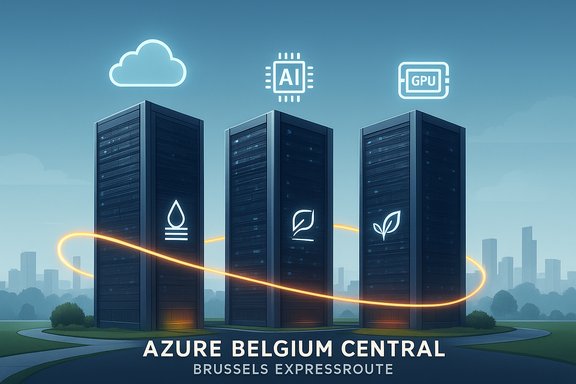
Microsoft’s Belgian cloud region is the product of a multi‑year build that the company says took roughly four years to complete. The new region comprises three physically separate datacentre sites that will operate together to provide availability‑zone resilience, local storage and compute for Azure services, and a direct private interconnect point has been provisioned in Brussels to link on‑premises networks with the new region via Azure ExpressRoute. The launch event for the region took place on 18 November 2025 and brings Azure’s in‑country presence to Belgium for the first time.
The company has not published a precise figure for capital expenditure on the Belgian region, but public reporting and industry commentary put the investment above €1 billion. Microsoft and local spokespeople emphasise this is part of a broader national programme — branded in Microsoft materials as an investment in Belgian digital transformation and skills development — intended to support national cloud adoption, AI projects and public‑sector modernisation.
Important context for readers:
Competition matters because:
Key strengths:
For enterprises and public buyers, the launch is an opportunity to simplify compliance and improve performance — but it is not a panacea. The practical value will be determined by service availability, the clarity of contractual locality guarantees, the timing of GPU and AI SKUs, and how local energy and planning authorities manage grid capacity and environmental trade‑offs.
Microsoft’s move also tightens a competitive European landscape where other hyperscalers are making large commitments in Belgium. That competition should benefit customers through more choices and potentially stronger procurement terms, but it also shifts the onus onto national policymakers and utilities to steward energy and land resources responsibly while maximising the social and economic returns of large‑scale digital infrastructure.
In short: Azure Belgium Central is an important infrastructure milestone for Belgium’s digital sovereignty and AI readiness — a practical enabler for customers — but its long‑term payoff will depend on transparent delivery of services, independent verification of sustainability claims, and prudent regional planning.
Source: belganewsagency.eu Microsoft opens first data centres in Belgium
 Background
Microsoft’s Belgian cloud region is the product of a multi‑year build that the company says took roughly four years to complete. The new region comprises three physically separate datacentre sites that will operate together to provide availability‑zone resilience, local storage and compute for Azure services, and a direct private interconnect point has been provisioned in Brussels to link on‑premises networks with the new region via Azure ExpressRoute. The launch event for the region took place on 18 November 2025 and brings Azure’s in‑country presence to Belgium for the first time.The company has not published a precise figure for capital expenditure on the Belgian region, but public reporting and industry commentary put the investment above €1 billion. Microsoft and local spokespeople emphasise this is part of a broader national programme — branded in Microsoft materials as an investment in Belgian digital transformation and skills development — intended to support national cloud adoption, AI projects and public‑sector modernisation.
Why this matters: quick overview
- Data residency and sovereignty: For regulated industries and government customers, the key advantage is that sensitive data and AI inference can now be kept on Belgian soil under Azure management, making compliance and auditability simpler.
- Latency and performance: Local availability zones and a Brussels ExpressRoute on‑ramp reduce round‑trip times for latency‑sensitive workloads — notably real‑time AI inference, industrial controls and edge scenarios.
- AI readiness: The region is designed for modern AI workloads (GPU support, high‑density racks and modern storage fabrics), providing local options for training, fine‑tuning and inference.
- Economic and jobs narrative: Microsoft projects sizeable economic spillovers from the investment, including job creation and local business opportunities — a common theme for hyperscaler expansions, although headline job and GDP figures should be treated as company projections.
- Sustainability posture: Microsoft is deploying advanced cooling technologies and zero‑evaporative liquid cooling designs in new builds to reduce water and energy intensity compared with older data‑centre generations.
Technical architecture and product implications
What "Azure Belgium Central" will provide
The new region is built to Microsoft’s modern availability‑zone model: multiple physically separate datacentres in the same national region that together deliver higher fault tolerance and the ability to architect zone‑resilient deployments. For Windows and Azure administrators this means:- The ability to deploy VMs, storage, managed databases and cloud services that are region‑local rather than routed to an external EU hub.
- Private, low‑latency connectivity via Azure ExpressRoute on‑ramps in Brussels, enabling secure hybrid architectures and direct network peering from local datacentres or telco PoPs.
- A staged roll‑out of Azure services and SKUs: Microsoft typically brings core IaaS and many PaaS services first, then adds specialised GPU and AI SKUs over time as rack capacity and accelerator supply ramp.
AI‑ready capacity and GPU availability
The vendor is positioning the Belgian region as AI‑ready, which in practice means:- Design for GPU‑dense racks and accelerator‑optimised VM SKUs used by Azure Machine Learning and managed inference services.
- High‑capacity networking and storage fabrics to feed GPU nodes with the throughput required for large model workloads.
- Support for both direct‑to‑chip liquid cooling and other modern cooling approaches to manage the thermal loads of accelerator hardware.
Interconnect and hybrid architectures
A permanent ExpressRoute on‑ramp in Brussels (operated in partnership with a major datacentre operator) short‑circuits a common friction point for enterprise cloud migrations: secure private connectivity. For Belgian enterprises and public bodies this simplifies hybrid designs that keep critical data on‑premises while leveraging Azure services for scale and AI:- Reduced network complexity and public‑internet exposure.
- Better SLA and throughput guarantees for replication, backup, and cross‑site caching.
- Straightforward integration with existing carrier ecosystems and local colocation facilities.
The economic case: jobs, investments and supply chains
Microsoft and local government statements frame the datacentre region as a catalyst for digital growth in Belgium. Company materials forecast billions in economic activity and a significant uplift in regional employment across construction, operations, supply chain and partner services over the coming years.Important context for readers:
- Headline job figures promoted by hyperscalers often mix construction‑phase employment (which is short term and capital‑intensive) with indirect and induced jobs across suppliers and local services. Long‑term operational headcount for a hyperscale region is typically modest relative to total capex.
- The broader economic uplift — training, partner ecosystem growth and improved cloud access for SMEs — can be real, but independent verification of multi‑year GDP uplift projections lags company press statements and depends on assumptions about adoption rates and supplier localisation.
Data residency, compliance and security implications
What changes for regulated organisations
Having an Azure region physically located within Belgium removes a key legal and operational obstacle for many buyers: the need to ensure data and certain processing remain in national territory. This is significant for:- Public‑sector procurements that mandate in‑country processing.
- Sectors with strict data localisation rules, e.g., parts of healthcare, defence‑adjacent datasets, and certain financial services activities.
- Organisations that require auditable controls and localised telemetry for AI systems and Copilot‑style deployments.
Security and transparency: what to demand
- Explicit SLAs and contractual guarantees about where data is processed and how failover or maintenance operations might move processing across regions.
- Audit logs and tamper‑evident telemetry channels for privileged access and firmware update events.
- Clarity around subcontractors, partner operators and any wholesale arrangements that place part of operations with third parties.
Sustainability and energy: promises, practicality, and scrutiny
Microsoft has made sustainability a central element of its datacentre narrative. The new Belgium region is built with the company’s next‑generation cooling and water‑efficiency technologies, including:- Direct‑to‑chip cold plates and closed‑loop liquid cooling to reduce water consumption and increase heat‑transfer efficiency.
- Designs that aim to eliminate evaporative water use for cooling during normal operations.
- Commitments to procure carbon‑free electricity and to partner on local renewable projects where possible.
- Grid firming and timing: Operating GPU‑dense AI clusters at scale still requires firm electrical capacity. Hyperscaler pledges of renewable procurement are frequently backed by long‑term power purchase agreements, but the timing of generation, grid upgrades and firming capacity matters for true 24/7 carbon‑free claims.
- Water claims: Closed‑loop liquid cooling greatly reduces operational water consumption, but embodied water and construction‑phase impacts, plus local watershed considerations for civil works, also matter.
- Local impacts: Large campus builds can require grid reinforcement and may prompt regulators to consider allocation rules to prevent grid crowding; national grid bodies are already debating allocation frameworks to manage rapid datacentre growth.
Competitive context: Google and the race for Belgian AI infrastructure
The Microsoft launch arrives as other hyperscalers expand in Belgium. Google recently announced a multi‑billion‑euro expansion of its Saint‑Ghislain campus, with a commitment in the same scale class that will add capacity and new renewable energy agreements. The net effect is a concentration of hyperscale capacity in Belgium that positions the country as a European hub for data and AI.Competition matters because:
- Multiple local hyperscalers increase choices for customers seeking in‑country cloud options and reduce single‑vendor dependency.
- The concentration intensifies local pressure on energy infrastructure and raises the political importance of transparent procurement and energy planning.
- Customers and procurement officers can use competition to negotiate stronger sovereignty, portability, and exit rights.
Risks, unknowns, and what to watch
- Unverifiable headline claims: Some of the larger economic and job‑creation numbers cited in corporate statements combine direct, indirect and induced effects and are best treated as company projections. Independent regional economic analysis should be sought to quantify concrete, long‑term benefits.
- Service parity and GPU availability: New regions rarely open with complete SKU parity. Customers should validate which GPU models, managed AI services, and PaaS features are available on day one, and ask about capacity allocation and reservation mechanisms.
- Grid and permitting constraints: The real bottleneck for rapid hyperscaler growth in small markets is often power and grid access. Local utilities and transmission operators will be central actors in determining feasible expansion timelines.
- Community acceptability and social licence: Large datacentre projects can trigger local concerns around land use, traffic during construction, and water or biodiversity impacts. Public engagement and transparent mitigation plans are essential.
- Concentration risk: National dependence on a handful of foreign hyperscalers raises strategic questions. Procurement teams should retain portability safeguards and multi‑cloud exit strategies where feasible.
What enterprises, Windows admins and public buyers should do next
- Catalogue workloads: Identify which workloads need in‑country processing for compliance or latency, and which can remain in existing EU regions. This informs migration sequencing.
- Validate day‑one services: Confirm the exact Azure SKUs, GPU types and managed services that will be available in Azure Belgium Central at general availability and in subsequent phases.
- Negotiate data locality clauses: Obtain explicit contract language that defines where data, inference, and telemetry are processed, and the audit rights and SLA remedies tied to those assurances.
- Plan for hybrid networking: Work with carriers and colocation partners to leverage the Brussels ExpressRoute on‑ramp. Design resilient network topologies that account for cross‑region failover and planned maintenance windows.
- Assess sustainability and energy exposure: For large, energy‑intensive projects, request transparency about Microsoft’s local renewable agreements, grid‑firming commitments, and PUE/WUE metrics.
Critical analysis: strengths and strategic concerns
Microsoft’s Belgium region is strategically sensible and technically robust. Locating an Azure region inside Belgium addresses a practical gap — many customers have struggled with cross‑border processing and latency for AI workloads. The ExpressRoute on‑ramp and availability‑zone design make the region a practical option for both enterprise and public‑sector workloads.Key strengths:
- Local sovereignty: A national Azure hub reduces legal and logistics friction for regulated workloads.
- AI readiness: Modern datacentre engineering and direct‑to‑chip cooling position the region to host dense AI compute effectively.
- Ecosystem effects: The presence of local Azure infrastructure accelerates partner opportunity, skills training and vendor ecosystems.
- Overpromised economic narratives: Projected job and GDP numbers require scrutiny and independent validation. Many hyperscaler economic claims inflate construction‑phase impacts relative to enduring operational jobs.
- Service and capacity timing: Organisations should not assume immediate feature parity with major European regions; careful validation is required for GPU‑heavy production work.
- Grid and community constraints: Rapid hyperscaler growth can provoke legitimate local concerns over electricity allocation and environmental impacts; these are policy issues beyond the vendor’s control.
Conclusion
Azure Belgium Central establishes a tangible, local option for Belgian organisations seeking cloud, AI and sovereign data processing under Microsoft Azure. The region brings modern engineering, low‑latency connectivity and a clear commitment to sustainability innovations that will matter for AI‑intensive workloads.For enterprises and public buyers, the launch is an opportunity to simplify compliance and improve performance — but it is not a panacea. The practical value will be determined by service availability, the clarity of contractual locality guarantees, the timing of GPU and AI SKUs, and how local energy and planning authorities manage grid capacity and environmental trade‑offs.
Microsoft’s move also tightens a competitive European landscape where other hyperscalers are making large commitments in Belgium. That competition should benefit customers through more choices and potentially stronger procurement terms, but it also shifts the onus onto national policymakers and utilities to steward energy and land resources responsibly while maximising the social and economic returns of large‑scale digital infrastructure.
In short: Azure Belgium Central is an important infrastructure milestone for Belgium’s digital sovereignty and AI readiness — a practical enabler for customers — but its long‑term payoff will depend on transparent delivery of services, independent verification of sustainability claims, and prudent regional planning.
Source: belganewsagency.eu Microsoft opens first data centres in Belgium
