

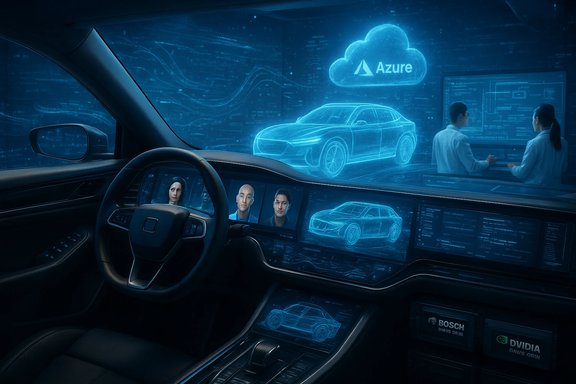
Microsoft used CES 2026 to put a stake in the ground: the future of the car will be cloud-native, AI-driven, and built around software-first engineering — and Microsoft’s Azure, Foundry, and partner ecosystem are being positioned as the secure backbone for that transition.
The automotive industry entered 2026 in the middle of a structural shift: increasingly, features and differentiation are defined by software and data rather than by discrete hardware components. That movement — from incremental embedded updates to fully software-defined vehicles (SDVs) — has accelerated OEMs’ adoption of cloud-first engineering, digital twins, and AI-assisted workflows. Microsoft’s CES 2026 messaging frames this shift as a platform play: cloud scale (Azure), enterprise-grade security, and AI tooling (including Microsoft Foundry and Copilot) combined with an open partner ecosystem to reduce time-to-market and modernize vehicle engineering workflows.
This article explains the concrete technologies Microsoft highlighted at CES, the partner announcements showcased alongside Azure, and the practical benefits — plus the risks — that automakers, suppliers, and fleet operators should weigh when adopting a cloud‑centric SDV strategy.
Key verified announcements at CES 2026:
However, there are practical limits:
The upside is significant: faster validation, more frequent feature updates, and richer in-cabin experiences. The downside is equally real: increased complexity, new security exposures, and recurring operational costs for AI services. For OEMs that approach the transition pragmatically — pilots first, independent security and performance validation, and clear contractual controls over data and portability — the pathway Microsoft and its partners are selling can be transformative. For everyone else, CES 2026 should be read as both an invitation and a warning: the tools to build the future of mobility are here, but execution will determine whether those tools deliver breakthroughs or headaches at scale.
(Verification summary — key corroborations used while reporting: Bosch AI cockpit press materials and Reuters coverage confirming compute and Microsoft integration; Cerence press releases describing xUI on NVIDIA AI Enterprise and Azure; Renesas, AMD and Siemens press and product pages describing RoX, R‑Car Gen5 and AMD VAS integration with Siemens PAVE360; ETAS announcement of calibration tools on Azure Marketplace; KPIT product demos and reporting at CES 2026; Neural Concept and MIT on DrivAerNet++ and vendor-reported design-cycle improvements.
Source: Microsoft CES 2026: Powering the next frontier in automotive - Microsoft Industry Blogs
 Background
The automotive industry entered 2026 in the middle of a structural shift: increasingly, features and differentiation are defined by software and data rather than by discrete hardware components. That movement — from incremental embedded updates to fully software-defined vehicles (SDVs) — has accelerated OEMs’ adoption of cloud-first engineering, digital twins, and AI-assisted workflows. Microsoft’s CES 2026 messaging frames this shift as a platform play: cloud scale (Azure), enterprise-grade security, and AI tooling (including Microsoft Foundry and Copilot) combined with an open partner ecosystem to reduce time-to-market and modernize vehicle engineering workflows.This article explains the concrete technologies Microsoft highlighted at CES, the partner announcements showcased alongside Azure, and the practical benefits — plus the risks — that automakers, suppliers, and fleet operators should weigh when adopting a cloud‑centric SDV strategy.
Digital engineering: cloud-native compute, simulation, and “shift-left” at scale
Why digital engineering matters now
The move to SDVs multiplies software complexity: modern vehicles approach billions of lines of code, span safety-critical and non-safety domains, and require continuous maintenance across the whole vehicle lifecycle. Cloud-native digital engineering promises three core benefits:- Scale for compute-heavy tasks like full-vehicle simulation and large-model training.
- Parallelism allowing geographically distributed engineering teams to run hundreds or thousands of scenarios concurrently.
- Shift-left validation, enabling earlier verification of system integration and safety cases before hardware prototypes exist.
Verified technology integrations and what they mean
- AMD + Siemens: AMD announced a Virtualized Automotive Stack (VAS) on Azure (NVads V710 v5-series VM) that supports nested virtualization for automotive workloads and pairs with Siemens’ PAVE360 digital twin environment for systems-level simulation. This lets developers run mixed-criticality virtualization (infotainment alongside safety functions) in a cloud environment for early integration testing. The AMD and Siemens materials are explicit about the technical goal: scale digital twin simulations and validate system behavior earlier in the lifecycle.
- Renesas RoX: Renesas demonstrated the R‑Car Gen5 family and the RoX development environment — a cloud-native toolkit and Whitebox SDK designed to accelerate SDV development. The R‑Car X5H is presented as a multi-domain SoC (up to hundreds of TOPS claimed by Renesas for AI workloads) and RoX emphasizes out-of-the-box software stacks and cloud evaluation tools suitable for early ADAS/IVI integration. These are vendor statements and reflect shipping samples and evaluation boards — useful for partners and OEMs planning early prototyping.
- ETAS on Azure: ETAS announced that its calibration and analytics suite (Calibration Suite, Data Operator, EATB, ASCMO) will be available via the Microsoft Marketplace and run on Azure, enabling calibration and parameter sweep workloads to burst into cloud compute. ETAS frames this as a practical “shift-left” enabler for calibration and model-based validation.
In-vehicle intelligence and the AI cockpit
The new digital cockpit: productivity, privacy, and safety trade-offs
Microsoft and partners framed the cockpit as the next productivity and experience battleground — a place for brand differentiation and recurring revenue. The new generation of cockpits blends local (edge) and cloud AI: small models and deterministic drivers run on zonal or SoC compute for low-latency tasks, while larger conversational or personalization models run in the cloud.Key verified announcements at CES 2026:
- Bosch AI extension platform: Bosch showcased an AI extension platform for cockpits that augments existing cockpit hardware with a compact unit powered by NVIDIA DRIVE AGX Orin-class compute. Bosch explicitly states the module supplies about 150–200 TOPS of additional compute and integrates with Microsoft Foundry and Microsoft 365 productivity features to enable “mobile office” scenarios that prioritize safety (for example, intelligently gating distractions when vehicle control demands attention). Bosch’s press release and CES materials document the specification band and the Microsoft/NVIDIA collaboration.
- Cerence xUI: Cerence confirmed that its Cerence xUI hybrid, agentic platform is optimized for NVIDIA AI Enterprise and running on Microsoft Azure, with multiple premium automakers adopting it for 2026 production programs. Cerence positions xUI as a hybrid approach — small on-device models for low latency and cloud orchestration for knowledge-intensive tasks.
- TomTom and ecosystem voice agents: TomTom demonstrated an AI Agent approach combining mapping/traffic intelligence with conversational interfaces; at CES they showed integrations with multi-agent voice companies (e.g., SoundHound) and Microsoft cloud services to provide multi-turn navigation and POI reasoning. This underlines a shift: map + context + voice are converging into one OEM-ready platform.
What OEMs and drivers can expect
- New in-vehicle assistants that can hold multi-turn dialogues, plan multi-stop EV routes, and coordinate across vehicle systems.
- Hybrid execution: small SLMs on SoC for always-on UI and safety, cloud LLMs for complex reasoning and personalization.
- A push to make the cabin a “mobile office” while claiming to limit driver distraction via vehicle-policy gating.
Partner spotlights: what the announcements mean in practice
AMD + Siemens + Microsoft — digital twins and nested virtualization
- What was announced: AMD’s VAS on Azure (Radeon PRO V710 + EPYC on NVads V710 v5-series VMs) and Siemens’ PAVE360 integration enable large-scale digital twin simulation with graphics acceleration in the cloud. Siemens positions PAVE360 as an off‑the‑shelf digital twin approach for systems-of-systems validation.
- Practical value: engineers can run thousands of virtual scenarios, exercise mixed‑criticality stacks, and reduce late-cycle integration defects by identifying system-level corner cases earlier.
- Verification note: AMD and Siemens provide vendor materials describing these capabilities; independent coverage corroborates the integration at CES. Performance numbers and per‑VM behavior will vary in real engineering workloads, so teams should benchmark representative workloads rather than rely solely on headline claims.
Renesas RoX and R‑Car Gen5
- What was announced: Renesas’ R‑Car X5H (Gen5) SoC and RoX Whitebox SDK, with claims of up to 400 TOPS of AI performance (chiplet-augmented) and multi-domain capability (ADAS, IVI, gateway). RoX AI Studio and the RoX platform provide cloud-native MLOps and model evaluation on R‑Car silicon.
- Practical value: central compute architectures that can consolidate domain controllers and enable zonal/central configurations — a key enabler of “less is more” hardware consolidation.
- Verification note: Renesas’ press materials are explicit about sample shipments and demo availability. The TOPS figures are vendor-provided peak claims; real-world performance will depend on workload mix and memory/IO characteristics. Treat TOPS as an approximate performance metric, and validate with partner reference workloads.
ETAS moves calibration to the cloud
- What was announced: ETAS launched its calibration toolchain on Microsoft Marketplace and Azure (Calibration Suite, Data Operator, EATB, ASCMO), aimed at shifting calibration and parameter optimization earlier in development.
- Practical value: calibration teams can burst to cloud compute for Monte Carlo sweeps and parametric tests, tying vehicle telemetry to analytics and faster iteration loops.
- Verification note: this is a tangible, immediately applicable vendor offering; ETAS’ own materials describe marketplace availability and live demos at CES.
KPIT’s Agentic AI suite, PTC’s PLM integration, and Neural Concept’s aerodynamics acceleration
- KPIT: showcased an Agentic AI suite for software development on Microsoft Foundry and Azure; multiple trade outlets reported demonstrations intended to compress defect resolution time and speed development cycles. KPIT materials emphasize measurable improvements in code quality and defect resolution for pilot programs.
- PTC: highlighted an “Intelligent Product Lifecycle” demo with Lamborghini, connecting PLM, ALM, and CAD into a single data foundation with AI assistance for requirements and engineering change management. PTC’s Codebeamer and Windchill AI features were emphasized for traceability and faster iteration.
- Neural Concept: showcased its ML-based aerodynamics platform using the MIT DrivAerNet++ dataset (8,000+ designs) and claims up to 30% shorter design cycles and significant program cost savings in customer case studies. MIT’s DrivAerNet++ dataset is public and widely cited; Neural Concept’s performance claims are vendor-reported outcomes from enterprise deployments. Use caution and validate on representative programs.
Security, governance, and lifecycle management
Enterprise-grade security vs. attack surface growth
Microsoft repeatedly emphasized enterprise-grade security and global cloud scale as differentiators, but the move to cloud-connected vehicles increases attack surface in non-trivial ways. Key considerations:- Threat surface: OTA update paths, cloud APIs, and telemetry streams must be secured end-to-end with strong identity and attestation for both back-end and in-vehicle endpoints.
- Mixed-criticality isolation: nested virtualization or zonal consolidation increases the stakes if hypervisor isolation is breached; suppliers propose Xen or hypervisor stacks but independent verification and rigorous penetration testing remain essential.
- Data governance: LLMs and personalization features require careful data-handling policies to meet privacy laws (GDPR, California privacy laws) — foundational design decisions need to be privacy-by-design. Vendor materials position security as a priority, but implementers must validate the full end-to-end threat model before fleet rollout.
Operational economics and inference cost
Running LLMs at fleet scale has real cost implications. Large models pushed to the cloud for features like natural-language assistants or personalization create recurring inference costs and operational complexity. Microsoft and vendors point to hybrid execution (edge SLMs + cloud LLMs) to minimize costs, but teams should:- Build realistic inference-cost models per vehicle and per monthly active user.
- Allocate budget for model updates, retraining, and guardrail changes.
- Measure latency, availability, and fallbacks for degraded connectivity.
Time-to-market: evidence and limits
Microsoft framed SDV and digital twin adoption as a way to shrink vehicle development cycles from the historic 48–60 months down to 24–36 months. The partners’ value proposition is real: digital twins, cloud-based calibration, and integrated PLM reduce rework and enable earlier validation.However, there are practical limits:
- Hardware supply and certification timelines still constrain production readiness.
- Regulatory and safety validation (functional safety, cybersecurity) require rigorous evidence packages that are not erased by cloud tools.
- Software complexity can create dependency chains across suppliers; success depends on precise governance and configuration management.
Risks and red flags to watch
- Vendor lock-in vs. openness: Microsoft and partners pitch an open ecosystem, but vehicle program teams must bake portability and data/export controls into contracts and architectures to avoid single-vendor constraints.
- Cybersecurity realism: moving validation and OTA orchestration to the cloud increases the value of hardened security design — assume adversaries will try to access update pipelines and telemetry. Independent security validation is non-negotiable.
- Latency & offline behavior: autonomous or safety-critical features must degrade gracefully when connectivity is reduced; hybrid architectures solve some but not all of these problems.
- Inference economics and sustainability: the environmental and cost implications of fleet-scale inference should be accounted for in TCO and sustainability reporting.
- Regulation and liability: expanding functionality (for example, “mobile office” in the cabin or assistant-based vehicle control) raises legal questions about driver distraction, product liability, and cross-border dataflow.
Practical recommendations for engineers and program managers
- Treat cloud integrations as first-class system components: include cloud service SLAs, data residency, and attestation checks in vehicle-level architecture docs.
- Run representative benchmarks: evaluate vendor “TOPS” and “peak” claims with your workloads and I/O patterns before committing to a silicon or cloud SKU.
- Start with hybrid pilots: deploy small, safety-independent features (navigation, voice assistants, personalization) to validate the stack and governance before moving safety-critical subsystems to cloud-enabled validation.
- Create an engineering copilot plan: adopt agentic and generative AI tools for requirements, testing, and defect triage—but validate outputs with domain experts and maintain traceability for compliance.
- Lockdown OTA and supply chain security: require hardware and software attestation, signed update delivery, and independent audits.
Conclusion
CES 2026 crystallized a familiar but now irreversible thesis: software and AI will determine the next decade of automotive differentiation, and cloud providers plus an ecosystem of silicon, tooling, and services will define the practical path. Microsoft’s presence at CES — and the partner announcements from AMD, Siemens, Renesas, Bosch, Cerence, ETAS, KPIT, PTC, TomTom, and others — demonstrate a workable blueprint for accelerating SDV development through Azure-hosted simulation, vendor-optimized stacks, and hybrid in-vehicle/cloud AI.The upside is significant: faster validation, more frequent feature updates, and richer in-cabin experiences. The downside is equally real: increased complexity, new security exposures, and recurring operational costs for AI services. For OEMs that approach the transition pragmatically — pilots first, independent security and performance validation, and clear contractual controls over data and portability — the pathway Microsoft and its partners are selling can be transformative. For everyone else, CES 2026 should be read as both an invitation and a warning: the tools to build the future of mobility are here, but execution will determine whether those tools deliver breakthroughs or headaches at scale.
(Verification summary — key corroborations used while reporting: Bosch AI cockpit press materials and Reuters coverage confirming compute and Microsoft integration; Cerence press releases describing xUI on NVIDIA AI Enterprise and Azure; Renesas, AMD and Siemens press and product pages describing RoX, R‑Car Gen5 and AMD VAS integration with Siemens PAVE360; ETAS announcement of calibration tools on Azure Marketplace; KPIT product demos and reporting at CES 2026; Neural Concept and MIT on DrivAerNet++ and vendor-reported design-cycle improvements.
Source: Microsoft CES 2026: Powering the next frontier in automotive - Microsoft Industry Blogs
