

Microsoft’s Ignite keynote pushed Azure from platform to operational partner, unveiling a sweeping set of AI-first infrastructure upgrades and the arrival of agentic operations through Azure Copilot—an ecosystem designed to put purpose-built AI agents at the center of migration, deployment, observability, resiliency and troubleshooting for cloud environments. The announcements combine datacenter-scale hardware advances, new silicon and offload engines, and higher-level managed services (AKS Automatic, HorizonDB for PostgreSQL, App Service Managed Instance) with an explicit governance-first model for agent-driven automation.
Azure’s 2025 message centers on three priorities: strengthening the global infrastructure footprint for AI-scale workloads, modernizing core compute and platform services to natively support AI, and transforming operations through embedded AI agents that can act—and be audited—on behalf of teams. The platform claims a globally distributed backbone with more than 70 regions and hundreds of datacenters, an expanded edge footprint for low-latency, zone-redundant defaults for services, and a set of governance primitives aligned with Entra and Azure Policy intended to make agentic operations auditable and controllable.
These announcements are not isolated product calls; they are presented as a systems effort: new datacenter designs (Fairwater sites), purpose-built racks using NVIDIA GB300 NVL72 systems, a high-speed AI WAN to link sites, Azure Boost offload hardware and software for infrastructure operations, and first-party silicon (Azure Cobalt, Maia) combined with managed services that reduce operational toil (AKS Automatic, App Service Managed Instance, Azure Copilot agents). Several of these initiatives have public technical documentation or primary coverage from industry partners that corroborate Microsoft’s direction.
Risk note: customers with latency-sensitive hybrid workflows will need to validate data residency, egress, and cross-region network costs when relying on cross-site AI WAN orchestration.
Verification note: performance claims (e.g., “five-times faster”) are context dependent. Benchmarks should be validated with representative workloads and Microsoft’s published performance guidance or partner test reports prior to procurement decisions.
Source: Microsoft Azure Announcing Azure Copilot agents and AI infrastructure innovations | Microsoft Azure Blog
 Background / Overview
Azure’s 2025 message centers on three priorities: strengthening the global infrastructure footprint for AI-scale workloads, modernizing core compute and platform services to natively support AI, and transforming operations through embedded AI agents that can act—and be audited—on behalf of teams. The platform claims a globally distributed backbone with more than 70 regions and hundreds of datacenters, an expanded edge footprint for low-latency, zone-redundant defaults for services, and a set of governance primitives aligned with Entra and Azure Policy intended to make agentic operations auditable and controllable.These announcements are not isolated product calls; they are presented as a systems effort: new datacenter designs (Fairwater sites), purpose-built racks using NVIDIA GB300 NVL72 systems, a high-speed AI WAN to link sites, Azure Boost offload hardware and software for infrastructure operations, and first-party silicon (Azure Cobalt, Maia) combined with managed services that reduce operational toil (AKS Automatic, App Service Managed Instance, Azure Copilot agents). Several of these initiatives have public technical documentation or primary coverage from industry partners that corroborate Microsoft’s direction.
Azure Copilot: agentic cloud operations
What Microsoft announced
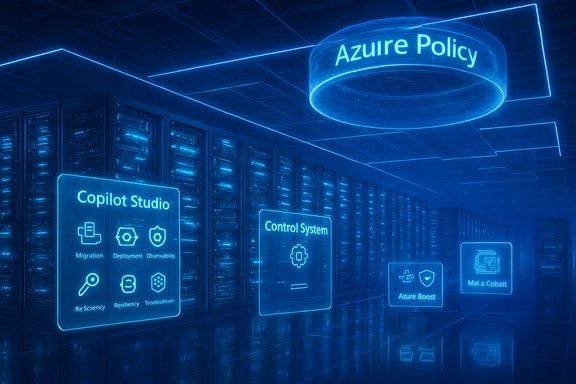
Azure Copilot is introduced as an agentic interface—a management plane that orchestrates purpose-built agents across the cloud lifecycle. The initial public preview includes six specialized agents: migration, deployment, optimization, observability, resiliency, and troubleshooting. The core promise is automation of repetitive and brittle tasks so engineering teams can prioritize architecture and product development. Azure Copilot ties agent actions to RBAC, Azure Policy, and tenant governance, supports full visibility and auditing of agent actions, and allows tenant control over chat and artifact storage (bring-your-own storage for retention and residency).Why it’s different: agent identity and governance
A key design shift is treating agents as first-class managed principals within the identity and governance fabric. Agents are represented as objects in Entra (managed identities / agent IDs), can be enrolled in access reviews and conditional access, and can be governed with policy-defined scopes. The platform surface—Copilot Studio, Copilot Control System, and an Agent Store—promises discovery, lifecycle management, and admin approval flows to reduce the likelihood of unmanaged or runaway agent actions. This governance-focused design explicitly responds to the production and compliance hurdles that historically block enterprise adoption of autonomous automation.Practical capabilities and limitations
- Agents can be configured to plan and act on tasks (for example, propose code changes, create migration artifacts, or execute remediation), but administrators can require human approvals or limit agent scopes.
- Observability is baked in: tracing, telemetry, and logs are included so actions are auditable and reversible where appropriate.
- Copilot is positioned to integrate with GitHub Copilot and Azure AI Foundry developer tools, enabling a flow from dev tooling to operations.
The AI infrastructure backbone: Fairwater, GB300, and AI WAN
Fairwater and the GB300 NVL72 systems
Microsoft described Fairwater as its most sophisticated AI datacenter design yet—an "AL superfactory" model pairing liquid cooling, flat network topologies that link hundreds of thousands of GPUs, and a dedicated AI WAN backbone to coordinate large jobs across sites. A major hardware milestone is the deployment of NVIDIA GB300 NVL72 racks and the new NDv6 GB300 VM family; Azure says it was among the first hyperscalers to put GB300 systems into production at scale. Independent coverage confirms Azure’s GB300 NVL72 deployment and Microsoft’s claim of integrated rack-scale designs that use liquid cooling, NVLink fabrics and high-bandwidth cluster networking. Practical scale examples cited by Microsoft included multi-rack clusters with very high GPU-to-GPU fabric bandwidth and pooled memory, enabling single-rack or cluster-scale training approaches for very large models. Microsoft also emphasized throughput benchmarks (claims such as processing more than 1.1 million tokens per second from a single rack appear in Azure’s announcement narrative). These figures are extraordinary—and while Microsoft and NVIDIA provide engineering context, exact performance will vary by model architecture, precision mode (e.g., FP4/INT8 variants), and workload. External third-party testing will be required for production-sizing decisions.AI WAN: cross-site coordination and utilization
To scale beyond single-site limits, Microsoft introduced an AI WAN that links Fairwater sites and other Azure datacenters with a high-speed network engineered to reduce bottlenecks and keep GPUs saturated across distributed training or inference jobs. The AI WAN is billed as a higher-level backbone optimized for the traffic patterns of model training—large, bursty, and all-to-all communication—which is a genuine engineering necessity as clusters expand to hundreds of thousands of accelerators.Risk note: customers with latency-sensitive hybrid workflows will need to validate data residency, egress, and cross-region network costs when relying on cross-site AI WAN orchestration.
Azure Boost, custom silicon and offload engines
What is Azure Boost?
Azure Boost is Microsoft’s infrastructure offload initiative: it moves virtualization-related work—networking, storage I/O, host management—off the hypervisor and host OS and onto purpose-built hardware/software accelerators (think DPU/SmartNIC-like functionality). Microsoft frames Boost as a combination of silicon, firmware, and host libraries that increase throughput, cut CPU overhead and improve isolation. This offload approach is consistent with industry trends where DPUs or SmartNICs are used to accelerate data-plane operations. Journalistic cross-check: independent infrastructure outlets reported early Boost previews that described significant gains—examples include 200 Gbps network throughput and remote storage throughput in the multi‑GB/s range with hundreds of thousands of IOPS in preview testing contexts. Third-party reportage and Microsoft’s own descriptive posts are broadly aligned on the architecture and intent, although numeric claims have varied between previews and later platform rollouts.Custom silicon: Azure Cobalt and Maia
Microsoft continues to expand first-party silicon efforts. Azure Cobalt (an Arm-based CPU family) and Maia (an accelerator) remain part of the roadmap: Cobalt targets energy-efficient general compute for services and virtual machines, while Maia targets high-efficiency inference and specialized model execution where it can reduce dependence on third-party GPUs for lower-cost inferencing. These chips are being integrated into Microsoft’s fleet and selectively offered to customers where advantageous. Independent coverage and Microsoft engineering posts confirm these projects and early deployment patterns. Practical takeaway: customers should expect a growing mix of GPU, accelerator, and first‑party silicon SKUs in the catalog—and plan for SKU-specific performance characteristics and pricing trade-offs.Modernizing workloads: AKS Automatic, HorizonDB and database evolution
AKS Automatic: Kubernetes on autopilot
Azure now offers AKS Automatic, a managed experience that embeds best practices and automates infrastructure provisioning and operation for Kubernetes. A key addition is the AKS Automatic-managed system node pools, which move critical cluster components (CoreDNS, metrics-server, etc. onto Microsoft‑managed infrastructure—reducing tenant operational burden and surface area for upgrades and patching. Microsoft Learn documentation and quickstart guides show AKS Automatic in preview and detail constraints (regions with three availability zones, supported VM families, and quotas). Benefits include:- Reduced cluster management overhead for platform teams
- Easier access to GPU-backed nodes as first-class AKS workers
- Managed patching and lifecycle for control-plane adjacent services
Databases: HorizonDB for PostgreSQL, DocumentDB, Azure SQL Managed Instance
Microsoft announced Azure HorizonDB for PostgreSQL, positioning it as a horizontally scalable, AI-integrated cloud-native offering; Azure DocumentDB, built on an open-source engine contributed to the Linux Foundation, reached general availability; and the App Service Managed Instance preview offers an easier path for migrating .NET apps without container refactoring. Azure also announced next‑generation Azure SQL Managed Instance, with Microsoft claiming up to five-times faster performance and double the storage in certain configurations in marketing materials. These database advances aim to reduce operational friction for cloud migrations and modern apps.Verification note: performance claims (e.g., “five-times faster”) are context dependent. Benchmarks should be validated with representative workloads and Microsoft’s published performance guidance or partner test reports prior to procurement decisions.
Security, resiliency and operational excellence
Resiliency and defaults
Azure is doubling down on resiliency by default. Examples cited at Ignite include making services like NAT Gateway zone‑redundant by default, expanded availability zone architecture across regions, and a public preview of Azure Resiliency, an experience for setting recovery objectives and validating failover drills. These moves shift more of the operational heavy lifting from customers to the platform, aiming to simplify multi-zone business continuity.Evolving security controls
Microsoft highlighted new security surfaces designed for agentic operations:- Bastion Secure by Default—hardens remote VM access to reduce configuration drift and exposure.
- Network Security Perimeter (public preview)—defines trust zones across tenants and subscriptions to control lateral movement.
- Sentinel integrations and Application Gateway Layer 7 protections—add AI-driven analysis and unified visibility for detection and response.
- Service Groups (GA)—provide centralized policy and control across large estates.
These updates attempt to bake security into the agentic lifecycle so that automation cannot bypass guardrails.
Real customer outcomes and migration automation
Azure and GitHub Copilot automation claim measurable impact in customer examples: large codebase migrations (hundreds of thousands of lines) and application modernizations that Microsoft cites as significantly faster with agentic tools. GitHub Copilot’s app modernization features (Java generally available, .NET in preview) are specifically called out as being able to automate dependency updates, resolve breaking changes and containerize applications as part of a guided process. Early customers and partners are reporting meaningful time-to-migration improvements when using these toolchains. Reality check: these outcomes typically come from curated case studies. Organizations should replicate the process on pilot workloads and quantify the migration pipeline (discovery accuracy, remediation fidelity, and required human oversight) before committing at scale.Independent verification and notable caveats
Several of the biggest infrastructure claims are supported by corroborating coverage from major ecosystem partners and independent reporting:- The GB300 NVL72 deployment and NDv6 GB300 VMs are described in Microsoft infrastructure posts and NVIDIA’s own blog coverage—these two sources together validate the core hardware claims.
- AKS Automatic preview and quickstarts are published on Microsoft Learn, providing technical guidance on limits and deployment preconditions.
- Azure Boost and offload architectures are covered in industry press and earlier Microsoft material; however, reported throughput/IOPS numbers differ across previews and marketing messaging. Independent articles from data center and infrastructure outlets describe Boost preview numbers (for example: 200 Gbps network throughput and multi‑GB/s storage throughput in early previews), while later marketing material in aggregate claims higher extremes in some contexts. Those numeric differences merit caution and direct verification for any procurement decision.
- Throughput and IOPS figures for Boost-enabled SKUs—these often depend on VM SKU, storage configuration, virtualization options, and subscription quotas.
- The “1.1 million tokens/second per rack” and similar throughput claims for GB300 clusters are engineering metrics; real-world model throughput will vary by model size, precision, and software stack.
- Database performance multipliers (e.g., “up to five-times faster”) are benchmark-relative claims and must be tested with representative workloads.
Strategic analysis: strengths, risks and what IT teams should do now
Strengths
- Integrated stack approach. Microsoft’s end-to-end systems thinking—from silicon (Maia/Cobalt) and Boost offload to rack-scale GB300 systems and the AI WAN—reduces integration friction for customers who consume managed SKUs.
- Governance-first agent model. Treating agents as managed identities with policy controls lowers one of the largest adoption barriers for autonomous automation.
- Managed Kubernetes evolution. AKS Automatic’s managed system node pools reduce ops burden for platform teams and accelerate cloud-native adoption.
- Rich migration tooling. GitHub Copilot app modernization and agentic migration features can materially shorten modernization timelines when correctly scoped.
Risks and open questions
- Demo-to-production gap. Agentic demos can mask edge cases—data access, approval flow lags, or erroneous actions in complex multi-service topologies.
- Cost predictability. High-throughput GPU clusters, cross-site AI WAN usage, and managed offload SKUs can increase consumption complexity; predictable pricing models are essential.
- New failure modes. Offload hardware introduces additional firmware/software complexity and new operational failure modes that require vendor maturity in fleet management and diagnostics.
- Security complexity. Agents increase automation surface area; unless identity, short-lived credentials, and auditing are ironclad, automation could widen risk exposure.
Practical next steps for IT leaders
- Inventory: map mission-critical apps and data that will be candidates for agentic migration or AI-driven automation.
- Pilot: run small, representative pilots for Copilot agents and AKS Automatic-managed clusters; measure accuracy, audit trails, and recovery scenarios.
- Validate performance: benchmark storage and network throughput against target workloads—especially for Boost-enabled and GB300 SKUs.
- Governance: build policy templates (RBAC, Azure Policy) and approval workflows before enabling agents to act automatically.
- Cost model: run consumption simulations for GPU clusters and cross-region AI WAN traffic; negotiate pricing/commitments where appropriate.
Conclusion
Microsoft’s Ignite 2025 slate advances a coherent argument: the next cloud wave is agentic and system‑centric. Azure’s investments—Fairwater datacenter designs, GB300 NVL72 rack deployments, AI WANs, Boost offload systems, first‑party silicon, AKS Automatic and agentic management via Azure Copilot—signal a platform bet on shifting toil from humans to verifiable, governed agents. For enterprises, the upside is real: faster migrations, less operational drag, and access to world-class AI scale. The caveat is equally real: agentic automation and novel offload hardware introduce new complexity, new failure modes, and verification obligations that demand careful piloting, robust governance, and vigilant cost management. The announcements are foundational; successful adoption will depend on measured validation, strong policy design, and realistic benchmarking against the workloads that matter most.Source: Microsoft Azure Announcing Azure Copilot agents and AI infrastructure innovations | Microsoft Azure Blog
