

Microsoft’s recent set of Azure announcements — from developer-focused billing and MSDN dev/test changes to the launch of an Azure IoT Suite and the integration of community VM images via VM Depot — together mark a clear strategic push to make Azure friendlier for developers, attractive to IoT business scenarios, and more open to community-driven Linux workloads.
Microsoft has approached Azure’s evolution on three parallel tracks: lowering friction and cost for developers and testers, enabling businesses to pilot and scale Internet of Things (IoT) solutions, and broadening platform choice by embracing community-driven virtual machine images. Each announcement targets a distinct audience but converges on the same goal: increase Azure adoption by reducing operational, technical, and economic barriers.
However, caution is warranted:
Microsoft’s Azure evolution here isn’t a single pivot but a coordinated set of signals: cheaper dev/test experimentation, an opinionated business IoT stack, and pragmatic openness to community images. Combined, they make it easier to build, test, and deploy a broader set of workloads on Azure — but they don’t remove the need for the same disciplined practices that make cloud projects successful in the long run.
Source: BetaNews https://betanews.com/commentary/mic...ows-azure-now-features-vm-depot-integration/]
 Background / Overview
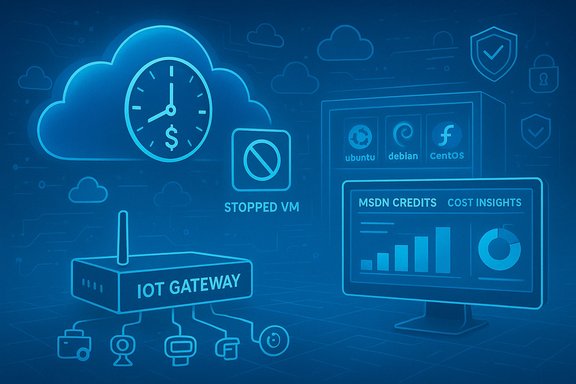
Microsoft has approached Azure’s evolution on three parallel tracks: lowering friction and cost for developers and testers, enabling businesses to pilot and scale Internet of Things (IoT) solutions, and broadening platform choice by embracing community-driven virtual machine images. Each announcement targets a distinct audience but converges on the same goal: increase Azure adoption by reducing operational, technical, and economic barriers.- For developers and testers, Microsoft introduced per-minute billing, removed charges for stopped virtual machines (while preserving deployment state), and created generous MSDN dev/test pricing and monthly credits designed to make short-lived environments inexpensive. These changes were positioned explicitly as dev/test improvements to lower the cost of experimentation and continuous integration workloads.
- For businesses, Microsoft announced the Azure IoT Suite — an integrated offering combining device connectivity, stream analytics, machine learning, and preconfigured templates for common scenarios such as remote monitoring, asset management, and predictive maintenance. The suite was presented as a way to acceleratproof-of-concept to production.
- For community and open-source ecosystems, Microsoft Open Technologies rolled VM Depot — a community-driven catalog of open-source virtual machine images — and integrated it into the Azure management portal, making it easier to deploy Linux-based stacks directly from a community catalog into Azure VMs.
Microsoft targets developers and testers: what changed and why it matters
Per-minute billing and stopped-VM policy
Prior to Microsoft’s update, Azure billed compute resources at hourly granularity. That meant short-lived runs — tests, builds, or transient workloads — could be billed for an entire hour even if they ran only for a few minutes. Microsoft moved to per-minute billing, which pro-rates the hourly rate to the actual minutes used. This lowers the incremental cost of bursty and ephemeral workloads and directly benefits CI/CD pipelines, short-duration integration tests, and ad hoc development VMs. Alongside that, Microsoft stopped billing compute while a VM was in the stopped state but preserved the VM’s deployment state and configuration. This is especially valuable for dev/test teams that can shut down entire environments outside working hours and avoid compute charges without losing configuration. The net result is a much lower cost of experimentation.MSDN dev/test pricing and monthly credits
Microsoft extended MSDN license rights to Azure and introduced heavily discounted MSDN dev/test rates (examples at the time included a flat $0.06 hourly dev/test VM rate for certain MSDN tiers) plus monthly monetary credits for MSDN subscribers. The program also added portal-level visibility for tracking credit usage. Together, these moves were marketed as an unbeatable offer for MSDN subscribers who need lots of short-lived Windows-based test capacity.Immediate impacts for developers and testers
- Lower cost for ephemeral workloads makes automated test farms, short-lived QA clusters, and disposable environments financially practical.
- Easier lifecycle management: teams can stop VMs each night and restart them in the morning without incurring charges or reconfiguration work.
- MSDN integration reduced licensing friction for Windows Server, SQL Server and other Microsoft server images on Azure.
Trade-offs and things to watch
- Stopping a VM frees compute costs but not all attached resources; managed disks, public IP addresses, and other billable items may still incur charges. Teams must maintain a complete cost model and automation to avoid unexpected storage or network charges.
- Per-minute billing reduces waste but increases the need for automation discipline: inefficient startup sequences or overly chatty test orchestration can still amplify cost.
- Dev/test discounts and credits change over time; organizations should verify the current program terms and long-run cost implications when planning budgets.
Azure moves to the Internet of Things: the Azure IoT Suite explained
What the Azure IoT Suite set out to deliver
Microsoft positioned the Azure IoT Suite as an integrated, enterprise-ready collection of Azure services tailored to IoT scenarios: device connectivity, ingestion and stream analytics, prebuilt solution templates (remote monitoring, predictive maintenance), and integration with Power BI and Azure ML for visualization and insights. It was framed as a bridge between raw device telemetry and business workflows, supporting scale, security, and enterprise governance. The announcement was made publicly at Microsoft Convergence and in Satya Nadella’s keynote, underscoring Microsoft’s intent to make Azure an IoT platform for business.Core components and developer-facing capabilities
The initial IoT Suite concept drew on a set of Azure building blocks that were already available — or being matured — at the time:- Event ingestion via Event Hubs or similar message brokers to accept telemetry from devices at high throughput.
- Real-time processing with Stream Analytics to detect patterns or drive alerts.
- Big-data processing with HDInsight (Hadoop/Spark) for batch analytics.
- Machine learning with Azure ML for predictive models and anomaly detection.
- Visualization using Power BI and dashboards for operators and business users.
- Device management and identity functions to register, authenticate, and provision devices at scale.
Business scenarios
Microsoft explicitly targeted business scenarios where IoT can drive measurable ROI:- Remote equipment monitoring in manufacturing or energy: reduce downtime and enable predictive maintenance.
- Asset tracking across supply chains: better utilization and loss prevention.
- Connected building systems: energy optimization tied to operational dashboards.
- Operational telemetry for retail or logistics fleets.
Security, provisioning, and scale considerations
Enterprises adopting IoT need robust device identity and lifecycle management. While Azure IoT offerings have evolved over time, the initial suite emphasized the ability to register and authenticate devices at scale and to pipeline telemetry securely into the cloud. That said, device-side security — key provisioning, firmware update mechanics, and physical security of endpoints — remained the buyer’s responsibility. The suite reduced cloud-side integration work but did not remove the need for secure device design and supply-chain controls.VM Depot integration: opening Azure to community images
What VM Depot offered
VM Depot was a community-driven catalog of open-source virtual machine images created and curated by contributors and partners. Microsoft Open Technologies launched VM Depot to make deploying Linux-based stacks and other open-source images to Azure straightforward. The integration added a BROWSE VMDEPOT option to the Azure management portal’s Virtual Machines tab so users could pick community-supported images and deploy them directly. This was an important signal that Azure was actively embracing non-Windows workloads and the Linux community.Practical benefits for developers and ops
- Faster prototyping: developers could spin up preconfigured stacks (Ruby on Rails, WordPress, Riak, Bitnami images) without manual image preparation.
- Community breadth: VM Depot aggregated images from Linux distributions and open-source stacks, increasing the choices available to Azure users.
- Lower friction for mixed workloads: organizations running Linux-based services could evaluate Azure more easily, and development teams could test cross-platform scenarios alongside Windows workloads.
Risks and governance
- Community images vary in maintenance, update cadence, and security patching. Relying on community images in production required due diligence: verify provenance, update policies, and patching history.
- Operational support and SLAs were different for community images versus first-party marketplace images; teams needed to plan for ongoing lifecycle maintenance.
- Vendor and infrastructure lock-in are reduced if images are portable, but cloud-specific integration (agents, monitoring, proprietary storage drivers) can still introduce migration friction.
Critical analysis: strengths, weaknesses, and enterprise risks
Strengths — lowering adoption friction
- Cost and licensing pragmatism: Per-minute billing and dev/test MSDN incentives materially lower the cost of experimentation and continuous integration, making the cloud accessible for smaller teams and enabling automated workflows without financial pain.
- Faster IoT time-to-value: Packaging analytics, machine learning, and device connectivity into a coherent IoT suite accelerates pilot projects and gives businesses usable starting points for common use cases. Microsoft’s platform-level integration into Power BI and Azure ML is a major advantage for organizations seeking end-to-end solutions.
- Platform openness: VM Depot’s integration demonstrates a pragmatic embrace of Linux and community ecosystems, helping Azure attract broader development and operations talent familiar with open-source stacks.
Weaknesses and practical limitations
- Operational blind spots: Stopping VMs avoids compute charges but does not remove all costs (storage, reserved IPs, backup snapshots). Organizations that assume “stopped = free” can still face bills from attached resources; careful cost modeling is essential.
- Dependency and lifecycle risk for community images: VM Depot images are only as good as their maintainers. For serious production use, teams must vet images, adopt robust patching procedures, and prefer images with clear maintainer commitment.
- IoT security and device-level risk: Cloud-side services simplify ingestion and analytics, but device provisioning, secure key storage, OTA updates, and physical tampering are non-trivial and remain key risk areas for IoT deployments. The cloud component cannot substitute for secure device engineering.
Strategic risks and vendor dynamics
- Platform lock-in vs. portability trade-offs: Azure’s integrated IoT stack and managed services accelerate development but can increase migration costs if proprietary connectors, managed services, and language-specific SDKs are used without abstraction. Design for portability where needed: prefer standard protocols (MQTT, AMQP) and containerized components when long-term portability is a concern.
- Evolving commercial terms: Dev/test discounts, credits, and program terms can and do change. Organizations should treat promos and credits as deployment accelerators, not permanent cost assumptions. Validate current pricing and licensing when planning ongoing budgets.
Practical guidance and recommended next steps
For Windows developers and testers
- Audit attached resource billing before assuming stopped VMs are free: create scripts or tags to identify attached managed disks, public IPs, snapshots, and backup retention that might still incur costs.
- Automate lifecycle using infrastructure-as-code: schedule shutdown/startup windows, auto-delete ephemeral resources, and use cost policies to enforce budget constraints.
- Leverage MSDN credits carefully: use monthly credits for load tests and CI environments but avoid embedding credits into long-term cost forecasts.
For businesses exploring IoT
- Start with a template: use the Azure IoT Suite templates for remote monitoring or predictive maintenance to validate the data flows and business value quickly. Focus first on signal/alert use-cases with measurable KPIs.
- Design for device identity: implement unique device identities, certificate-based authentication, and a robust provisioning workflow from day one. Consider the operational model for updates and key rotation.
- Pilot then harden: run pilots to validate ingestion, latency, and analytics, then iterate toward production by adding governance: monitoring, alerting, compliance, and disaster recovery.
For ops teams using VM Depot/community images
- Vet images: check maintainer credibility, update cadence, and whether images have ongoing security patching.
- Harden post-deployment: run configuration management/patching tools immediately after deployment (e.g., Ansible, Chef, Puppet) to ensure images are brought to a known baseline.
- Prefer curated marketplace images for production unless you have strong governance around community image maintenance.
Cross-checks and verification
Key factual points in this feature have been verified against multiple independent sources:- The developer-focused changes — per-minute billing, no charge for stopped VMs, MSDN dev/test pricing and credits — are documented on Microsoft product blogs and widely reported by independent outlets. Evidence includes Microsoft engineering communications summarizing the changes and contemporaneous technology press coverage.
- The Azure IoT Suite announcement and the core vision for a preconfigured IoT offering were made public at Microsoft Convergence and through Microsoft’s official blogs and press releases that detail the suite’s integration with Stream Analytics, Power BI, and Azure Machine Learning.
- VM Depot’s launch and subsequent integration into the Azure portal were covered by the tech press and originated with Microsoft Open Technologies’ community catalog initiative. The VM Depot catalog enabled community VM images to be deployed through the Azure portal.
Final assessment — who benefits and who should be cautious
Microsoft’s trio of moves is strategically coherent: reduce cost and friction for developers, provide enterprise-ready IoT tooling for business transformation, and open Azure more widely to open-source workloads. For developers, testers, and organizations that value speed and experimentation, the announcements lower practical barriers and accelerate cloud adoption.However, caution is warranted:
- Cost savings from dev/test pricing require disciplined automation and resource governance to prevent leakages from storage or attached resources.
- IoT wins depend equally on secure device engineering and cloud analytics; neglecting on-device security undermines any cloud-side investment.
- Community images are powerful for prototyping but need governance and maintenance planning before being used in production.
Microsoft’s Azure evolution here isn’t a single pivot but a coordinated set of signals: cheaper dev/test experimentation, an opinionated business IoT stack, and pragmatic openness to community images. Combined, they make it easier to build, test, and deploy a broader set of workloads on Azure — but they don’t remove the need for the same disciplined practices that make cloud projects successful in the long run.
Source: BetaNews https://betanews.com/commentary/mic...ows-azure-now-features-vm-depot-integration/]
