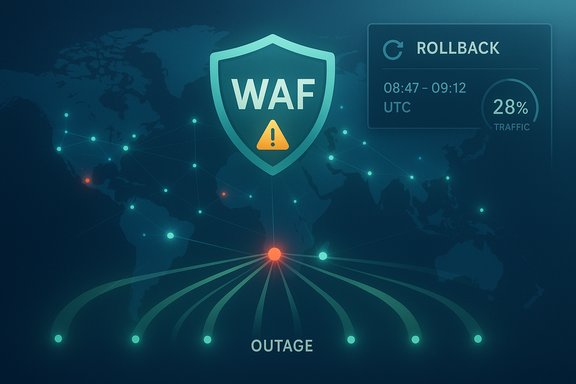
On the morning of December 5, 2025 a wave of 500‑level errors rippled across the public web: LinkedIn, Canva, Zoom and dozens of other high‑traffic services returned “500 Internal Server Error” messages, outage trackers lit up, and millions of users saw content delivery and sign‑in flows fail. Early confusion and repeated reports from social platforms and status pages produced one common narrative in the wild — “the cloud is down again” — but the technical truth was split across two separate incidents separated by weeks: a high‑impact Microsoft Azure outage traced to an Azure Front Door configuration change in late October, and a distinct December 5 disruption caused by a Cloudflare dashboard/API and edge validation fault that generated the 500 errors users experienced that day. This feature unpacks what actually happened, where the Meyka piece you provided gets it right and where it conflates events, and what this sequence of outages means for enterprise architects, site owners, and everyday users who depend on cloud‑fronted services.
The month’s headlines look like a single storm, but there were two different storms with related but distinct causes. On October 29, 2025 Microsoft disclosed a global incident affecting many Azure‑hosted services; the company traced the root cause to an inadvertent configuration change in Azure Front Door (AFD), a global application delivery and edge routing fabric. That event produced DNS failures, routing anomalies and broad authentication failures across Microsoft first‑party services and customer workloads fronted by AFD. Separately, on December 5, 2025 a Cloudflare incident produced short, sharp 500 Internal Server Errors that prevented users from reaching sites fronted by Cloudflare’s edge — including Canva and LinkedIn for some users — and caused dashboard and API operations to fail for Cloudflare customers. This was an edge/control‑plane degradation affecting challenge/validation and API subsystems rather than Microsoft’s Azure edge fabric. Multiple news outlets and Cloudflare’s own status updates reported a resolved fix and progressive restoration later the same day. Both incidents share a common, uncomfortable lesson: modern web services concentrate public ingress and traffic‑management logic at a small number of edge providers, which amplifies blast radius when a core control plane or routing fabric fails.
The Meyka report captured the user perception and the practical fallout of the December 5 disturbances, but it incorrectly fused the day’s user‑visible 500 errors with the earlier Azure Front Door event. Accurate incident attribution matters — because the defensive architecture, failover tools and remediation steps differ dramatically between an Azure AFD control‑plane error and a Cloudflare challenge/API fault.
There is good news: the operational playbook for large cloud providers works — rapid rollback, freeze, node recovery and targeted mitigations returned services to normal in hours, not days. The institutional lesson for platform owners and WindowsForum readers is blunt and actionable: plan for partial failure, practice failover, decentralize critical ingress, and build user experiences that tolerate brief network‑edge outages without turning productive sessions into opaque error pages.
For enterprises that depend on LinkedIn, Canva, or any Cloudflare/Azure‑fronted service for business‑critical work, treat December 5 as a practical wake‑up call: invest in redundancy where it counts, test your fallbacks regularly, and make sure the very management consoles used to respond to an incident aren’t fronted by the same fragile path you’re trying to fix.
(Selected internal incident notes and forum threads consulted during preparation of this article are available in the forum archives and incident timelines supplied with this briefing.
Source: Meyka Microsoft azure down? LinkedIn, Canva Down Users Report 500 Server Error: What’s Causing the Outage? | Meyka
 Background / Overview
The month’s headlines look like a single storm, but there were two different storms with related but distinct causes. On October 29, 2025 Microsoft disclosed a global incident affecting many Azure‑hosted services; the company traced the root cause to an inadvertent configuration change in Azure Front Door (AFD), a global application delivery and edge routing fabric. That event produced DNS failures, routing anomalies and broad authentication failures across Microsoft first‑party services and customer workloads fronted by AFD. Separately, on December 5, 2025 a Cloudflare incident produced short, sharp 500 Internal Server Errors that prevented users from reaching sites fronted by Cloudflare’s edge — including Canva and LinkedIn for some users — and caused dashboard and API operations to fail for Cloudflare customers. This was an edge/control‑plane degradation affecting challenge/validation and API subsystems rather than Microsoft’s Azure edge fabric. Multiple news outlets and Cloudflare’s own status updates reported a resolved fix and progressive restoration later the same day. Both incidents share a common, uncomfortable lesson: modern web services concentrate public ingress and traffic‑management logic at a small number of edge providers, which amplifies blast radius when a core control plane or routing fabric fails.What happened on December 5, 2025 — the Cloudflare incident explained
A front‑door validation and API fault, not an Azure misconfiguration
The December 5 disruption showed the classic symptoms of an edge provider control‑plane failure: browser pages rendered a generic “500 Internal Server Error” with Cloudflare referenced in the response, challenge pages (the “Please unblock challenges.cloudflare.com” interstitial) appeared for legitimate users, and many SaaS dashboards and APIs returned errors. Those signals pointed to Cloudflare’s challenge/validation and API surfaces failing to complete request validation or token exchange, effectively blocking legitimate user sessions at the edge rather than the origin servers being offline. News outlets and users reported the company implemented a fix and monitored results within a relatively short time window that morning. This matters because the visible symptom — a 500 — is ambiguous. A 500 can reflect an origin server failure, a reverse proxy failure, or an edge middleware breaking token validation. On December 5 the evidence strongly favored the latter: Cloudflare’s dashboard and API surfaced problems, third‑party services that rely on Cloudflare’s edge were affected in parallel, and Cloudflare posted updates indicating an internal issue affecting dashboard/API and challenge subsystems that was then fixed.Why LinkedIn and Canva users saw 500 errors
Many modern web apps run behind Cloudflare (or a similar CDN/waf provider) to terminate TLS, apply bot checks, and reduce load on origin servers. When the edge layer cannot complete its bot/human challenge validation or API checks, it returns a 5xx to the client before the request ever reaches the origin. That’s why user‑facing apps that were otherwise healthy suddenly looked “down” — the edge layer interposed itself and failed-open behavior turned into fail‑closed blocking. On December 5, both social signals (Reddit threads, outage trackers) and media reports traced the failure to Cloudflare’s control plane.Revisiting the Meyka narrative: where it’s accurate and where it misattributes
The Meyka article supplied by the user correctly captures the user experience — LinkedIn and Canva users did see 500 errors and large volumes of incident reports — and it correctly stresses the broader implications: cloud concentration, the harm to business productivity, and the renewed case for multi provider redundancy. However, Meyka attributes the December 5 global 500‑error wave to a Microsoft Azure failure (specifically Azure Front Door); that is a conflation of two separate incidents and is not supported by contemporaneous evidence.- The October 29 Azure outage was real, high‑impact, and tied by Microsoft to an inadvertent configuration change in Azure Front Door. That incident produced DNS and routing failures and affected many first‑party Microsoft services and customer workloads.
- The December 5 incident — the one described by users seeing 500 errors on LinkedIn and Canva — is consistently reported in mainstream coverage and Cloudflare’s own status updates as a Cloudflare edge/API/dashboard degradation. Multiple outlets and user telemetry place Cloudflare, not Microsoft, at the center of the December 5 event.
Timeline — key events, verified
- October 29, 2025: Azure experiences a global incident beginning around 16:00 UTC related to an inadvertent configuration change in Azure Front Door (AFD). Microsoft blocks further AFD config changes, deploys a rollback to a last known good configuration, and progressively restores edge nodes. The incident affected Microsoft 365 sign‑ins, Azure portal access and multiple downstream services.
- November 18, 2025: A Cloudflare incident earlier in November had already demonstrated how edge validation subsystems can fail and block legitimate traffic, setting context for why organizations were alarmed by December 5.
- December 5, 2025 (morning UTC): Cloudflare posts status updates that its dashboard and API are experiencing issues; numerous websites and SaaS apps return 500 errors and challenge pages. Cloudflare implements a fix and reports the issue as resolved later that morning. Affected services included Canva and LinkedIn for some users, along with many others that rely on Cloudflare’s edge.
- December 5 (afternoon/evening UTC): Services report recovery with intermittent issues tailing off as caches reconverged and API operations stabilized. Independent outage trackers and social posts show error rates returning to normal.
Technical anatomy: Azure Front Door vs Cloudflare edge failures
Azure Front Door (AFD) — a control‑plane misconfiguration with systemic impact
Azure Front Door is Microsoft’s Layer‑7 global edge fabric: it performs TLS termination, global HTTP(S) routing, DNS‑level mapping for certain endpoints, WAF enforcement and caching. Because Microsoft uses AFD to front many of its own control‑plane endpoints — including Entra ID (Azure AD) and the Azure Portal — an incorrect AFD configuration can prevent token issuance and authentication, creating a cascade of sign‑in failures and management plane outages even when origin services are healthy. Microsoft’s October post‑incident updates attribute the outage to an inadvertent tenant configuration change that produced invalid or inconsistent states in AFD and then required a rollback. The practical symptom set of an AFD control‑plane failure:- DNS resolution anomalies.
- TLS handshake failures and hostname mismatches.
- Token issuance/authentication timeouts for Entra ID‑backed services.
- Blank or partially rendered management portal blades.
- Large numbers of downstream 502/504 errors from fronted applications.
Cloudflare edge/control plane — challenge validation and API/dashboard faults
Cloudflare’s platform mixes CDN caching, DNS, DDoS mitigation, bot mitigation (challenge systems), and customer APIs. When the challenge/validation systems or API surfaces fail, legitimate sessions can be blocked while origin servers remain healthy. The experience to end users is identical to a crash: 500 errors or challenge interstitials. For many SaaS companies that rely on Cloudflare, that single point of ingress can make perfectly healthy back‑end servers unreachable to users. The December 5 timeline and status messages indicate Cloudflare’s dashboard/API and validation layers were failing to complete normal exchanges, causing large numbers of 500 responses.Business impact and operational fallout
Even short outages at the ingress layer have outsized consequences:- Productivity loss: Designers caught mid‑save on Canva, recruiters updating profiles on LinkedIn, and remote teams on Zoom all saw minutes-to-hours of disruption. For time‑sensitive campaigns or trading desks, those minutes translate to measurable financial harm.
- Operational risk: Admins locked out of provider management consoles or unable to make emergency config changes face an operational paralysis during incidents, complicating mitigation and recovery. The Azure case in October showed how a management portal fronted by the affected fabric can become hard to reach just when administrators need access most.
- Brand and trust damage: Repeated, visible outages erode user confidence and prompt enterprise customers to demand stronger SLAs and credits, or to explore multi‑provider architectures.
- Cascading dependencies: Payment flows, identity providers, analytics pipelines and monitoring services frequently rely on the same edge providers, so a single edge failure can cascade into multiple industries simultaneously. The December 5 event struck financial apps, gaming backends and creative SaaS alike because many shared the same edge provider.
Practical recommendations — how platforms and customers should build resilience
The outages provide a concrete list of defensive measures organizations should adopt. These are practical, operational steps rather than theoretical prescriptions.- Multi‑CDN and multi‑edge strategies: Do not assume a single edge provider will always be available. Use at least two providers and implement DNS‑level failover (with short TTLs for rapid switching) so a Cloudflare or AFD failure does not render front ends inaccessible.
- Multi‑region and multi‑cloud failover for control planes: For critical services (identity, payment gateways, admin consoles), deploy fallback paths that do not rely on a single vendor’s ingress requirements. When possible, separate management plane access from customer‑facing traffic paths.
- Local caching and offline‑first UX: Architect user flows so that short front‑end interruptions do not immediately block productivity. Local caching, optimistic saves, and periodic background sync reduce the impact of temporary edge failures.
- Graceful degradation: Build applications to fall back to degraded but useful modes (read‑only mode, queued writes) rather than returning opaque 500 pages.
- Staged rollouts and change‑management hardening: For cloud operators and platform teams, the frequent root cause of high‑blast‑radius incidents is control‑plane change. Enforce stricter validation, smaller canaries, stronger rollback automation and “change freeze” policies during high‑risk windows.
- Monitoring diversity: Combine provider status pages with independent external monitoring and synthetic transactions that test both edge and origin paths. This helps discriminate between edge failures and origin outages quickly.
- Runbooks for incident response: Have documented playbooks that include steps for failing over DNS, failing the portal away from the edge provider, and communicating externally to users and customers.
Risk assessment — strengths and lingering vulnerabilities
Strengths exposed
- Rapid detection and rollback: Both Microsoft and Cloudflare deployed rollback strategies and fixes within hours; progressive recovery showed that standard containment playbooks still work for control‑plane incidents. Microsoft froze AFD changes and rolled back to a last known good configuration; Cloudflare deployed a fix for the dashboard/API and moved to monitoring quickly.
- Public communication: Both firms posted status updates that allowed external monitoring services and customers to triangulate impact and mitigation steps, which reduced user confusion even if not every technical detail was revealed immediately.
Remaining risks
- Concentration of ingress: The fundamental architecture of modern web delivery puts a small number of edge providers in front of most web traffic. That concentration means a single control‑plane bug can scale to millions of affected sessions in minutes.
- Change‑control fragility: The Azure incident centered on a configuration change reaching production in a way that the safeguards did not prevent — a reminder that human or automation errors at the control plane remain a top systemic risk.
- Visibility gaps: Many outage trackers and customer dashboards rely on the very services that may be impacted, making real‑time diagnosis from customer vantage points noisy or incomplete during incidents.
How to think about “Who’s to blame?” — a measured approach
Assigning blame in the immediate aftermath of an outage is rarely useful. Two practical points matter more to engineers and customers than moral judgment:- Identify the failing component and its failure mode (control plane vs data plane; edge vs origin; token issuance vs content delivery). The mitigation path depends on that diagnosis. For example, Azure’s October problem required AFD rollback and node recovery; the December 5 problem required restoring Cloudflare’s challenge/API paths and allowing caches and tokens to reconverge.
- Fix systemic process issues: Are deployment pipelines allowing risky changes to propagate? Are validation and canarying sufficient? Are runbooks and failover paths exercised? Outages are operational learning opportunities; the right response is to re‑engineer process and automation to reduce recurrence risk.
Short FAQs (practical answers)
- Was LinkedIn actually down on December 5, 2025?
For many users yes — LinkedIn exhibited 500 errors for some users because the Cloudflare edge and validation subsystem was degraded — not because Azure experienced a fresh AFD configuration failure on that same day. - What caused the October 29 Microsoft outage referenced in Meyka?
Microsoft traced that incident to an inadvertent configuration change in Azure Front Door that led to DNS, routing and authentication problems across AFD‑fronted services. - Should I move away from single‑provider clouds or CDNs?
For critical, customer‑facing services and management/control planes, multi‑cloud and multi‑CDN designs materially reduce systemic risk. Implement short TTL DNS, multi‑provider failover, and graceful degradation to mitigate outages.
Final analysis: the larger lesson for WindowsForum readers and IT teams
The December 5 500‑error wave and the linked October Azure outage are two faces of the same structural problem: modern webs are built on a small set of global edge and cloud fabrics. When those fabrics either misconfigure themselves or experience an internal degradation, whole classes of applications become unavailable simultaneously.The Meyka report captured the user perception and the practical fallout of the December 5 disturbances, but it incorrectly fused the day’s user‑visible 500 errors with the earlier Azure Front Door event. Accurate incident attribution matters — because the defensive architecture, failover tools and remediation steps differ dramatically between an Azure AFD control‑plane error and a Cloudflare challenge/API fault.
There is good news: the operational playbook for large cloud providers works — rapid rollback, freeze, node recovery and targeted mitigations returned services to normal in hours, not days. The institutional lesson for platform owners and WindowsForum readers is blunt and actionable: plan for partial failure, practice failover, decentralize critical ingress, and build user experiences that tolerate brief network‑edge outages without turning productive sessions into opaque error pages.
For enterprises that depend on LinkedIn, Canva, or any Cloudflare/Azure‑fronted service for business‑critical work, treat December 5 as a practical wake‑up call: invest in redundancy where it counts, test your fallbacks regularly, and make sure the very management consoles used to respond to an incident aren’t fronted by the same fragile path you’re trying to fix.
(Selected internal incident notes and forum threads consulted during preparation of this article are available in the forum archives and incident timelines supplied with this briefing.
Source: Meyka Microsoft azure down? LinkedIn, Canva Down Users Report 500 Server Error: What’s Causing the Outage? | Meyka