

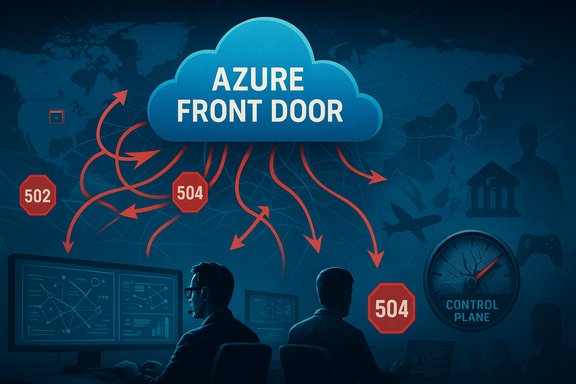
A large, synchronous failure inside Microsoft’s Azure cloud knocked customer-facing services offline across Europe and beyond on Wednesday, October 29, 2025, forcing airports, airlines, banks and gaming platforms to fall back to manual processes while engineers rolled back an unintended configuration change in Azure Front Door (AFD) and restored routing. Microsoft confirmed the incident as an AFD routing and DNS control-plane problem and began deploying a “last known good” configuration while blocking further changes; public outage trackers and corporate statements show the disruption produced widespread sign‑in failures, 502/504 gateway errors and blank admin consoles across Microsoft 365, Xbox/Minecraft, and numerous third‑party web properties.
Azure is one of the world’s three hyperscale cloud platforms and operates a global edge and application delivery fabric known as Azure Front Door (AFD). AFD performs TLS termination, global Layer‑7 routing, Web Application Firewall (WAF) enforcement and CDN-like caching for Microsoft’s own services and thousands of customer endpoints. When that edge fabric misroutes traffic or its control plane applies an incorrect configuration at scale, otherwise healthy backend services become unreachable or fail to authenticate, producing the outward appearance of a catastrophic outage. The October 29 incident arrived against a high-scrutiny backdrop after several other hyperscaler outages earlier in the month. Hyperscalers collectively control the majority of global cloud infrastructure—industry trackers put AWS at roughly 30% and Azure at about 20% of market share in mid‑2025—so failures at that scale have outsized consequences for governments, financial institutions and consumer services.
This coupling—edge routing plus centralized identity—creates a classic common‑mode failure: many independent services share the same critical control plane, and a single mistake can become a systemic outage.
Source: Visit Ukraine Microsoft Azure outage: some airports affected by cloud ‘crash’
 Background
Azure is one of the world’s three hyperscale cloud platforms and operates a global edge and application delivery fabric known as Azure Front Door (AFD). AFD performs TLS termination, global Layer‑7 routing, Web Application Firewall (WAF) enforcement and CDN-like caching for Microsoft’s own services and thousands of customer endpoints. When that edge fabric misroutes traffic or its control plane applies an incorrect configuration at scale, otherwise healthy backend services become unreachable or fail to authenticate, producing the outward appearance of a catastrophic outage. The October 29 incident arrived against a high-scrutiny backdrop after several other hyperscaler outages earlier in the month. Hyperscalers collectively control the majority of global cloud infrastructure—industry trackers put AWS at roughly 30% and Azure at about 20% of market share in mid‑2025—so failures at that scale have outsized consequences for governments, financial institutions and consumer services. What happened: a concise technical timeline
- Around 16:00 UTC on October 29, Microsoft’s telemetry and external monitors first registered elevated packet loss, high latencies and gateway failures for services fronted by AFD. Outage‑tracker graphs spiked as users reported sign‑in failures and content load errors.
- Microsoft publicly identified an inadvertent configuration change in Azure Front Door’s control plane as the proximate trigger and initiated two immediate actions: block further configuration changes and deploy a rollback to the last-known-good configuration. Engineers also failed the Azure management portal away from AFD to restore administrative access.
- The rollback and traffic rebalancing restored many services progressively over several hours, but DNS and CDN caches, client-side TTLs and regional propagation produced residual, tenant‑specific impacts that lingered longer for some organizations. Microsoft continued to monitor and post updates as nodes were recovered and orchestration units restarted.
Who and what were affected
The outage produced a broad, visible impact across consumer and enterprise services:- Microsoft first‑party services: Office/Microsoft 365 web apps (Outlook on the web, Teams), Microsoft 365 admin portals, the Azure Portal itself, Copilot integrations, Xbox Live authentication and Minecraft login/matchmaking all experienced sign‑in failures, blank consoles or intermittent availability.
- Airlines and airports: Alaska Airlines publicly confirmed its website and mobile app were down during the outage and advised travelers to expect delays; Heathrow’s website experienced outages that forced airport staff to revert to manual check-in and processing in some areas. Multiple carriers and airport hubs reported degraded online services where Azure front ends were involved.
- Financial services and retail: Banks including NatWest reported temporary restrictions on online banking access in some regions, while retailers and food retailers that fronted public sites via AFD saw timeouts and checkout failures. These disruptions translated into stranded online transactions and ticketing delays.
- Gaming and consumer platforms: Millions of players saw sign‑in failures, blocked downloads or storefront errors on Xbox and Minecraft platforms during the height of the incident. Gaming outages amplified public attention to the incident.
- Public-sector and other services: Government portals and voting services experienced localized failures where they relied on Azure fronting, producing the kind of friction that converts a technical outage into a civic problem. Independent reports and community reconstructions emphasized that not every reported impact was immediately or publicly confirmed by operators; where confirmation is absent those customer-level reports should be treated as provisional.
The technical anatomy: why AFD + Entra ID failures look catastrophic
AFD is not merely a CDN. It is a global Layer‑7 ingress fabric with several critical responsibilities:- TLS termination and certificate handling at the edge
- URL‑based global routing and failover
- Request inspection and WAF enforcement
- Integration with centralized identity/token services (Microsoft Entra ID)
This coupling—edge routing plus centralized identity—creates a classic common‑mode failure: many independent services share the same critical control plane, and a single mistake can become a systemic outage.
Microsoft’s mitigation and communications
Microsoft’s playbook during the outage followed standard incident-response doctrine for control‑plane failures:- Freeze further changes to the implicated control plane to stop state drift (the company blocked AFD configuration updates).
- Roll back to a validated, last‑known‑good configuration.
- Fail critical administrative entry points off the troubled fabric (move the Azure Portal off AFD) to restore operator access.
- Rebalance traffic and restart orchestration/control units to recover capacity.
- Monitor and communicate recovery progress publicly through the Azure Service Health dashboard.
Real‑world consequences: airports, airlines and banking
The October 29 outage illustrates how cloud edge failures cause immediate operational disruption:- Airports and airlines rely on web front ends and mobile apps for check‑in, boarding passes and passenger communications. When those endpoints fail, ground staff must revert to manual ticketing and boarding checks, lengthening queues and increasing the risk of missed connections. Alaska Airlines’ website and app failures during this incident caused check‑in and boarding friction reported by both passengers and media.
- Banking services that depend on centralized authentication flows can block customer sign‑ins or transactional interfaces; NatWest and other banks briefly restricted access to protect customer integrity while outage conditions persisted. Even where telephone and branch services remain available, the inability to log in online produces reputational damage and customer complaints.
- Retailers and point-of-sale flows that leverage Azure front doors for web, mobile and payment gateway routing experienced failed purchases and checkout errors. Every minute of degraded online checkout translates into lost revenue and service desk overhead.
Why this keeps happening: concentrated control planes and change management
There are a few structural reasons incidents like this recur:- Centralization of critical surfaces. A handful of hyperscalers provide edge, DNS and identity services to a vast share of internet‑facing workloads. When those central surfaces misbehave, the blast radius grows far beyond a single tenant. Market data shows the Big Three (AWS, Azure, Google) control roughly 60–63% of the cloud infrastructure market, intensifying the consequences of any one provider’s outage.
- Fragile change management at hyperscale. Global configuration changes are inherently risky. Adequate canarying, per‑PoP gating, and conservative propagation are the guardrails—when they fail or when shared control planes are updated in a way that affects many tenants, the impact is systemic. Post‑incident reconstructions point to inadvertent automation or configuration drift as recurring vectors for large outages.
- Identity coupling. Centralized identity providers (Entra ID/Azure AD) reduce friction for SSO but become single points of failure. When token issuance or redirect flows break at the edge, applications using Entra ID become inaccessible even if their origin infrastructure remains healthy.
- DNS/caching inertia. Rollbacks are necessary but not sufficient for fast recovery. DNS TTLs, CDN caches and client browsers can continue to hit broken paths long after the provider has fixed the underlying configuration, extending the user‑visible recovery window.
What administrators and Windows-centric IT teams should do now
Short-term during an outage:- Use programmatic interfaces: Azure CLI, PowerShell and REST APIs may expose alternate management paths when the portal is unreliable. Test these paths and their authorization scopes in peacetime.
- Maintain break‑glass accounts: Keep emergency admin credentials isolated, protected with hardened MFA, and exercised periodically.
- Publish contingency runbooks: Ensure customer‑facing teams have manual and offline procedures (e.g., queue management for airports, phone workflows for banks) that front‑line staff can follow.
- Monitor diverse signals: Combine Microsoft Service Health with third‑party telemetry and social/outage trackers to avoid single‑source blind spots.
- Map critical dependencies explicitly: Know which services depend on AFD, Entra ID, or a single CDN/DNS profile.
- Architect for graceful degradation: Where business impact is high, adopt multi‑region or multi‑provider ingress strategies and independent identity fallback mechanisms.
- Separate management planes: Host critical administrative and failover consoles behind different ingress paths to avoid “admin portal goes down with the edge” scenarios.
- Tighten change control: Enforce smaller canary windows, per‑PoP gating and staged rollouts for global routing and WAF rules.
- Exercise failover drills: Regularly test DNS failover, certificate rotation and identity issuer fallback workflows so the team can execute under pressure.
Policy and market implications
Two consequences are likely to follow incidents of this nature:- Regulatory and procurement scrutiny: Governments and large enterprises may demand stronger SLAs, clearer tenant-level telemetry and contractual remedies for systemic outages, increasing pressure on hyperscalers to publish deeper post‑incident analyses and remediation roadmaps.
- Commercial rebalancing: Some organizations—particularly in transportation, finance and critical infrastructure—will re-evaluate single‑vendor lock‑in and consider multi‑cloud or sovereign-cloud options for their most critical customer‑facing surfaces. Expect renewed interest in independent edge/CDN vendors and regional clouds that can serve as failover options.
Notable strengths and weaknesses in Microsoft’s handling
Strengths:- Rapid identification and public acknowledgment: Microsoft quickly attributed the incident to an AFD configuration change and communicated remediation steps, which allowed customers to activate contingency plans.
- Standard, methodical remediation: Blocking changes, rolling back to a known‑good configuration and failing admin portals away from the impacted fabric are textbook and appropriate responses to control‑plane incidents.
- Blast radius of a shared control plane: AFD’s global placement means a single misconfiguration produces outsized downstream effects; this architectural reality increases fragility even as it brings performance and convenience.
- Slow visible recovery: Technical fixes completed inside a provider’s fabric can take longer to present as recovered to end users because of DNS, CDN caches and client TTLs—this prolongs user‑facing pain even after engineers have remediated the root cause.
- Change‑control and canarying gap: The incident underscores persistent operational risk in how global configuration changes are staged and gated. The fact that an inadvertent configuration change reached production at global scale suggests guardrails need strengthening.
Claims to treat with caution
- Attribution to external attack: Some social posts speculated that DDoS or malicious actors caused the disruption. Microsoft’s public communications focused on an unintended configuration change; independent evidence for a deliberate attack is not definitive at this time and should be treated as unverified until a formal post‑incident report provides forensic details.
- Precise financial cost: While the business impact is real and measurable, calculating the total cost of this outage requires internal transaction and revenue data that are not publicly available. Any headline figure claiming total losses in dollars per hour for all affected customers should be treated as an estimate unless published by the impacted organizations.
Practical takeaways for Windows users and IT departments
- Expect disruption resilience to be a procurement criterion: When purchasing cloud services or architecting customer‑facing systems, factor edge and identity failure scenarios into RFPs and architecture reviews.
- Maintain alternate paths: Even small teams should own basic failover capabilities—alternate DNS records, emergency identity providers, and programmatic admin paths are practical and relatively low cost.
- Practice incident drills: Outage playbooks aren’t useful if they’re theoretical; schedule and run tabletop exercises that simulate portal loss and token issuance failures.
- Communicate early with customers: Public and internal communications matter. Customers tolerate outages better when they receive prompt, clear guidance and a timeline for mitigation.
Conclusion
The October 29, 2025 Azure outage is a stark demonstration of the trade‑offs at the heart of modern cloud computing: centralized edge and identity services deliver global performance and ease of management, but they also concentrate single points of failure that can cascade into real‑world disruption for airports, banks and retail. Microsoft’s mitigation—blocking changes, deploying a rollback, failing admin portals away from the affected fabric—recovered many services within hours, yet the event exposes persistent fragility in the ecosystem and will accelerate efforts by enterprises to demand stronger SLAs, diversify critical ingress paths and rehearse failover runbooks. The incident is both a technical case study and a practical call to action: design for failure, verify contingency plans now, and treat edge and identity as critical failure domains rather than mere infrastructure conveniences.Source: Visit Ukraine Microsoft Azure outage: some airports affected by cloud ‘crash’
