

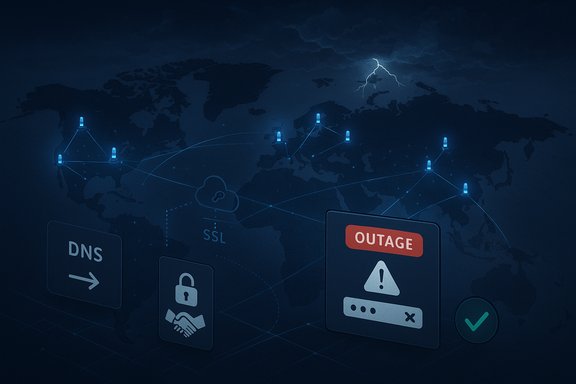
Microsoft’s cloud platform experienced a sharp, high‑visibility outage on October 29–30, 2025 after an unintended DNS/routing configuration change to Azure Front Door (AFD) propagated across Microsoft’s global edge fabric. The error produced widespread name‑resolution and routing failures that manifested as login timeouts, blank admin consoles, 502/504 gateway responses and interrupted consumer services — from Microsoft 365 and Copilot to Xbox Live and numerous third‑party websites — before engineers rolled back the change, rehomed traffic to healthy points of presence, and progressively restored service within hours.
For cloud providers, the path forward is engineering and governance: make deployment gates truly non‑bypassable, canary changes in realistic ways that exercise identity and portal flows, compartmentalize admin and public ingress traffic, and improve incident communication channels that remain reliable even when primary dashboards are impaired. For enterprise customers, the imperative is defensive architecture: multi‑path management access, multi‑region failovers, rigorous chaos testing and contract language that demands measurable, verifiable resiliency improvements.
This incident will drive near‑term changes across the ecosystem. The practical winners will be organizations that treat resilience as a continuous engineering discipline — not a checkbox — and cloud vendors that translate their post‑incident promises into verifiable, technical change.
Source: Techgenyz Microsoft Azure Outage Resolved Swiftly: Inside Microsoft’s Powerful Recovery of Global Cloud Services 2025
 Background and overview
What is Azure Front Door and why it matters
Azure Front Door (AFD) is Microsoft’s globally distributed Layer‑7 edge and application delivery service that provides TLS termination, global HTTP(S) routing, caching, web application firewall (WAF) capabilities and, in many cases, DNS‑level routing for public endpoints. Because AFD often sits at the perimeter for both Microsoft first‑party control planes (Azure Portal, Microsoft Entra ID, Microsoft 365) and thousands of customer applications, a single control‑plane configuration error has the potential to affect a very large, diverse set of services instantly.Timeline snapshot (verified public milestones)
- Detection: Elevated error rates, DNS anomalies and failed sign‑ins were widely reported beginning at roughly 16:00 UTC on October 29, 2025.
- Attribution: Microsoft’s incident updates identified an inadvertent configuration change impacting Azure Front Door as the proximate trigger.
- Containment: Engineers blocked further AFD configuration rollouts and began deploying a “last‑known‑good” configuration while failing the Azure Portal away from AFD where possible.
- Recovery: Microsoft progressively recovered edge nodes, rebalanced traffic to healthy Points of Presence (PoPs), and reported AFD availability climbing back above 98% as mitigation completed over the following hours. Independent monitors and multiple outlets confirmed a progressive restoration of services.
How a single configuration change became a global outage
Anatomy of the failure
At its core, the incident demonstrates the fragility that arises when global routing, TLS termination and identity flows share a concentrated control plane. Two interacting failure modes appear in the public record and reconstructions:- An inadvertent configuration change was accepted by the AFD control plane and propagated to many edge PoPs.
- A validation/deployment gating gap permitted the bad configuration to distribute rather than being caught in an automated pre‑deployment gate or limited canary.
Why DNS and routing errors are especially damaging at edge scale
DNS is the first stage of client reachability. When DNS resolution returns wrong endpoints, client TLS handshakes may fail (mismatched host headers), and authentication flows that rely on consistent routing and low latency (token issuance, OAuth redirects) time out. Because many services cache DNS entries and ISPs propagate changes at different rates, even after the immediate configuration rollback the recovery produced a protracted convergence window with a residual “tail” of tenant‑specific errors.Immediate impact — services and sectors affected
Microsoft first‑party products hit
- Microsoft 365: Outlook on the web, Teams sign‑in and the Microsoft 365 Admin Center experienced widespread sign‑in failures and blank admin blades.
- Entra ID (Azure AD): Authentication and token issuance delays blocked user sign‑ins across multiple surfaces.
- Xbox and Minecraft: Multiplayer sign‑ins, storefront access and account validations failed intermittently for console and PC users.
- Copilot and platform services: Cloud‑hosted Copilot features, App Service endpoints and other Azure‑hosted public APIs showed degraded availability.
Customer and industry fallout
The outage rippled into sectors that rely on Azure for public‑facing systems and customer touchpoints. Airlines (including reported issues at Alaska Airlines and Hawaiian Airlines), retail check‑outs, national public services and even legislative bodies experienced degraded or unavailable web services during the incident window. Public outage trackers recorded tens of thousands of user complaints at peak. These downstream impacts amplify the risk profile for enterprises that route critical customer experiences through a single vendor’s edge fabric.Microsoft’s incident response: what they did right
Containment and remediation sequence
Microsoft executed a familiar containment playbook for control‑plane regressions with sensible risk management steps:- Freeze configuration rollouts to prevent additional propagation of the faulty state.
- Deploy a rollback to a verified “last‑known‑good” AFD configuration.
- Fail critical management portals away from the affected fabric to restore administrative access.
- Recover and reload edge node configurations and reintroduce traffic to healthy PoPs incrementally to avoid a thundering‑herd on origins.
Communications and visibility
Microsoft posted status updates to its Azure and Microsoft 365 status channels and issued progress updates as recovery milestones were reached. While status pages delivered important alerts, some customer‑facing dashboards themselves were intermittently impaired, complicating real‑time transparency for affected tenants. The reliance on the same public control planes for status publication highlights the need for independent, resilient communication channels during major incidents.Critical analysis — strengths, gaps and operational tradeoffs
Strengths
- Rapid detection and containment: Microsoft’s telemetry identified the anomalous behavior quickly and engineers executed a coordinated rollback and traffic rehoming within hours. The triage shows mature incident processes and a robust change‑management rollback capability.
- Conservative recovery approach: The choice to reintroduce nodes incrementally reduced the risk of creating new cascading failures while traffic converged. That conservative posture favors stability over speed when the blast radius is global.
Gaps and risks exposed
- Concentration of critical control planes: Placing identity, management portals and public APIs behind a single global edge fabric increases systemic risk. When the fabric misbehaves, diverse, unrelated products can fail simultaneously.
- Insufficient pre‑deployment canarying or validation: Public narratives suggest an invalid or unintended config reached production; that implies gaps in gating logic or canary scope that allowed a configuration to deploy at global scale. Strengthened validation and more robust deployment gating could have intercepted this change.
- Customer visibility and communication fragility: Status pages and dashboards are typically the first line of customer communication; when those are partially impacted, customers lose situational awareness. Independent comms channels and pre‑published ‘playbooks’ for tiered updates improve trust during incidents.
Operational tradeoffs that shape risk
Centralizing routing and TLS at the edge reduces complexity for developers, simplifies certificates and WAF policies, and improves latency through global PoPs. Those gains come with a tradeoff: a single misconfigured control‑plane object can create high‑impact failure domains. Organizations designing at hyperscaler scale must continuously balance operational simplicity against catastrophic blast radius risk.What Microsoft has promised and what to watch for next
Public commitments
Microsoft has committed to a formal post‑incident review (Post‑Incident Review, PIR) and to tightening change controls and validation pipelines for global networking and edge routing changes. Microsoft also stated it will provide affected customers with tailored incident reports and remediation timelines. These are standard and expected outcomes for an incident of this scale.Areas where public statements should be verified
- Exact root‑cause technical details beyond “inadvertent configuration change” (e.g., whether a software bug in validation logic also played a role) should be treated as provisional until the PIR is published. Public reconstructions implicate both bad input and a gating failure, but internal diagnostics and change logs are needed to confirm specifics. This is a point where public reporting must await Microsoft’s definitive post‑incident documentation.
Practical recommendations for enterprises and architects
Short‑term survivability checklist (immediately actionable)
- Harden DNS caching strategies: lower DNS TTLs for critical endpoints where practical, and validate client behavior against aggressive DNS changes during drills.
- Establish management fallback paths: ensure programmatic admin access via CLI/PowerShell endpoints or secondary portals that do not depend on the same edge fabric as the primary portal.
- Maintain an incident playbook that includes identity‑flow fallbacks: design authentication flows to degrade gracefully (e.g., token cache reuse, alternate identity providers for critical admin tasks).
- Use health checks and multi‑region failovers: deploy origins across multiple regions and configure AFD (or equivalent) with origin failover and clear priority rules to limit single‑point failure impact.
Medium‑term architecture changes
- Implement multi‑cloud or hybrid fallbacks for mission‑critical public surfaces; use DNS‑level traffic steering or gateway‑level failovers to move traffic off a provider when necessary.
- Compartmentalize control planes: where possible, separate management/control functions from public ingress fabrics to reduce shared failure domains.
- Simulate control‑plane failures in regular chaos‑engineering exercises to validate human and automated responses under degraded edge conditions.
Contractual and compliance steps
- Revisit SLAs and incident reporting commitments: require clear timelines for PIRs, evidence of remediation, and specific verification metrics for changes to global routing and name‑resolution services.
- Demand independent audits: enterprise customers with critical uptime needs should condition business on independent resiliency attestations for providers’ global routing and DNS deployment processes.
Engineering lessons for cloud providers
Hardening deployment pipelines
- Strengthen gating and validation: non‑bypassable schema validation, staged canarying limited by customer and by PoP, and automated rollback triggers when anomalous telemetry appears.
- Expand controlled canaries: canaries must exercise the same code paths and configuration schemas as production; synthetic tests should reflect identity, hostname and token issuance flows, not merely static content routing.
Control‑plane compartmentalization and defensive defaults
- Segment management endpoints into alternate ingress topologies so that a fault in one global fabric doesn’t simultaneously remove administrative access.
- Default to conservative failover behavior: when a PoP returns inconsistent DNS responses, demote it from rotation until validated rather than accepting it back into service automatically.
Transparency and customer trust
- Commit to proactive, concrete post‑incident deliverables that go beyond generic assertions: publish change logs, validation gaps, remediation steps and concrete timelines for code‑level fixes where appropriate (subject to security and IP constraints). Public trust is renewed by verifiable change.
Post‑incident verification and unanswered questions
What needs confirmation from Microsoft’s PIR
- The exact validation path that permitted the configuration to deploy at scale (was it human error, an automated job, or a tooling bug?.
- Whether the incident involved a software defect in the control plane’s validator in addition to the misapplied config.
- Precise counts of affected tenants and customer‑level impact windows (Microsoft will have authoritative telemetry; public estimates are indicative but not final). Until the PIR is published, these details remain provisional.
Public transparency expectations
Enterprises and regulators are likely to press for more than a narrative; they will seek publicly verifiable measures that the same class of failure is far less likely to recur. That includes commit timelines for deployment‑pipeline hardening, third‑party validation of fixes, and follow‑up verification sessions with large enterprise customers.Conclusion — resilience at hyperscale requires both engineering and governance
The October 29–30 Azure outage is a textbook demonstration of the power and peril of centralizing edge routing, TLS and identity at global scale. Microsoft’s recovery — rapid detection, configuration freeze, rollback and staged node recovery — reflects mature operations. Yet the incident also exposes systemic vulnerability: when an edge control plane is compromised, a huge swath of services and customers can be affected instantly.For cloud providers, the path forward is engineering and governance: make deployment gates truly non‑bypassable, canary changes in realistic ways that exercise identity and portal flows, compartmentalize admin and public ingress traffic, and improve incident communication channels that remain reliable even when primary dashboards are impaired. For enterprise customers, the imperative is defensive architecture: multi‑path management access, multi‑region failovers, rigorous chaos testing and contract language that demands measurable, verifiable resiliency improvements.
This incident will drive near‑term changes across the ecosystem. The practical winners will be organizations that treat resilience as a continuous engineering discipline — not a checkbox — and cloud vendors that translate their post‑incident promises into verifiable, technical change.
Source: Techgenyz Microsoft Azure Outage Resolved Swiftly: Inside Microsoft’s Powerful Recovery of Global Cloud Services 2025
