

Microsoft’s cloud backbone briefly collapsed on October 29 when an inadvertent configuration change in Azure Front Door (AFD) — Microsoft’s global Layer‑7 edge and application‑delivery fabric — propagated across the edge control plane, producing DNS, routing and authentication failures that knocked Microsoft 365, the Azure Portal, Xbox/Minecraft sign‑in flows and thousands of customer websites and apps offline for several hours before engineers rolled back to a “last known good” configuration and recovered service.
Azure Front Door is not a simple content delivery network. It’s a globally distributed ingress and routing fabric that performs TLS termination, host header and hostname routing, Web Application Firewall (WAF) enforcement, and DNS‑level traffic steering for both Microsoft’s first‑party services and countless customer endpoints. Because AFD often sits in front of identity and management surfaces (Microsoft Entra ID / Azure AD, the Azure Portal) and many customer public APIs, a control‑plane or configuration error at that layer can present exactly like a service‑wide outage even when origin back ends are healthy.
The October 29 incident surfaced in the early-to-mid afternoon UTC window. Microsoft’s status messages and independent reporting agree on the broad arc: elevated packet loss and HTTP gateway errors were detected, Microsoft traced the root to an inadvertent tenant configuration change in AFD, the company blocked further AFD changes and deployed a rollback to a previously validated configuration while failing the Azure Portal away from AFD, and services returned progressively as nodes and DNS caches reconverged. Public outlets and cloud‑monitoring feeds recorded tens of thousands of user reports at the peak of the disruption.
Microsoft has said it will complete an internal retrospective and publish post‑incident findings in line with its PIR process; those documents will be the best place to confirm the finer points and evaluate whether the corrective actions address both the software defect and the procedural gaps that allowed the change to pass safety gates in the first place. Until then, the practical steps above provide a pragmatic starting point for teams and policymakers to reduce exposure to future incidents of this type.
Source: Silicon Republic What happened with the Microsoft Azure outage?
 Background / Overview
Azure Front Door is not a simple content delivery network. It’s a globally distributed ingress and routing fabric that performs TLS termination, host header and hostname routing, Web Application Firewall (WAF) enforcement, and DNS‑level traffic steering for both Microsoft’s first‑party services and countless customer endpoints. Because AFD often sits in front of identity and management surfaces (Microsoft Entra ID / Azure AD, the Azure Portal) and many customer public APIs, a control‑plane or configuration error at that layer can present exactly like a service‑wide outage even when origin back ends are healthy.The October 29 incident surfaced in the early-to-mid afternoon UTC window. Microsoft’s status messages and independent reporting agree on the broad arc: elevated packet loss and HTTP gateway errors were detected, Microsoft traced the root to an inadvertent tenant configuration change in AFD, the company blocked further AFD changes and deployed a rollback to a previously validated configuration while failing the Azure Portal away from AFD, and services returned progressively as nodes and DNS caches reconverged. Public outlets and cloud‑monitoring feeds recorded tens of thousands of user reports at the peak of the disruption.
What exactly went wrong
The proximate trigger: a tenant configuration change in Azure Front Door
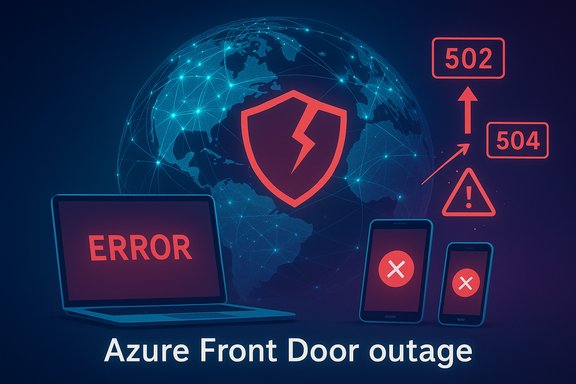
Microsoft’s operational description — consistent across its incident messages — pins the proximate cause on an inadvertent tenant configuration change within the Azure Front Door control plane. The change introduced an invalid or inconsistent configuration state so a significant number of AFD nodes could not load the expected configuration. Those nodes failed to process TLS handshakes, host header mapping and routing rules correctly, producing increased latencies, timeouts and 502/504 gateway errors across downstream services. Microsoft halted AFD configuration deployments and initiated a rollback to a “last known good” configuration while recovering affected nodes.How an edge misconfiguration amplifies
AFD executes routing and TLS logic at the edge, which means:- TLS handshakes and certificate/SNI decisions are evaluated at PoPs (Points of Presence). If an edge PoP has an inconsistent binding or mapping, clients can see TLS or hostname errors before the origin is contacted.
- Identity token issuance for Microsoft services (via Entra ID / Azure AD) often traverses the same ingress path; when the edge drops or misroutes token exchange requests, sign‑ins fail across multiple products simultaneously.
- A single control‑plane change can propagate to thousands of PoPs. If deployment validation or canary checks fail, the bad change can be accepted at scale and produce a very large blast radius in minutes.
Timeline (concise, verified)
- Detection (~16:00 UTC, 29 October 2025) — Telemetry and external monitors show spikes in latencies, DNS anomalies and 502/504 errors for AFD‑fronted endpoints. Public outage trackers register a rapid escalation of user‑side reports.
- Public acknowledgement (minutes after detection) — Microsoft posts incident updates referencing Azure Front Door connectivity and portal access problems, and states the team is investigating. Customers are warned of portal and sign‑in issues.
- Mitigation actions (immediate) — Microsoft blocks all AFD configuration changes to prevent further propagation; it begins deploying a rollback to a validated “last known good” configuration and fails the Azure Portal away from AFD so admins regain management access.
- Recovery (over several hours) — Rollback and rerouting restore most AFD capacity; traffic rebalances as orchestration units and PoPs come back online. DNS TTLs, ISP caches and tenant‑specific routing produce a lingering tail where some customers still see intermittent problems. Microsoft reports the majority of services returning to normal by late evening UTC.
- Post‑incident steps — Microsoft begins an internal retrospective and signals that a Preliminary Post Incident Review (PIR) will follow, with a Final PIR typically published within 14 days.
Scope and real‑world impact
Services that showed visible disruption
- Microsoft first‑party services: Microsoft 365 (Outlook on the web, Teams), Azure Portal, Microsoft 365 admin center, Microsoft Entra (Azure AD) sign‑in flows, Xbox Live, Minecraft authentication and storefront operations.
- Platform and infrastructure surfaces: Azure App Service, Azure SQL Database, Azure Databricks, Azure Maps, Azure Virtual Desktop, Azure Communication Services, Media Services, Copilot and Defender integrations (a partial list of affected products reported during the incident).
- Enterprise and public services: retail, banking, airline and government digital services that route through Azure or rely on Microsoft identity — notable reports included Starbucks, Capital One, Heathrow Airport, Alaska Airlines and a suspended vote in the Scottish Parliament where digital systems were affected. The outage also impacted a wide set of third‑party websites that use Azure Front Door for global traffic delivery.
Scale of reports
Outage trackers and monitoring feeds recorded tens of thousands of user complaints at the peak — figures that vary by tracker and are noisy by nature — but the scale was large enough to produce visible disruptions across consumer, corporate, and government services in multiple regions. Exact incident counts differ by monitoring feed; they are directional indicators of scale rather than audited totals.Microsoft’s immediate technical response
Microsoft executed a familiar containment playbook for control‑plane incidents:- Freeze configuration rollouts to AFD to stop further propagation of the faulty state.
- Deploy rollback of the AFD control plane to the last validated configuration across the global fleet.
- Fail management portals away from AFD where possible to restore administrative access for remediation.
- Recover edge nodes and rehome traffic progressively to healthy PoPs while monitoring capacity to avoid overloads as nodes returned.
Why this incident matters: architectural lessons
Centralization buys convenience — and systemic risk
The October 29 outage illustrates a structural trade‑off in modern cloud design: consolidation of routing, security and authentication into a small number of global, managed control planes simplifies operations and lowers cost — but it also concentrates single points of failure that can produce correlated outages across many otherwise independent services.- When edge routing, TLS termination and identity share the same control plane, a single mistake in that plane can break sign‑ins across dozens of products at once.
- Operational automation and scale mean a misapplied change can propagate globally faster than humans can react, unless deployment gates and canaries catch the regression early.
Validation and deployment hardening are essential
Microsoft acknowledged that protection mechanisms intended to validate and block erroneous deployments failed due to a software defect, allowing the faulty configuration to bypass safety validations. That admission underlines the importance of multi‑layered validation, strict canarying, and robust rollback controls in high‑blast‑radius systems. The mitigation and follow‑up must include not only code fixes but also process, tooling and organizational adjustments to reduce similar risks in the future.Policy and strategic fallout: the digital sovereignty debate
Two high‑profile cloud outages within a short span — the AWS disruption earlier in October and Microsoft’s AFD incident — rekindled intense debate about vendor concentration, national digital sovereignty, and the proper role of hyperscalers in critical infrastructure.- Industry figures argued that governments and critical institutions should treat reliance on a handful of U.S. hyperscalers as a national resilience issue. Building multi‑cloud, regionally sovereign or on‑premise alternatives is now being framed as more than preference — it’s being called a matter of digital sovereignty.
- Smaller cloud providers and regional vendors positioned the outages as proof points for why some public services and critical systems should be hosted closer to home or under national control. Critics of hyperscaler concentration pointed to the economic and operational fragility that arises when essential services depend on remote, third‑party control planes.
Strengths and defensive measures shown by Microsoft
The incident also demonstrates some operational strengths:- Rapid containment playbook — Microsoft’s decision to freeze AFD changes and deploy a rollback quickly limited further propagation and formed the backbone of effective mitigation. The fact that the company could push a global rollback and rehome traffic shows the operational muscle that hyperscalers possess.
- Transparent status updates — Microsoft provided rolling updates through its Azure Service Health and status channels, and has a standard post‑incident review process (PIR) that promises deeper technical findings. That transparency helps customers plan remediation and post‑mortem action.
- Scale for recovery — the ability to reallocate traffic among PoPs and to recover orchestration units at hyperscaler scale is nontrivial; these systems usually restore high percentages of capacity much faster than smaller operators could.
Risks, unanswered questions and unverifiable claims
- Microsoft attributed the trigger to an “inadvertent tenant configuration change” and said validation gates failed due to a software defect. While the incident narrative is consistent and plausible, the full technical detail and a step‑by‑step timeline are still pending Microsoft’s PIR, so some internal mechanics and root‑cause subtleties remain to be fully verified. The PIR is the right channel for those final confirmations.
- Public counts of user‑side incident reports (Downdetector totals and similar metrics) vary widely between trackers and snapshots; these figures are useful as signal but are not an authoritative measurement of customer impact by themselves. Treat these numbers as indicative rather than definitive.
- Claims that the outage was malicious or attributable to external attackers have not been substantiated by Microsoft’s public statements; the company described the event as an inadvertent configuration change and a subsequent software defect in validation tooling. Any attribution beyond that would be speculative until the PIR or additional forensic details are published.
Practical guidance for IT teams and operators
The incident offers concrete, operational lessons for organizations that rely on cloud providers.- Do not assume provider SLAs or platform redundancy eliminate all risk. Instead:
- Plan for provider degradation with fallback modes and manual procedures for critical workflows (e.g., check‑in desks, payment fallbacks, offline admin operations).
- Diversify critical control planes where possible: split authentication and management functionality across multiple identity providers or implement staged local authentication caches for critical systems.
- Use resilient DNS and client TTL practices: keep DNS TTLs short for canary/experimental routes but be mindful of tail behavior during rollbacks; implement fallback DNS resolvers for critical services.
- Test failovers and runbooks. Regular chaos‑testing focused on control‑plane failures (edge routing, DNS, authentication) is necessary — not optional.
- Harden administrative access: ensure alternate management paths (API keys, service principals, out‑of‑band consoles) are available and secured to allow recovery when the web portal is impacted.
- Identify the critical control‑plane dependencies (identity, edge routing, DNS).
- Implement and test at least one alternate management path that does not traverse the same edge fabric.
- Maintain operational playbooks and runbooks for provider outages and rehearse them quarterly.
- Use multi‑region and multi‑provider redundancy for critical services when feasible; quantify the cost vs risk tradeoffs.
- Subscribe to provider service health feeds and automate alerts into your incident response tooling.
What governments and regulators should consider
- Digital sovereignty is a resilience strategy, not only a political slogan. Public-sector services, national critical infrastructure and electoral systems rely on availability and must consider contractual and architectural measures to reduce single‑vendor concentration risk.
- Procurement frameworks should require demonstrable multi‑path recovery options and tested incident playbooks from cloud suppliers for critical services.
- Minimum resiliency standards might be appropriate for sectors like finance, transport and public safety — where outage externalities are systemic and carry public safety risk. Independent audits and transparency around infrastructure dependencies could become part of regulation.
The commercial context: high revenue, high scrutiny
The outage occurred at a time when Microsoft had just reported strong quarterly results and continued Azure revenue growth, which highlights another tension: compelling business growth and heavy adoption can increase systemic dependency on a single provider. Hyperscalers will continue to be indispensable to many businesses because they provide unmatched scale, tooling, and global reach — but that same ubiquity raises the reputational and regulatory stakes when outages occur.Closing analysis — balanced verdict
The October 29 Azure disruption is a textbook example of modern-cloud complexity: a configuration error in a high‑blast‑radius control plane rapidly amplified into multi‑product outages that touched consumer apps, enterprise productivity tools and national services. Microsoft’s response — immediate freeze of changes, global rollback, portal failover and node recovery — was the right operational playbook and restored most services within hours. The company’s commitment to publish post‑incident findings and to harden validation and rollback controls is necessary and appropriate. At the same time, the outage underlines unavoidable truths:- Operational scale is a double‑edged sword. Hyperscalers offer capabilities smaller operators cannot match, but those capabilities concentrate systemic risk.
- Digital sovereignty and multi‑path resilience are practical imperatives for critical infrastructure and deserve investment and policy attention beyond rhetoric.
- Engineering discipline matters. Better deployment validation, canary strategies, and redundant management paths would materially reduce the odds that a single configuration mistake becomes a global event.
Microsoft has said it will complete an internal retrospective and publish post‑incident findings in line with its PIR process; those documents will be the best place to confirm the finer points and evaluate whether the corrective actions address both the software defect and the procedural gaps that allowed the change to pass safety gates in the first place. Until then, the practical steps above provide a pragmatic starting point for teams and policymakers to reduce exposure to future incidents of this type.
Source: Silicon Republic What happened with the Microsoft Azure outage?
