

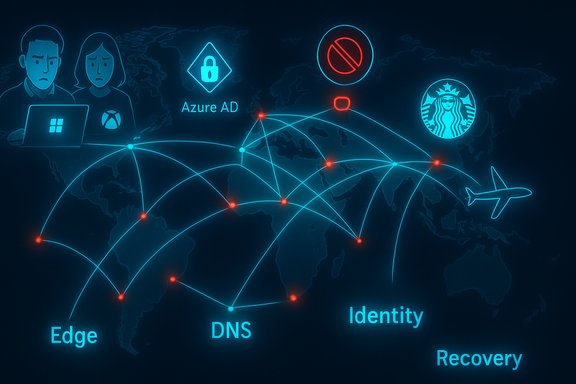
Microsoft's cloud fabric suffered a significant disruption that left millions frustrated and multiple high‑profile services — from Microsoft 365 to Xbox and third‑party sites like Starbucks and several airlines — intermittently or wholly unavailable as engineers raced to roll back a faulty edge configuration and restore global routing.
Background
The outage began in the mid‑afternoon UTC window on October 29, when monitoring systems and public trackers started reporting elevated errors, DNS anomalies, and 502/504 gateway responses affecting endpoints fronted by Microsoft’s global edge service, Azure Front Door (AFD). Microsoft’s initial incident messages and subsequent diagnostics pointed to an inadvertent configuration change in AFD’s control plane as the proximate cause, prompting the company to block further configuration rollouts, deploy a rollback to a last‑known‑good state, and route management traffic away from affected front‑door nodes while recovery progressed. This event was not a narrow, single‑site failure. Because AFD functions as a Layer‑7 global ingress fabric — handling TLS termination, HTTP(S) routing, Web Application Firewall enforcement, DNS-level mappings, and origin failover — a control‑plane slip propagated quickly across many PoPs (points of presence), producing an outsized, cross‑product outage footprint. Independent trackers and reports show a rapid spike in user complaints for Azure‑backed services and Microsoft‑owned products.Overview: what went down and why it mattered
- First‑party Microsoft services affected: Microsoft 365 (including Outlook on the web and Microsoft 365 admin surfaces), the Azure Portal, Microsoft Entra (Azure AD) authentication flows, Microsoft Store, Game Pass, Xbox Live, and Minecraft sign‑in/matchmaking were among the most-visible casualties.
- Third‑party and downstream impacts: Numerous customer websites and mobile apps that use Azure Front Door for global ingress experienced timeouts or gateway errors. Reported examples included Starbucks, Kroger, Costco, several airlines (notably Alaska Airlines), Heathrow Airport, and a number of public‑sector portals. These business disruptions translated into real operational friction — from blocked mobile ordering and loyalty features to airport check‑in and boarding‑pass processing delays.
- Why a single change cascaded: AFD’s central role in routing traffic and terminating authentication flows meant that errors at the edge interfered with Microsoft Entra ID token issuance and management plane access, so even healthy origin servers could not be reached or authenticated against. This conflation of ingress, DNS, and identity in the same fabric created a high‑impact single point of failure.
Timeline — concise, verifiable sequence
- Detection (~15:45–16:00 UTC, Oct 29): Internal telemetry and external monitors detect elevated latencies, DNS resolution failures, and gateway errors for many AFD‑fronted endpoints; public trackers spike.
- Acknowledgement: Microsoft posts incident banners and messages saying it is investigating connectivity issues impacting several Azure services and Microsoft 365 products.
- Root cause hypothesis: Microsoft identifies an inadvertent configuration change in Azure Front Door’s control plane as the likely trigger. Engineers freeze AFD configuration rollouts.
- Containment and rollback: Microsoft deploys a rollback to the last validated configuration and fails the Azure Portal away from AFD where feasible to restore administrative access; nodes are recovered and traffic rebalanced across healthy PoPs.
- Recovery: Progressive restoration occurs over several hours as DNS convergence and cache expiry allow corrected routing to propagate; Microsoft reports services returning to normal and tracks residual tail‑end issues.
The technical anatomy: Azure Front Door, DNS and identity
What is Azure Front Door (AFD)?
Azure Front Door is a global Layer‑7 edge service that provides routing, TLS termination, caching, Web Application Firewall (WAF) enforcement, and global load balancing for applications and APIs. It often sits as the first public hop for Microsoft services and thousands of customer origins, which gives it outsized influence over reachability and authentication flows. When AFD is healthy, it reduces latency and simplifies DDoS/WAF protection; when it fails, it can sever the internet’s ability to find or route to otherwise healthy back ends.Why DNS and control‑plane changes matter
- DNS mapping and anycast routing: AFD interacts with DNS and routing glue to steer users to nearest PoPs. If routing rules or hostname bindings are misapplied, hostnames may resolve incorrectly or to nodes that cannot reach the origin.
- TLS termination and SNI obligations: Because AFD handles TLS at the edge, certificate mapping errors or SNI mismatches can interrupt TLS handshakes, making endpoints appear unreachable.
- Identity coupling: Many Microsoft services depend on Microsoft Entra (Azure AD) for token issuance. If the edge fabric interferes with access to Entra endpoints, sign‑in and single sign‑on flows fail across multiple services simultaneously. That dependency turned what might have been isolated website outages into cross‑product sign‑in failures.
Scope and measurable impact
Public outage aggregators recorded rapid spikes in user reports for Azure and multiple Microsoft product pages, with instantaneous snapshots ranging from tens of thousands to, in some captures, six‑figure blips. These publicly reported counts are a directional indicator of scale — useful for showing geographic spread and urgency — but they are noisy and not equivalent to Microsoft’s internal telemetry. Different services and regions saw widely varying impact windows due to DNS TTLs, ISP caches, and geographic routing dynamics. Treat crowdsourced figures as signal, not definitive audit metrics.Real‑world examples of customer‑visible impact included:
- Retail and hospitality: Starbucks mobile ordering and loyalty features displayed outage messages and mobile app errors during the event; Kroger and Costco reported storefront interruptions tied to Azure‑fronted endpoints.
- Travel: Alaska Airlines acknowledged that Azure’s outage affected services they host on Microsoft infrastructure, disrupting check‑in and boarding operations and forcing manual workarounds at some airports. Heathrow and other airport systems reported passenger‑facing friction.
- Gaming and entertainment: Xbox Live, Game Pass, and Minecraft players reported sign‑in failures, matchmaking problems, stalled downloads and inaccessible stores; some consoles required restarts after services were restored.
Microsoft’s operational response — what worked and what could be tighter
Strengths
- Rapid acknowledgement and transparency: Microsoft posted rolling updates on status pages and social channels, which reduced uncertainty while remediation proceeded. Open status messaging is critical during live incidents for large enterprise and consumer customer bases.
- Conservative containment: Freezing AFD configuration rollouts and reverting to a validated configuration is textbook containment for a control‑plane failure. Those steps limited further propagation of the faulty state and reduced the risk of repeated oscillation.
- Failover of management surfaces: Failing the Azure Portal away from the affected fabric restored some administrative access and allowed programmatic management alternatives (PowerShell/CLI) to be used where the GUI was unreliable. That preserved vital operator escape hatches.
Weaknesses and areas for improvement
- Change governance and canarying: An “inadvertent configuration change” that propagates to global PoPs suggests gaps in deployment guardrails, canary isolation, or automated rollback triggers. When control‑plane changes can impact identity and admin planes, canaries should be isolated, and staged rollouts should minimize blast radius by region and tenant class.
- Single‑fabric exposure for identity and management: Co‑locating identity token issuance, management portals, and customer ingress on the same global fabric increases systemic risk. Separating critical identity and admin control paths from general content distribution — or providing hardened secondary activation paths — would reduce the chance an edge slip disables administrative recovery.
- DNS cache and TTL expectations: While Microsoft can correct the control plane quickly, recovery is delayed by global DNS caching behavior. More explicit customer guidance about expected DNS convergence windows and mitigation playbooks could shorten confusion during the tail.
Broader implications for cloud concentration and systemic risk
This incident followed another hyperscaler outage in the same operational window, underscoring a larger strategic tension: hyperscale clouds deliver unparalleled scale and features, but concentration of critical primitives — edge routing, DNS, and identity — across a handful of vendors amplifies systemic risk.- When global ingress fabrics support both first‑party management and a wide catalog of tenant front ends, a single control‑plane mistake can produce simultaneous outages across commerce, transport, and public services.
- The commercial incentives that drive consolidation — cost, performance, ease of use — also concentrate failure modes, making incident response and cross‑tenant resilience matters of national and economic significance.
Practical, tested recommendations for Windows administrators and IT teams
Organizations that depend on Microsoft services should treat this incident as an operational stimulus: assume the edge can fail and prepare measurable recovery runbooks.- Map critical dependencies
- Inventory user journeys that rely on external ingress or Microsoft Entra authentication: admin portals, payment gateways, booking/check‑in flows, and loyalty systems.
- Identify which journeys are fronted by Azure Front Door, Microsoft Entra, or other single‑vendor ingress.
- Harden identity fallbacks
- Where feasible, provision secondary SSO endpoints or local token‑issuance fallback mechanisms for essential administrative accounts.
- Pre‑generate emergency administration credentials and store them securely in an offline, auditable vault so critical changes can be executed if portal access is limited.
- Test DNS and TTL behavior
- Avoid unreasonably long DNS TTLs for endpoints that require rapid failover. Run simulated failover drills across multiple resolvers and geographic regions to measure convergence times and identify weak links.
- Apply multi‑path design to critical flows
- Architect payment, booking, and authentication paths such that a primary cloud ingress failure doesn’t fully block critical business operations. Consider edge‑redundant architectures, geo‑diverse endpoints, or hybrid architectures for mission‑critical services.
- Validate outage runbooks and staff readiness
- Document step‑by‑step escalation matrices for incidents where vendor control planes impair administrative access. Practice programmatic failover (PowerShell/CLI) and ensure runbooks are tested against simulated portal outages.
- Contract and SLA clarity
- For services that directly affect revenue or safety, ensure contracts and SLAs reflect both availability expectations and compensation/response commitments in the event of broad control‑plane failures. Negotiate access to post‑incident reviews and timelines for root‑cause and remediation details.
Risk assessment for enterprises and consumers
- Operational risk: High for organizations that rely on single‑path identity and ingress. The real cost is not just lost transactions but staff time, manual workarounds, customer dissatisfaction, and potential regulatory scrutiny for critical sectors (travel, finance, healthcare).
- Reputational risk: High for consumer brands that present an expectation of “always‑on” digital experiences (ordering, loyalty, boarding). Short outages during peak times can produce outsized social media backlash and operational chaos at physical touchpoints like airports and stores.
- Systemic risk: Medium to high as long as the major hyperscalers continue to centralize identity and edge services; the internet’s increasing dependence on a few control planes remains a structural vulnerability.
What we still don’t know — and caution on numbers
Public trackers captured large spikes in outage reports, but the exact counts vary across services and snapshots. Headlines that quote a specific Downdetector peak should be treated as indicative rather than precise; aggregator feeds reflect user‑reported issues at instants in time and are affected by sampling windows, duplicate reports, and automated checks. Microsoft’s internal telemetry and its formal post‑incident review will be the authoritative record for impacted tenants and exact durations. Until Microsoft publishes the full post‑incident report, any detailed attribution of downstream corporate losses or precise user counts should be labeled tentative.What Microsoft should publish (and why it matters)
To rebuild confidence and help customers harden their systems, the next public‑facing deliverables should include:- A detailed, timestamped Post‑Incident Review (PIR) that describes exactly what configuration change propagated, which validation gates failed, and why automated guardrails did not block the change.
- A clear remediation plan to prevent recurrence: improved canarying, stricter staging (regional/tenant isolation), automated rollbacks with impact‑sensitive thresholds, and separation of identity/management control paths from general content delivery.
- Concrete guidance for customers: expected DNS convergence windows, verified programmatic alternatives for admin access, and prescriptive architecture patterns to reduce single‑fabric dependencies.
Conclusion
The October 29 Azure Front Door incident was a high‑visibility reminder that hyperscale convenience carries concentration risk. Microsoft’s rapid containment and rollback limited the window of catastrophic failure, but the outage exposed systemic fragilities: a global edge service that simultaneously manages ingress, DNS, TLS termination and identity becomes a single choke point when a control‑plane slip occurs. For Windows administrators, cloud architects, and enterprise leaders, the practical takeaway is clear: assume the edge can and will fail, build multi‑path resilience for authentication and critical customer journeys, and insist on robust change‑governance and transparent post‑incident reporting from providers. These are not optional upgrades — they are baseline resilience requirements for any organization that treats cloud‑hosted services as essential infrastructure.Source: AOL.com Microsoft outage affects thousands as Xbox, Starbucks and have interruptions
