Azure Front Door Outage Oct 29 2025: Cause, Rollback and Recovery

  • Thread Author
Microsoft’s Azure cloud platform suffered a high‑visibility global outage on October 29, 2025 after an inadvertent configuration change in Azure Front Door (AFD) caused widespread DNS, routing and authentication failures that cascaded through Microsoft 365, Outlook, Copilot, Xbox Live, and numerous third‑party sites; Microsoft moved quickly to freeze AFD changes, roll back to a last‑known‑good configuration, and recover edge nodes, restoring service progressively over the following hours.

Global network operations center monitoring cloud traffic with DNS and WAF protections.Background / Overview​

Azure Front Door (AFD) is Microsoft’s global edge and application‑delivery fabric: a distributed Layer‑7 ingress service that performs TLS termination, global HTTP(S) routing and failover, Web Application Firewall (WAF) enforcement, and CDN‑style acceleration. Because Microsoft uses AFD to front many first‑party control‑plane endpoints (including Microsoft Entra ID / Azure AD and the Azure Portal) and because thousands of customer applications also rely on AFD, a fault in AFD’s control or data plane can look like a company‑wide outage even when origin back ends are healthy. On October 29, Microsoft’s public status updates and independent monitoring agreed on a core narrative: an erroneous configuration change propagated into parts of AFD’s global footprint, causing many AFD nodes to become unhealthy or to misroute traffic. That produced elevated packet loss, DNS resolution failures, TLS/hostname anomalies and token‑issuance timeouts — symptoms that blocked sign‑ins and rendered admin blades and storefronts partially or wholly unusable in affected regions. Microsoft’s immediate response was to block further AFD configuration changes and deploy a rollback to a previously validated state while recovering nodes and rebalancing traffic.

Timeline: what happened, when (verified)​

  • Microsoft’s status page and multiple outlets place the visible start of the incident at approximately 16:00 UTC on 29 October 2025 (which is 21:30 IST). Microsoft used that timestamp in its incident notifications and used it as the anchor for mitigation steps.
  • Public trackers and outage reports spiked shortly after that time as users worldwide reported login failures, portal timeouts, 502/504 gateway errors and other symptoms across Microsoft 365, Azure Portal, Xbox, Minecraft and many customer sites that front through AFD.
  • Microsoft’s operational playbook during the incident included two parallel actions: (1) freeze all AFD config changes to prevent further propagation of the faulty state, and (2) deploy a rollback to the “last known good” configuration for AFD while recovering edge nodes and failing the Azure Portal away from AFD where possible. Those steps were the core containment and recovery actions reported publicly.
  • Recovery progressed over several hours as traffic was rebalanced, orchestration units restarted and edge nodes progressively re‑integrated. Different outlets reported slightly different completion/mitigation estimates (Microsoft reported progressive signs of recovery and aimed for full mitigation within a multi‑hour window). Observed local user windows vary depending on DNS cache convergence and regional propagation delays.
Important verification note: public reporting and Microsoft’s status notifications agree on the proximate trigger (an inadvertent configuration change impacting AFD) and the mitigation pattern (freeze, rollback, node recovery). Precise start and end times reported by end users and third‑party trackers can differ by minutes to hours because DNS TTLs, cache state and client‑side behavior affect when individual users see failures and restorations.

Anatomy of the failure: why an edge config change breaks so much​

AFD is not a simple CDN cache — it is a globally distributed Layer‑7 ingress fabric that also centralizes TLS handling, routing logic and WAF/security policy enforcement for a large set of Microsoft and customer endpoints. A misapplied routing rule, DNS mapping change, certificate binding, or other control‑plane update can therefore:
  • Redirect traffic to unreachable or black‑holed origins.
  • Break TLS handshakes at the edge (causing certificate/hostname mismatches).
  • Interrupt token issuance and refresh flows when identity endpoints are fronted by affected AFD nodes.
  • Propagate incorrect metadata to data‑plane components that rely on precise control‑plane inputs.
In this incident, the misconfiguration led to many AFD nodes becoming unhealthy or dropping out of routing pools; remaining healthy nodes became overloaded and traffic rebalancing took time, which manifested as elevated latencies and timeouts across many dependent services. These mechanics explain the classic symptom set observed: failed sign‑ins, partially rendered admin blades, 502/504 gateway responses and intermittent availability for game authentication, storefronts and third‑party sites.

Services and sectors affected​

The outage’s reach was broad because AFD fronts both Microsoft’s own consumer and enterprise surfaces and thousands of customer workloads. Reported impacts included:
  • Microsoft 365 web apps and admin center (Outlook on the web, Teams, Microsoft 365 Admin Center) — sign‑in failures and blank or partially rendered blades.
  • Azure Portal management blades — admins experienced inability to view or edit resources in the GUI; Microsoft failed the portal away from AFD where feasible to restore access.
  • Xbox Live, Microsoft Store, Game Pass, Minecraft — login and authentication errors blocked sign‑in, storefront access and purchases for some users.
  • Azure PaaS services and downstream customer sites — numerous enterprise and consumer websites (airlines, retailers, banking portals) that use Azure Front Door reported 502/504 errors and timeouts; airlines reported check‑in and boarding‑pass disruptions.
Downdetector‑style and social trackers showed large spikes in user complaints during the incident’s peak; these platforms are useful for signal but are not precise counts of affected accounts. Microsoft’s status page and incident entries remain the authoritative operational record.

What Microsoft said — and what it didn’t​

Microsoft’s public incident notices for the event stated plainly that an inadvertent configuration change impacting Azure Front Door was the suspected trigger, and that engineers were deploying a rollback while blocking further changes to the AFD configuration. Those public updates matched the mitigation actions observed and reported by multiple outlets and independent monitoring feeds. What Microsoft has not (publicly) disclosed in full detail as of the incident window:
  • Exactly which configuration change (the precise rule, metadata object or human/automation step) introduced the faulty state.
  • Whether the error was the result of a manual mistake, an over‑permissive automation tool, a CI/CD pipeline failure, or a more subtle software defect in AFD’s control plane.
  • Which internal teams or change management workflows allowed the change to reach production, and whether any canaries or staged rollouts failed to catch it.
Those deeper investigatory details typically appear in post‑incident reviews (PIRs) or public postmortems; Microsoft’s status history and previous PIRs show the company sometimes publishes detailed root‑cause reports after thorough internal analysis. For example, a prior AFD incident in October included a detailed PIR that described how bypassing an automated protection layer during a cleanup allowed erroneous metadata to propagate and crash data‑plane components — a candid example that shows Microsoft will publish granular mechanics when the investigation completes. That earlier PIR included commitments to harden protections and add runtime validation pipelines. Cautionary flag: some press and community write‑ups quoted stronger language (for example, “a software flaw allowed the incorrect configuration to bypass built‑in safety checks”) — that wording may refer to past AFD incidents’ PIRs or to internal findings that Microsoft has not uniformly published for this specific October 29 event. Treat strong technical attributions as provisional until a formal Microsoft postmortem is released.

Recovery actions in practice​

Microsoft’s reported mitigation steps during the incident reflect a standard control‑plane containment playbook, executed at large scale:
  • Block further AFD config changes (freeze) — prevent additional config drift or accidental re‑introduction of faulty state.
  • Deploy the “last known good” configuration — restore a validated control‑plane snapshot to stop ongoing misrouting.
  • Recover and restart affected orchestration units (Kubernetes pods and other nodes) where automated restarts did not recover quickly enough.
  • Rebalance global traffic progressively to healthy Points of Presence (PoPs) to avoid overwhelming the remaining capacity.
  • Fail the Azure Portal away from AFD where possible, providing administrators alternative management paths while AFD recovered.
These steps are effective but not instantaneous. Recovery time is driven by several friction points: DNS and CDN cache convergence, TLS/hostname cache states on clients, global traffic convergence timing, and the need to avoid overloading healthy PoPs during rebalancing. That explains why some customers reported lingering latency or intermittent errors after Microsoft declared the rollback completed.

What this means for enterprises and operations teams​

This incident reinforces several operational truths for cloud architects and IT leaders:
  • Single‑plane dependencies are systemic risk: centralizing identity, portal management and customer ingress on a single vendor’s edge fabric yields operational efficiency — but it also concentrates blast radius when that fabric falters. Design multi‑path management and multi‑CDN or multi‑region failovers where critical.
  • Runbooks must assume the portal can be unreachable: ensure scripts, CLI-based automation, service principals and out‑of‑band control channels are tested and available in real incidents. Many organisations reported switching to PowerShell/CLI programmatic actions during the outage.
  • Change governance and automated safety checks matter: the proximate trigger was a configuration change. Enterprises should treat vendor control‑plane changes with the same caution they use for their own: validate canaries, monitor staged rollouts, and maintain rollback automation. Microsoft’s own PIRs for prior AFD incidents listed improvements to validation pipelines and protections — a useful precedent.
  • Service contracts and SLAs need operational detail: beyond financial credits, large customers should negotiate runbook access, engineering escalation paths and contractual commitments around notification windows and post‑incident timelines. Incidents affecting global routing and identity can have outsized business impact; procurement should reflect that risk.

Strengths in Microsoft’s response — where they did well​

  • Rapid containment posture: Microsoft’s immediate freeze of AFD changes and the rollback to a last‑known‑good configuration reflect a mature incident playbook focused on stopping further harm. That two‑track approach (stop new changes + restore safe state) is textbook public‑cloud incident response.
  • Transparent, iterative status updates: Microsoft posted active service health advisories (incident MO1181369 for Microsoft 365) and provided rolling updates to customers; independent monitoring and newsrooms corroborated the timeline quickly. That cross‑corroboration reduces speculation and helps customers make short‑term operational decisions.
  • Use of failover paths for management plane: failing the Azure Portal away from AFD where feasible allowed some administrators to regain access faster than waiting for the entire global edge fabric to be restored — a pragmatic move that speeds recovery for critical management operations.

Risks and unresolved questions​

  • Root‑cause depth remains murky: Microsoft attributed the outage to an inadvertent configuration change but has not yet published a detailed, itemized postmortem for the October 29 incident at the time of early reporting. Without a PIR, organizations lack full evidence about whether the error was procedural (human error), tooling (automation bug), or a latent software defect. This matters for downstream risk assessments and vendor trust.
  • Edge control‑plane fragility is systemic: even with improved testing, any global change mechanism that can touch thousands of PoPs within minutes is a high‑risk surface. Ensuring staged rollouts, stricter gating, and non‑bypassable safety nets is essential — but implementing these at hyperscale is nontrivial and requires discipline. Evidence from prior AFD incidents shows Microsoft is aware of this, but the pace and thoroughness of changes will determine future resilience.
  • Operational transparency and customer tooling: customers need better, timely signals when platform control‑plane changes affect Tenant experience. Automated, reliable incident notifications and programmatic health hooks reduce the window where customers are blind to impact and improve enterprise incident orchestration. Microsoft has committed to expand automated alerts in previous PIR commitments; whether that work is completed or sufficient for global incidents is still to be verified.

How vendors and customers should respond (practical checklist)​

  • For cloud platform vendors
  • Harden staging and canary gating with real‑traffic prevalidation and automated rollback triggers.
  • Build immutable protection barriers that cannot be bypassed by cleanup or maintenance scripts.
  • Publish clear PIRs promptly and provide customer‑facing runbooks and programmatic incident hooks.
  • For enterprise cloud teams
  • Maintain non‑portal management paths (service principals, CLI scripts, runbook automation) and test them regularly.
  • Define traffic fallback strategies (Azure Traffic Manager, secondary CDNs, regional failover) and exercise them.
  • Add synthetic checks that measure both origin and edge health, not just high‑level app availability.
  • Revisit procurement and SLA language to require operational commitments and timely communications for control‑plane incidents.

Sorting fact from speculation: claims to treat cautiously​

Several early reports and aggregator posts have used stronger language (for example, statements that a software flaw allowed incorrect configuration to bypass built‑in safety checks or that Microsoft implemented new validation layers immediately). While similar mechanics were explicitly described in a prior AFD Post‑Incident Review (which documented a case where bypassing automated protections during a cleanup led to propagation of erroneous metadata), the October 29 incident’s detailed causal mechanics and any software‑fix commitments should be verified against Microsoft’s formal postmortem once published. In other words: the general pattern (config change → AFD node failures → rollback) is well‑supported by Microsoft’s status updates and independent reporting, but some technical attributions require Microsoft’s PIR to be fully reliable.

Wider context — why hyperscaler outages matter now​

The October 29 Azure outage follows a recent cluster of high‑impact incidents across hyperscalers. The broader context is an industry where a small set of cloud providers deliver critical routing, identity and application delivery functions for vast numbers of consumer and enterprise services. When a centralized edge fabric like AFD fails, the blast radius can touch airlines, retailers, public services and millions of end users simultaneously. That concentration of dependence raises strategic questions for resilience, procurement and national critical‑infrastructure planning. Enterprises and governments are increasingly rethinking how to architect for partial vendor outages, balancing cost, complexity and risk.

Takeaway and conclusion​

The October 29, 2025 Azure outage was, at its core, a control‑plane failure in a global edge routing fabric: an inadvertent configuration change in Azure Front Door triggered DNS and routing anomalies that cascaded into broad authentication and portal failures. Microsoft’s response — freezing AFD changes, rolling back to a last‑known‑good configuration, and recovering nodes while rerouting traffic — is the correct operational playbook and it restored many services within hours. Yet the event also underscores a fundamental engineering and operational tension: centralizing identity and edge routing simplifies global management but concentrates systemic risk. For customers, the practical lessons are immediate and actionable: test non‑portal management flows, implement multi‑path ingress and failovers, and demand clearer operational commitments from cloud vendors. For cloud platforms, the required work is harder — stronger, non‑bypassable validation, comprehensive canarying, and faster, clearer post‑incident transparency. The incident will almost certainly prompt renewed scrutiny of edge control‑plane governance and accelerate investments in validation pipelines and automated rollback safeguards — but the details and timelines of those changes should be confirmed through Microsoft’s official post‑incident report when it is released.

Source: Digit Why did Microsoft Azure crash? Company reveals surprising cause behind global outage
 

A widespread Microsoft Azure outage that began in the mid‑afternoon UTC on October 29, 2025, knocked key services — including Microsoft 365 web apps, Microsoft Teams, the Azure management portal, Xbox and several downstream customer sites — offline or into intermittent failure while engineers rolled back Azure Front Door to a previously validated configuration and worked DNS and routing convergence to restore normal service.

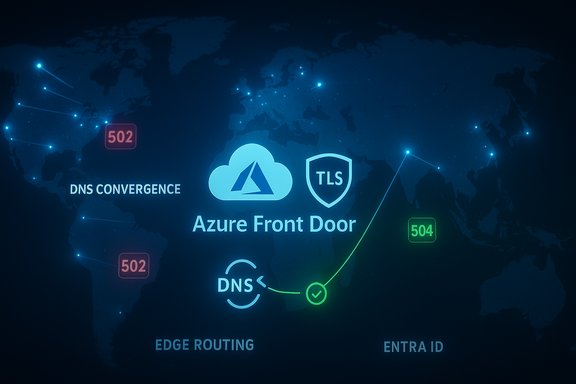
Global map showing Azure Front Door with DNS convergence, TLS shield, and edge routing.Background / Overview​

The disruption centered on Azure Front Door (AFD), Microsoft’s global Layer‑7 edge and application delivery fabric that performs TLS termination, global HTTP(S) routing, Web Application Firewall (WAF) enforcement and DNS‑level routing for many first‑party Microsoft control planes and thousands of customer applications. Microsoft’s incident notices and independent reporting describe the proximate trigger as an inadvertent configuration change in AFD that produced DNS and routing anomalies across multiple Points‑of‑Presence (PoPs). AFD is not a simple CDN — it is a shared, globally distributed control plane and data plane. Because AFD often fronts identity issuance (Microsoft Entra ID) and management consoles, an edge fabric failure can take down token‑based sign‑in flows and administrative blades even when origin compute and storage remain healthy. That coupling explains why Outlook on the web, Teams, the Azure Portal and gaming authentication surfaces all showed simultaneous symptoms during the incident.

What happened — concise summary​

  • The first visible customer‑facing errors began around 16:00 UTC on October 29, 2025, with monitoring systems and outage trackers reporting elevated latencies, DNS anomalies and HTTP 502/504 gateway errors across services fronted by AFD.
  • Microsoft publicly identified an inadvertent configuration change affecting AFD as the likely trigger and began containment actions: block further AFD changes and deploy a rollback to a “last known good” configuration. Microsoft warned that DNS and routing convergence would extend the visible recovery window for some users.
  • Engineers rolled back the edge configuration, failed critical management surfaces away from the troubled fabric where possible, and recovered nodes and PoPs in a staged manner to avoid oscillation. Microsoft reported progressive recovery and AFD availability rising into the high‑90s during the mitigation window.
These are the operational anchors that multiple independent outlets and community reconstructions corroborated in the hours after the outage.

Timeline — hour‑by‑hour reconstruction​

Detection and spike (approx. 16:00 UTC, Oct 29)​

Internal telemetry and external probes first showed spikes in packet loss, TLS timeouts and DNS anomalies. Public outage aggregators displayed rapid surges in user complaints for Azure and Microsoft 365 categories. Many end users reported failed sign‑ins, blank admin blades, and timeouts when trying to reach Microsoft consumer and enterprise surfaces.

Public acknowledgement and containment (minutes after detection)​

Microsoft posted incident notices indicating Azure Front Door and related DNS/routing were affected and that an “inadvertent configuration change” appeared to be the trigger. The immediate containment steps were:
  • Freeze AFD configuration rollouts to prevent further propagation.
  • Deploy a rollback to the “last known good” AFD configuration.
  • Fail the Azure Portal and other management surfaces away from AFD where possible to restore administrative access.

Rollback and staged recovery (next several hours)​

Microsoft initiated the rollback deployment and indicated that initial signs of improvement would appear within the deployment window (the company cited a roughly 30‑minute propagation expectation for the configuration change, after which node recovery and traffic rebalancing would follow). As the rollback completed, engineers recovered affected orchestration units and rehomed traffic to healthy PoPs, producing progressive recovery signals. Residual, tenant‑specific or regional issues lingered while DNS caches, ISP resolvers and client TTLs converged to the corrected state.

Restoration and tail effects (late night into Oct 30)​

Most core services showed restoration to near‑normal levels within several hours, though a visible tail of intermittent reports persisted for some customers depending on their resolvers and ISPs. Microsoft continued monitoring and temporarily blocked customer changes to AFD to reduce the risk of re‑introducing faulty state.

Exact scope and what was affected​

The outage produced a broad and highly visible blast radius because AFD sits in the critical path for many Microsoft control planes and third‑party customer front ends. Reported and observed impacts included:
  • Microsoft 365 web apps: Outlook on the web, Word/Excel/PowerPoint web editors with sign‑in failures or interrupted sessions.
  • Collaboration: Microsoft Teams sign‑ins, meeting connectivity and chat functions affected in many tenants.
  • Azure management plane: Azure Portal blades and several management APIs rendered blank or timed out until the portal was failed away from AFD.
  • Identity: Microsoft Entra (Azure AD) token issuance and sign‑in flows experienced delays/timeouts, cascading across services.
  • Consumer/gaming: Xbox Live authentication, Microsoft Store and Minecraft sign‑in/matchmaking and storefront functions showed failures or stalled downloads.
  • Downstream customer sites: Airlines, retailers, banks and other businesses that front public sites through AFD observed 502/504 gateway errors or timeouts in some regions.
A number of outlets and trackers recorded five‑figure spikes in outage reports during the peak of the event. Those aggregated counts vary substantially by aggregator, sampling window and amplification from social platforms; treat any single number as an indicator of scale rather than a definitive user count. Some contemporaneous captures cited mid‑five‑figure totals for Azure and Microsoft 365 reports; others recorded lower or higher peaks depending on timing. The exact count of affected users or transactions is not publicly verifiable from external trackers alone.

Technical anatomy — why a Front Door configuration error cascades​

Understanding why this single change cascaded into multi‑product disruption requires looking at what AFD does and how Microsoft uses it:
  • TLS termination at the edge. AFD terminates client TLS handshakes at PoPs and manages host header and certificate mappings. If edge certificate or hostname mappings misalign, TLS handshakes can fail before origin connections happen.
  • Global Layer‑7 routing and health checks. AFD evaluates URL‑ and path‑based rules to steer client requests to origins. A misapplied route or inconsistent control‑plane state can direct huge volumes of traffic to unhealthy or black‑holed origins.
  • DNS/anycast glue and resolver behavior. Anycast and DNS glue are core to steering clients to nearby PoPs. DNS anomalies at the edge can produce resolution failures even when backend endpoints remain functional. DNS cache behavior and resolver TTLs lengthen recovery visibility.
  • Identity coupling. Many Microsoft services — Microsoft 365, Azure Portal, Xbox — rely on Microsoft Entra ID for token issuance. If an edge fabric route that fronts Entra endpoints breaks, authentication flows fail across multiple services simultaneously.
In short: AFD centralizes routing, security and identity at the edge for scale and manageability — and that centralization creates a high blast radius when control‑plane changes fail validation or propagate inconsistent configuration. Multiple post‑incident reconstructions and Microsoft’s own status messages indicate that a validation defect in the deployment path allowed an erroneous configuration to propagate, converting a narrowly scoped change into a global outage. Treat that internal root‑cause attribution as Microsoft’s preliminary finding pending a full post‑incident review.

Microsoft’s response and the engineering playbook they followed​

Microsoft’s mitigation sequence followed a textbook control‑plane containment playbook for distributed edge fabrics:
  • Freeze configuration rollouts to stop further propagation of the faulty state.
  • Rollback to a last‑known‑good configuration — a validated safe state — and redeploy across AFD.
  • Fail management surfaces away from AFD (for example, route the Azure Portal via alternative ingress) so administrators regain control paths.
  • Recover nodes and PoPs in a staged manner while monitoring telemetry to avoid oscillation and overload.
Microsoft provided rolling status updates via Azure service health channels and social posts on X (formerly Twitter). The company explicitly stated the incident was caused by an internal configuration error rather than a malicious attack, and committed to a deeper post‑incident review and hardening of validation and rollback controls. The visible restoration pattern was consistent with expectations: the control‑plane rollback corrected the instant cause, but DNS caches, CDN and resolver TTLs produced an uneven user‑visible recovery tail. Microsoft temporarily blocked customer‑initiated AFD changes while mitigations were in effect to reduce chance of recurrence during convergence.

Independent verification of key claims​

To ensure accuracy and avoid single‑source reliance, key claims were cross‑checked across multiple independent outlets and community reconstructions:
  • Root cause (AFD configuration change causing DNS/routing failures): reported by Microsoft via incident notices and corroborated by major outlets.
  • Affected services (Teams, Microsoft 365, Azure Portal, Xbox/Minecraft and third‑party sites): consistently observed in outage trackers and news reporting.
  • Containment steps and rollback to “last known good” configuration with a short propagation window: Microsoft described this sequence publicly; contemporaneous reporting confirmed the approach and estimated propagation timeframes.
Where public numbers or localized claims differ (for example, aggregated Downdetector‑style report counts or geographic concentration), those discrepancies are explicitly flagged below. Several independent community reconstructions archived in forum threads also match the operational timeline and technical anatomy summarized here.

What was uncertain or unverifiable in the immediate aftermath​

  • Exact outage report totals: public aggregator snapshots and media cited five‑figure spikes, but counts vary by feed and time slice. Any single number (e.g., “over 25,000 reports”) should be treated as indicative rather than exact unless confirmed by provider telemetry.
  • Regional confinement: some early summaries suggested a heavier impact in the Eastern U.S., but Microsoft’s incident updates and independent monitors described global AFD impact with regionally uneven symptomology due to PoP and resolver differences; it is therefore inaccurate to describe the outage as strictly limited to a single region without Microsoft’s formal segmentation data. Where outlets said the East U.S. saw concentrated effects, that likely reflects PoP routing and customer distribution rather than a hard boundary. Treat regional claims cautiously.
These cautionary notes are important for readers assessing operational exposure and when communicating impact to stakeholders.

Business and operational impact — what this outage exposed​

This incident underscores several enduring realities for enterprises that rely on hyperscale cloud providers:
  • Vendor concentration risk. When critical identity, routing and shield services are centralized across a few providers, a single control‑plane regression can amplify into cross‑sector disruption. The back‑to‑back timing with another hyperscaler outage earlier in October intensified scrutiny on vendor concentration.
  • Dependency mapping gaps. Many organizations discovered that their public interfaces, authentication flows or checkout paths used AFD implicitly via vendor or partner configurations, exposing them to third‑party edge failures.
  • Operational blind spots for admin access. Administrators reported the ironic problem of being unable to use the Azure Portal to triage issues because the portal itself was fronted by the same fabric. Microsoft’s decision to fail the portal to alternate ingress helped, but the episode highlights the need for multi‑channel admin recovery paths.
  • DNS and caching inertia. Even after the control‑plane was corrected, DNS caches and resolver behavior created an extended user‑visible tail that prolonged business impact for some customers.

Practical recommendations for enterprises and IT teams​

  • Map your dependencies. Maintain an up‑to‑date inventory of which public‑facing services, auth flows and partner integrations rely on specific edge or CDN providers.
  • Design admin escape hatches. Ensure out‑of‑band administrative paths (programmatic APIs on alternate networks, service account shells, resilient CLI/PowerShell endpoints on separate ingress) are available and tested.
  • Plan DNS and failover strategies. Use multi‑resolver failover, conservative TTL strategies for critical records, and documented failover playbooks for switching away from a troubled edge fabric.
  • Exercise multi‑provider resilience for critical customer journeys. Where revenue or operations are time sensitive, consider multi‑cloud or provider‑agnostic front doors to reduce single‑fabric blast radius.
  • Demand transparency and SLAs that cover control‑plane regressions. Engage providers on deployment safeguards, rollback guarantees and post‑incident root‑cause reporting that include control‑plane validation metrics.
These steps reduce exposure and shorten mean time to recovery when provider control‑plane incidents occur.

Strengths and weaknesses in Microsoft’s response — critical analysis​

Strengths
  • Rapid detection and public acknowledgement. Microsoft identified the control‑plane surface (AFD) quickly and narrowed mitigation steps, which helped shorten the overall outage window.
  • Use of a validated rollback. Reverting to a “last known good” state is the most reliable immediate remediation for control‑plane regressions. The staged node reintroduction minimized risk of oscillation.
Weaknesses / risks exposed
  • Validation guardrails failed. Early reporting indicates an internal validation or deployment defect allowed an erroneous configuration to propagate. That gap converted what might have been a contained issue into a broad outage. Microsoft has committed to post‑incident review and hardening.
  • High blast radius by design. Centralizing routing, TLS and identity at the edge yields operational efficiency but concentrates failure impact. Long‑term resilience requires architecture and contract changes that reduce single‑surface dependence.
  • Customer communication friction. When the Azure Portal and admin blades are affected, many customers lack clear, rapid operational guidance beyond status posts. Providers must offer tested, resilient admin paths and more granular tenant‑level telemetry during incidents.

What to watch next — accountability and technical follow‑up​

Microsoft has signaled a formal Post‑Incident Review (PIR) will be produced that should:
  • Detail the exact deployment path and validation failure that permitted the misconfiguration to propagate.
  • Surface any tooling or process changes to harden AFD configuration rollout, automated validation and safe‑deployment mechanisms.
  • Provide clearer guidance on the classification and regional distribution of impact, and exact counts where possible for enterprise customers.
Enterprises should watch for those PIR details and adjust contracts, runbooks and architectural design patterns based on Microsoft’s concrete remediation measures.

Conclusion​

The October 29 Azure outage was a vivid reminder that the benefits of a centralized, high‑performance edge fabric come with concentrated operational risk. Microsoft’s rapid rollback and staged recovery reduced the incident’s duration, but the event exposed weaknesses in deployment validation, the operational impact of identity‑edge coupling, and the practical difficulty of restoring service for every tenant while DNS and global routing converge.
For IT leaders and operators, the lesson is clear: map dependencies, build resilient admin and failover paths, and demand stronger validation and transparency from providers. Hyperscalers will continue to drive scale and innovation, but episodes like this underline that architectural scale must be matched by commensurate investments in safe deployment, fault isolation and operational escape hatches to keep businesses running when the next edge‑routing regression hits.
Source: Zoom Bangla News Microsoft Azure Outage Disrupts Teams and 365 Services, Recovery Underway
 

Back
Top