

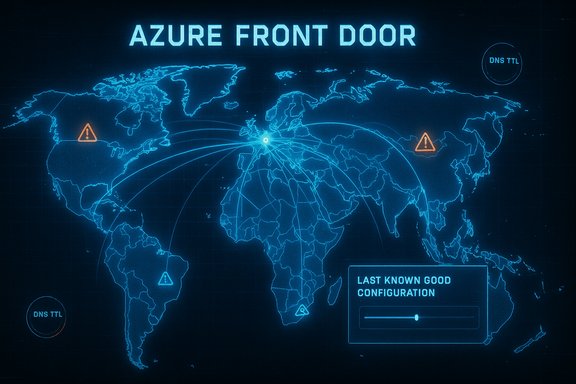
Websites and services around the world that rely on Microsoft’s cloud infrastructure recovered after a high‑profile outage on October 29, 2025, which left high‑traffic sites — including airline check‑in pages, major UK banks, large retailers and gaming services — intermittently unreachable for hours. Microsoft identified an issue in its Azure Front Door (AFD) edge routing and networking layer, attributed to an inadvertent configuration change, and reverted to a previously working configuration; the rollback restored most services, though residual DNS caching and client‑side TTLs produced lingering errors for some users.
Background
Microsoft Azure is one of the three hyperscale cloud providers that host a substantial portion of modern web traffic and platform services. Within Azure, Azure Front Door (AFD) is a global, edge‑level service that handles traffic routing, load balancing, and content delivery for applications and websites. AFD sits in front of web properties to provide low latency, DDoS mitigation, TLS termination, and other routing features — but its very role as an internet choke point means a configuration error can produce broad collateral damage.On October 29, 2025, the symptoms were clear and familiar: large numbers of reports on outage monitors, site timeouts and gateway errors, authentication and sign‑in failures for Microsoft 365 customers, and public status pages showing degraded service. The outage affected consumer platforms (Minecraft, Xbox services), business apps (Microsoft 365 admin surfaces, Outlook on the web), and dozens of third‑party websites that rely on Azure for routing or authentication. Government and public services reported interruptions in voting and online court services in some jurisdictions.
Microsoft’s public post‑incident update described the incident as a loss of availability in AFD triggered by an inadvertent configuration change. Engineers rolled back to a “last known good” configuration and worked to recover healthy nodes and re‑route traffic. The rollback progression and the global nature of DNS caching determined how quickly individual users and services saw recovery.
What went wrong: technical overview
Azure Front Door, DNS, and the control plane risk
Azure Front Door is an edge routing platform: it manages the mapping between public hostnames and the distributed front‑end nodes that accept incoming connections. Because AFD is both a control plane (configurations, routing rules, certificates) and a data plane (the actual traffic flows), mistakes in control plane configuration can propagate immediately to the data plane and manifest as site outages.The October 29 incident was reported as an inadvertent configuration change. When an AFD configuration that controls routing or DNS mappings is altered incorrectly, the effect can be one of two classes:
- Misrouted traffic that hits error pages or unresponsive backends.
- DNS resolution failures where hostnames no longer resolve correctly, causing clients to fail early.
Rollback strategy and mitigations
Microsoft’s operational response followed two concurrent actions:- Blocking configuration changes to the AFD environment to prevent further drift.
- Deploying the last known good configuration and recovering healthy nodes before returning traffic to them.
Timeline and visible impact
- Approximately 16:00 UTC on October 29, 2025, Microsoft recorded the first signs of Azure Front Door degradation. Users began reporting increased latencies, timeouts and errors across numerous services.
- During the afternoon and evening, outage tracking sites and user reports showed spikes for Microsoft 365, Outlook, Xbox/Minecraft, airline check‑in pages, and retail banking web pages.
- Microsoft announced they suspected an inadvertent AFD configuration change and initiated a rollback to a prior configuration while blocking additional changes to AFD.
- Over the following hours, engineers recovered nodes and re‑routed traffic; by late evening UTC many high‑profile websites and services were reachable again, though some pages remained affected due to DNS caching and TTLs.
Who felt the pain
The outage was notable not just for Microsoft‑branded services like Microsoft 365, Outlook on the web, Xbox and Minecraft, but for the way it rippled through companies that use Azure as part of their web delivery or authentication stack.- Consumer services affected: Xbox Live and Minecraft sign‑in flows; Microsoft Store storefronts and app downloads.
- Business tools impacted: Microsoft 365 admin center, several Microsoft 365 web applications and portals.
- Third‑party sites disrupted: airline check‑in and information pages, bank web portals, major retail and grocery websites, telecoms status pages, and government services.
- Public sector systems: judicial and parliamentary online services that use hosted platforms or Microsoft service integrations reported operational degradation.
Strengths: what Microsoft got right
- Rapid identification and rollback: Engineers identified the relevant subsystems (AFD) and deployed a rollback to a last known good configuration — a clear, pragmatic response to control plane failures.
- Blocking further changes: By freezing configuration changes during the incident, Microsoft reduced the risk of compounding the problem and allowed operators to stabilize the environment.
- Progressive recovery: The staged recovery allowed healthy nodes to be brought back while monitoring avoided a blind re‑enablement that could have reintroduced failures.
- Public communication: Microsoft used social channels to post updates while some internal status pages were affected, providing real‑time visibility for customers and operators.
Weaknesses and risks exposed
- Single‑service choke points: AFD’s role as a global front door makes it a potential single point of failure. When the edge routing control plane fails, a broad slice of the internet can be affected.
- Control plane fragility: Inadvertent configuration changes — whether human error, flawed automation, or CI/CD pipeline problems — remain one of the most persistent failure modes in cloud platforms.
- DNS propagation effects: Recovery is not instantaneous for the end user because DNS caches and TTLs can continue to serve stale, broken records, prolonging impact.
- Transparency limits: Status dashboards are themselves dependents on the platform they report on. When the status page is affected, customers rely on social channels and third‑party monitors — an imperfect substitute.
- Interdependence illusions: Multi‑cloud architectures and third‑party dependencies can make it hard to identify the root cause promptly; providers and consumers alike can be misled into thinking multiple clouds are down when only one provider’s routing layer is the culprit.
Business and legal implications
Outages at hyperscale cloud providers have downstream effects beyond technical inconvenience. The October 29 incident raised immediate consumer‑protection and operational questions:- Consumer impact and compensation: Financial services and retailers facing service interruptions may be obligated to waive fees, refund missed transactions, or handle disputes arising from failed payments.
- Regulatory attention: Critical infrastructure outages — airports, courts, government digital services — draw regulatory scrutiny and potentially require formal incident reports to national regulators depending on the sector and jurisdiction.
- SLAs and third‑party risk: Service level agreements often include uptime commitments, but when the root cause is a cloud provider control plane, vendors and customers must navigate contract terms, substitution clauses, and liability allocation.
- Operational continuity: Businesses that rely on third‑party hosted services must demonstrate continuity plans; failure to maintain services for critical customer journeys (payments, identity verification, emergency services) can lead to financial and reputational loss.
Practical takeaways for IT teams and WindowsForum readers
Short‑term defensive steps (what to do now)
- Audit critical dependencies: Map which public‑facing services and authentication flows rely on Azure Front Door or equivalent edge services.
- Lower critical DNS TTLs during maintenance windows: For controlled rollbacks, temporary TTL reductions speed recovery but must be used cautiously to avoid DNS rate limits.
- Prepare alternate routes: Configure failover pathways that bypass a single edge provider, such as multi‑CDN setups or direct IP fallbacks for critical endpoints.
- Verify observability outside provider dashboards: Maintain independent monitoring that tests user journeys end‑to‑end and does not rely on the provider’s own status feeds.
- Test incident communications: Ensure fallback status channels (email, SMS, alternative web hosts) are available if the primary status page is impacted.
Architectural and policy recommendations (medium to long term)
- Adopt multi‑CDN and multi‑region strategies: Distribute front door responsibilities among multiple vendors where possible to reduce single‑vendor control plane risk.
- Enforce stricter change management: Gate changes to global routing and control plane resources with multi‑step approvals, canary deployments and automated rollback triggers.
- Segment critical identity services: Avoid coupling authentication token issuance and identity management to the same global edge path used for content distribution where feasible.
- Practice chaos engineering for control planes: Run controlled failure tests of routing and DNS to validate how your systems respond to provider incidents.
- Negotiate clear SLAs and runbooks: Contracts should include runbooks for incident coordination and financial remedies that reflect the impact on core business processes.
Why the internet still feels brittle
This outage comes in a sequence of high‑profile hyperscaler incidents that expose a structural truth: efficiency and low cost drive consolidation, but consolidation concentrates systemic risk. The economics of cloud hosting encourage customers to standardize on a small set of global providers for performance and integration, which makes outages sharper and broader when they happen.Two additional dynamics make these incidents noisy and confusing:
- Multi‑cloud entanglement: Many large services use parts from multiple clouds. When one provider has a routing outage, components hosted elsewhere may still function, but user‑facing integrations fail in surprising ways; outage monitors and users often misattribute the fault to the wrong provider.
- Visibility limitations: Some cloud internal metrics and control plane operations are not visible to customers; this makes root cause analysis slower and communication harder during an incident.
Critical analysis: what Microsoft and the cloud industry must fix
- Control plane hardening: Providers should further isolate and sandbox control plane operations. Automated safety checks, stronger schema validation and stricter human‑in‑the‑loop confirmations for global routing changes would reduce exposure.
- Versioned and immutable control plane states: Better tooling for rollbacks, including deterministic testing of the rollback state in parallel with live traffic, can shorten recovery windows.
- Improved status independence: Status and incident channels should be hosted on systems outside of the affected control plane; providers must ensure customers can access reliable incident information even when the platform’s status pages are impacted.
- Transparent post‑incident reporting: Customers and regulators expect detailed, timely post‑incident reports that go beyond “inadvertent configuration change.” These reports should include root cause analysis, corrective actions, mitigations, and concrete timelines.
- Stronger incentives for multi‑provider resilience: Enterprise procurement and regulatory frameworks could incentivize architectures that avoid single‑point control plane risks for critical infrastructure.
What remains unclear or unverifiable
Several items reported in the immediate aftermath may be difficult to confirm publicly:- The exact human or automated workflow that introduced the configuration change (person‑to‑person procedural failures versus an automation/script error) often remains internal to Microsoft until full post‑incident reporting is issued.
- Any internal disciplinary actions or personnel decisions are not publicly verifiable and should be treated as speculative.
- Exact timelines for when every affected third‑party site was restored depend on each customer’s DNS TTLs and caching behavior; therefore individual recovery times vary and cannot be globally asserted with precision.
The bottom line for Windows users and IT professionals
The October 29 Azure Front Door incident is a sharp reminder that modern internet architecture trades centralized convenience for systemic risk. Microsoft’s rollback and recovery actions were effective in restoring most services, but the episode exposes structural weaknesses in edge control plane design, change management and visibility. For IT teams, the immediate priorities are to map dependencies, harden change processes, and prepare multi‑path recovery options for customer‑facing services.From a wider perspective, resilience will increasingly depend on distributed approaches: multi‑provider routing, independent observability, and contractual remedies that reflect real business impact. The outage is not proof that hyperscalers are unusable — rather, it underlines that they must be used with a deliberate resilience design rather than as a single, unquestioned dependency.
Practical checklist: immediate actions for administrators
- Review web and authentication endpoints that traverse Azure Front Door and document failover options.
- Confirm DNS TTL settings for critical hostnames and set emergency plans for temporary TTL adjustments when planning provider rollbacks.
- Add independent health checks (external to provider dashboards) that verify both DNS resolution and full application flows.
- Build and test a bypass path for critical authentication endpoints (e.g., alternate identity endpoints or on‑premises fallback).
- Ensure communication templates and incident playbooks are ready to inform customers, regulators and partners quickly in the event of future disruptions.
The October 29 outage will be a case study for cloud architects and operational teams: it shows how a single configuration change at the network edge can manifest as national‑scale service disruptions, and it underscores the importance of robust change controls, multi‑path resilience, and independent monitoring. As companies continue to lean into cloud efficiencies, the balancing act between performance, cost and systemic risk must be managed deliberately — not left to chance.
Source: AOL.com Websites disabled in Microsoft global outage come back online
