

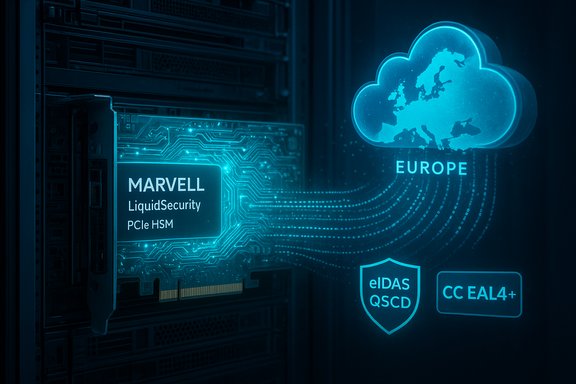
Microsoft and Marvell have quietly moved a major piece of cloud security infrastructure into European production: Azure’s cloud HSM and key‑management services are now expanded to support use cases that require European regulatory compliance thanks to Marvell LiquidSecurity hardware security modules (HSMs) achieving eIDAS and Common Criteria EAL4+ certifications—and Microsoft has enabled these Marvell‑powered HSMs across Azure Key Vault, Azure Key Vault Managed HSM and Azure Cloud HSM for customers in Europe. This development unlocks qualified electronic signatures, cross‑border identity services and other regulated workflows in Azure’s public and sovereign clouds, while raising fresh questions about performance claims, certification scope and operational risk for enterprises and government buyers.
The cloud HSM market has shifted rapidly from niche, on‑prem appliances to cloud‑native, multi‑tenant services. Traditional 1U/2U HSM appliances—full servers running general‑purpose processors in secure enclosures—served well for single‑tenant deployments, but they’re expensive, power‑hungry and hard to scale for hyperscale cloud providers and their customers. Marvell’s LiquidSecurity line was designed to reimagine the HSM as a PCIe adapter powered by custom OCTEON DPUs and cryptographic accelerators, optimized for low power, high density and partitioned multi‑tenant operation in cloud datacenters.
On December 1, 2025, Marvell formally announced that Microsoft expanded Azure’s use cases in Europe for cloud services built on Marvell LiquidSecurity HSMs. The timing follows two European certifications awarded to LiquidSecurity earlier in 2025: eIDAS approval under an Austrian scheme and Common Criteria evaluation to EAL4+ for specific device families and firmware versions. Microsoft representatives have stated publicly that these validated HSM modules power multiple Azure key‑management services, enabling compliance scenarios previously confined to on‑prem QSCDs (Qualified Signature Creation Devices) and traditional dedicated HSM appliances.
However, the benefits come with critical caveats: certification scope matters, firmware and operational controls matter, and headline performance claims must be validated against the actual cryptographic mix an organization uses. Buyers must demand precise certificate artifacts, perform workload benchmarking, and negotiate contractual controls to mitigate vendor dependency and supply‑chain risk.
For teams building or procuring cloud key‑management and signing services, the sensible next steps are clear: validate the certification scope, run production‑representative benchmarks, require hardware attestation and auditable logs, and architect for crypto agility and portability. Done right, cloud‑hosted, Marvell‑powered HSMs in Azure offer a practical path to compliant, scalable cryptographic services across Europe—transforming how regulated digital trust is implemented while raising the bar for operational discipline in secure cloud deployments.
Source: telecomtv.com Marvell extends collaboration with Microsoft, expanding Azure Global Cloud Security Services in Europe
 Background
The cloud HSM market has shifted rapidly from niche, on‑prem appliances to cloud‑native, multi‑tenant services. Traditional 1U/2U HSM appliances—full servers running general‑purpose processors in secure enclosures—served well for single‑tenant deployments, but they’re expensive, power‑hungry and hard to scale for hyperscale cloud providers and their customers. Marvell’s LiquidSecurity line was designed to reimagine the HSM as a PCIe adapter powered by custom OCTEON DPUs and cryptographic accelerators, optimized for low power, high density and partitioned multi‑tenant operation in cloud datacenters.On December 1, 2025, Marvell formally announced that Microsoft expanded Azure’s use cases in Europe for cloud services built on Marvell LiquidSecurity HSMs. The timing follows two European certifications awarded to LiquidSecurity earlier in 2025: eIDAS approval under an Austrian scheme and Common Criteria evaluation to EAL4+ for specific device families and firmware versions. Microsoft representatives have stated publicly that these validated HSM modules power multiple Azure key‑management services, enabling compliance scenarios previously confined to on‑prem QSCDs (Qualified Signature Creation Devices) and traditional dedicated HSM appliances.
What changed: certifications and Azure expansion
- eIDAS certification (Austrian scheme): LiquidSecurity HSM adapters were validated as a Qualified Signature Creation Device (QSCD) under the eIDAS regulatory framework when managed by a qualified trust service operator in accordance with the regulation’s rules. This is the EU’s legal standard for devices that create qualified electronic signatures with legal equivalence to handwritten signatures in cross‑border contracts.
- Common Criteria EAL4+ evaluation: Marvell reported that LiquidSecurity achieved EAL4+ status under applicable Common Criteria protection profiles. EAL4+ provides an internationally recognized assurance level for security functionality and development processes relevant to many procurement frameworks.
- Microsoft integration: Microsoft upgraded firmware, validated HSM modules in Azure Key Vault Managed HSM and Azure Key Vault Premium, and expanded Azure Cloud HSM to use Marvell LiquidSecurity hardware across European regions—clearing the way for trust‑service providers, governments and regulated industries to adopt cloud‑hosted qualified signing and identity services.
Technical overview: LiquidSecurity by the numbers
Marvell’s LiquidSecurity architecture is explicitly designed for cloud scale and operational economics. Key technical attributes verified against vendor materials and independent coverage include:- Form factor and platform: LiquidSecurity HSMs are delivered as PCIe adapters (single‑slot HHHL cards and variants) intended for dense server hosts rather than rack‑mounted appliance chassis.
- Underlying processor: The adapters are powered by Marvell OCTEON DPUs and custom cryptographic accelerators, offloading cryptographic workloads from the host CPU.
- Key capacity and partitions:
- Storage capacity: product documentation states support for up to 1,000,000 keys per adapter and up to 45 isolated partitions to enable multi‑tenant separation.
- Partitioning: partitions offer isolated execution environments and key storage boundaries, which cloud providers use to map tenants, applications or trust domains.
- Performance characteristics: performance claims vary by algorithm:
- Up to 100,000 elliptic curve (ECC) operations per second for P‑256 style algorithms as published in product briefs.
- Up to 1,000,000 authenticated encryption (GCM/AES‑GCM) operations per second reported for symmetric crypto workloads in independent technical coverage.
- RSA‑2048 throughput is lower (tens of thousands of ops/sec depending on the reported workload and configuration).
- Power envelope: typical operating power is in the tens of watts (Marvell cites ranges like 35–50W for high‑performance cards), far lower than full 1U HSM appliances.
- Compliance and update model: LiquidSecurity devices have a compliance roadmap that includes FIPS 140‑3 Level 3, Common Criteria and eIDAS, and the devices support in‑field firmware updates to enable new algorithms—including planned post‑quantum variants.
How LiquidSecurity differs from traditional HSM appliances
- Density and TCO: PCIe cards reduce rack space and per‑transaction power costs versus 1U/2U appliances.
- Cloud native: API‑first SDKs, partition isolation, and integration with orchestration systems make it straightforward for cloud providers to expose HSM-as‑a‑service.
- Multi‑tenant: hardware partitioning and FIPS/CC compliance within a PCIe boundary enable secure tenant separation without per‑tenant appliances.
- Custom silicon: OCTEON DPUs and focused crypto accelerators deliver higher per‑watt throughput for common cloud cryptographic workloads.
Compliance and legal implications: what eIDAS and EAL4+ actually enable
The combination of eIDAS QSCD acknowledgment and Common Criteria EAL4+ validation is powerful—but nuanced.eIDAS: enabling legally qualified signatures in the cloud
- eIDAS defines Qualified Electronic Signatures and requires QSCDs for certain trust services. A device certified under an EU‑recognized scheme (for example, the Austrian A‑SIT scheme) can be part of a QSCD‑based signing service when a Qualified Trust Service Provider (QTSP) operates it according to regulatory controls.
- In practice, this means Azure customers can use managed HSM services backed by LiquidSecurity HSMs to host keys used for qualified signatures—provided the operational model meets the QTSP and national supervisory rules. The device certificate alone is necessary but not sufficient: the trust service operator’s processes, personnel controls and run‑time operations must also conform to eIDAS and national supervisory guidance.
- The vendor’s eIDAS documentation includes the usual legal caveats: remote QSCD operation is acceptable when the QTSP ensures the operational controls and user bindings required by the regulation.
Common Criteria EAL4+: an international assurance layer
- EAL4+ provides a level of independent evaluation for development and testing processes and some functional coverage. For procurement and government use, EAL4+ is a recognized assurance level that simplifies qualification against procurement policies compared with marketing‑only claims.
- However, Common Criteria reports vary in scope. The evaluated configuration, protection profile, firmware version and evaluator reports define what exactly was validated. Procurement teams must verify that the certificate covers the intended firmware/configuration and usage model (e.g., partitioning, remote attestation, backup/restore).
FIPS 140‑3 Level 3
- Many regulated customers (banks, government) require FIPS 140‑3 Level 3 validation for HSM modules. Marvell and Microsoft have reported FIPS 140‑3 Level 3 validations for LiquidSecurity devices and the Azure HSM firmware updates, which enables financial and government customers to use Azure HSM services under those compliance regimes.
Use cases unlocked by this collaboration
- Qualified electronic signatures and cross‑border contract certification: QTSPs and document services can offer EU‑recognized qualified signature workflows hosted in Azure, reducing friction for cross‑border e‑signatures and notarization.
- National identity and passport services: government identity providers and passport authorities can use HSM‑backed signing to validate identity documents and perform secure key management at scale while meeting national and EU regulations.
- Payment and PKI at scale: payment processors and certificate authorities can host key material for large‑scale signing, timestamping and certificate issuance in Azure HSMs while keeping compliance with certification requirements.
- Healthcare and regulated data protection: secure medical record encryption keys and high‑volume audit‑trail signing can be migrated to cloud HSM services with validated security boundaries.
Strengths and strategic implications
- Operational agility: the cloud HSM model eliminates upfront capital expenditures, simplifies firmware and key lifecycle management, and reduces the need for on‑prem HSM logistics.
- Economics and density: PCIe adapters drastically lower power, rack space and per‑key TCO for cloud providers and service integrators.
- Compliance runway: EAL4+ and eIDAS enable Azure to compete for regulated workloads across the EU that were previously difficult to host in public cloud services.
- Vendor engineering: Marvell’s silicon‑first approach (OCTEON DPUs + crypto accelerators) demonstrates the value of custom silicon for targeted security workloads—higher throughput per watt and a pathway to future crypto agility (post‑quantum updates).
- Broader cloud ecosystem: Azure’s ability to offer eIDAS‑qualified services can push the ecosystem toward centralized, cloud‑hosted trust services, reducing fragmentation.
Risks, caveats and unanswered questions
- Certification scope and operational dependency
- Certifications are tightly tied to specific hardware models, firmware versions, and evaluated configurations. If Microsoft or customers run different firmware, or if Marvell updates the firmware, the certification scope may not automatically extend. Procurement teams must request certificate artifacts and evaluator reports to confirm scope before relying on regulatory claims.
- eIDAS QSCD approval is only meaningful when the device is operated by a compliant QTSP under the applicable national scheme; the device certificate does not, by itself, validate the cloud operator’s processes.
- Ambiguities in performance claims
- Marketing headlines often cite “more than one million operations per second” or “up to 100,000 ECC ops/sec” without clarifying the algorithm, message sizes, or concurrency model. In practice, symmetric AES‑GCM workloads can achieve far higher throughput than asymmetric signing; RSA signing and end‑to‑end signing workflows will show lower throughput. Buyers should benchmark their expected workload mix (certificate signing, TLS handshakes, CMS/PKCS#7 signing) under Azure’s multitenant service model.
- Single‑vendor dependence and lock‑in risk
- The HSM hardware and firmware ecosystem is concentrated. Heavy reliance on a single hardware provider for compliance‑level key management creates negotiation and supply‑chain dependencies. Customers should insist on strong contractual clauses, hardware attestation capabilities, and migration paths (key export under secure procedures or split‑key architectures) to mitigate vendor lock‑in.
- Multi‑tenant boundary concerns
- Partitioned HSM designs aim to provide tenant isolation, but shared hardware raises legitimate questions about side‑channel risk, noisy‑neighbor effects and the rigorousness of attestation. Common Criteria and FIPS provide assurance for specific threats and mitigations, but organizations handling extremely high‑value secrets may still prefer single‑tenant, dedicated HSM clusters.
- Firmware update and lifecycle management risk
- Cloud HSM providers must push firmware updates for security and algorithm upgrades. Firmware changes may affect certification status and, if not managed correctly, could create operational downtime or change the documented boundary. Customers should demand explicit change control notifications and rollback provisions.
- Supply chain and firmware integrity
- Custom silicon and firmware require robust supply‑chain security and reproducible builds. Customers must be confident that firmware attestation and secure boot mechanisms are in place and that cryptographic attestations can be independently validated.
- Quantum readiness and cryptographic agility
- Marvell’s roadmap mentions field updates for post‑quantum algorithms, but mainstream adoption and interoperability (QTSPs, national regulators, client PKIs) remain a future problem. Customers should prioritize key‑management procedures that enable crypto agility today (hybrid signatures, algorithm agility policies).
- Unverifiable or promotional claims
- Some vendor statements—such as the number of top cloud providers using LiquidSecurity or aggregated ops/sec across mixed workloads—are difficult to independently verify without third‑party audits. Procurement teams should treat such claims as indicator data and require proof from audited deployments or independent benchmarks.
Practical guidance for buyers and operators
Enterprises, sovereign clouds and procurement teams should treat the Azure + Marvell development as a valuable opportunity—but follow disciplined validation and operational practices:- Verify certificates and scope
- Request full certification artifacts: eIDAS QSCD statement, Common Criteria certificate & evaluation report, FIPS validation certificates, and the exact firmware/build identifiers assessed.
- Confirm the certified configuration maps to the cloud service implementation (firmware, partitioning, remote attestation).
- Demand operational evidence
- Obtain Microsoft’s operational compliance documentation: QTSP agreements (if relevant), deployment diagrams, attestation APIs, SLAs, and change control policies.
- Review Azure’s HSM firmware update process and rollback mechanisms.
- Run a proof of concept
- Benchmark real signing workloads (document signing, PKI issuance, TLS termination patterns) in Azure regions where LiquidSecurity is available to measure latency, throughput, and per‑tenant throughput under expected concurrency.
- Validate key import/export, backup/restore, and disaster recovery procedures.
- Insist on hardware attestation and logs
- Ensure the service exposes cryptographic attestation of HSM modules and tamper‑evident audit logs. These are essential for forensic validation and regulatory audits.
- Negotiate contractual protections
- Include portability clauses (secure key escrow and retrieval), indemnities related to certification lapses, and commitments for advance notice of firmware or hardware changes that could affect certified status.
- Architect for crypto agility
- Use hybrid signing approaches and design for algorithm migration now—store migration paths, and avoid irreversible bindings to single algorithm families that will be brittle when quantum‑safe standards mature.
- Consider hybrid models for extreme sensitivity
- For the highest‑value signing and keys (national root CAs, sovereign law enforcement keys), maintain dedicated, single‑tenant HSM clusters or split‑control multi‑cloud architectures to balance cost and control.
Competitive and market implications
- Cloud HSMs as a mainstream service: The validation of PCIe‑based cloud HSMs for regulated EU workflows accelerates cloud adoption among conservative verticals (finance, government, trust services). Expect competing cloud providers to accelerate their own certified HSM programs or to partner with alternative module vendors.
- Pressure on legacy HSM appliance vendors: Appliance vendors face pressure to deliver denser, lower‑power alternatives or to offer cloud‑friendly integration models. Some firms will respond by building modular PCIe or mezzanine HSM options for integration into hyperscale hosts.
- Consolidation and differentiation: Vendors will compete on three axes: compliance coverage (certifications and inspector reports), density/performance (ops per watt), and operational transparency (attestation APIs and auditable logs). Those that win will blend silicon performance with robust, transparent compliance processes.
Final assessment
The extension of Marvell‑powered Azure HSM services into European compliance scenarios is a watershed moment for cloud trust services. It removes a longstanding friction point for organizations that require eIDAS‑grade signatures and Common Criteria assurance while offering compelling economics and operational agility. The move can materially lower the cost and complexity of delivering qualified signatures, identity verification and regulated key management in the cloud.However, the benefits come with critical caveats: certification scope matters, firmware and operational controls matter, and headline performance claims must be validated against the actual cryptographic mix an organization uses. Buyers must demand precise certificate artifacts, perform workload benchmarking, and negotiate contractual controls to mitigate vendor dependency and supply‑chain risk.
For teams building or procuring cloud key‑management and signing services, the sensible next steps are clear: validate the certification scope, run production‑representative benchmarks, require hardware attestation and auditable logs, and architect for crypto agility and portability. Done right, cloud‑hosted, Marvell‑powered HSMs in Azure offer a practical path to compliant, scalable cryptographic services across Europe—transforming how regulated digital trust is implemented while raising the bar for operational discipline in secure cloud deployments.
Source: telecomtv.com Marvell extends collaboration with Microsoft, expanding Azure Global Cloud Security Services in Europe
