

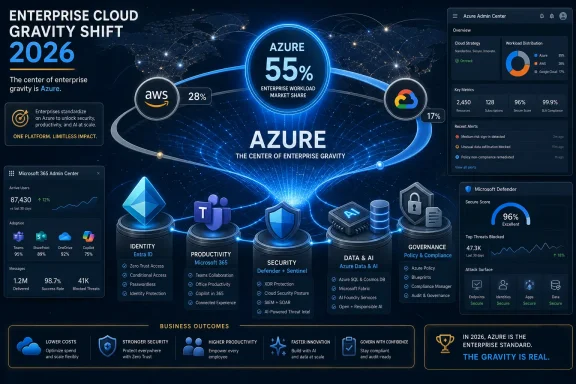
Microsoft’s Azure was named the primary cloud provider by 55 percent of U.S. CIO respondents in a new Jefferies survey published around July 1, 2026, compared with 28 percent for Amazon Web Services and a much smaller showing for Google Cloud. That is not the same thing as saying Azure has definitively “beaten” AWS in the global cloud market. But it is a meaningful signal from the part of the market Microsoft most wants to own: large enterprises trying to turn AI experiments, identity systems, productivity software, data estates, and security budgets into one coherent platform. The cloud race is no longer just about who rented out the most compute first; it is increasingly about who can make the corporate stack feel inevitable.
The most striking number in the Jefferies readout is not simply Azure’s 55 percent share as the primary provider among surveyed CIOs. It is the change from the prior Jefferies survey, where Azure reportedly led AWS by only seven points, 45 percent to 38 percent. A widening to 27 points suggests more than normal survey noise, even allowing for the limited sample size and the inherent squishiness of CIO polling.
Spending intent tells the same story. Azure now accounts for 46 percent of expected cloud spending among respondents, compared with 29 percent for AWS, expanding from a much narrower 40-to-37 spread in the earlier survey. If the usage question captures where organizations think they are anchored, the spending question captures where they expect marginal dollars to go.
That distinction matters because cloud share is not only a scoreboard; it is a habit-forming mechanism. Once workloads, security controls, observability tools, data pipelines, identity policies, and procurement discounts gather around one provider, “primary cloud” becomes less a preference than an operating model. The CIO may still talk about multicloud strategy, but the engineering organization often knows which cloud gets the next serious workload.
This is where Microsoft’s advantage is most obvious. Azure does not arrive as a standalone cloud vendor asking enterprises to rethink their world from scratch. It arrives attached to Microsoft 365, Entra ID, Windows Server lineage, SQL Server migrations, GitHub, Defender, Sentinel, Power Platform, Fabric, Teams, and Copilot. AWS still has deep technical credibility and enormous scale, but Microsoft has the rare advantage of selling cloud as an extension of systems companies already run.
But the Jefferies survey points to a different battleground: the enterprise CIO’s consolidation agenda. In that arena, the decisive question is not always which provider has the most elegant service catalog. It is which provider can reduce vendor sprawl, satisfy boards that AI investments are disciplined, and offer procurement leverage across productivity, security, infrastructure, and application modernization.
That is a Microsoft-shaped question. CIOs are under pressure to fund AI without letting costs balloon into a science project. They are also under pressure to harden identity, control data access, manage endpoint risk, and rationalize software spending. Azure benefits when those priorities collapse into a single buying conversation.
AWS can and does compete aggressively in AI infrastructure, databases, analytics, and enterprise migration. But Microsoft’s route to the budget often starts before the cloud discussion formally begins. The company can enter through Office, Windows, Teams, Active Directory modernization, endpoint security, developer tooling, or a Copilot pilot, then pull Azure into the center of the architecture.
That shift favors Microsoft because Azure is not merely hosting AI workloads. It is being positioned as the substrate for Microsoft’s entire AI product line. Copilot for Microsoft 365, GitHub Copilot, Security Copilot, Azure OpenAI Service, Fabric, and Power Platform all reinforce the idea that enterprise AI should live close to existing Microsoft data, identity, and compliance boundaries.
This is not just marketing. In most large organizations, AI adoption is constrained less by model fascination than by mundane blockers: permissions, data classification, audit trails, endpoint posture, integration with line-of-business applications, and the ability to explain the bill. Microsoft’s pitch is that these problems are easier to solve when AI sits inside a stack the enterprise already trusts.
That does not mean the pitch is always true in practice. Microsoft’s licensing can be labyrinthine, Azure’s service sprawl can be daunting, and Copilot deployments still require serious governance work. But the strategic proposition is clear: Azure is where the enterprise AI budget can be made to look like an extension of existing modernization plans rather than a speculative moonshot.
That is not the profile of a dead growth market. It is the profile of a market entering a more selective but still expanding phase. Enterprises may scrutinize waste more aggressively, but they are not retreating to a pre-cloud world.
The workload migration figures reinforce that point. Jefferies found that 85 percent of CIOs expect more than half of workloads to be in the cloud by the end of 2027, up from 75 percent in the prior survey. More than half of respondents reportedly expect over 80 percent of workloads to be cloud-based by then.
For WindowsForum readers, that is the practical center of the story. The cloud debate is no longer abstract. It affects identity architecture, endpoint management, hybrid server strategy, disaster recovery, licensing, developer environments, and the skills IT departments need to hire or retrain for. If the average enterprise estate is moving further into the cloud through 2027, the question is not whether administrators touch cloud systems. It is whether cloud administration becomes inseparable from ordinary Windows, security, and productivity administration.
That tradeoff is familiar to anyone who has watched Microsoft for more than one product cycle. The company is at its strongest when it turns integration into inevitability. Windows and Office did it on the desktop. Active Directory did it in the datacenter. Microsoft 365 did it for productivity and identity. Azure now appears to be benefiting from the same playbook, updated for AI.
For CIOs, the appeal is obvious. One vendor can offer a defensible roadmap, unified account teams, bundled discounts, and a story that boards understand. For IT pros, the experience is more complicated. Integration can reduce the pain of stitching together systems, but it can also turn licensing changes, portal redesigns, service retirements, and security defaults into estate-wide events.
The biggest Azure risk may not be technical failure. It may be strategic overconcentration. If enterprises treat Microsoft as the default answer to every AI, security, data, and cloud question, they may discover later that default is another word for difficult to leave.
But the hyperscaler market is increasingly rewarding enterprise distribution. Google has improved its enterprise posture over the years, yet it still lacks Microsoft’s productivity foothold and AWS’s early cloud-native dominance. In a budget environment where CIOs are trying to justify AI and cloud spend as part of broader platform consolidation, that matters.
Google Cloud may continue to win targeted workloads, especially where data, analytics, and AI engineering sophistication are paramount. But the Jefferies numbers suggest that CIOs are not giving it the same default expansion role. It is a contender, not the enterprise center of gravity.
That difference has consequences for customers. A specialized cloud can be the best place for a specific workload, but corporate standardization often favors the vendor that is “good enough” across many categories and already embedded in procurement. In the 2026 cloud market, breadth plus distribution may beat brilliance in isolated domains.
If Azure becomes the primary cloud for a larger share of U.S. CIOs, Microsoft skills become more valuable across roles that used to be separate. The Windows admin becomes an Entra ID and Intune admin. The SQL Server specialist becomes a Fabric, Azure SQL, or Synapse migration stakeholder. The security engineer spends more time inside Defender, Sentinel, Purview, and conditional access policies. The developer support team has to understand GitHub, Azure DevOps, OpenAI endpoints, and cloud cost controls.
This is not a clean replacement of one skill set with another. It is a layering effect. Hybrid environments will remain messy, legacy applications will keep running, and not every workload belongs in public cloud. But the direction of travel is clear: Microsoft’s cloud lead, if sustained, makes Azure literacy part of the baseline enterprise IT toolkit.
That shift will also change internal politics. Cloud architecture will no longer be the exclusive domain of a central platform team. Security, identity, endpoint, compliance, finance, development, and operations teams will all have a claim on Azure decisions because Azure touches all of them. The winners inside IT departments will be the people who can translate across those boundaries.
That caveat matters because cloud markets are huge, uneven, and segmented. AWS can lose ground in one survey and still remain deeply entrenched in startups, digital-native businesses, media workloads, and large enterprise accounts. Azure can lead in CIO preference and still face execution risks around capacity, cost management, service reliability, and governance complexity.
There is also a timing issue. AI demand is distorting cloud buying behavior. Some organizations are increasing spend because they have real workloads moving into production. Others are reserving capacity or funding pilots because they fear being left behind. The next two years will separate durable platform adoption from AI-driven budget enthusiasm.
Still, sentiment has power. CIO surveys influence investor narratives, vendor sales motions, partner ecosystems, and executive confidence. If enough buyers believe Azure is the safer AI-era default, that belief can become self-reinforcing. Cloud platforms are not just products; they are ecosystems of skills, partners, certifications, migration playbooks, and executive assumptions.
A decade ago, many Windows shops could treat Azure as a future concern or a niche extension of the datacenter. That posture is harder to defend now. Entra ID is central to identity. Intune and Autopilot are central to endpoint modernization. Defender and Sentinel are central to security operations. Azure Arc, Azure Virtual Desktop, and hybrid management patterns keep blurring the boundary between cloud and local infrastructure.
The Jefferies survey suggests that this blur is becoming the mainstream enterprise model. If more than half of workloads are expected to sit in the cloud for most large organizations by the end of 2027, then Windows infrastructure is no longer defined by what lives in a server room. It is defined by identity, policy, telemetry, automation, and cost control across environments.
That makes governance the next major skills battleground. It is not enough to know how to deploy a resource group or join a device to Entra ID. IT teams need naming standards, role-based access discipline, privileged identity controls, budget alerts, data retention policies, backup assumptions, disaster recovery testing, and a clear model for who owns what. Azure’s growth will reward organizations that professionalize cloud operations and punish those that simply let every project create its own little kingdom.
Microsoft’s cloud advantage in 2026 is not that Azure is suddenly the only credible hyperscaler. It is that Azure has become the most natural place for many enterprises to reconcile the things they already bought from Microsoft with the AI systems they are now being asked to deploy. AWS will not disappear, Google Cloud will not stop innovating, and multicloud will remain both strategy and slogan. But if the next phase of cloud is decided inside the messy, budget-constrained, identity-heavy reality of enterprise IT, Microsoft has turned Azure from an infrastructure choice into the path of least resistance — and in corporate technology, that path has a way of becoming the road everyone else has to build around.
 Azure’s New Lead Is Really a Vote for Microsoft’s Enterprise Gravity
The most striking number in the Jefferies readout is not simply Azure’s 55 percent share as the primary provider among surveyed CIOs. It is the change from the prior Jefferies survey, where Azure reportedly led AWS by only seven points, 45 percent to 38 percent. A widening to 27 points suggests more than normal survey noise, even allowing for the limited sample size and the inherent squishiness of CIO polling.Spending intent tells the same story. Azure now accounts for 46 percent of expected cloud spending among respondents, compared with 29 percent for AWS, expanding from a much narrower 40-to-37 spread in the earlier survey. If the usage question captures where organizations think they are anchored, the spending question captures where they expect marginal dollars to go.
That distinction matters because cloud share is not only a scoreboard; it is a habit-forming mechanism. Once workloads, security controls, observability tools, data pipelines, identity policies, and procurement discounts gather around one provider, “primary cloud” becomes less a preference than an operating model. The CIO may still talk about multicloud strategy, but the engineering organization often knows which cloud gets the next serious workload.
This is where Microsoft’s advantage is most obvious. Azure does not arrive as a standalone cloud vendor asking enterprises to rethink their world from scratch. It arrives attached to Microsoft 365, Entra ID, Windows Server lineage, SQL Server migrations, GitHub, Defender, Sentinel, Power Platform, Fabric, Teams, and Copilot. AWS still has deep technical credibility and enormous scale, but Microsoft has the rare advantage of selling cloud as an extension of systems companies already run.
AWS Is Still the Giant, but the Center of Gravity Has Shifted
AWS remains a formidable business, and any serious reading of the cloud market has to start there. Amazon created much of the modern public cloud category, trained a generation of developers on its primitives, and still has a breadth of services that rivals often imitate. For startups, cloud-native teams, and infrastructure-heavy engineering cultures, AWS is not yesterday’s platform.But the Jefferies survey points to a different battleground: the enterprise CIO’s consolidation agenda. In that arena, the decisive question is not always which provider has the most elegant service catalog. It is which provider can reduce vendor sprawl, satisfy boards that AI investments are disciplined, and offer procurement leverage across productivity, security, infrastructure, and application modernization.
That is a Microsoft-shaped question. CIOs are under pressure to fund AI without letting costs balloon into a science project. They are also under pressure to harden identity, control data access, manage endpoint risk, and rationalize software spending. Azure benefits when those priorities collapse into a single buying conversation.
AWS can and does compete aggressively in AI infrastructure, databases, analytics, and enterprise migration. But Microsoft’s route to the budget often starts before the cloud discussion formally begins. The company can enter through Office, Windows, Teams, Active Directory modernization, endpoint security, developer tooling, or a Copilot pilot, then pull Azure into the center of the architecture.
AI Has Turned Cloud From Infrastructure Into Distribution
The Jefferies findings land in the middle of a broader market shift: AI has made cloud platforms feel less like rented servers and more like distribution channels for intelligence. The old cloud story was elasticity, pay-as-you-go infrastructure, and faster deployment. The new story is access to models, GPUs, data governance, developer workflows, and application-layer automation.That shift favors Microsoft because Azure is not merely hosting AI workloads. It is being positioned as the substrate for Microsoft’s entire AI product line. Copilot for Microsoft 365, GitHub Copilot, Security Copilot, Azure OpenAI Service, Fabric, and Power Platform all reinforce the idea that enterprise AI should live close to existing Microsoft data, identity, and compliance boundaries.
This is not just marketing. In most large organizations, AI adoption is constrained less by model fascination than by mundane blockers: permissions, data classification, audit trails, endpoint posture, integration with line-of-business applications, and the ability to explain the bill. Microsoft’s pitch is that these problems are easier to solve when AI sits inside a stack the enterprise already trusts.
That does not mean the pitch is always true in practice. Microsoft’s licensing can be labyrinthine, Azure’s service sprawl can be daunting, and Copilot deployments still require serious governance work. But the strategic proposition is clear: Azure is where the enterprise AI budget can be made to look like an extension of existing modernization plans rather than a speculative moonshot.
The Budget Numbers Say Cloud Is Not Done Growing
Jefferies’ survey also pushes back against a recurring bear case: that the cloud migration wave is maturing and the next phase will be mostly optimization. According to the reported figures, Jefferies now expects cloud spending to grow 10.1 percent in 2026, slightly faster than the 9.6 percent expected for 2025. Around 95 percent of respondents reportedly expect cloud budgets to rise year over year in 2026, while only 3 percent expect a small decline.That is not the profile of a dead growth market. It is the profile of a market entering a more selective but still expanding phase. Enterprises may scrutinize waste more aggressively, but they are not retreating to a pre-cloud world.
The workload migration figures reinforce that point. Jefferies found that 85 percent of CIOs expect more than half of workloads to be in the cloud by the end of 2027, up from 75 percent in the prior survey. More than half of respondents reportedly expect over 80 percent of workloads to be cloud-based by then.
For WindowsForum readers, that is the practical center of the story. The cloud debate is no longer abstract. It affects identity architecture, endpoint management, hybrid server strategy, disaster recovery, licensing, developer environments, and the skills IT departments need to hire or retrain for. If the average enterprise estate is moving further into the cloud through 2027, the question is not whether administrators touch cloud systems. It is whether cloud administration becomes inseparable from ordinary Windows, security, and productivity administration.
Microsoft’s Advantage Comes With Lock-In Written in Fine Print
The same forces that make Azure attractive also make it risky. Microsoft’s enterprise gravity can simplify procurement and architecture, but it can also deepen dependency. A company that standardizes on Microsoft for identity, productivity, endpoint security, collaboration, data, AI, and cloud infrastructure may gain operational coherence while losing bargaining power.That tradeoff is familiar to anyone who has watched Microsoft for more than one product cycle. The company is at its strongest when it turns integration into inevitability. Windows and Office did it on the desktop. Active Directory did it in the datacenter. Microsoft 365 did it for productivity and identity. Azure now appears to be benefiting from the same playbook, updated for AI.
For CIOs, the appeal is obvious. One vendor can offer a defensible roadmap, unified account teams, bundled discounts, and a story that boards understand. For IT pros, the experience is more complicated. Integration can reduce the pain of stitching together systems, but it can also turn licensing changes, portal redesigns, service retirements, and security defaults into estate-wide events.
The biggest Azure risk may not be technical failure. It may be strategic overconcentration. If enterprises treat Microsoft as the default answer to every AI, security, data, and cloud question, they may discover later that default is another word for difficult to leave.
Google Cloud Remains the Specialist in a Market Rewarding Bundles
Google Cloud’s position in the Jefferies survey is the quiet part of the story. Only 25 percent of CIOs reportedly expect to increase spending on Google Cloud, compared with 68 percent for Azure and 45 percent for AWS. That does not mean Google Cloud lacks strengths. Its data analytics, AI research lineage, Kubernetes heritage, and technical infrastructure are serious assets.But the hyperscaler market is increasingly rewarding enterprise distribution. Google has improved its enterprise posture over the years, yet it still lacks Microsoft’s productivity foothold and AWS’s early cloud-native dominance. In a budget environment where CIOs are trying to justify AI and cloud spend as part of broader platform consolidation, that matters.
Google Cloud may continue to win targeted workloads, especially where data, analytics, and AI engineering sophistication are paramount. But the Jefferies numbers suggest that CIOs are not giving it the same default expansion role. It is a contender, not the enterprise center of gravity.
That difference has consequences for customers. A specialized cloud can be the best place for a specific workload, but corporate standardization often favors the vendor that is “good enough” across many categories and already embedded in procurement. In the 2026 cloud market, breadth plus distribution may beat brilliance in isolated domains.
The Stock-Market Framing Is Too Narrow for IT
TipRanks naturally frames the Jefferies survey through the lens of MSFT, AMZN, and GOOGL as investments. That is useful context, but it is not the most important reading for WindowsForum’s audience. For administrators, architects, and security teams, the survey is less about stock upside and more about where enterprise operating models are heading.If Azure becomes the primary cloud for a larger share of U.S. CIOs, Microsoft skills become more valuable across roles that used to be separate. The Windows admin becomes an Entra ID and Intune admin. The SQL Server specialist becomes a Fabric, Azure SQL, or Synapse migration stakeholder. The security engineer spends more time inside Defender, Sentinel, Purview, and conditional access policies. The developer support team has to understand GitHub, Azure DevOps, OpenAI endpoints, and cloud cost controls.
This is not a clean replacement of one skill set with another. It is a layering effect. Hybrid environments will remain messy, legacy applications will keep running, and not every workload belongs in public cloud. But the direction of travel is clear: Microsoft’s cloud lead, if sustained, makes Azure literacy part of the baseline enterprise IT toolkit.
That shift will also change internal politics. Cloud architecture will no longer be the exclusive domain of a central platform team. Security, identity, endpoint, compliance, finance, development, and operations teams will all have a claim on Azure decisions because Azure touches all of them. The winners inside IT departments will be the people who can translate across those boundaries.
Survey Momentum Is Not Market Share, and CIOs Can Change Their Minds
The Jefferies survey is important, but it should not be overread. A CIO survey captures sentiment, spending intent, and reported primary-provider preference among a specific group of respondents. It does not directly measure global cloud revenue, workload count, profitability, or technical superiority.That caveat matters because cloud markets are huge, uneven, and segmented. AWS can lose ground in one survey and still remain deeply entrenched in startups, digital-native businesses, media workloads, and large enterprise accounts. Azure can lead in CIO preference and still face execution risks around capacity, cost management, service reliability, and governance complexity.
There is also a timing issue. AI demand is distorting cloud buying behavior. Some organizations are increasing spend because they have real workloads moving into production. Others are reserving capacity or funding pilots because they fear being left behind. The next two years will separate durable platform adoption from AI-driven budget enthusiasm.
Still, sentiment has power. CIO surveys influence investor narratives, vendor sales motions, partner ecosystems, and executive confidence. If enough buyers believe Azure is the safer AI-era default, that belief can become self-reinforcing. Cloud platforms are not just products; they are ecosystems of skills, partners, certifications, migration playbooks, and executive assumptions.
Redmond’s Cloud Story Now Runs Through the Admin Console
For Windows administrators and Microsoft-centric shops, Azure’s rise is both opportunity and burden. The opportunity is career relevance. The burden is that Microsoft’s cloud stack is expanding faster than many organizations can govern it.A decade ago, many Windows shops could treat Azure as a future concern or a niche extension of the datacenter. That posture is harder to defend now. Entra ID is central to identity. Intune and Autopilot are central to endpoint modernization. Defender and Sentinel are central to security operations. Azure Arc, Azure Virtual Desktop, and hybrid management patterns keep blurring the boundary between cloud and local infrastructure.
The Jefferies survey suggests that this blur is becoming the mainstream enterprise model. If more than half of workloads are expected to sit in the cloud for most large organizations by the end of 2027, then Windows infrastructure is no longer defined by what lives in a server room. It is defined by identity, policy, telemetry, automation, and cost control across environments.
That makes governance the next major skills battleground. It is not enough to know how to deploy a resource group or join a device to Entra ID. IT teams need naming standards, role-based access discipline, privileged identity controls, budget alerts, data retention policies, backup assumptions, disaster recovery testing, and a clear model for who owns what. Azure’s growth will reward organizations that professionalize cloud operations and punish those that simply let every project create its own little kingdom.
The CIO Survey Leaves a Very Practical Message for 2026
The Jefferies numbers should be read as a directional warning rather than a coronation. Azure is gaining mindshare where Microsoft’s broader enterprise machine is strongest, and that has immediate implications for budgets, skills, and architecture.- Azure’s reported 55 percent primary-provider share among surveyed CIOs shows Microsoft is converting enterprise trust into cloud preference.
- AWS remains a major force, but the survey suggests Microsoft is winning more of the next marginal enterprise cloud dollar.
- AI is making cloud decisions less about raw infrastructure and more about identity, data governance, security, and application integration.
- Google Cloud still has technical strengths, but the CIO spending-intent numbers point to weaker near-term enterprise momentum.
- Windows and Microsoft 365 administrators should treat Azure, Entra ID, Intune, Defender, and cost governance as core career territory, not adjacent specialties.
- Enterprises that standardize heavily on Microsoft should balance the benefits of integration against the long-term risks of lock-in.
Microsoft’s cloud advantage in 2026 is not that Azure is suddenly the only credible hyperscaler. It is that Azure has become the most natural place for many enterprises to reconcile the things they already bought from Microsoft with the AI systems they are now being asked to deploy. AWS will not disappear, Google Cloud will not stop innovating, and multicloud will remain both strategy and slogan. But if the next phase of cloud is decided inside the messy, budget-constrained, identity-heavy reality of enterprise IT, Microsoft has turned Azure from an infrastructure choice into the path of least resistance — and in corporate technology, that path has a way of becoming the road everyone else has to build around.
References
- Primary source: TipRanks
Published: Wed, 01 Jul 2026 19:20:15 GMT
Loading…
www.tipranks.com - Related coverage: investing.com
Loading…
www.investing.com - Related coverage: es.investing.com
Loading…
es.investing.com - Related coverage: jefferies.com
Loading…
www.jefferies.com - Related coverage: gurufocus.com
Loading…
www.gurufocus.com - Related coverage: m.za.investing.com
Loading…
m.za.investing.com