

Microsoft used Open Source Summit North America on May 18, 2026, to announce an upcoming Azure Linux 4.0 public preview for Azure Virtual Machines, the general availability of Azure Container Linux, and a broader push around open standards for agentic AI systems. The news is not just another Linux SKU update from a company that long ago made peace with the penguin. It is Microsoft trying to turn the operating system, the container host, the agent framework, and the governance plane into one continuous argument: the AI stack should be open enough to travel, but managed enough to sell to enterprises.
That tension is the real story. Microsoft is pitching openness at precisely the moment when every major AI platform vendor would prefer to become the default control point for agents, tools, identity, and deployment. The company’s wager is that the next cloud lock-in battle will not be fought only over models or GPUs, but over the boring-sounding layers that decide whether autonomous software can be trusted inside a real organization.
There was a time when Microsoft saying “Linux is foundational” would have been treated as a corporate confession. In 2026, it reads more like infrastructure weather. Azure depends on Linux, Microsoft 365 depends on Linux, GitHub depends on Linux, and the AI systems that now dominate cloud capacity planning depend on Linux and Kubernetes at a scale that makes the old Windows-versus-Linux framing look quaint.
That does not make Microsoft a neutral actor. It makes Microsoft a hyperscaler with a strategic need to harden, standardize, and govern the Linux substrate beneath its AI ambitions. Azure Linux 4.0 and Azure Container Linux are not sentimental gestures to open source; they are the kind of control-surface investments cloud providers make when the generic operating system layer becomes too important to leave entirely generic.
The company’s message is deliberately pragmatic. Azure Linux is positioned as a distribution maintained by the same organization operating the cloud it runs on. Azure Container Linux is positioned as an immutable, container-optimized operating system for workloads where the host should be boring, replaceable, and locked down. Together, they let Microsoft say that the foundation for AI workloads is open source, while also implying that the safest path through that foundation runs through Azure.
That is the modern Microsoft Linux posture in one sentence: upstream where it helps trust, vertically integrated where it helps Azure.
That is valuable in the same way a good server room is valuable: nobody should notice it unless something goes wrong. AI workloads are increasingly complex at the application layer, with orchestration systems, model endpoints, vector stores, tool calls, policy engines, and observability pipelines all stacked together. The operating system should not add drama to that mix.
Microsoft’s bet is that “secure by default” has become a more compelling Linux feature than broad package abundance for many production workloads. Enterprises running regulated systems do not necessarily want a general-purpose distribution carrying everything a developer might someday need. They want a smaller attack surface, clearer provenance, and a patch story they can explain to auditors.
The catch is that cloud-provider Linux distributions always carry a portability question. Azure Linux may be open source, but its strongest value proposition is obviously inside Azure. That does not make it illegitimate; it simply means customers should understand the trade. The more the OS is tuned to the cloud around it, the more attractive it becomes operationally — and the more carefully architects need to think about exit paths.
That model fits Kubernetes, and it fits AI workloads even better. Training and inference systems are already assembled from schedulers, containers, accelerators, data pipelines, and service meshes. The host OS is there to provide a secure, predictable base for the container runtime and hardware access. If it becomes an artisanal snowflake, something has gone wrong.
Immutability also changes the security conversation. A reduced, read-only or tightly controlled host image limits the space where attackers can persist, and it makes drift easier to detect. For sysadmins used to nursing long-lived Linux hosts through years of package changes, this can feel like losing flexibility. For platform teams responsible for fleets, it looks like survival.
Microsoft’s timing is not accidental. As AI workloads scale, the number of machines involved in a single service can be enormous, and the blast radius of supply-chain compromise or configuration drift grows with it. The humble container host is becoming a security boundary for systems that may soon be allowed to perform higher-value actions on behalf of humans.
A conventional application does what its developers coded it to do. An agentic system is more probabilistic: it interprets goals, selects tools, delegates subtasks, and may operate across systems built by different vendors. The more useful it becomes, the more dangerous it becomes without identity, audit, policy, and containment.
This is why Microsoft’s Linux announcements sit beside its agent governance push rather than in a separate bucket. The OS foundation, container runtime, orchestration layer, agent framework, and governance toolkit are increasingly part of one production story. Enterprises will not deploy agents widely just because the demos are impressive. They will deploy them when the control plane looks familiar enough to manage.
Microsoft knows this playbook because it watched Kubernetes evolve from a developer fascination into enterprise infrastructure. Kubernetes did not become boringly successful until role-based access control, admission policies, network controls, observability, and managed services made it tolerable for conservative organizations. Microsoft is now arguing that agents need an equivalent maturation path.
This is a strategic place to stand. Models are expensive and competitive, but model access is becoming multi-vendor by necessity. Applications are fragmented across industries and internal workflows. The connective layer — the place where agents communicate, invoke tools, observe results, and obey enterprise policy — is where durable platforms can form.
Microsoft Agent Framework is presented as an open source SDK and runtime that carries forward lessons from Semantic Kernel and AutoGen. That consolidation matters because Microsoft’s agent developer story has been energetic but sprawling. Developers do not want three overlapping abstractions and a migration guide every six months; they want a stable path from local experimentation to production deployment.
The harder question is whether “open” in this context means broadly interoperable or merely open enough to encourage adoption before cloud gravity takes over. Microsoft is hardly alone in walking that line. Every large AI vendor wants standards that prevent rivals from owning the market, but each would still prefer customers to run the resulting workloads on its own infrastructure.
That panic is rational. Without shared protocols, the agent ecosystem could fragment into vendor-specific islands: one agent framework for each cloud, one tool protocol for each model family, one governance model for each software suite. That would be bad for customers, but it would also slow the market. Agents become more useful when they can call more tools, coordinate across more systems, and operate under policies that do not have to be rebuilt from scratch every time a vendor changes.
The comparison to the Cloud Native Computing Foundation is obvious and intentional. CNCF helped turn Kubernetes from a powerful project into an ecosystem with shared expectations. AAIF is being asked to do something similar for agents, but under more difficult conditions. Kubernetes orchestrates containers; agents orchestrate actions, context, credentials, and intent. The failure modes are stranger.
The presence of major AI rivals inside the same foundation should be read as both encouraging and defensive. OpenAI, Anthropic, Google, Microsoft, AWS, and others all have reasons to prevent a single competitor from defining the agent layer. That is how open standards often happen in technology: not because everyone becomes altruistic, but because mutual suspicion creates room for neutral ground.
The enterprise concern is not merely that an agent might hallucinate. It is that an agent might hallucinate while holding permissions, invoking APIs, reading sensitive data, or chaining actions across systems faster than a human reviewer can follow. The old AI safety discussion often focused on model behavior in isolation. Agentic AI makes the environment part of the risk.
That is why the Kubernetes analogy matters. Kubernetes without RBAC, admission controllers, namespaces, network policy, and audit logs would be a science project for most enterprise environments. Agents need comparable constraints, but mapped to tasks rather than pods. Who asked the agent to act? What data could it see? Which tools could it invoke? What did it change? Can the action be replayed, reversed, or blocked?
Microsoft’s governance pitch is therefore aimed squarely at the people who get called after the demo: security teams, platform engineers, compliance officers, and administrators. The company is saying that agent adoption will not scale through enthusiasm alone. It will scale through controls that make autonomy legible.
That changes the stakes for long-running problems. Maintainer burnout, underfunded critical packages, unclear provenance, dependency confusion, malicious updates, and shallow review practices were already serious. Add autonomous tooling that can touch more repositories and more infrastructure, and those problems become accelerants.
Microsoft’s continued investment in OpenSSF, Alpha-Omega, and GitHub’s secure open source work fits the larger thesis: AI cannot safely scale on a brittle commons. The company is also making a subtler argument that AI itself can help secure that commons through automated testing, vulnerability discovery, and dependency maintenance. That is plausible, but it is not magic.
The danger is confusing automation with assurance. An agent can generate a patch, but humans and institutions still need to decide what trust process surrounds it. Open source projects vary widely in maintainer capacity, review culture, release discipline, and security maturity. AI can reduce toil, but it can also produce convincing noise at industrial scale.
Windows administrators are already living in a world where Entra ID, Azure Arc, Defender, GitHub, PowerShell, WSL, AKS, Microsoft 365, and Azure policy surfaces overlap. The next wave adds agents that may operate across those boundaries. A help desk agent might query Intune, summarize device health, open a remediation script, and coordinate with a security agent watching Defender signals. Whether that workflow runs on Windows servers is almost beside the point.
The important question is how identity and policy travel. If Microsoft can make agent governance feel like a natural extension of existing enterprise controls, it will have a major advantage with organizations already standardized on its stack. If those controls are open enough to work across clouds and frameworks, customers get leverage. If they are open in name but Azure-shaped in practice, the leverage shifts back to Microsoft.
That is why the Linux foundation layer matters even to Windows-heavy shops. The workloads that automate the enterprise may run on Linux containers in Azure while acting on Windows devices, Microsoft 365 tenants, GitHub repositories, and line-of-business systems. The administrative surface becomes cross-platform whether the endpoint fleet does or not.
The agentic era will need the same pressure. Standards bodies can be captured by inertia as easily as by vendors. Open source projects can become de facto controlled by the companies funding most of the engineering. Protocols can be extended in ways that preserve formal compatibility while making one platform the “best” place to run.
Microsoft deserves credit for recognizing that agent interoperability needs neutral institutions before the market calcifies. It also deserves scrutiny because it has every incentive to make Azure the most comfortable home for the open agent stack. Those two truths can coexist. In fact, they usually do.
The healthiest outcome for customers is not a world where Microsoft, Google, AWS, OpenAI, or Anthropic wins the agent layer outright. It is a world where they compete on implementation, reliability, security, tooling, and price while sharing enough protocol ground that customers can move agents, tools, and policies without starting over.
That tension is the real story. Microsoft is pitching openness at precisely the moment when every major AI platform vendor would prefer to become the default control point for agents, tools, identity, and deployment. The company’s wager is that the next cloud lock-in battle will not be fought only over models or GPUs, but over the boring-sounding layers that decide whether autonomous software can be trusted inside a real organization.
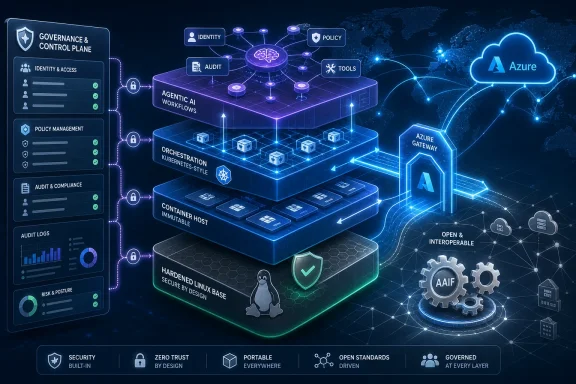 Microsoft’s Linux Story Has Moved From Apology to Leverage
There was a time when Microsoft saying “Linux is foundational” would have been treated as a corporate confession. In 2026, it reads more like infrastructure weather. Azure depends on Linux, Microsoft 365 depends on Linux, GitHub depends on Linux, and the AI systems that now dominate cloud capacity planning depend on Linux and Kubernetes at a scale that makes the old Windows-versus-Linux framing look quaint.That does not make Microsoft a neutral actor. It makes Microsoft a hyperscaler with a strategic need to harden, standardize, and govern the Linux substrate beneath its AI ambitions. Azure Linux 4.0 and Azure Container Linux are not sentimental gestures to open source; they are the kind of control-surface investments cloud providers make when the generic operating system layer becomes too important to leave entirely generic.
The company’s message is deliberately pragmatic. Azure Linux is positioned as a distribution maintained by the same organization operating the cloud it runs on. Azure Container Linux is positioned as an immutable, container-optimized operating system for workloads where the host should be boring, replaceable, and locked down. Together, they let Microsoft say that the foundation for AI workloads is open source, while also implying that the safest path through that foundation runs through Azure.
That is the modern Microsoft Linux posture in one sentence: upstream where it helps trust, vertically integrated where it helps Azure.
Azure Linux 4.0 Is About Predictability, Not Romance
The upcoming public preview of Azure Linux 4.0 on Azure Virtual Machines matters because it expands Microsoft’s Linux distribution from a behind-the-scenes component into something more visible to customers building cloud-native and AI-native systems. For developers and administrators, the pitch is not novelty. It is fewer moving parts, a reduced package footprint, consistent performance, and a distribution lifecycle aligned with Azure itself.That is valuable in the same way a good server room is valuable: nobody should notice it unless something goes wrong. AI workloads are increasingly complex at the application layer, with orchestration systems, model endpoints, vector stores, tool calls, policy engines, and observability pipelines all stacked together. The operating system should not add drama to that mix.
Microsoft’s bet is that “secure by default” has become a more compelling Linux feature than broad package abundance for many production workloads. Enterprises running regulated systems do not necessarily want a general-purpose distribution carrying everything a developer might someday need. They want a smaller attack surface, clearer provenance, and a patch story they can explain to auditors.
The catch is that cloud-provider Linux distributions always carry a portability question. Azure Linux may be open source, but its strongest value proposition is obviously inside Azure. That does not make it illegitimate; it simply means customers should understand the trade. The more the OS is tuned to the cloud around it, the more attractive it becomes operationally — and the more carefully architects need to think about exit paths.
The Immutable Host Is Becoming the Default Enterprise Compromise
Azure Container Linux reaching general availability is the cleaner statement of where infrastructure is heading. Container hosts are increasingly treated less like traditional servers and more like firmware for a cluster. You do not lovingly customize them; you stamp them out, patch them, replace them, and keep the meaningful state somewhere else.That model fits Kubernetes, and it fits AI workloads even better. Training and inference systems are already assembled from schedulers, containers, accelerators, data pipelines, and service meshes. The host OS is there to provide a secure, predictable base for the container runtime and hardware access. If it becomes an artisanal snowflake, something has gone wrong.
Immutability also changes the security conversation. A reduced, read-only or tightly controlled host image limits the space where attackers can persist, and it makes drift easier to detect. For sysadmins used to nursing long-lived Linux hosts through years of package changes, this can feel like losing flexibility. For platform teams responsible for fleets, it looks like survival.
Microsoft’s timing is not accidental. As AI workloads scale, the number of machines involved in a single service can be enormous, and the blast radius of supply-chain compromise or configuration drift grows with it. The humble container host is becoming a security boundary for systems that may soon be allowed to perform higher-value actions on behalf of humans.
Agentic AI Turns the Stack Inside Out
The phrase agentic AI is already suffering from vendor overuse, but the underlying shift is real enough. The industry is moving from chat interfaces that answer questions toward software agents that can call tools, use credentials, modify systems, file tickets, write code, summarize logs, and coordinate with other agents. That is not just a new application pattern. It is a new trust problem.A conventional application does what its developers coded it to do. An agentic system is more probabilistic: it interprets goals, selects tools, delegates subtasks, and may operate across systems built by different vendors. The more useful it becomes, the more dangerous it becomes without identity, audit, policy, and containment.
This is why Microsoft’s Linux announcements sit beside its agent governance push rather than in a separate bucket. The OS foundation, container runtime, orchestration layer, agent framework, and governance toolkit are increasingly part of one production story. Enterprises will not deploy agents widely just because the demos are impressive. They will deploy them when the control plane looks familiar enough to manage.
Microsoft knows this playbook because it watched Kubernetes evolve from a developer fascination into enterprise infrastructure. Kubernetes did not become boringly successful until role-based access control, admission policies, network controls, observability, and managed services made it tolerable for conservative organizations. Microsoft is now arguing that agents need an equivalent maturation path.
The Open Agent Stack Is Also a Battle for the Middle
Microsoft’s proposed open agentic stack includes frameworks, protocols, runtime components, governance primitives, and partnerships with projects such as Ray and NVIDIA Dynamo. The company is trying to occupy the middle layer between model providers and business applications. That middle is where orchestration happens, where telemetry is captured, where policy is enforced, and where developers decide whose abstractions they will live with.This is a strategic place to stand. Models are expensive and competitive, but model access is becoming multi-vendor by necessity. Applications are fragmented across industries and internal workflows. The connective layer — the place where agents communicate, invoke tools, observe results, and obey enterprise policy — is where durable platforms can form.
Microsoft Agent Framework is presented as an open source SDK and runtime that carries forward lessons from Semantic Kernel and AutoGen. That consolidation matters because Microsoft’s agent developer story has been energetic but sprawling. Developers do not want three overlapping abstractions and a migration guide every six months; they want a stable path from local experimentation to production deployment.
The harder question is whether “open” in this context means broadly interoperable or merely open enough to encourage adoption before cloud gravity takes over. Microsoft is hardly alone in walking that line. Every large AI vendor wants standards that prevent rivals from owning the market, but each would still prefer customers to run the resulting workloads on its own infrastructure.
AAIF Is the Standards Body Everyone Suddenly Needs
The Agentic AI Foundation gives this push its institutional wrapper. Under the Linux Foundation umbrella, AAIF is meant to provide neutral governance for agent-related standards and projects, including work around agent-to-agent communication, runtimes, and orchestration. Microsoft’s support is notable not because it is surprising, but because it signals how quickly the agent market has reached the interoperability panic stage.That panic is rational. Without shared protocols, the agent ecosystem could fragment into vendor-specific islands: one agent framework for each cloud, one tool protocol for each model family, one governance model for each software suite. That would be bad for customers, but it would also slow the market. Agents become more useful when they can call more tools, coordinate across more systems, and operate under policies that do not have to be rebuilt from scratch every time a vendor changes.
The comparison to the Cloud Native Computing Foundation is obvious and intentional. CNCF helped turn Kubernetes from a powerful project into an ecosystem with shared expectations. AAIF is being asked to do something similar for agents, but under more difficult conditions. Kubernetes orchestrates containers; agents orchestrate actions, context, credentials, and intent. The failure modes are stranger.
The presence of major AI rivals inside the same foundation should be read as both encouraging and defensive. OpenAI, Anthropic, Google, Microsoft, AWS, and others all have reasons to prevent a single competitor from defining the agent layer. That is how open standards often happen in technology: not because everyone becomes altruistic, but because mutual suspicion creates room for neutral ground.
Governance Is the Product Enterprises Will Actually Buy
Microsoft’s Agent Governance Toolkit may prove more important than the flashier agent framework pieces. Identity, policy, audit, access boundaries, and lifecycle controls are not the parts that light up a keynote demo. They are the parts that determine whether a bank, hospital, manufacturer, school district, or government agency can let agents touch production systems.The enterprise concern is not merely that an agent might hallucinate. It is that an agent might hallucinate while holding permissions, invoking APIs, reading sensitive data, or chaining actions across systems faster than a human reviewer can follow. The old AI safety discussion often focused on model behavior in isolation. Agentic AI makes the environment part of the risk.
That is why the Kubernetes analogy matters. Kubernetes without RBAC, admission controllers, namespaces, network policy, and audit logs would be a science project for most enterprise environments. Agents need comparable constraints, but mapped to tasks rather than pods. Who asked the agent to act? What data could it see? Which tools could it invoke? What did it change? Can the action be replayed, reversed, or blocked?
Microsoft’s governance pitch is therefore aimed squarely at the people who get called after the demo: security teams, platform engineers, compliance officers, and administrators. The company is saying that agent adoption will not scale through enthusiasm alone. It will scale through controls that make autonomy legible.
Open Source Security Becomes an AI Safety Issue
The supply-chain section of Microsoft’s announcement is easy to treat as a familiar corporate responsibility paragraph. It should not be. If agents are going to write code, update dependencies, generate tests, triage issues, and patch vulnerabilities, then open source security becomes part of the agentic trust boundary.That changes the stakes for long-running problems. Maintainer burnout, underfunded critical packages, unclear provenance, dependency confusion, malicious updates, and shallow review practices were already serious. Add autonomous tooling that can touch more repositories and more infrastructure, and those problems become accelerants.
Microsoft’s continued investment in OpenSSF, Alpha-Omega, and GitHub’s secure open source work fits the larger thesis: AI cannot safely scale on a brittle commons. The company is also making a subtler argument that AI itself can help secure that commons through automated testing, vulnerability discovery, and dependency maintenance. That is plausible, but it is not magic.
The danger is confusing automation with assurance. An agent can generate a patch, but humans and institutions still need to decide what trust process surrounds it. Open source projects vary widely in maintainer capacity, review culture, release discipline, and security maturity. AI can reduce toil, but it can also produce convincing noise at industrial scale.
Windows Shops Should Not Treat This as Someone Else’s Linux News
For WindowsForum readers, the temptation is to file this story under “Azure Linux” and move on. That would miss the practical impact. Microsoft’s infrastructure future is hybrid, containerized, Linux-heavy, and increasingly agent-mediated, even for organizations whose endpoints and identity systems remain deeply Windows-centric.Windows administrators are already living in a world where Entra ID, Azure Arc, Defender, GitHub, PowerShell, WSL, AKS, Microsoft 365, and Azure policy surfaces overlap. The next wave adds agents that may operate across those boundaries. A help desk agent might query Intune, summarize device health, open a remediation script, and coordinate with a security agent watching Defender signals. Whether that workflow runs on Windows servers is almost beside the point.
The important question is how identity and policy travel. If Microsoft can make agent governance feel like a natural extension of existing enterprise controls, it will have a major advantage with organizations already standardized on its stack. If those controls are open enough to work across clouds and frameworks, customers get leverage. If they are open in name but Azure-shaped in practice, the leverage shifts back to Microsoft.
That is why the Linux foundation layer matters even to Windows-heavy shops. The workloads that automate the enterprise may run on Linux containers in Azure while acting on Windows devices, Microsoft 365 tenants, GitHub repositories, and line-of-business systems. The administrative surface becomes cross-platform whether the endpoint fleet does or not.
The Cloud-Native Lesson Is That Neutrality Takes Work
Microsoft’s argument borrows heavily from the cloud-native era: open interfaces, shared governance, distributed innovation, and collective security. Those principles helped Linux, containers, and Kubernetes become the substrate of modern cloud computing. But they were never self-executing. They required governance fights, conformance tests, vendor restraint, and customers willing to demand portability.The agentic era will need the same pressure. Standards bodies can be captured by inertia as easily as by vendors. Open source projects can become de facto controlled by the companies funding most of the engineering. Protocols can be extended in ways that preserve formal compatibility while making one platform the “best” place to run.
Microsoft deserves credit for recognizing that agent interoperability needs neutral institutions before the market calcifies. It also deserves scrutiny because it has every incentive to make Azure the most comfortable home for the open agent stack. Those two truths can coexist. In fact, they usually do.
The healthiest outcome for customers is not a world where Microsoft, Google, AWS, OpenAI, or Anthropic wins the agent layer outright. It is a world where they compete on implementation, reliability, security, tooling, and price while sharing enough protocol ground that customers can move agents, tools, and policies without starting over.
The Real Signal Is Below the Demo Layer
The announcements are easiest to understand as plumbing, but that is exactly why they matter. Microsoft is trying to shape the layers that will determine whether agentic AI becomes enterprise infrastructure or remains a chaotic collection of demos and bespoke integrations.- Azure Linux 4.0 is being positioned as a hardened Azure-aligned Linux base for virtual machines running modern cloud and AI workloads.
- Azure Container Linux reaching general availability reinforces the shift toward immutable, minimal hosts for containerized production systems.
- Microsoft’s agent framework work is an attempt to consolidate developer abstractions before the agent ecosystem fragments too badly.
- The Agentic AI Foundation gives vendors a neutral place to standardize agent interoperability, even as they continue competing fiercely above and below that layer.
- Governance primitives such as identity, audit, policy, and access boundaries will decide how quickly enterprises allow agents to perform meaningful work.
- Open source supply-chain security is no longer adjacent to AI strategy, because autonomous agents will increasingly depend on and modify that same software commons.
References
- Primary source: HPCwire
Published: Mon, 18 May 2026 18:31:38 GMT

Microsoft Backs Open Agentic AI Ecosystem with New Linux Releases, Governance Tools, and AAIF Push - AIwire
May 18, 2026 — Open source is the foundation for AI and, as AI workloads scale, developers need that foundation to be more secure, more predictable, and easier to build apps […] www.hpcwire.com
- Official source: opensource.microsoft.com

From open source to agentic systems: Microsoft at Open Source Summit North America 2026 | Microsoft Open Source Blog
Discover how Azure Linux 4.0 and Azure Container Linux deliver a secure, scalable Linux foundation for cloud native apps, containers, and AI workloads. opensource.microsoft.com
- Related coverage: linuxfoundation.org
Agentic AI Foundation Welcomes 97 New Members As Demand for Open, Collaborative Agent Standardization Increases
Industry leading organizations unite under neutral Foundation led by new governing board chair David Nalleywww.linuxfoundation.org - Related coverage: phoronix.com
- Related coverage: modelcontextprotocol.info
MCP joins the Agentic AI Foundation
Today marks a major milestone for the Model Context Protocol. Anthropic is donating MCP to the Agentic AI Foundation, a directed fund under the Linux Foundation. MCP will become a founding project of the newly created foundation. In one year, MCP has become one of the fastest-growing and... modelcontextprotocol.info
- Related coverage: docker.com
Docker Joins the Agentic AI Foundation | Docker
Learn from Docker experts to simplify and advance your app development and management with Docker. Stay up to date on Docker events and new version www.docker.com

- Related coverage: linux-magazin.de
- Related coverage: windowscentral.com
- Related coverage: itpro.com
Anthropic says MCP will stay 'open, neutral, and community-driven' after donating project to Linux Foundation
The AAIF aims to standardize agentic AI development and create an open ecosystem for developers www.itpro.com
- Official source: developer.microsoft.com
Azure Decoded: Getting Ready for the Migrate & Modernize Summit | Microsoft Reactor
Learn new skills, meet new peers, and find career mentorship. Virtual events are running around the clock so join us anytime, anywhere!developer.microsoft.com - Official source: info.microsoft.com
Microsoft Azure Summit
Register for Microsoft Azure Summit: Migrate and Modernize with Agentic AIinfo.microsoft.com
- Related coverage: infoworld.com

Linux Foundation launches Agentic AI Foundation
Backed by AWS, Google, Microsoft, OpenAI, and others, the AAIF kicks off with contributed projects from Anthropic, Block, and OpenAI. www.infoworld.com
- Related coverage: cxodigitalpulse.com

OpenAI, Anthropic, and Industry Leaders Form Agentic AI Foundation Under Linux Foundation - CXO Digitalpulse
In a major step toward standardising and streamlining the rapidly growing field of agentic AI, OpenAI, Anthropic and Block—backed by Google.. www.cxodigitalpulse.com
- Related coverage: 0e190a550a8c4c8c4b93-fcd009c875a5577fd4fe2f5b7e3bf4eb.ssl.cf2.rackcdn.com
- Official source: cdn-dynmedia-1.microsoft.com
- Related coverage: project.linuxfoundation.org
