

Microsoft’s brief advisory that Azure Linux includes this open‑source library and is therefore potentially affected is an important inventory signal — but it is not a categorical guarantee that Azure Linux is the only Microsoft product that could carry the vulnerable Go html/template code implicated by CVE-2023-39318.
CVE-2023-39318 is a vulnerability in the Go standard library’s html/template package that was disclosed in September 2023. At its core the bug stems from the template parser’s improper handling of HTML-like comment tokens (for example <!-- ... -->) and hashbang (#!) tokens inside <script> contexts, which can confuse the context-tracking logic and lead to template actions being escaped incorrectly. The practical outcome is a class of Cross-Site Scripting (XSS) risk: under specific conditions an attacker-controlled value might be interpreted as script content rather than data, defeating the template's escaping guarantees.
The Go project released patched versions to fix the parser behavior; the practical remediation for developers and packagers is to run a patched Go toolchain (Go 1.20.8 or later in the 1.20 line, and 1.21.1 or later in the 1.21 line), or to apply vendor/OS patches that upgrade the packaged Go runtime and libraries. Multiple downstream Linux distributors and vulnerability databases have cataloged the defect and issued package updates for their respective Go packages.
Microsoft’s Security Response Center (MSRC) has published short, product‑scoped attestation language for certain vulnerabilities, and for CVE-2023-39318 the MSRC entry names Azure Linux as a Microsoft‑distributed product that “includes this open‑source library and is therefore potentially affected.” That wording is precise and useful for Azure Linux customers — but it must be read in context: it tells customers what Microsoft has verified so far, not what Microsoft absolutely guarantees about every internal product or artifact.
Potential carriers include:
Key supply‑chain takeaways:
That attestation is useful because:
For development teams, the fix is straightforward: ensure your runtime and libraries are upgraded to patched Go versions, avoid risky template patterns, and apply CSP and other runtime mitigations where immediate patching is not possible. For security and platform teams, the next steps are to ingest vendor VEX/CSAF mappings when available, automate SBOM and image scanning, rebuild affected images with patched toolchains, and treat attested product lists as starting points rather than exhaustive lists of exposure.
CVE-2023-39318 reminds us that even standard libraries can contain subtle parsing logic bugs with real XSS consequences — the combination of vendor transparency (attestations + VEX/CSAF) and disciplined artifact-level hygiene is the most reliable path to closing that gap.
Source: MSRC Security Update Guide - Microsoft Security Response Center
 Background / Overview
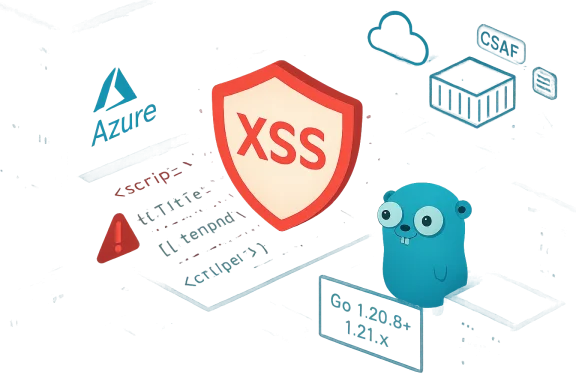
CVE-2023-39318 is a vulnerability in the Go standard library’s html/template package that was disclosed in September 2023. At its core the bug stems from the template parser’s improper handling of HTML-like comment tokens (for example <!-- ... -->) and hashbang (#!) tokens inside <script> contexts, which can confuse the context-tracking logic and lead to template actions being escaped incorrectly. The practical outcome is a class of Cross-Site Scripting (XSS) risk: under specific conditions an attacker-controlled value might be interpreted as script content rather than data, defeating the template's escaping guarantees.The Go project released patched versions to fix the parser behavior; the practical remediation for developers and packagers is to run a patched Go toolchain (Go 1.20.8 or later in the 1.20 line, and 1.21.1 or later in the 1.21 line), or to apply vendor/OS patches that upgrade the packaged Go runtime and libraries. Multiple downstream Linux distributors and vulnerability databases have cataloged the defect and issued package updates for their respective Go packages.
Microsoft’s Security Response Center (MSRC) has published short, product‑scoped attestation language for certain vulnerabilities, and for CVE-2023-39318 the MSRC entry names Azure Linux as a Microsoft‑distributed product that “includes this open‑source library and is therefore potentially affected.” That wording is precise and useful for Azure Linux customers — but it must be read in context: it tells customers what Microsoft has verified so far, not what Microsoft absolutely guarantees about every internal product or artifact.
What the MSRC attestation means — and what it doesn’t
Microsoft’s attestation is an inventory statement
When MSRC says “Azure Linux includes this open‑source library and is therefore potentially affected,” it is performing three things:- Confirming that Microsoft examined the Azure Linux distribution images and found the implicated upstream component present.
- Notifying customers that the Azure Linux images they might be running (or using in the Azure Marketplace) are within scope and should be patched or updated.
- Committing to supply‑chain transparency in the form of machine‑readable VEX/CSAF mappings and product mappings, and to extend those mappings if additional Microsoft products are later found to ship the same upstream component.
It is not an exclusivity guarantee
Crucially, the attestation does not equal an exhaustive scan of every Microsoft artifact, nor does it imply that other Microsoft products cannot contain the affected code. The presence of a component upstream (in this case, the Go standard library’s html/template) can appear in many different kinds of Microsoft artifacts:- Microsoft‑built binaries that embed the Go runtime or vendor the html/template package.
- Containers, appliances, or Marketplace images that include Go-based software or a Go toolchain.
- Developer tools, platform services, or partner artifacts that Microsoft distributes and that were built with a vulnerable Go version.
- Third‑party integrations bundled in Microsoft products.
Technical summary of CVE-2023-39318 (what went wrong)
- Affected component: Go standard library package html/template.
- Vulnerability class: Improper context handling that may result in improper escaping of template actions in <script> contexts.
- Exploitable condition: inclusion of HTML-like comment tokens or hashbang tokens in or around script blocks that confuse the template parser’s context state machine.
- Impact: Possibility of XSS when template rendering mixes untrusted input into script contexts and the parser fails to maintain correct escaping semantics.
- Remediation: Upgrading the Go runtime to patched versions (for example Go 1.20.8+ in the 1.20 series; fixes were released for the 1.21 series as well). Where distributions package Go, apply the vendor or distribution patch.
Who else could be affected beyond Azure Linux?
The short, practical answer for administrators and security teams is: anything Microsoft ships that includes the vulnerable Go runtime or vendors the vulnerable html/template package could be affected. That list is not limited to Azure Linux, and the absence of a public MSRC attestation for a product is not proof that the product is safe.Potential carriers include:
- Azure Marketplace images and vendor-supplied VM images based on Go-built components.
- Microsoft‑distributed containers that embed Go applications or the Go toolchain.
- Microsoft services or internal tools built with Go (including platform services where Microsoft directly runs Go-based processes).
- Developer-facing artifacts (SDKs, tooling) that may have included Go toolchains or vendorized packages.
- Partner software and Azure Marketplace offerings that Microsoft distributes or hosts on behalf of third parties.
What operators should do now — prioritized, practical steps
- Treat the Azure Linux attestation as immediate, actionable guidance.
- Ensure Azure Linux instances (and any images derived from them) are updated to the patched Go package or to the updated distribution snapshot Microsoft publishes.
- If you manage Azure Marketplace images or Marketplace‑published VMs that use Azure Linux, rebuild and republish with the patched packages.
- Inventory all Microsoft-supplied artifacts you run or host.
- Search for Go toolchains and go binaries inside images: look for the presence of a Go runtime or for the html/template package in vendor directories.
- Scan container registries, VM images, and orchestration images for vulnerable Go versions (for example, check for go version strings or package metadata).
- Use SBOMs and software composition analysis to find packaged copies of the html/template library.
- Check Microsoft product mappings and machine-readable VEX/CSAF feeds.
- MSRC’s product attestation is a starting point. Watch for updates: Microsoft has signaled that it will publish and extend CSAF/VEX mappings of affected products and will update CVE entries when more products are identified.
- When those VEX/CSAF mappings arrive, consume them into your vulnerability management pipeline so product- and artifact-level impact can be automatically tracked.
- Patch and rebuild where necessary.
- For images or artifacts that include Go, rebuild them with a fixed Go toolchain (patched releases), or apply the vendor patch that upgrades the distribution’s Go package.
- For container images, the safest course is to rebuild from a patched base image rather than relying on runtime mitigation.
- Apply defense‑in‑depth controls immediately.
- Harden Content Security Policy (CSP) headers to limit script execution sources and reduce the blast radius of potential XSS.
- Review template usage: avoid injecting untrusted user input directly into script contexts; if unavoidable, use explicit, context-aware APIs and review their escaping semantics.
- Run runtime protection and web application firewalls to detect anomalous script injections where remediation cannot be applied immediately.
- For development teams: fix code, not just the runtime.
- Developers should review templates that place user data inside script tags.
- Consider migrating sensitive templates to safer patterns (for example, JSON-encoding server data and reading it from well-scoped data blocks, or using strict CSP + nonces for scripts).
How this advisory fits into software supply‑chain practice
Microsoft’s attestation model — calling out a named Microsoft product that includes an upstream open‑source component — reflects modern supply‑chain hygiene: identify where an upstream defect actually appears inside distributed products, and publish machine-readable attestations so customers and downstream integrators can take targeted action.Key supply‑chain takeaways:
- Product-level attestations are helpful because they convert an upstream CVE into a concrete list of vendor-distributed artifacts that require patching.
- However, a single product attestation does not absolve organizations from conducting their own artifact-level inventory. If you have Microsoft images, containers, or services in your estate, assume possible exposure until verified.
- Machine-readable VEX/CSAF outputs are useful only if you integrate them into your vulnerability management pipeline. Manual checks against vendor pages are no longer sufficient for timely remediation.
Risk calculus and realistic threat scenarios
This vulnerability’s realistic attacker model and risk depend on two factors: (1) whether the vulnerable html/template is actually used at runtime by a Microsoft‑distributed artifact you operate, and (2) whether a template mixes attacker-controlled input directly into script contexts without additional safeguards.- High risk: public-facing web apps or APIs that render templates with user-supplied content inside <script> tags and that were compiled with or run on the vulnerable Go runtime.
- Medium risk: systems that include the vulnerable library but do not place untrusted data into script contexts, or that have mitigating controls like strict CSP that block script execution from injected contexts.
- Low risk: artifacts that do not include Go’s html/template at all, or systems that only store affected code in source form and never serve it as web content.
Why Azure Linux showed up first (and what that implies)
Azure Linux (previously known in Microsoft parlance as the CBL-Mariner‑based family) is a general-purpose Linux distribution Microsoft publishes and maintains for Azure services and images. Because Microsoft owns and curates Azure Linux, it is both natural and operationally straightforward for MSRC to inventory those images and publish a product-level attestation.That attestation is useful because:
- It tells Azure customers exactly where a patch will be applied and where they should prioritize updates.
- It documents Microsoft’s internal supply‑chain checks, reducing customer uncertainty.
- It indicates Microsoft’s intent to provide machine-readable VEX/CSAF outputs so enterprise automation can consume the mapping.
Practical examples of checks and queries you can run today
- Container images: scan your registries with an SCA tool and search for Go package versions. Rebuild images that include Go < fixed versions.
- VM images: mount or run a quick package query to identify the Go package and its version string.
- Source trees: search for imports of html/template and review templates that place variables into <script> contexts.
- SBOMs: if you consume SBOMs from Microsoft or partners, ingest their VEX/CSAF outputs and cross‑reference component names and versions against your SBOM inventory.
- Runtime detection: use WAF rules or application logging to identify unusual script injection or template rendering anomalies.
Strengths and limitations of Microsoft’s public approach
Strengths:- Microsoft’s product attestation gives customers a known starting point: Azure Linux is confirmed and patches will be pushed.
- The commitment to publish CSAF/VEX mappings (announced as starting in October 2025) improves automation and reduces manual lookup burden.
- Product-focused communications reduce noise for customers who only use a subset of Microsoft artifacts.
- Product-scoped attestations are time‑boxed: absence of a product in the public mapping is not evidence of safety.
- Customers who rely on Microsoft-hosted third‑party images or partner distributions may still have exposure that isn’t covered by Microsoft’s initial attestation.
- Timely remediation still depends on operators’ ability to consume VEX/CSAF outputs and to rebuild or update internal artifacts quickly.
Developer guidance: patterns to avoid and mitigation coding practices
- Avoid injecting raw user input into JavaScript contexts inside templates. Prefer data serialization patterns where server data is encoded to JSON and then safely parsed in a script that reads from a data attribute or a script‑type="application/json" block.
- Validate and canonicalize input on the server whenever possible. Escaping alone is often the last line of defense.
- Adopt explicit escaping helpers for JavaScript contexts. Relying solely on implicit template context tracking increases risk where the template engine has a parser bug.
- Use automated tests that exercise template rendering with edge case inputs (including HTML comment tokens and hashbang lines) to detect regressions in escaping behavior.
Conclusion
Microsoft’s MSRC attestation that Azure Linux includes the affected html/template library and is therefore potentially affected by CVE-2023-39318 is a clear, actionable alert for Azure Linux operators — but it is not an exclusivity guarantee for all Microsoft products. The correct operational posture is to treat the attestation as a confirmed carrier for Azure Linux while simultaneously running artifact-level inventory, scanning, and patching across any Microsoft-supplied or Microsoft-hosted images, containers, and services you operate.For development teams, the fix is straightforward: ensure your runtime and libraries are upgraded to patched Go versions, avoid risky template patterns, and apply CSP and other runtime mitigations where immediate patching is not possible. For security and platform teams, the next steps are to ingest vendor VEX/CSAF mappings when available, automate SBOM and image scanning, rebuild affected images with patched toolchains, and treat attested product lists as starting points rather than exhaustive lists of exposure.
CVE-2023-39318 reminds us that even standard libraries can contain subtle parsing logic bugs with real XSS consequences — the combination of vendor transparency (attestations + VEX/CSAF) and disciplined artifact-level hygiene is the most reliable path to closing that gap.
Source: MSRC Security Update Guide - Microsoft Security Response Center
