

The short, practical answer is: Microsoft has publicly attested that Azure Linux includes the upstream NTFS3 code referenced by CVE‑2025‑38167 and is therefore potentially affected, but that attestation is product‑scoped — it is not a technical proof that Azure Linux is the only Microsoft product that could ever include the same vulnerable code. Customers should treat Azure Linux as a confirmed remediation priority while simultaneously performing artifact‑level discovery for other Microsoft‑supplied images and binaries until those artifacts are explicitly attested as Not Affected. erview
CVE‑2025‑38167 is a Linux kernel vulnerability assigned to the NTFS3 filesystem component with the terse description: fs/ntfs3: handle hdr_first_de() return value. Upstream maintainers fixed the problem by adding defensive handling where the helper hdr_first_de() can return NULL; failing to handle that return correctly risks dereferencing a NULL pointer in kernel code (a typical stability/availability bug). The issue was recorded in the Linux kernel CVE announcements and indexed by major vulnerability databases shortly after the fix was merged.
The patch is small and straightforward in intent — validate the pointer returned by hdr_first_de() before use — but because the Linux kernel is compiled into many different images and vendor kernels, the presence (or absence) of the vulnerable code is an artifact‑level property: it depends on which upstream commits were included, whether the vendor backported the fix, and how the kernel was configured and packaged. Multiple distributions and cloud vendors published fixed kernel packages after the upstream commits were accepted.
Microsoft’s public CVE guidance for many Linux kernel CVEs — including the NTFS3 fix — follows the same pattern: the Microsoft Security Response Center (MSRC) notes whether a named Microsoft product contains the implicated open‑source component and thus whether that product is potentially affected. For CVE‑2025‑38167, MSRC’s FAQ text calls out Azure Linux as including the NTFS3 code and therefore being potentially affected; Microsoft also states it will update CVE pages and machine‑readable VEX/Cmoducts is identified. That public posture is accurate for Azure Linux and consistent with Microsoft’s phased VEX rollout, but it must be read as an inventory attestation rather than an exclusivity guarantee.
Long answer and practical reasoning:
Immediate steps (0–24 hours)
In plain operational terms: treat Microsoft’s attestation as a high‑confidence flag for Azure Linux, but do not let it displace due diligence for the rest of your fleet.
Operationally: patch Azure Linux immediately if you run it; scan and verify other Microsoft images and artifacts you run (Marketplace images, WSL, container images, AKS node images); automate SBOM and VEX ingestion to shorten the time between vendor inventory and your remediation actions; and when in doubt, treat un‑attested artifacts as unknown and verify by inspection. The upstream kernel commits and multiple distribution advisories provide the concrete fixes you need to confirm remediation across your estate.
Source: MSRC Security Update Guide - Microsoft Security Response Center
CVE‑2025‑38167 is a Linux kernel vulnerability assigned to the NTFS3 filesystem component with the terse description: fs/ntfs3: handle hdr_first_de() return value. Upstream maintainers fixed the problem by adding defensive handling where the helper hdr_first_de() can return NULL; failing to handle that return correctly risks dereferencing a NULL pointer in kernel code (a typical stability/availability bug). The issue was recorded in the Linux kernel CVE announcements and indexed by major vulnerability databases shortly after the fix was merged.
The patch is small and straightforward in intent — validate the pointer returned by hdr_first_de() before use — but because the Linux kernel is compiled into many different images and vendor kernels, the presence (or absence) of the vulnerable code is an artifact‑level property: it depends on which upstream commits were included, whether the vendor backported the fix, and how the kernel was configured and packaged. Multiple distributions and cloud vendors published fixed kernel packages after the upstream commits were accepted.
Microsoft’s public CVE guidance for many Linux kernel CVEs — including the NTFS3 fix — follows the same pattern: the Microsoft Security Response Center (MSRC) notes whether a named Microsoft product contains the implicated open‑source component and thus whether that product is potentially affected. For CVE‑2025‑38167, MSRC’s FAQ text calls out Azure Linux as including the NTFS3 code and therefore being potentially affected; Microsoft also states it will update CVE pages and machine‑readable VEX/Cmoducts is identified. That public posture is accurate for Azure Linux and consistent with Microsoft’s phased VEX rollout, but it must be read as an inventory attestation rather than an exclusivity guarantee.
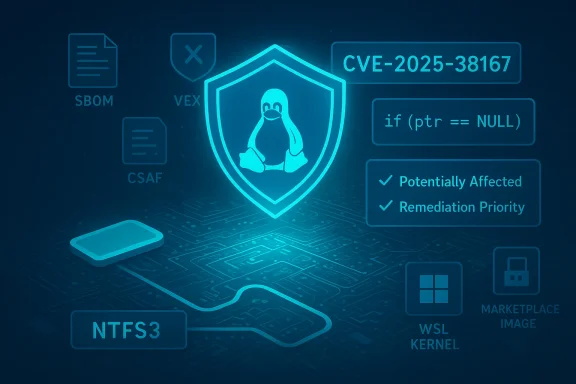 Why the MSRC sentence matters — attestation versus exclusivity
What MSRC actually told customers
When MSRC says “Azure Linux includes this open‑source library and is therefore potentially affected,” it is performing two things at once:- It is providing an authoritative, product‑level inventory signal: Micrnspected the Azure Linux build outputs and confirmed the presence of the upstream code mapped to that CVE. That makes Azure Linux a known carrier and therefore a clear remediation target.
- It is documenting a process commitment: Microsoft has begun publishing machine‑readable Cand will update those attestations (and CVE mappings) as its inventory work expands. That program is phased, and Azure Linux was an early product to receive coverage.
Why that phrasing is not “only Azure Linux”
A short but crucial point: product‑scoped attestation ≠ exclusivity. Stating that one Microsoft product includes a component does not — and practically cannot — prove that no other Microsoft product ever includes it. Large vendors ship hundreds or thousands of artifacts (VM images, container base layers, Marketplace appliances, WSL kernels, managed node images, SDKs and agents). Any of those artifacts can independently include upstream kernel code depending on how they were built. The absence of an MSRC attestation for Product B is an absence of attestation, not a technical proof of absence. Security teams should tC statement as an authoritative confirmation for Azure Linux while keeping other Microsoft artifacts within the “unknown until verified” bucket.Technical anatomy of CVE‑2025‑38167 (what to know)
- Component: NTFS3 (in‑kernel NTFS driver) — the vulnerable code lives in fs/ntfs3/index.c and related helpers.
- Root cause: hdr_first_de() may return NULL; code paths that use its return value did not always check for NULL, so a subsequent dereference could occur. This is a classic null‑pointer robustness bug.
- Impact class: primarily stability/availability (kernel oops/panic), not a remote code execution or secrecy failure in its default form. The vulnerability’s risk profile varies by deployment: kernels in systems that ever mount NTFS volumes (including hotplugged disks, attached VM disks, or Marketplace images that expose NTFS partitions) carry the relevant attack surface.
- Fix: defensive NULL checks and propagation of error returns; upstream kernels include the patches and distributors have backported or shipped fixed kernel packages. The Linux kernel CVE announcement lists the upstream commits that resolve the issue.
Cross‑checking the record: independent confirmations
I verified the core facts across independent sources before forming recommendations:- Linux kernel CVE announcement: the kernel CVE mailing list and upstream changelogs that record the assignment and the affected file(s). These messages describe the defect and list the commit(s) that implement the fix.
- National vulnerability databases and trackers: NVD, OSV, and multiple distribution trackers (Debian, Amazon Linux, KernelCare dashboards) record CVE‑2025‑38167 with consistent technical descriptions and indicate package‑level fixes for the distributions that ship kernels incorporating the upstream commits. These are independent attestations of the same root cause and remediation steps.
- Vendor patch advisories: multiple distribution vendors (Debian/Ubuntu, Red Hat, Amazon Linux, Oracle) produced advisories and kernel package fixes; vendor pages and ALAS entries list the fixed kernel package versions that address the issue. This shows the fix was widely communicated and distributed across Linux vendors.
Does any Microsoft product other tha NTFS3?
Short answer: We cannot rule it out; Microsoft has publicly attested Azure Linux only so far, and that attestation is authoritative for Azure Linux — but the product scope of MSRC’s statement must be respected.Long answer and practical reasoning:
- Microsoft’s public CVE entries typically begin by mapping the vulnerable upstream component to a Microsoft product inventory that Microsoft maintains for the product families they manage. For CVE‑2025‑38167, Microsoft’s published text confirms Azure Linux include3 code and therefore Azure Linux images are potentially affected. That is an actionable, high‑confidence signal for Azure Linux customers.
- However, Microsoft as an organization provides many Linux‑based artifacts beyond Azure Linux images: WSL kernels, Azure VM Marketplace images, AKS node images, container base layers published by Microsoft, and various partner/appliance Marketplace images. Any of those artifacts could, in principle, incm kernel commits (or backports) that contained the NTFS3 defect depending on build timing and configuration. The MSRC attestation is not an exhaustive scan of every such artifact.
- Microsoft’s VEX/CSAF program is being rolled out in phases (Azure Linux was an early target). MSRC states it will update CVE entries and publish attestatt products are found to ship the implicated component. That is an operational promise, not an immediate guarantee. Until Microsoft publishes a “Not Affected” or “Affected” attestation for a given product, the product’s status remains unverified from a public‑attestation perspective.
Practical guidance for administrators and developers
Treat MSRC’s Azure Linux attestation as high priority for Azure Linux images — then expand triage across other Microsoft artifacts you actually run.Immediate steps (0–24 hours)
- Inventory: identify where you run Azure Linux images (VMs, VM scale sets, AKS node pools, Marketplace images). Inventory any Microsoft‑published container base images or Marketplace appliances you consume. Use your cloud provider console, image IDs, and SBOMs where available. Azure Linux is a confirmed carrier; start here.
- Patch: apply the vendor‑provided kernel updates for Azure Linux as soon as they are available and validated in your environment. If you cannot apply a full kernel upgrade immediately, prioritize planned maintenance windows and fall back to compensating controls (e.g., restrict access to machines that would mount external NTFS volumes). Distribution advisories and the upstream kernel commit list provide the exact fix references to verify backports.
- Detection: scan your codebases, CI pipelines, and image registries for kernels or images that were built from upstream commit ranges that predate the fix. For Ms, extract package lists (or use SBOMs) and kernel version strings; compare them to vendor advisories. For OS‑level packages, distribution trackers list the fixed package versions.
- Expand artifact scans: treat Microsoft Marketplace images, WSL images, and container images as candidates. If you run any Microsoft‑published images that include a Linux kernel (for example, WSL kernels or curated container images), request SBOMs or apply image scanning to detect the presence of the vulnerable code. Remember: lack of an MSRC attestation is not assurance of safety — it’s an unknown.
- Rebuild statically linked artifacts: if you or your vendors ship statically linked kernels or userland binaries that vendor parts of the kernel or FS code, rebuild with patched sources. A kernel patch applied atel does not fix statically compiled copies embedded in custom images or vendor appliances.
- Test: after patching, run functional tests that exercise NTFS mounting and relevant filesystem operations, and exercise workflows that previously surfaced the vulnerability in staging before rolling patches into production.
- Automate SBOM/VEX ingestion: ensure your vulnerability management tooling consumes vendor CSAF/VEX attestations (when available) and that you map vendor products to your running artifacts. Microsoft is expanding VEX coverage; when it publishes a VEX entry for a product, you can use that to automate triage for that product family.
- Harden image provenance: prefer upstream vendor images that publish SBOMs and commit to VEX/CSAF transparency; maintain pinned kernel configurations and reproducible builds for critical images.
- Request attestations: where you rely on third‑party Marketplace images or vendor appliances, request SBOMs and VEX attestations from the seller to remove ambiguity.
What Microsoft’s phrasing implicitly acknowledges (and why that matters)
Microsoft’s MSRC entries typically follow a defensible pattern: name a product where the vendor has completed an inventory check and found the component, and commit to expanding coverage. That practice is realistic: exhaustive scanning and verification across every image, kernel, container, agent, and appliance shipped by a global vendor is a long project. The advantage of this approach is transparency for the product that was checked; the downside is the potential for false reassurance if readers misinterpret the attestation as an exclusive claim. The correct reading is: Azure Linux has been checked and found to include the NTFS3 code; other Microsoft artifacts have not necessarily been checked yet (or their check results have not been published).In plain operational terms: treat Microsoft’s attestation as a high‑confidence flag for Azure Linux, but do not let it displace due diligence for the rest of your fleet.
Risk scenarios and realistic exploitability
CVE‑2025‑38167 is primarily a robustness issue: a NULL pointer dereference in a filesystem helper. The highest practical risks are:- Denial of service on a host that mounts or processes a maliciously crafted NTFS header or enjoys repeated triggering of the buggy path. An attacker who can feed specially formed filesystem metadata to a target process that causes the kernel to dereference the NULL pointer could induce kernel oops/panic.
- Supply‑chain exposure: the vulnerable code could be present in images or kernels that host services exposed to less‑trusted inputs (for example, multi‑tenant Marketplace appliances that accept uploaded disk images). The greatest exposure arises when images or disks originate from untrusted parties.
How I verified Microsoft’s published claim and why independent crosschecks matter
- I confirmed the kernel CVE announcement and the list of upstream commits that implement the fix on the kernel CVE mailing list. That tells us precisely which files were changed and where to look in vendor kernels for equivalent backports.
- I checked independent vulnerability trackers (NVD, OSV, vendor security trackers) to ensure the CVE metadata matches the upstream description and to find distribution package advisories that identify fixed package versions for major distributions. This triangulation avoids over‑reliance on a single feed and helps operators find vendor packages that include the backport. ([nvd.nist.gov](https://nvd.nist.gov/vuln/detail/cve-2025-38167?utm_soMicrosoft’s attestation wording I relied on Microsoft’s MSRC guidance as described in the public CVE entry and cross‑checked community analyses that explain how to interpret the MSRC phrasing. Those community analyses correctly interpret Microsoft’s line as a product‑scoped attestation and nal implications for customers.
Takeaway checklist (actionable)
- If you run Azure Linux images: treat them asicrosoft’s or distribution kernel updates immediately.
- Inventory other Microsoft‑published artifacts you run (Marketplace images, WSL kernels, Microsoft container images) and scan them for vulnerable kernels or for the presence of the NTFS3 code as shipped. If you cannot confirm Not Affected, treat them as unknown and triage accordingly.
- For custom or third‑party images: request SBOMs and VEX attestations from vendors; rebuild static binaries or images that vendor kernel code with patched sources.
- Test post‑patch: exercise NTFS mount paths and perform kernel stress tests in staging to validate that the fix is applied and that no regressions appear.
- Use the MSRC VEX/CSAF feed when available to automate product‑level triage; until VEX attestation exists for a given product, assume the product’s status is unverified.
Conclusion
Microsoft’s public statement that “Azure Linux includes this open‑source library and is therefore potentially affected” is accurate and operationally important: it tells Azure customers to prioritize patching their Azure Linux images for CVE‑2025‑38167. However, that precise wording should not be misread as a universal guarantee that no other Microsoft product could contain the vulnerable NTFS3 code. The MSRC entry is an authoritative product‑level attestation for Azure Linux; absence of explicit attestations for other Microsoft artifacts is an absence of attestation, not an assurance of absence.Operationally: patch Azure Linux immediately if you run it; scan and verify other Microsoft images and artifacts you run (Marketplace images, WSL, container images, AKS node images); automate SBOM and VEX ingestion to shorten the time between vendor inventory and your remediation actions; and when in doubt, treat un‑attested artifacts as unknown and verify by inspection. The upstream kernel commits and multiple distribution advisories provide the concrete fixes you need to confirm remediation across your estate.
Source: MSRC Security Update Guide - Microsoft Security Response Center
