

Microsoft’s public advisory correctly identifies Azure Linux as a Microsoft product that “includes this open‑source library and is therefore potentially affected,” but that phrasing is a scoped product attestation — not a technical guarantee that no other Microsoft product could include the vulnerable Express.js library. erview
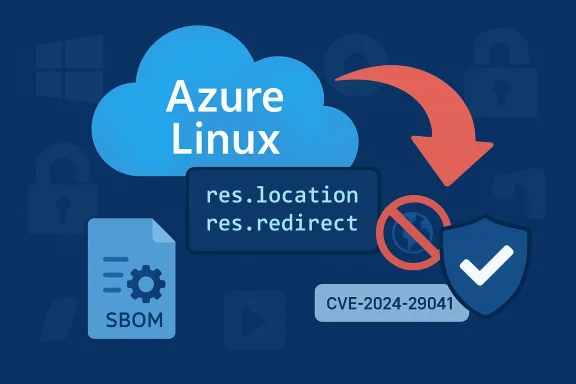
CVE‑2024‑29041 is an open redirect vulnerability affecting the popular Node.js web framework Express.js. The underlying issue stems from how Express encodes and normalizes user‑supplied redirect targets (the value passed to res.location() / res.redirect()), allowing certain malformed URLs to bypass typical redirect allow‑list checks and cause the application to redirect clients to attacker‑controlled destinations. The vulnerability affects Express versions earlier than 4.19.2 and pre‑release 5.0 builds prior to 5.0.0‑beta.3; fixes were shipped in 4.19.2 and 5.0.0‑beta.3.
This article explains what Microsoft’s Azure Linux attestation means in practice, why that attestation does not imply exclusivity, and what security teams and developers should do to assess exposure and remediate risk across Microsoft‑provided artifacts and the broader estate.
Two points are important and often misunderstood:
By combining vendor attestations with internal SBOMs, SCA scans, and runtime detection, organizations can close the blind spots this kind of supply‑chain / library vulnerability exposes and reduce the operational window attackers can exploit.
Source: MSRC Security Update Guide - Microsoft Security Response Center
CVE‑2024‑29041 is an open redirect vulnerability affecting the popular Node.js web framework Express.js. The underlying issue stems from how Express encodes and normalizes user‑supplied redirect targets (the value passed to res.location() / res.redirect()), allowing certain malformed URLs to bypass typical redirect allow‑list checks and cause the application to redirect clients to attacker‑controlled destinations. The vulnerability affects Express versions earlier than 4.19.2 and pre‑release 5.0 builds prior to 5.0.0‑beta.3; fixes were shipped in 4.19.2 and 5.0.0‑beta.3.
This article explains what Microsoft’s Azure Linux attestation means in practice, why that attestation does not imply exclusivity, and what security teams and developers should do to assess exposure and remediate risk across Microsoft‑provided artifacts and the broader estate.
 What the vulnerability is — technical summary
- Express encodes redirect targets using the encodeurl routine before writing into the Location header. Under normal circumstances that is acceptable, but certain malformed inputs — for example strings that confuse naive allow‑list checks, double‑slash constructs, or non‑standard serializations — can pass a check performed before encoding and then become an effective absolute or external URL after encoding and transmission.
- The primary impacted code path is res.location(), which is also invoked by res.redirect(), so typical redirect helpers are in scope.
- Impact: an attacker who can supply a redirect target as part of a URL (for example a returnTo parameter on a login callback) can craft an input that bypasses an allow list and redirect victims to malicious sites — classic phishing / credential capture vectors. The exploit requires no privileges but usually requires user interaction (click / navigation).
What Microsoft actually said — reading the attestation
Microsoft’s public CVE entries frequently include a short FAQ answering whether “Azure Linux is the only Microsoft product that includes this open‑source library and is therefore potentially affected.” In those FAQ responses Microsoft explains that Azure Linux is the distro they have inventory‑checked and that they began publishing machine‑retations in October 2025; they also state they will update the CVE/VEX entry if they identify additional Microsoft products that ship the component. That exact formulation has appeared on multiple MSRC CVE pages.Two points are important and often misunderstood:
- The statement is an authoritative yes for Azure Linux: Microsoft has checked the Azure Linux artifacts and found the upstream component present. Customers using Azure Linux should treat that as a confirmed remediation signal.
- The statement is not a categorical exclusiviting explicitly leaves open the possibility that other Microsoft products may contain the same upstream library, and Microsoft says it will update mappings as more products are identified. Treat the absence of a named product in a Microsoft CVE entry as “not yet verified” rather than “definitely not affected.”
Short answer to the user’s question
No — Azure Linux is not necessarily the only Microsoft product that can include Express.js and therefore be affected by CVE‑2024‑29041. What Microsms is that Azure Linux has been inventory‑checked and is a known carrier; it does not prove the absence of the library in other Microsoft images, kernels, or product artifacts. Microsoft has also said it will update CVE/VEX records if other products are found to ship the same component.Why the difference between “attested product” and “all products” matters
Large vendors ship a wide variety of artifacts: distribution images, container base layers, marketplace images, cloud service agents, appliance images, and runtime binaries. Whether a specific upstream library is present in any given Microsoft artifact depends on:- Build inputs (which distro snapshot or package set was used).
- Packaging choices (was the library included as a system package, bundled into an application, or omitted entirely).
- Build configuration (static vs. dynamic linking; minimal base images may omit Node or npm).
- Product scope (a kernel CVE will not apply to a Windows binary that never includes the library; conversely a web‑facing gateway or admin console might have Node/Express bundled and therefore be in scope).
Independent confirmation of the Express.js vulnerability and fixes
To avoid reliance on a single source, the Express.js open‑redirect issue is documented across multiple security databases:- The U.S. National Vulnerability Database (NVD) summarizes the issue, the affected versions, and remediation versions.
- The GitLab / npm advisories and OSV entries record the same technical root cause and point to Express.js commits that implement the fix — the fix completed through several maintenance releases culminating in 4.19.2 and later.
- Multiple Linux distribution advisories (Ubuntu/Debian and others) have recorded the issue for packaged node‑express releases and applied the package updates in their repositories.
Practical implications for Microsoft customers and administrators
If you run Microsoft‑provided artifacts in your environment, here is how to reason about exposure and what to do next.1) Treat the Azure Linux attestation as an immediate, confirmed hit if you use Azure Linux
- If you run Azure Linux images or Microsoft‑published Linux artifacts specified as “Azure Linux,” assume the vulnerable express versions could be present and follow Microsoft’s remediation guidance in their CVE entry. That attestation is authoritative for that product family.
2) Inventory all Microsoft artifacts in your environment
- Don’t stop at Azure Linux. Inventory other Microsoft artifacts you run, including:
- WSL2 kernels and WSL distributions supplied or updated by Microsoft.
- Microsoft‑published Marketplace VM images and container base images.
- Agents and telemetry components that ship with Microsoft updates.
- Managed services or appliances that include Node.js (for example, older management consoles, developer tooling, or packaged dashboards).
- Use SBOMs, VEX/CSAF feeds, automated package scanners, and runtime discovery to check whether express (or other affected packages) are installed. Microsoft’s CSAF/VEX program reduces friction for this task where MSRC has published attestations; where Microsoft hasn’t published attestations, treat the artifact as “unverified.”
3) Scan your application code and images for Express usage
- For container images and server artifacts, run package managers and binary scans:
- npm ls express or yarn why express
- container image scan with your SCA (software composition analysis) tool
- For Windows‑hosted workloads (IIS, App Service) check application dependencies packaged with deployments. Express is an application‑level library — it will be present where Node apps are deployed, whether that’s on Azure Linux, Windows hosted containers, or on Microsoft Marketplace images.
4) Patch and harden
- Upgrade Express to 4.19.2 or later. If you cannot upgrade, implement the application mitigations described below.
- If Microsoft publishes product updates for Azure Linux or other Microsoft artifacts, apply them per your change control procedures.
Application mitigations and developer guidance
Even with vendor patches, developers should follow defensive coding practices to prevent redirect‑based attacks in general.- Upgrade Express to a fixed version: 4.19.2 or later (and patched 5.0 betas). This addresses the library bug at the source.
- Pre‑parse and validate URLs before calling res.location() or res.redirect():
- Use the Node.js URL parser: new URL(userInput, base) or require('url').parse() to obtain canonical components.
- Normalize hostnames and schemes explicitly and compare canonical forms against allow lists.
- Enforce an explicit allow list of permitted hosts and only accept relative paths when possible. Don’t rely on superficial string checks that could be bypassed by encoded/malformed inputs.
- Where redirects are required, prefer server‑si a token or short identifier to an internal URL), avoiding direct reflection of user‑supplied targets.
- Add defense‑in‑depth: set HTTP headers and controls that reduce phishing impact (CSP, Referrer‑Policy) and instrument redirects with logging and alerts for uncommon target domains.
Detection and monitoring guidance
- Search logs for use of res.redirect/res.location patterns that include external domains, and flag any successful redirects to domains not on the allow list.
- Use runtime scanning solutions that can detect outbound HTTP Location headers pointing at untrusted hosts.
- Monitor MSRC CVE pages and Microsoft CSAF/VEX feeds for updates. Microsoft has pledged to expand product mappings when new artifacts are identified, and those machine‑readable attestations greatly speed automated inventory work.
If Microsoft updates the CVE mapping, what will change?
If Microsoft discovers additional products ship the same Express.js code, you can expect:- The MSRC CVE entry will be updated to list the additional product(s).
- Microsoft may publish CSAF/VEX attestations for those products that you can import into your vulnerability management system.
- Microsoft may publish vendor patches or guidance for those products; follow their update instructions for each product.
Risk assessment: who should worry most
- Application owners and DevOps teams that deploy Node.js applications — whether on Azure Linux, Azure App Service, Azure Container Instances, or on-premises containers built from Microsoft base images — should prioritize scanning and patching.
- Sible for Microsoft Marketplace images, managed appliances, or Microsoft‑provided toolchains that may bundle Node.js should treat the Azure Linux attestation as a trigger to inventory their Microsoft artifacts.
- ly on third‑party solutions (e.g., vendor appliances or management consoles) which in turn are deployed on Microsoft images should request SBOMs from those vendors and confirm the presence or absence of affected Express versions.
Strengths and limitations of Microsoft’s approach
Microsoft’s approach to publishing product‑scoped attestations and moving to machine‑readable CSAF/VEX has clear operational benefits:- Strengths
- Attestations provide an authoritative, automation‑friendly signal for the products Microsoft has checked — that speeds remediation for customers who consume the CSAF/VEX feeds.
- Naming Azure Linux first makes sense because Microsoft maintains that distro and can quickly map upstream components in it.
- The public committries if additional products are identified creates an auditable remediation trail.
- Limitations and risks
- Product‑scoped attestations are not comprehensive. Many Microsoft artifacts may not be inventory‑checked yet, and customers must not assume absence from the list implies safety.
- Attestation timing matters: there is a window between public disclosure and when all downstream artifacts are inventoried and patched.
- For vulnerabilities in application‑level libraries like Express, the attack surface is distributed: many apps, containers, and images can include the same vulnerable package even when the vendor has only attested a single product family.
Recommended short‑term action checklist (practical, prioritized)
- Patch any Azure Linux images you run to Microsoft’s updated image or apply the OS/package upgrades Microsoft publishes (treat the Azure Linux attestation as a confirmed hit).
- Run software composition scans across your container images and deployed application artifacts and patch any express versions < 4.19.2.
- If you cannot upgrade immediately, implement application mitigations: pre‑parse user URLs with the Node.js URL parser and enforce canonical allow lists before calling res.location()/res.redirect().
- Inventory Microsoft artifacts in your envilace images, vendor appliances, managed services). Treat those artifacts as “unverified” until you have SBOM evidence or Microsoft attestation.
- Add logging and detection rules for unexpected outbound Location headers or redirects to external domains.
- Subscribe to MSRC/CSAF feeds and your distribution advisories so you receive timely updates if Microsoft expands the product mapping.
Conclusion
Microsoft’s wording — “Azure Linux includes this open‑source library and is therefore potentially affected” — is a precise, action‑oriented attestation for Azure Linux customers, but it is not an exclusivity statement. Azure Linux is a confirmed carrier when Microsoft says so, and customers should act accordingly. However, because Express.js is an application‑level library that can appear across a wide variety of artifacts, security teams should not assume Azure Linux is the only Microsoft product that could be affected. Inventory, scan, and patch broadly: upgrade Express to 4.19.2 (or later), apply Microsoft’s product patches where issued, and enforce application‑level validation to prevent redirect allow‑list bypasses.By combining vendor attestations with internal SBOMs, SCA scans, and runtime detection, organizations can close the blind spots this kind of supply‑chain / library vulnerability exposes and reduce the operational window attackers can exploit.
Source: MSRC Security Update Guide - Microsoft Security Response Center
