

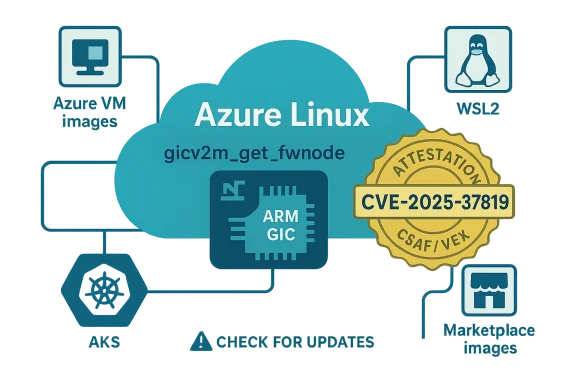
Microsoft’s MSRC entry for CVE-2025-37819 makes a narrow, careful claim: the company has attested that its Azure Linux distribution includes the upstream Linux component that contains the irqchip/gic‑v2m vulnerability (the gicv2m_get_fwnode use‑after‑free), and Microsoft says it will update the CVE if other products are later found to ship the same code — but that wording should not be read as a guarantee that Azure Linux is the only Microsoft product that could include the vulnerable code.
The vulnerability tracked as CVE-2025-37819 is a use‑after‑free in the Linux kernel’s irqchip/gic‑v2m code path: the callback
Microsoft’s public statement (the MSRC vulnerability page FAQ text) explains that Microsoft has verified the presence of the library inside its Azure Linux distro and that the company will extend attestations to other product families if they are found to include the same upstream sources. That precisely answers what Microsoft has published so far, but it leaves an important operational question open for defenders: does the presence of the vulnerable code in Azure Linux imply that no other Microsoft product ships the same code? It does not.
Below I walk through what Microsoft has actually said, why their phrasing matters, which Microsoft artifacts are plausible carriers of the vulnerable kernel code, how to check your environment, and what practical mitigation, detection, and supply‑chain steps security teams should take now.
General checks (Linux hosts, including Azure VMs and on‑prem images):
Source: MSRC Security Update Guide - Microsoft Security Response Center
 Background / Overview
The vulnerability tracked as CVE-2025-37819 is a use‑after‑free in the Linux kernel’s irqchip/gic‑v2m code path: the callback gicv2m_get_fwnode() was incorrectly marked with __init, which allows it to be freed while it remains registered with the PCI subsystem. Under certain boot/firmware conditions (reported reproducibly on Juno boards with ACPI boot), this can provoke kernel paging faults and crashes during PCI host bridge probing. The issue was fixed upstream in the kernel tree and has been picked up by multiple downstream distributions as a kernel security advisory.Microsoft’s public statement (the MSRC vulnerability page FAQ text) explains that Microsoft has verified the presence of the library inside its Azure Linux distro and that the company will extend attestations to other product families if they are found to include the same upstream sources. That precisely answers what Microsoft has published so far, but it leaves an important operational question open for defenders: does the presence of the vulnerable code in Azure Linux imply that no other Microsoft product ships the same code? It does not.
Below I walk through what Microsoft has actually said, why their phrasing matters, which Microsoft artifacts are plausible carriers of the vulnerable kernel code, how to check your environment, and what practical mitigation, detection, and supply‑chain steps security teams should take now.
What Microsoft actually said — and what that means
Microsoft’s FAQ around this CVE is intentionally conservative and focused on attestation: they have inspected and mapped the component to the Azure Linux product family and publish machine‑readable attestations (CSAF/VEX) for that product. Their message is essentially:- Azure Linux is confirmed to include the upstream open‑source component that contained the vulnerability.
- Microsoft is publishing attestations and machine‑readable impact data as part of its transparency work (CSAF/VEX).
- If the company identifies additional Microsoft products that include the vulnerable component, it will update the CVE entry to reflect that.
- An attestation describes what Microsoft has inspected and mapped. It is authoritative for the named product family (Azure Linux), but it is not a blanket statement about every Microsoft artifact.
- The absence of an attestation for another Microsoft product is not the same as a positive assurance that the other product does not include the same upstream source files or compiled objects.
Why the wording matters to defenders and asset owners
Vendor attestations are extremely valuable: they give defenders an authoritative starting point for triage and automated mapping from CVE → affected product → remediate. But there are two common misreadings that create risk:- Reading an attestation as an exclusion. If a vendor attests product X includes a component, that does not mean other vendor products cannot include it. Microsoft explicitly reserves the right to expand mappings when more artifacts are analyzed.
- Assuming the vendor has exhaustively scanned every binary and build artifact across the organization. Large vendors ship many Linux artifacts (custom kernels, cloud VM images, appliances, edge images, update channels). The inventory and build provenance work required to map every artifact to every upstream file takes time.
The technical context — what is vulnerable and how it’s exploitable
- The vulnerable code lives in the irqchip/gic‑v2m driver, an ARM‑platform component that implements a GICv2 virtual MSI frame interface (GICv2m). This is not a generic x86 driver — it is primarily relevant to ARM and ARM virtualization scenarios where GICv2m is present.
- The root cause:
gicv2m_get_fwnode()was registered as a PCI callback while being tagged__init, which lets the function’s memory be released after module init completes; the callback remains registered and may later be invoked, causing a use‑after‑free, kernel paging faults and crashes. - Exploitability: The vulnerability is rated with a local attack vector: an attacker needs to be local (or already able to run code on the host) to trigger it. In realistic attack models this yields denial‑of‑service (kernel panic/crash), and in some cases may be exploitable to escalate privileges or manipulate kernel state, depending on the platform and surrounding runtime conditions.
- Affected kernel versions: the fix was applied in certain stable kernel branches; distributions have shipped fixes in their kernel packages. Not all kernels are vulnerable — the presence of the vulnerable code depends on the kernel version and configuration.
Which Microsoft products could plausibly include the vulnerable code?
Microsoft’s Linux work spans several public artifacts and product lines that could, in principle, contain upstream Linux kernel sources or compiled kernels that include irqchip/gic‑v2m. The most relevant families to check are:- Azure Linux (formerly CBL‑Mariner / AzureLinux) — Microsoft has publicly attested this product. It is the distribution Microsoft uses internally and publishes for Azure‑centric workloads.
- WSL2 (Windows Subsystem for Linux) — Microsoft builds and ships a Linux kernel for WSL2 and maintains a public kernel source tree. The WSL2 kernel is typically built for x86_64, but Microsoft’s kernel sources and build trees are public and must be inspected for the presence of architecture‑specific files.
- CBL‑Mariner / AzureLinux upstream branches and packages — these are Microsoft’s base distro artifacts; historically they have been used not only for Azure Linux images, but also to produce images for other Microsoft services.
- Azure VM images, AKS node images, Marketplace images and custom images — Azure images are built from base distributions and customized kernels; many Azure images use Microsoft‑maintained kernels (linux‑azure or other tuned kernels).
- Edge and embedded images Microsoft distributes for appliances — some specialized images or device software produced by Microsoft teams may include components from the same upstream kernel tree.
- Third‑party vendors building on Microsoft artifacts — any downstream product or appliance that imports Microsoft kernel builds or packages may also inherit the component.
How to check whether your Microsoft‑supplied artifacts include the vulnerable code
If you run Microsoft‑supplied Linux artifacts, or use Windows features that ship Linux kernels, you should verify whether the affected code is present in your specific artifacts.General checks (Linux hosts, including Azure VMs and on‑prem images):
- Identify the kernel version and vendor string:
- run
uname -aandcat /proc/versionto capture kernel release and build info. - Check whether the kernel version falls into the vulnerable ranges listed by NVD and downstream advisories:
- compare your
uname -ragainst vendor advisories and the kernel.org/CPE guidance for CVE‑2025‑37819. - Search the kernel build for the symbol or driver:
- check System.map for
gicv2m_get_fwnode: sudo zgrep -n 'gicv2m_get_fwnode' /boot/System.map-* || sudo grep -R 'gicv2m_get_fwnode' /lib/modules/$(uname -r) -n- search for filesystem objects that contain the driver name:
grep -R --line-number 'gic-v2m' /lib/modules/$(uname -r) || find /boot -type f -exec strings {} \; | grep -i 'gicv2m' -n- For packaged kernels, check package manifest strings and build logs for presence of the driver sources.
- From inside WSL run
uname -ato get the WSL kernel version andcat /proc/version. WSL2 uses a Microsoft‑built kernel shipped through Windows Update; knowing the version allows you to map it to kernel.org versions and determine whether the upstream commit that fixed CVE‑2025‑37819 is present. - Microsoft publishes the WSL kernel source tree (the WSL2 kernel GitHub repo). Clone the same branch or the version matched to your WSL kernel and search the tree for
irqchip/gic-v2morgicv2m_get_fwnode. - If you use a custom WSL kernel, search the kernel sources you built.
- Determine the image identifier (VM image SKU) or node image digest.
- Request or download the artifact (for example, by spinning up a test VM) and perform the same symbol/source searches on the running kernel or installed modules.
- Use your organization’s image provenance and software‑bill‑of‑materials (SBOM) data to map build inputs to upstream components whenever possible.
Mitigation and remediation guidance
- Prioritize systems by exposure and platform
- ARM‑based systems, cloud VMs running on ARM hosts, and devices running Microsoft‑distributed Linux images should be higher priority.
- Systems that are local‑accessible to many users or that host untrusted workloads should also be prioritized.
- Apply vendor fixes
- Where your OS vendor or Microsoft has published kernel updates, apply them through normal patch procedures. Distributions listed in the public advisories have pushed kernel updates; apply distribution kernel packages and reboot as required.
- For WSL2 users: ensure Windows Update and WSL updates are applied. If you run a custom WSL kernel, rebuild from patched sources.
- For environments where immediate patching is difficult, use compensating controls
- Restrict local access to systems and limit who can log in or run code.
- Harden guest configuration and disable unnecessary PCI/plug‑in components where feasible on ARM platforms.
- For multi‑tenant environments, segregate workloads and avoid running untrusted code on images that can access host PCI or firmware interfaces.
- Validate patches
- After applying updated kernels, confirm the offending symbol is no longer present or the patched function is present in the kernel build. Use the same search commands as above to verify the fix.
- Track vendor attestations and CSAF/VEX feeds
- Consume vendor CSAF/VEX outputs and your supplier vulnerability attestations. Microsoft has committed to publishing CSAF/VEX attestations for Azure Linux and to extend those attestations as they map more artifacts.
Detection and monitoring: what to look for
Because the primary observable failure mode is kernel paging faults and crashes during PCI host bridge probe, detection should focus on kernel logs, crash signatures, and stability anomalies:- Watch for kernel oops, panic, or page fault entries referencing
gicv2m_get_fwnode,pci_set_bus_msi_domain, orpci_register_host_bridge. - Centralized log collection (syslog, journalctl forwarding) makes it possible to detect crash clusters quickly.
- Monitor for unexpected reboots or kernel panics on ARM hosts, particularly after hardware probing or hotplug events.
- For cloud images and VMs, watch for instance crashes during boot or when new PCI devices are attached/virtualized (MSI related activity).
- If you operate a vulnerability management platform, map installed kernels to the CVE and flag assets whose kernel versions are within the vulnerable ranges.
Forensics and incident response considerations
- If you observe a crash and suspect exploitation, collect:
- kernel logs and
dmesgoutput from the boot prior to the crash, /proc/kcoreand System.map (if available),- any crash dumps (kdump) or serialized kernel crash artifacts your distribution provides.
- Because exploitation requires local execution, a successful exploit usually indicates an attacker already has foothold; treat such events as potential escalation of a larger compromise and follow containment and remediation playbooks.
- Preserve VM images and host forensic snapshots for later analysis — minor differences in kernel configuration or platform firmware may materially change exploitability.
Supply‑chain and policy recommendations for organizations
- Build or buy SBOMs: demand machine‑readable SBOMs for critical images and firmware. SBOMs make it easier to map CVEs to artifacts rapidly.
- Subscribe to vendor CSAF/VEX feeds and integrate them into your vulnerability management tooling so attestations can be automatically correlated to deployed artifacts.
- Maintain an inventory of Microsoft artifact types in your environment (Azure Marketplace images, WSL usage, AKS node images, custom images built from Microsoft packages). This inventory is the single best thing you can do to speed triage when a vendor publishes an attestation that only covers a subset of their artifacts.
- Apply layered security: host‑based hardening, least privilege, and strict tenancy separation reduce blast radius if a kernel‑level DoS or escalation is possible.
Practical checklists you can use right now
- Quick triage (per host):
uname -a— capture kernel release.sudo zgrep -n 'gicv2m_get_fwnode' /boot/System.map-*— search for the exact symbol.sudo grep -R --line-number 'gic-v2m' /lib/modules/$(uname -r)— look for modules referencing the driver.journalctl -k -b -1 | grep -i 'gicv2m|pci_register_host_bridge|pci_set_bus_msi_domain'— review prior boot kernel messages for crashes.- WSL2:
- Inside WSL:
uname -aandcat /proc/version. - If concerned, map the reported WSL kernel version to the WSL kernel source branch and search the source tree.
- Azure images:
- Identify image SKU/digest and spin up a test instance.
- Run the same per‑host checks from above inside the test instance.
Strengths and limitations of Microsoft’s approach
Strengths:- Microsoft’s willingness to publish CSAF/VEX attestations for Azure Linux is a positive step toward machine‑readable, auditable vendor attestations.
- Publicly attesting which product families contain a component speeds triage for defenders who consume those attestations.
- Attestations are per‑product; they require continual expansion and accurate mapping to cover the many artifacts a large vendor produces. Until that mapping is complete, defenders should not use a single product attestation as evidence of universal absence across vendor artifacts.
- Microsoft’s attestation does not remove the operational need to inspect deployed artifact instances — artifact‑level inspection is still required for sound risk management.
- Because the vulnerability is platform and configuration dependent (ARM + ACPI + PCI interactions), some organizations may underestimate risk if they do not run ARM‑based images but rely on vendor statements that do not clearly enumerate platform conditions.
Final assessment and recommended action
- Short answer to the user’s question: No — Azure Linux is not necessarily the only Microsoft product that could include the vulnerable open‑source library. Microsoft has attested Azure Linux as containing the component, and has pledged to update CVE entries as other affected Microsoft products are identified. That is an important and authoritative disclosure for Azure Linux, but it is not an exhaustive guarantee about every Microsoft artifact.
- What you should do now:
- Treat Microsoft’s attestation as authoritative for Azure Linux and remediate those Azure Linux instances promptly when vendor updates are available.
- Independently verify other Microsoft artifacts you run — especially WSL2 kernels, Azure VM images, AKS node images, Marketplace images, and any Microsoft‑provided kernel images — using the practical checks above.
- Integrate CSAF/VEX and vendor attestations into your vulnerability triage pipeline so attestation updates can be matched to your inventory automatically.
- Prioritize patching and hardening for ARM‑based systems and any environment where kernel crashes or local escalation materially impact business operations.
Source: MSRC Security Update Guide - Microsoft Security Response Center
