

Microsoft’s short public answer — that Azure Linux “includes this open‑source library and is therefore potentially affected” — is correct and useful, but it is product‑scoped, not a universal exclusion of other Microsoft artifacts; absence of attestations for other Microsoft products is not proof those products are free of the vulnerable kernel code.
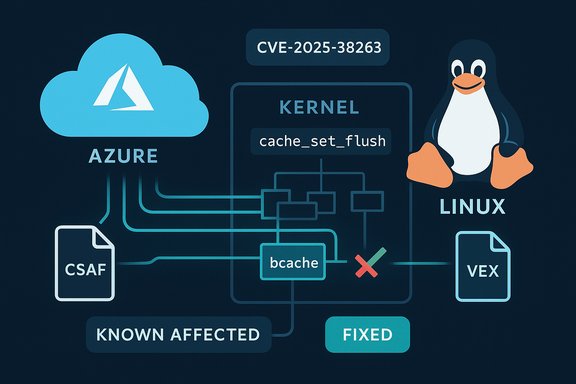
The kernel flaw tracked as CVE‑2025‑38263 (a NULL‑pointer problem fixed in bcache’s cache_set_flush is part of a broader mid‑2025 wave of Linux kernel robustness fixes that affected multiple device and storage subsystems. Upstream maintainers merged small, surgical patches to remove the NULL dereference and prevent worker threads or flush paths from entering an unsafe state. Multiple Linux distributors and vulnerability trackers catalogued the fix and prepared backports or package updates for stable kernels. Microsoft’s Security Response Center (MSRC) published a short, machine‑friendly attestation that Azure Linux includes the implicated open‑source component and is therefore potentially affected, and the company also stated it began publishing CSAF/VEX machine‑readable attestations in October 2025 and will update CVE entries if additional Microsoft products are identified.
That MSRC language is explicitly an inventory statement for the Azure Linux product family: it tells customers which Microsoft‑published images and kernels Microsoft has already scanned and mapped to the upstream CVE. This is an authoritative signal for Azure Linux customers — but it is not, by itself, a guarantee that no other Microsoft product contains the same upstream bcache code.
Crucially, product‑scoped VEX/CSAF attestations are phased inventory outputs — they represent what a vendor has completed checking so far. The MSRC sentence you quoted is a completed‑inventory result for Azure Linux, not a claim that the company has already scanned every Microsoft distribution, kernel binary, marketplace appliance, WSL2 kernel, or custom image. Microsoft explicitly committed to updating CVE entries and attestations if it discovers additional Microsoft products that ship the implicated upstream component.
Microsoft’s public commitment to expand CSAF/VEX attestations and update CVE records is a meaningful improvement in transparency; it simply changes the operational task from guessing which Microsoft artifacts are affected to checking the vendor’s attestations and your own artifact inventory. Until the VEX set covers every kernel‑bearing artifact you run, the cautious posture is to verify and patch per‑artifact rather than to rely on a single attestation as a universal clean bill of health.
Source: MSRC Security Update Guide - Microsoft Security Response Center
 Background / Overview
The kernel flaw tracked as CVE‑2025‑38263 (a NULL‑pointer problem fixed in bcache’s cache_set_flush is part of a broader mid‑2025 wave of Linux kernel robustness fixes that affected multiple device and storage subsystems. Upstream maintainers merged small, surgical patches to remove the NULL dereference and prevent worker threads or flush paths from entering an unsafe state. Multiple Linux distributors and vulnerability trackers catalogued the fix and prepared backports or package updates for stable kernels. Microsoft’s Security Response Center (MSRC) published a short, machine‑friendly attestation that Azure Linux includes the implicated open‑source component and is therefore potentially affected, and the company also stated it began publishing CSAF/VEX machine‑readable attestations in October 2025 and will update CVE entries if additional Microsoft products are identified.That MSRC language is explicitly an inventory statement for the Azure Linux product family: it tells customers which Microsoft‑published images and kernels Microsoft has already scanned and mapped to the upstream CVE. This is an authoritative signal for Azure Linux customers — but it is not, by itself, a guarantee that no other Microsoft product contains the same upstream bcache code.
Why Microsoft named Azure Linux first (and what that actually means)
Microsoft’s phased rollout of CSAF/VEX attestations began with Azure Linux because that product family is a coherent, centrally built distribution with a single package/repo and a clear kernel build pipeline. That makes automated inventory and machine‑readable attestations straightforward to produce and publish. Publishing attestations is a practical, scalable way for vendors to provide deterministic triage signals: “KnownAffected”, “Fixed”, “NotAffected”, or “UnderInvestigation” per product artifact. Microsoft made Azure Linux the initial mapping target for that reason.Crucially, product‑scoped VEX/CSAF attestations are phased inventory outputs — they represent what a vendor has completed checking so far. The MSRC sentence you quoted is a completed‑inventory result for Azure Linux, not a claim that the company has already scanned every Microsoft distribution, kernel binary, marketplace appliance, WSL2 kernel, or custom image. Microsoft explicitly committed to updating CVE entries and attestations if it discovers additional Microsoft products that ship the implicated upstream component.
The technical reality: why other Microsoft artifacts could also be carriers
Open‑source kernel code is reused across many artifacts and is included or excluded at build time based on kernel version and CONFIG_* build flags. Whether a given Microsoft artifact includes bcache (or any kernel subsystem) depends on:- Kernel version and commits (was the vulnerable commit present in the tree the artifact was built from?
- Kernel configuration flags (e.g., whether bcache was compiled in or as a module)
- Packaging and build provenance (distribution package vs. a custom kernel binary)
- Static embedding or vendor patches (some Marketplace appliances or images may include statically linked or bundled binaries)
What the MSRC wording means operationally
- For Azure Linux: treat the MSRC attestation as authoritative. If you run official Azure Linux images, those images are in‑scope and must be remediated according to Microsoft’s updates and kernel package advisories. The VEX/CSAF output provides an automatable signal for vulnerability management pipelines.
- For other Microsoft artifacts (WSL2, linux‑azure, Marketplace images, AKS node images, curated container host images): do not assume safety. Treat them as unverified until you either see a Microsoft attestation for the product or you inspect the artifact yourself (kernel version, CONFIG flags, module presence).
- Absence of an attestation ≠ absence of the vulnerable code. It may simply mean inventory work for that product family is not yet complete. Microsoft’s statement commits to updating the CVE and VEX records when new carriers are identified.
Practical triage: how to verify whether a given Microsoft artifact is affected
Below is a prioritized, pragmatic runbook operators can use immediately to discover and remediate exposures across systems that may include Microsoft‑provided Linux kernels.- Identify the artifact type and owner
- Azure Linux VM images (official): use the vendor guidance and MSRC attestation as the first cue.
- WSL2 instances: check the WSL kernel in use and whether it is updated via wsl --update.
- Marketplace images / custom VM images: treat as separate artifacts; do not assume they inherit Azure Linux attestations.
- For each host or image, run a quick artifact check:
- uname -a and uname -r to identify the running kernel.
- If available: zgrep CONFIG_BLK_DEV_BCACHE /proc/config.gz or grep CONFIG_BCACHE /boot/config-$(uname -r) to detect whether bcache was built in.
- lsmod | grep bcache to see if a bcache module is loaded.
- For kernel packages: inspect the package changelog or vendor security advisory and map the kernel / package version to the upstream commit that fixes CVE‑2025‑38263.
- Cross‑map kernel versions to vendor advisories:
- Use distribution security trackers (Ubuntu, Debian, SUSE, Red Hat), the NVD and upstream commit lists to find the exact fix commit and which stable/backport releases include it.
- If you run Microsoft‑supplied kernels outside Azure Linux (for example WSL2 kernels or linux‑azure images), search the WSL release notes and Microsoft kernel repos for backport or patch releases.
- If you cannot patch immediately:
- Restrict untrusted access to hosts that could exercise bcache flush paths.
- Isolate vulnerable hosts from multi‑tenant or untrusted workloads.
- Mitigate by disabling features you do not need that interact with block flushes; treat mitigations as temporary and plan kernel updates.
- Patch and reboot:
- Kernel fixes require package updates and reboots to become effective. Plan staged rollouts, preserve logs and vmcore if you are investigating crashes, and validate post‑patch behavior in staging.
Detection, logging and forensic signals to watch for
Because CVE‑2025‑38263 and many similar kernel fixes are primarily availability/robustness issues, detection focuses on signs of IO stalls, worker thread blocking, and kernel oopses:- Kernel logs (dmesg, journalctl) showing worker threads blocked, stack traces referencing bcache or cache_set_flush, or repeated writeback throttle (wbt_wait warnings.
- Elevated I/O latency and scheduling stalls correlated with flush or metadata commit activity (XFS, ext4, Btrfs).
- Kernel oops/panic traces that include bcache stack frames; preserve vmcore/dmesg snapshots for vendor triage.
- In multi‑tenant clouds, look for correlated tenant IO anomalies (one VM’s workload causing host‑level IO stalls affecting others).
Risk assessment — who should worry first
- High priority: operators of multi‑tenant hosts, shared infrastructure, or platforms running many untrusted workloads on a common hypervisor or node. A local kernel robustness bug that produces blocking or hangs can degrade tenant isolation and availability. Azure Linux images used as guest kernels or as node images for managed services should be patched immediately per Microsoft guidance.
- Medium priority: single‑tenant VMs and developer workstations. The practical impact here is often limited to latency, temporary I/O stalls, or rare crashes, but patching is still recommended.
- Lower priority: systems that do not build bcache into their kernels or do not use device‑mapper/bcache features — confirm with kernel config checks.
Strengths and risks of Microsoft’s CSAF/VEX approach
Strengths- Machine‑readable attestations (CSAF/VEX) give security teams deterministic inputs for automation and faster triage. Microsoft’s published attestation for Azure Linux is a helpful signal for customers who run those images.
- Phased rollout is practical: starting with Azure Linux reduces initial complexity and allows Microsoft to publish high‑quality mappings first.
- Phased coverage leaves interim uncertainty. An attestation that lists only Azure Linux does not prove other Microsoft artifacts are clean — it simply means those artifacts have not yet been attested. Security teams must maintain their own artifact inventories and verification processes until vendor coverage is exhaustive.
- Multiple kernel artifacts complicate mapping. Microsoft builds and publishes different kernel binaries (WSL2, linux‑azure, Marketplace images). Each is an independent artifact that must be checked separately for the vulnerable code and for the fix.
- Third‑party Marketplace images and embedded binaries may ship old or statically linked code that vendor attestation of Azure Linux cannot touch; those remain the responsibility of the image vendor or tenant. Require image provenance and vendor attestations as part of deployment policy.
Concrete, short checklist (one page runbook style)
- Step 1 — Fast inventory
- Run: uname -r; zgrep CONFIG_BCACHE /proc/config.gz || grep CONFIG_BCACHE /boot/config-$(uname -r)
- Run: lsmod | grep bcache
- If you see CONFIG_BCACHE=y or a loaded module, mark the host as candidate for immediate patching.
- Step 2 — Map to fix
- Compare uname -r/kernel package version to distribution advisories or the upstream commit that fixes CVE‑2025‑38263.
- If the kernel package predates the fix, apply the vendor patch.
- Step 3 — Patch and validate
- Install the fixed kernel package from your distro or Microsoft (for Azure Linux).
- Reboot in a staged manner and validate I/O/latency behavior under representative workloads.
- Step 4 — Block mitigations (temporary)
- Restrict access to untrusted workloads that can mount images or perform raw I/O with REQ_PREFLUSH patterns.
- Isolate vulnerable hosts in maintenance windows.
- Step 5 — Automate and monitor
- Ingest Microsoft CSAF/VEX feeds into your VM/inventory pipeline and use them to auto‑tag Azure Linux images as KnownAffected/Fixed.
- Continue artifact inventory for WSL2, linux‑azure, Marketplace images, and third‑party appliances.
When a definitive answer is not possible (and how to close the gap)
It is not possible, based solely on Microsoft’s current Azure Linux attestation, to categorically claim that no other Microsoft product includes the vulnerable bcache code. The attestation is definitive for Azure Linux, but other Microsoft artifacts remain unverified until Microsoft publishes additional VEX/CSAF attestations or until you perform artifact‑level checks on those specific images and kernels. Operators should therefore treat the current MSRC wording as an authoritative “yes” for Azure Linux and as a prompt to verify other Microsoft artifacts individually. Microsoft has stated it will update CVE records and attestations when more products are identified; until then, artifact inspection is the only reliable path to certainty.Conclusion — the practical takeaway for WindowsForum readers
Microsoft’s published statement that “Azure Linux includes this open‑source library and is therefore potentially affected” is accurate and valuable: it gives Azure Linux customers a clear, automatable remediation cue. However, it is a product‑scoped inventory attestation, not an exclusionary claim about every Microsoft artifact. Security and operations teams must therefore:- Patch Azure Linux images immediately where they are used.
- Treat all other Microsoft‑supplied kernels and images (WSL2, linux‑azure, Marketplace images, AKS/VM host images) as unverified artifacts and run the artifact checks above.
- Automate ingestion of Microsoft CSAF/VEX outputs to accelerate triage for attested product families, and maintain internal inventories for artifacts that are not yet attested.
- Require image provenance for marketplace/partner images and demand timely patch attestations from third‑party image vendors.
Microsoft’s public commitment to expand CSAF/VEX attestations and update CVE records is a meaningful improvement in transparency; it simply changes the operational task from guessing which Microsoft artifacts are affected to checking the vendor’s attestations and your own artifact inventory. Until the VEX set covers every kernel‑bearing artifact you run, the cautious posture is to verify and patch per‑artifact rather than to rely on a single attestation as a universal clean bill of health.
Source: MSRC Security Update Guide - Microsoft Security Response Center
