

Microsoft’s brief MSRC entry that “Azure Linux includes this open‑source library and is therefore potentially affected” is an authoritative product‑level attestation — but it is not a categorical statement that no other Microsoft product can contain the same vulnerable code.
Microsoft’s Security Response Center (MSRC) has adopted a concise FAQ-style wording for many Linux-related CVE pages that reads, in essence, “Azure Linux includes this open‑source library and is therefore potentially affected.” That wording is intended to tell Azure customers that Microsoft inspected the artifacts it publishes under the Azure Linux family and found the implicated upstream component mapped to the CVE. The phrasing also carries an important operational promise: Microsoft has said it will expand its machine-readable CSAF/VEX attestations and update CVE product mappings if additional Microsoft products are later found to include the same upstream component.
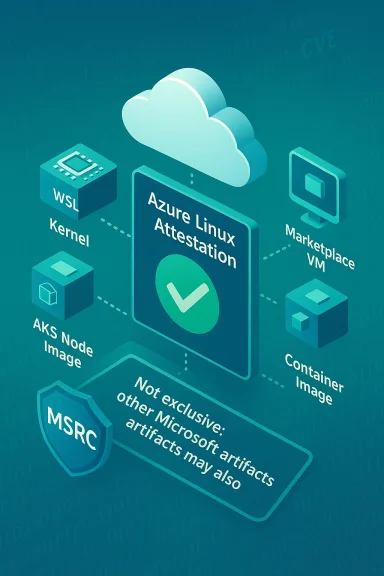
To be clear: the MSRC line is a precise inventory result for a named product family (Azure Linux). It is valuable because it gives Azure customers a specific remediation target. However, the line should not be read as an exclusivity claim that prevents the same vulnerable code from appearing in other Microsoft‑distributed artifacts or images. Multiple community analyses and vendor-advisory patterns have emphasized this distinction.
Caveat: the precise impact and exploitability for any given CVE depend on the code path, the kernel configuration (which modules are enabled), and whether a product’s kernel build included the module or feature in question. That’s why per-artifact verification is essential.
For defenders, the right posture is simple and practical: prioritize Azure Linux for immediate action, verify every other Microsoft artifact you run, automate your image and SBOM pipelines, and rely on MSRC’s expanding CSAF/VEX output as it becomes available to reduce manual work — but never as the only source of truth for your environment.
Source: MSRC Security Update Guide - Microsoft Security Response Center
 Background / Overview
Microsoft’s Security Response Center (MSRC) has adopted a concise FAQ-style wording for many Linux-related CVE pages that reads, in essence, “Azure Linux includes this open‑source library and is therefore potentially affected.” That wording is intended to tell Azure customers that Microsoft inspected the artifacts it publishes under the Azure Linux family and found the implicated upstream component mapped to the CVE. The phrasing also carries an important operational promise: Microsoft has said it will expand its machine-readable CSAF/VEX attestations and update CVE product mappings if additional Microsoft products are later found to include the same upstream component.To be clear: the MSRC line is a precise inventory result for a named product family (Azure Linux). It is valuable because it gives Azure customers a specific remediation target. However, the line should not be read as an exclusivity claim that prevents the same vulnerable code from appearing in other Microsoft‑distributed artifacts or images. Multiple community analyses and vendor-advisory patterns have emphasized this distinction.
What the MSRC attestation actually establishes
- Confirmed carrier for Azure Linux: When MSRC issues the short attestation, it means Microsoft completed an inventory check for that product family and found the implicated open-source component in the Azure Linux build outputs. Customers running Azure Linux images should treat those images as in-scope and follow Microsoft’s remediation guidance.
- Not proof of absence elsewhere: The absence of an MSRC attestation for other Microsoft products does not prove those products are free of the vulnerable code. MSRC’s attestation program is phased and product‑scoped; many Microsoft artifacts (WSL kernels, Marketplace images, AKS node images, container base images, custom Marketplace appliances, and vendor agents) may not yet have an attestation even though they could include the same upstream code depending on how they were built.
- Commitment to update: Microsoft has publicly committed to adding CSAF/VEX attestations and updating CVE entries when more product-level inventory work is completed. That commitment improves transparency over time but does not absolve operators of the responsibility to perform artifact-level verification now.
Why this matters for CVE‑level response (the practical consequence)
A vendor attestation naming a product is operationally meaningful: it creates a high-priority remediation path for customers of that product. For Azure customers this means:- Prioritize patching and updates to Microsoft‑published Azure Linux images and kernels immediately.
- Use Microsoft’s published updates or replacement images to remediate the risk in Azure Linux artifacts.
- Automate where possible: when MSRC provides CSAF/VEX machine-readable attestations, use those to drive vulnerability orchestration and patch workflows.
Technical context (vhost/vsock — what is being mentioned)
The CVE you referenced concerns the vhost/vsock subsystem and a failure to initialize a control variable (seqpacket_allow) in some code paths. That type of defect is typical of logic/initialization bugs in I/O or device emulation layers: uninitialized flags may change behavior in corner cases, possibly enabling unexpected features or causing incorrect validation decisions. Upstream maintainers and distribution vendors track these defects closely and publish fixes in stable kernel branches; distributors then issue kernel package updates or backports. Independent trackers and vendor advisories are the canonical places to verify the exact fix commit and which kernel releases include it. Where Microsoft’s MSRC attestation names Azure Linux, it is indicating that Microsoft’s Azure Linux builds include the implicated upstream code and therefore should be treated as carriers until patched.Caveat: the precise impact and exploitability for any given CVE depend on the code path, the kernel configuration (which modules are enabled), and whether a product’s kernel build included the module or feature in question. That’s why per-artifact verification is essential.
Cross-checking and verification best practices
To answer the question “Is Azure Linux the only Microsoft product that includes this open-source library?”, you must separate two things: what Microsoft has attested publicly, and what is possible given Microsoft’s product portfolio.- What Microsoft has attested: Azure Linux — confirmed. That is Microsoft’s public inventory mapping for the CVE at the time of the advisory. Treat Azure Linux images as known carriers.
- What is technically possible: Many Microsoft artifacts could include the same code — Microsoft builds and publishes many kernel images and Linux-based artifacts (Azure VM images, Marketplace images, AKS node images, Windows Subsystem for Linux (WSL) kernels, container images, and bespoke kernels used by platform services). Whether any of those artifacts is actually affected depends on the kernel versions and the build options used when those artifacts were created. Absence of public attestation is not proof of absence.
- Inspect published SBOMs or CSAF/VEX attestations where available. If Microsoft publishes a machine-readable attestation for a product, that will be the authoritative mapping for that product.
- For distro images, query package lists inside the image:
- Debian/Ubuntu: run dpkg -l | grep <package-name> or inspect /var/lib/dpkg/status in an offline image.
- RHEL/CentOS/Fedora: run rpm -qa | grep <package-name>.
- Alpine: run apk info | grep <package-name>.
- Inspect kernel versions and config inside images:
- Check uname -r and inspect /boot/config-$(uname -r) or the kernel .config present in the image.
- Compare the kernel version and stable branch to the upstream fix commit range to determine if the fix is present or backported.
- For WSL2 and custom Microsoft kernels:
- Check the WSL kernel binary version shipped with the Windows feature or the custom kernel used by the WSL distro.
- Microsoft publicly publishes WSL kernel sources and versioning information; use those artifacts to verify whether the fixed commit is present.
- For container images and Marketplace artifacts:
- Unpack image layers and inspect file systems for the binaries or kernel modules that reference the implicated symbol or file paths.
- Use SBOM generation tools (syft) or image scanners (Trivy, Clair) to enumerate installed packages and known CVEs.
- If you operate at scale, automate artifact discovery:
- Use image registries’ APIs and orchestration tools to generate SBOMs and scan images before deployment.
- Integrate the results into your patch orchestration and vulnerability management system.
Risks and limitations in relying on a single attestation
Relying solely on the single line in an MSRC CVE entry creates several operational risks:- False sense of security: Administrators may prematurely assume that only Azure Linux is affected and stop scanning other Microsoft images and artifacts. The correct posture is to treat the MSRC attestation as authoritative for Azure Linux only, and to verify other artifacts separately.
- Phase-driven coverage: Microsoft’s CSAF/VEX rollout is phased. Over time, more products will receive attestations, but until then many artifacts will be unverified. Treat “not attested” as “unknown,” not “not affected.”
- Artifact divergence and backports: Microsoft and other vendors sometimes backport fixes to long-lived kernel series or apply distribution-specific backports. An artifact built with a backport may be safe even if its kernel version nominally appears vulnerable; conversely, an artifact with a newer kernel may still be vulnerable if a particular configuration compiled out the fix. Per-artifact verification is required.
- Third‑party and customer images: Marketplace images published by third parties, customer-supplied custom images, and images derived from Microsoft base images can embed vulnerable packages independently; vendor attestations rarely cover third-party content. Scan everything you deploy.
Recommended operational playbook (step-by-step)
- For Azure Linux (immediate, high priority)
- Identify all running Azure Linux VMs and images in your estate.
- Update kernels and packages using Microsoft’s published updates or replacement images.
- Reboot or otherwise follow vendor guidance to ensure the patched kernel is active.
- Use Microsoft’s CSAF/VEX attestation (when available) to automate detection and remediation.
- For other Microsoft-provided artifacts and images
- Inventory all Microsoft-supplied images and binaries in your environment (WSL, Marketplace VMs, AKS node images, containers, agents).
- For each artifact, produce an SBOM or run an image/package scan.
- If the implicated component or vulnerable kernel version is present, plan and execute remediation (patch, rebuild, or replace).
- If you cannot patch immediately, apply compensating controls (isolation, remove affected components, restrict privileged local access).
- Detection and validation
- Monitor vendor advisories and independent trackers for updated attestations (MSRC CSAF/VEX) and cross-check upstream kernel changelogs and distro advisories.
- Validate remediation by checking kernel versions and verifying the fix commit range is included or the package version is the fixed one.
- Long-term supply-chain hygiene
- Require SBOMs for images you consume and publish SBOMs for artifacts you distribute.
- Automate image scanning in CI pipelines to detect vulnerable packages before images are pushed to registries.
- Adopt a policy that treats "not attested" as "unknown" and requires verification for any third-party or vendor-supplied image.
Critical analysis — strengths and weaknesses of Microsoft’s attestation approach
Strengths- Clarity where applied: For Azure Linux customers the attestation provides a clear, actionable statement. That reduces time-to-remediation for a widely used product.
- Machine-readable VEX/CSAF commitment: Microsoft’s commitment to machine-readable attestations is an important step toward automating vulnerability response at scale. When broadly applied, this will materially reduce ambiguity for large customers.
- Operational hygiene signal: Public attestations force vendors and customers to perform inventory work that historically was inconsistent across product lines.
- Phased rollout leaves gaps: The phased nature of the rollout means many artifacts will remain unverified for a period, increasing the chance of missed exposure in heterogeneous environments.
- Potential misinterpretation: Simple wording can be misread as an exclusivity claim; many operations teams may deprioritize broader scanning as a result.
- Dependency on artifact discovery by vendor: The vendor’s discovery process may miss artifacts or third-party images that an enterprise runs; customers must not defer discovery to the vendor alone.
Practical recommendations for defenders
- Treat MSRC attestation as authoritative for the named product (Azure Linux) and prioritize accordingly. Do not, however, treat the attestation as a global exclusion for other artifacts.
- Perform artifact-level discovery for anything you run that Microsoft supplied or touches Microsoft channels — WSL kernels, AKS node images, Marketplace images, Windows agents that bundle Linux components, and container images. Use SBOMs, package queries, and image scanners to detect the implicated code.
- Automate checks into CI/CD and image pipelines. Prevent vulnerable images from being pushed by adding SBOM generation and vulnerability scanning gates.
- Where immediate patching isn’t possible, apply containment: restrict local user capabilities, isolate affected images, and reduce access to privileged functions that could trigger the bug.
- Track Microsoft’s CSAF/VEX attestations as they are published and integrate them into your vulnerability management system so you can shift from manual scanning to event-driven automation when attestations cover more product families.
Conclusion
Short, public MSRC wording that “Azure Linux includes this open‑source library and is therefore potentially affected” is a valuable, authoritative product-level signal: it confirms that Azure Linux images have been inventory-checked and should be prioritized for remediation. At the same time, the statement is deliberately narrow: it is an attestation for a named product family, not an exclusive technical guarantee that no other Microsoft product can include the same vulnerable library. Security teams should treat MSRC’s attestation as a high-confidence instruction to patch Azure Linux artifacts, and should simultaneously treat all other Microsoft-supplied artifacts in their environment as unknown until verified — performing SBOM checks, package inspections, and image scanning to determine if they too are carriers and require remediation.For defenders, the right posture is simple and practical: prioritize Azure Linux for immediate action, verify every other Microsoft artifact you run, automate your image and SBOM pipelines, and rely on MSRC’s expanding CSAF/VEX output as it becomes available to reduce manual work — but never as the only source of truth for your environment.
Source: MSRC Security Update Guide - Microsoft Security Response Center
