

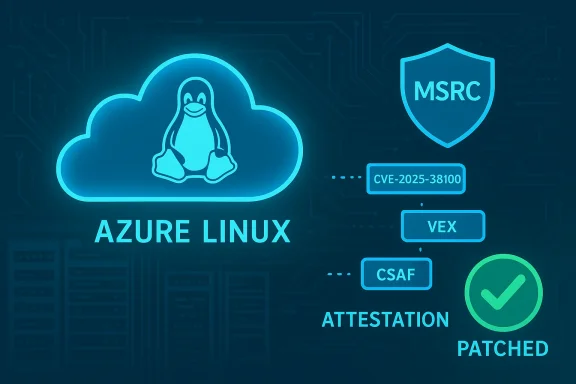
The short, operational answer is: No — Azure Linux is not the only Microsoft product that could include the vulnerable Linux kernel code behind CVE-2025-38100, but it is the only Microsoft product Microsoft has publicly attested so far to include the upstream component and therefore to be “potentially affected.” ps://www.microsoft.com/en-us/msrc/blog/2025/10/toward-greater-transparency-machine-readable-vulnerability-exploitability-xchange-for-azure-linux)
CVE-2025-38100 is an in-tree Linux kernel fix described as “x86/iopl: Cure TIF_IO_BITMAP inconsistencies.” The bug is a NULL-pointer dereference / crash that can occur when the kernel’s IO bitmap cleanup paths interact with thread flags in an inconsistent state, most commonly during failed fork() or when kernel threads are created from a user-space thread that carried TIF_IO_BITMAP in its flags. The upstream fix prevents the problematic cleanup from operating on non-current tasks and clears TIF_IO_BITMAP more aggressively during thread-copy operations.
Multiple mainstream vulnerability trackers and distro teams recorded the issue, assigned CVE-2025-38100, and mapped the upstream patch into stable kernel branches and vendor kernels; Ubuntu, Amazon Linux, and other vendors published package advisories or backports to remediate the problem in affected kernels.
Why it matters in practice: the vulnerability is a kernel-level NULL dereference that can cause a crash or denial-of-service when the specific thread/flag conditions are met. Exploitation requires local code execution context (i.e., a local user or process that can exercise the relevant kernel paths) and the presence of the affected kernel code in the running binary. That last point — whether a given product or image actually contains the vulnerable code — is the core inventory question behind the user’s question.
Microsoft’s VEX/CSAF rollout began with Azure Linux (formerly CBL‑Mariner) as a pilot product. The stated objective of that program is to publish machine-readable attestations that tell customers, in a deterministic way, whether particular Microsoft artifacts are Known Affected, Not Affected, Under Investigation, ic CVE. The rollout is intentionally phased, which is why Microsoft’s initial attestations name Azure Linux first and promise updates as inventories expand.
Put another way: the MSRC m Microsoft product have we inspected and found to include the upstream component?” — and the answer so far is Azure Linux. It does not answer “Which Microsoft products could include the component?” That second question must be answered through artifact-by-artifact inspection or through subsequent Microsoft attestations.
In short: act on Azure Linux now, verify the rest, and automate the attestation feeds into your triage pipeline so the next time an upstream kernel fix lands you can answer “which of my artifacts are affected?” with a deterministic, auditable result.
Source: MSRC Security Update Guide - Microsoft Security Response Center
 Background / overview
CVE-2025-38100 is an in-tree Linux kernel fix described as “x86/iopl: Cure TIF_IO_BITMAP inconsistencies.” The bug is a NULL-pointer dereference / crash that can occur when the kernel’s IO bitmap cleanup paths interact with thread flags in an inconsistent state, most commonly during failed fork() or when kernel threads are created from a user-space thread that carried TIF_IO_BITMAP in its flags. The upstream fix prevents the problematic cleanup from operating on non-current tasks and clears TIF_IO_BITMAP more aggressively during thread-copy operations.Multiple mainstream vulnerability trackers and distro teams recorded the issue, assigned CVE-2025-38100, and mapped the upstream patch into stable kernel branches and vendor kernels; Ubuntu, Amazon Linux, and other vendors published package advisories or backports to remediate the problem in affected kernels.
Why it matters in practice: the vulnerability is a kernel-level NULL dereference that can cause a crash or denial-of-service when the specific thread/flag conditions are met. Exploitation requires local code execution context (i.e., a local user or process that can exercise the relevant kernel paths) and the presence of the affected kernel code in the running binary. That last point — whether a given product or image actually contains the vulnerable code — is the core inventory question behind the user’s question.
What Microsoft actually said (and how to read it)
Microsoft’s Security Response Center (MSRC) pages for a number of Linux kernel CVEs have used the same short FAQ language: essentially, “Azure Linux includes this open‑source li potentially affected by this vulnerability,” followed by a note that Microsoft began publishing machine‑readable CSAF/VEX attestations in October 2025 and will update CVE entries if additional Microsoft products are identified. That phrasing is deliberate: it is an authoritative, product‑level attestation for Azure Linux — not a categorical guarantee that no other Microsoft product can contain the same upstream source.Microsoft’s VEX/CSAF rollout began with Azure Linux (formerly CBL‑Mariner) as a pilot product. The stated objective of that program is to publish machine-readable attestations that tell customers, in a deterministic way, whether particular Microsoft artifacts are Known Affected, Not Affected, Under Investigation, ic CVE. The rollout is intentionally phased, which is why Microsoft’s initial attestations name Azure Linux first and promise updates as inventories expand.
Put another way: the MSRC m Microsoft product have we inspected and found to include the upstream component?” — and the answer so far is Azure Linux. It does not answer “Which Microsoft products could include the component?” That second question must be answered through artifact-by-artifact inspection or through subsequent Microsoft attestations.
Why the distinction matters: product attestation vs. global exclusion
- Attestation is actionable for Azure Linux — if you run Azure Linux images, treat the MSRC statement as a definitive signal to patch or apply the fixed kernel packages Microsoft supplies. The Microsoft verified the component’s presence in those build artifacts.
- Attestation is not a guarantee for other artifacts — Microsoft ships and maintains multiple distinct Linux kernel artifacts and images across product lines (WSL2 kernels, linux-azure VM SKUs, AKS images, curated Marketplace VM images, container base images, and more). The presence of a vulnerable upstream commit in a given artifact depends on the kernel version used, the exact commit range, local backports, and the kernel CONFIG options used at build time. Those are build-time, artifact-specific facts that cannot be inferred solely from a single product attestation.
- Operational risk from false reassurance — treating the Azure Linux attestation as a universal “all clear” for other Microsoft artifacts risks leaving actual carriers unpatched. For defenders, absence of an attestation is not proof of absence of risk.
Which Microsoft products might realistically be carriers?
You should treat the following Microsoft artifacts as potentially relevant carriers until verified:- Azure Linux images / kernels: MSRC has attested these as potentially affected for the CVE in question — treat them as the primary remediation target.
- *Windows Subsystem for Linux (WSL2) kernel:and ships a custom WSL kernel; that kernel is derived from upstream branches and is maintained in a public repository. If a WSL kernel build used a vulnerable upstream commit (or if the vulnerable code was present in the WSL kernel branch), WSL2 instances could manifest the issue on Windows hosts running that kernel. Vernel release or tag you run.
- linux-azure / Azure-tuned kernels used in VM SKUs: Some Azure VM images use Microsoft-patched or Azure-specific kernel builds. Those kernels may differ across SKU or image generations; cheversion & build metadata for each VM image you run.
- Azure Marketplace images, container base images, and AKS node images: These are separate build artifacts; they may include different kernel packages or rely on distribution kernels (Ubuntu, Red Hat, etc.). Don’t assume Marketplace images or managed node images are identical to the Azure Linux attested artifact.
- Specialized appliances or embedded artifacts Microsoft maintains: Any Microsoft-published appliance or specialized image that bundles a Linux kernel (for telemetry, networking, or appliance functionality) should be treated as an unverified artifact pending a VEX attestation or an inventory check.
Practical verification checklist — what you should do now (step‑by‑step)
If your environment uses Azure, Microsoft images, WSL, or any Microsoft-supplied Linux artifacts, perform the following checks. Each step is ordered from fascation and remediation.- Prioritize and patch Azure Linux images immediately.
- If you run Azure Linux images, install the fixed kernel packages Microsoft publishes for the CVE or follow Microsoft’s remediation guidance for the Azure Linux kernel variant. The MSRC attestation makes this non-negotiable.
- Inventory Microsoft-supplied artifacts in your estate.
- Produce an inventory of: WSL2 instances, Azure VM images (by image SKU), Marketplace images you use, AKS node images, and any Microsoft-supplied appliance images. Treat each artifact as a unique kernel build until proven otherwise.
- Check kernel versions and commit ranges.
- For each artifact, identify the kernel version and — if available — the exact kernel package or kernel build tag. For WSL, Microsoft publishes the WSL kernel source and release tags publicly; compare the WSL build tag against the upstream commit(s) that fixed CVE‑2025‑38100.
- Examine kernel config flags (CONFIG_*).
- The vulnerable code path appears in the x86 I/O bitmap / iopl subsystem. Confirm whether the relevant code was compiled into the kernel (built-in or as a module). Kernel CONFIG choices can eliminate large classes of in-tree vulnerabilities simply by not compiling the code paths.
- Use SBOMs / VEX / CSAF where available.
- Consume Microsoft’s VEX/CSAF attestations (the Azure Linux VEX feed) for your automation pipelines and combine vendor attestations with your artifact checks for a deterministic inventory. Microsoft has published a blog explaining the VEX/CSAF rollout and points to its attestation feeds.
- If an artifact is un-attested and you cannot determine presence by metadata, perform a runtime verification.
- Boot a test instance and inspect /proc/version, the kernel package metadata, or extract the kernel image and search for the relevant symbol names and commit identifiers.
- For WSL, you can compare the running kernel release against the WSL kernel tags on GitHub to see which stable tree and patches were included.
- Apply vendor or upstream fixes, or rebuild artifacts.
- If an artifact contains the vulnerable code and a vendor patch is not available, plan to rebuild that kernel with the upstream fix backported or change the artifact to a vendor-supplied, fixed kernel image. Use standard patch-and-validate procedures.
- Monitor for indicators and telemetry.
- Watch kernel oops traces and crash logs for the stack trace patterns described in the vulnerability (NULL pointer in tss_update_io_bitmap / task_update_io_bitmap / io_bitmap_exit paths). While a crash alone is not proof of exploitation, repeated or deterministic crashes triggered by unprivileged processes indicate the vulnerability may be present and exercised.
Detection and mitigation guidance for defenders
- Detection: add kernel log monitoring for oops/panic traces that include the functions tss_update_io_bitmap, task_update_io_bitmap, or io_bitmap_exit. These symbol names are the canonical trace points that upstream maintainers referenced in the patch. Correlate crashes with recent forks or thread creation patterns that create kernel threads from user-space contexts.
- Temporary mitigation: where patching immediately is impractical, limit the exposure by restricting untrusted users from being able to exercise the kernel code paths that allocate or manipulate IO bitmaps (e.g., avoid workloads that perform raw I/O port operations or require IOPL emulation), and apply standard hardening controls (least privilege, container isolation, restricted user namespaces). Note that mitigation is strongly environment-dependent; patching the kernel remains the definitive fix.
- Longor VEX/CSAF feeds into your asset management and SIEM to automate per-artifact attestations and avoid manual reconciliation errors. Microsoft’s VEX rollout for Azure Linux is a template for how vendors will increasingly publish machine-readable attestations — but until coverage is exhaustive, you must validate yourself.
How confident can we be in Microsoft’s public statement?
- High confidence that Azure Linux images were inspected and Microsoft found the implicated upstream component. Microsoft explicitly points to Azure Linux in its MSRC advisory language and has published VEX/CSAF attestation tooling and examples for Azure Linux. That product-level attestation is authoritative for Azure Linux.
- Moderate to low confidence about whether other Microsoft artifacts (WSL kernels, Marketplace images, AKS node images, and other kernel-bearing artifacts) include the same vulnerable code — because Microsoft’s attestation rollout is phased and those artifacts are not uniformly attested yet. The correct operational stance is to assume “unverified” until proof to the contrary.
Examples and concrete verification commands (practical how-to)
- Check the running kernel release on a Linux VM:
- Run: uname -r
- Inspect package metadata: dpkg -l linux-image-* or rpm -qa | grep kernel
- Compare the reported kernel version anupstream stable branch notes and your distribution’s advisory to see whether the fix was backported.
- For WSL2 instances:
- From a WSL shell, run: uname -r and then match that release string to the WSL2-Linux-Kernel repository tags to determine which stable branch and patch set are used. Microsoft publishes WSL kernel tags and release notes publicly.
- If you need to search a kernel image for function names:
- Extract vmlinux / System.map and grep for tss_update_io_bitmap / task_update_io_bitmap / io_bitmap_exit. That helps determine whether the symbol is present in the compiled artifact you run.
Risks and caveats
- This CVE is a kernel robustness/null-dereference issue; while it is not widely reported as a remote kernel privilege escalation vector, a local crash or kernel panic at scale in a multi-tenant environment is a serious availability problem and, in some chained scenarios, could be part of a local privilege-escalation or sandbox-escape path. Treat kernel-level failures as high-priority to remediate.
- Microsoft’s public attestation model improves automation for customers, but it does not replace per-artifact verification. Until VEX coverage expands beyond Azure Linux, security teams must do the checking themselves for other Microsoft products they depend on.
- If you see the vulnerable trace signatures in your kernel logs but cannot identify the artifact source, assume the worst (vulnerable kernel present) and isolate or patch the host as a precaution while you investigate.
Final assessment and recommended next steps
- If you run Azure Linux: apply Microsoft’s updates now. Microsoft has attested Azure Linux contains the implicated component and is the immediate remediation priority.
- If you run other Microsoft artifacts (WSL2, Marketplace images, AKS nodes, linux-azure kernels, or Microsoft-maintained appliances): do not assume they are unaffected. Inventory, check kernel version / build tags, and validate whether the fix is present or backported. Use the WSL GitHub tags as a source for WSL kernel mapping and vendor advisories (Ubuntu, Amazon Linux, Red Hat) for distribution kernels.
- Integrate vendor VEX/CSAF feeds (starting with Azure Linux) into your automation, but supplement vendor attestations with artifact-level discovery until VEX coverage is complete across all Microsoft product lines.
- Monitor kernel logs for the canonical stack traces and treat repeated oops/panic events as immediate incident responses.
In short: act on Azure Linux now, verify the rest, and automate the attestation feeds into your triage pipeline so the next time an upstream kernel fix lands you can answer “which of my artifacts are affected?” with a deterministic, auditable result.
Source: MSRC Security Update Guide - Microsoft Security Response Center
