

Microsoft’s short answer — Azure Linux is the only Microsoft product that Microsoft has publicly attested to include the vulnerable ublk component for CVE‑2025‑38182 so far — is accurate as an attestation, but it is emphatically not a technical guarantee that no other Microsoft artifact could contain the same upstream code or be affected.
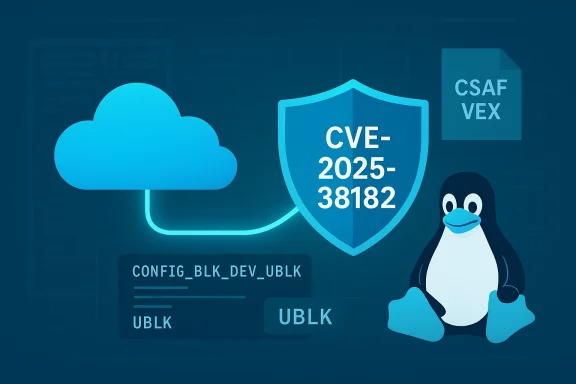
CVE‑2025‑38182 is a Linux kernel vulnerability in the ublk (userspace block driver) code path. The upstream description and vendor trackers describe the problem as a failure to sanity‑check userspace-supplied parameters when adding a ublk device — specifically the values for queue depth and number of queues — which can lead to a robustness/availability impact when malformed inputs are accepted by the kernel. Public vulnerability trackers and vendor advisories list the issue and its severity metrics.
The ublk facility is a userspace‑backed block driver exposed by the kernel (CONFIG_BLK_DEV_UBLK / module ublk_drv). It provides a control interface (for example a misc device and control IOCTLs) that lets a userspace ublk server register block devices and handle I/O from userspace using io_uring for performance. Because ublk negotiates parameters (queue depth, number of hardware queues, buffer sizes) between kernel and userspace, failures to validate those inputs can produce kernel faults, denial‑of‑service (panic/oops), or other undesirable states if extreme or inconsistent values are used. The kernel documentation and configuration metadata confirm the driver name and config symbol.
Microsoft’s public note for this CVE follows the pattern the company has been rolling out: a product‑scoped inventory attestation that a named product — in this case Azure Linux — includes the implicated open‑source component and is therefore potentially affected. Microsoft has also announced a phased rollout of machine‑readable CSAF/VEX attestations, starting with Azure Linux, so customers can automate trusted mappings between CVEs and Microsoft products.
However, this does not mean Azure Linux is the only Microsoft artifact that could include the vulnerable code. Large vendors compile and ship many independently built kernel artifacts: Azure Marketplace VM images, guest kernelsages, WSL kernels, AKS node images, curated container base images, partner appliances, and internal/developer builds. Each compiled kernel is an artifact with its own configuration, backports, and potential modules. The same upstream source can appear in any of those artifacts depending on kernel version, configuration flags, and whether a vendor backported the fix. Therefore absence of a VEX/CSAF attestation for Product B is an absence of attestation, not proof of absence.
Conclusion: Azure Linux is the only Microsoft product Microsoft has publicly declared as including the implicated ublk component for CVE‑2025‑38182 at the time of the attestation — but that declaration is a scoped inventory result, not a universal proof of exclusivity. Defenders must combine vendor attestations with artifact‑level discovery, kernel config inspection, and rapid patching to close the gap between “attested” and “fully verified” across their Microsoft‑sourced images and kernels.
Source: MSRC Security Update Guide - Microsoft Security Response Center
 Background / Overview
CVE‑2025‑38182 is a Linux kernel vulnerability in the ublk (userspace block driver) code path. The upstream description and vendor trackers describe the problem as a failure to sanity‑check userspace-supplied parameters when adding a ublk device — specifically the values for queue depth and number of queues — which can lead to a robustness/availability impact when malformed inputs are accepted by the kernel. Public vulnerability trackers and vendor advisories list the issue and its severity metrics.The ublk facility is a userspace‑backed block driver exposed by the kernel (CONFIG_BLK_DEV_UBLK / module ublk_drv). It provides a control interface (for example a misc device and control IOCTLs) that lets a userspace ublk server register block devices and handle I/O from userspace using io_uring for performance. Because ublk negotiates parameters (queue depth, number of hardware queues, buffer sizes) between kernel and userspace, failures to validate those inputs can produce kernel faults, denial‑of‑service (panic/oops), or other undesirable states if extreme or inconsistent values are used. The kernel documentation and configuration metadata confirm the driver name and config symbol.
Microsoft’s public note for this CVE follows the pattern the company has been rolling out: a product‑scoped inventory attestation that a named product — in this case Azure Linux — includes the implicated open‑source component and is therefore potentially affected. Microsoft has also announced a phased rollout of machine‑readable CSAF/VEX attestations, starting with Azure Linux, so customers can automate trusted mappings between CVEs and Microsoft products.
What “Azure Linux includes the library and is potentially affected” actually means
Attestation, not exclusivity
When MSRC says Azure Linux “includes the open‑source library and is therefore potentially affected,” it is reporting the result of an inventory and mapping exercise for that specific product family. That sentence is a clear, actionable signal for Azure Linux users: Microsoft inspected the Azure Linux build artifacts and found the upstream component mapped to the CVE. Treat it as authoritative for Azure Linux images and kernels.However, this does not mean Azure Linux is the only Microsoft artifact that could include the vulnerable code. Large vendors compile and ship many independently built kernel artifacts: Azure Marketplace VM images, guest kernelsages, WSL kernels, AKS node images, curated container base images, partner appliances, and internal/developer builds. Each compiled kernel is an artifact with its own configuration, backports, and potential modules. The same upstream source can appear in any of those artifacts depending on kernel version, configuration flags, and whether a vendor backported the fix. Therefore absence of a VEX/CSAF attestation for Product B is an absence of attestation, not proof of absence.
Why Microsoft started with Azure Linux
Microsoft deliberately started VEX/CSAF attestations with the Azure Linux distribution as a phased rollout: it’s an inventory that Microsoft maintains directly and therefore a logical first candidate to provide machine‑readable attestations. That choice increases transparency for customers using Azure Linux, but it also means other products will be added over time rather than all being covered from day one. Relying on the initial Azure Linux attestations as a global clearance for every Microsoft kernel artifact is a potential operational pitfall.Independent confirmation: what public trackers show
Key public sources independently corroborate the technical facts about CVE‑2025‑38182:- The NVD entry records the vulnerability description and basic metadata pointing to the ublk input‑validation fix.
- Distribution and vendor trackers (for example, Oracle Linux, Rapid7 and other distro feeds) list the CVE and point to upstream kernel commits that implemented the defensive parameter checks; the vulnerability is described as a local, low‑privilege vector with availability impact.
- Kernel documentation and configuration indexes show the ublk driver and the config symbol used to build it (CONFIG_BLK_DEV_UBLK / module ublk_drv), which tells operators where to look in their kernel builds to determine if ublk is present.
Practical answer to the user question
- Is Azure Linux the only Microsoft product that includes the open‑source ublk code and is therefore potentially affected?
- Operationally: No — Azure Linux is the only Microsoft product Microsoft has publicly attested to include the implicated component so far, but that attestation is product‑scoped and phased, not an exhaustive scan of all Microsoft artifacts. Other Microsoft products could contain the code; the company has said it will update CVE entries if additional products are identified.
- Technically: It depends on the artifact. Any Microsoft‑distributed kernel build that was compiled with CONFIG_BLK_DEV_UBLK enabled (or where the ublk module is present) and that did not include the downstream fix or backport would be a carrier of the vulnerable code. That includes (but is not limited to) Azure Linux images, any curated Marketplace images that include a kernel with ublk, bespoke VM or container images, and any WSL/guest kernels Microsoft ships that were built from older upstream code. Because inclusion is a build‑time artifact propertch artifact individually.
What defenders should do now — a concrete checklist
If you operate systems in which Microsoft images, kernels, or artifacts are used, treat the Azure Linux attestation as a high‑confidence signal to act for Azure Linux, and treat all other Microsoft artifacts as unverified until proven otherwise. The following steps are practical, prioritized, and actionable.1) Inventory and prioritize (fast)
- Enumerate all Microsoft‑provided artifacts you run: Azure Linux images, Linux images from Azure Marketplace, curated Microsoft container images, WSL kernels distributed by Microsoft, AKS node images, and any vendor images obtained through Microsoft channels.
- Prioritize items by exposure: multi‑tenant hosts, images that allow untrusted users to create devices or load modules, and images used in continuous integration or developer environments.
2) Confirm whether ublk is present in each artifact (artifact‑level checks)
- Kernel config check: Inspect /boot/config-$(uname -r) or the kernel config embedded in your image for the symbol CONFIG_BLK_DEV_UBLK. If it is set to Y or M, the driver is present or available as a module. Kernel config viewers and distro package metadata can help find the symbol.
- Module check: On a running host, run lsmod | grep ublk or check for the ublk module file under /lib/modules/$(uname -r)/drivers/block; presence indicates the driver was built.
- Device node/process check: Check for /dev/ublk-control or any running ublksrv/ublk server processes — these indicate active use.
- Image inspection: For images you do not run, extract the kernel or inspect the image manifest and kernel configuration to see whether ublk was enabled at build time.
3) Map the kernel version / commit range to the upstream fix
- If ublk is present, determine whether the kernel build includes the upstream fix or backport that addressed CVE‑2025‑38182. Public advisories and vendor trackers point to the upstream kernel commits and stable backports; match your kernel package metadata (commit tags, stable‑patch numbers) to those references. If you cannot determine by version numbers alone, conservatively treat it as in‑scope until verified.
4) Patch or mitigate
- Apply vendor updates where available (for Azure Linux, apply Microsoft’s published kernel packastro). For other distributions and images, follow the vendor advisory for the kernel package and reboot into a patched kernel.
- If you cannot patch immediately:
- Remove or blacklist the ublk module where feasible (modprobe -r ublk_drv, add to blacklist) and reboot, only if you are sure no legitimate workloads use ublk functionality.
- Restrict who can create/control block devices in multi‑tenant or containerized environments (limit CAP_SYS_ADMIN/CAP_MKNOD/CAP_NET_ADMIN exposures, enforce strong namespace and capability boundaries).
- Isolate untrusted workloads from hosts that provide privileged device creation capabilities.
5) Monitor and validate
- After patching or mitigation, validate that the kernel package version or commit includes the upstream remediation. Monitor logs for kernel oopses, device creation attempts, or unexpected ublk control calls. Use host integrity scans and image‑scanning pipelines to prevent reintroduction of vulnerable images into production.
Why the vendor attestation approach is helpful — and where it falls notable benefits
- Actionability for customers: A named product attestation (Azure Linux = Known Affected) gives customers a direct, machine‑readable signal to trigger patching automation and vulnerability management workflows. That reduces noise and false positives for organizations that consume Microsoft’s CSAF/VEX outputs.
- **Automatabes let security teams automate triage and apply targeted remediation to attested products quickly. This is particularly valuable for cloud customers who rely on vendor attestations to prioritize patches at scale.
Risks and blind spots
- False reassurance: Customers may mistakenly assume that because Azure Linux is named, other Microsoft‑published images are unaffected. That mental model can leave un‑attested artifacts unverified and unpatched. The attestation is scoped to what Microsoft has inspected so far and does not act as an exclusion certificate for every Microsoft artifact.
- Artifact variability: Vendors (including Microsoft) ship many independently built kernels and images. A single attestation for one product cannot cover the diversity of build configurations, backports, and packaging choices across a large ecosystem.
- Operational burden on customers: Until vendor attestations are comprehensive, organizations must maintain artifact‑level discovery and scanning processes (SBOMs, image inspection, kernel config mapping) to be sure they are not missing carriers of the vulnerable code.
Technical context and exploitability (short technical primer)
- Attack vector: Local. The vulnerability requires the ability to issue the control call that adds a ublk device from userspace or to execute a malicious userspace ublk server negotiating malformed parameters. Public CVSS mappings list AV:L and low privileges required, with availability impact rated high in some trackers.
- Impact: Availability/robustness — kernel oops, panic, or resource misconfiguration. Because ublk is a userspace-backed device, many I/O behaviors are mediated in userspace, but malformed negotiation of core parameters at device creation time is handled by kernel code and must be validated to preserve kernel integrity.
- Exploit complexity: Low to moderate for a local attacker with the ability to create control commands; higher if the environment restricts device creation to root or strongly confinners or environments that expose device control to tenants expand the practical attack surface.
How vendors and cloud operators typically map this class of risk
When a kernel CVE like this is disclosed, good operational practice is:- Vendor publishes a product‑level advisory and, where possible, machine‑readable attestations for product families they maintain directly. Microsoft has begun that process with Azure Linux and VEX/CSAF outputs.
- Distributors and cloud vendors publish patched ker affected versions and list fixed package names. Operators map those packages to the actual kernels running in their images and take remediation actions (patch, rebuild, rotate images). Public trackers (NVD, distro advisories) provide the canonical mapping for many distributions.
- Security teams use SBOMs, image layer scanning, kernel config checks, and simple module presence checks (lsmod, /lib/modules lookups) to discover carriers in their fleet. This reduces the risk of missing carriers that a vendor’s initial attestation did not explicitly list.
Final assessment and recommendations
- Microsoft’s public attestation that Azure Linux includes the ublk component and is potentially affected is a positive transparency step and should be treated as an immediate, high‑priority signal for operators running Azure Linux images. Apply Microsoft’s updates for Azure Linux without delay.
- Do not assume this attestation implies that all other Microsoft products are safe. The attestation is product‑scoped and phased; other Microsoft artifacts may still include the vulnerable ublk code depending on how those artifacts were built. Until Microsoft expands VEX/CSAF coverage to other products or you verify artifacts directly, treat other Microsoft images as unverified and perform artifact‑level checks.
- Operators should:
- Inventory Microsoft artifacts in use.
- Check for CONFIG_BLK_DEV_UBLK or the presence of the ublk module in kernels.
- Map kernel package versions or commit ranges to the upstream fix referenced by vendor advisories.
- Patch Azure Linux images immediately; for other artifacts, patch or mitigate as needed based on the artifact verification.
- Use SBOMs, image scanning, and automated VEX/CSAF ingestion where possible to reduce manual triage work.
Conclusion: Azure Linux is the only Microsoft product Microsoft has publicly declared as including the implicated ublk component for CVE‑2025‑38182 at the time of the attestation — but that declaration is a scoped inventory result, not a universal proof of exclusivity. Defenders must combine vendor attestations with artifact‑level discovery, kernel config inspection, and rapid patching to close the gap between “attested” and “fully verified” across their Microsoft‑sourced images and kernels.
Source: MSRC Security Update Guide - Microsoft Security Response Center
