

Microsoft’s one-line MSRC attestation that “Azure Linux includes this open‑source library and is therefore potentially affected” is accurate as a product-level inventory statement — but it is not a technical guarantee that no other Microsoft product can contain the same vulnerable NFS server code; defenders must therefore treat Azure Linux as a confirmed remediation priority while performing artifact-level discovery across other Microsoft-distributed kernels, images, and binaries. erview
CVE-2025-38231 is a Linux-kernel vulnerability disclosed in July 2025 that affects the kernel’s NFS server (nfsd) code. In short, a delayed-initialization race can allow a deferred laundromat work item to access an uninitialized pointer (nfsd_ssc), producing a NULL-pointer dereference; in kernel context this typically manifests as an oops or panic and creates an availability (DoS) risk. The upstream fix is to initialize the nfsd_ssc object before scheduling laundromat_work so the delayed worker cannot race ahead of initialization.
Microsoft’s Security Response Center (MSRC) answered the FAQ “Is Azure Linux the only Microsoft product that includes this open‑source library and is therefore potentially affected?” with a concise product-mapping statement naming Azure Linux and noting Microsoft began publishing machine‑readable CSAF/VEX attestations in October 2025 and will update CVE pages if additional Microsoft products are identified as affected. That text is an authoritative, product‑scoped inventory attestation for Azureerationally useful — but it must be read as a scope statement, not an exclusivity certificate.
Source: MSRC Security Update Guide - Microsoft Security Response Center
CVE-2025-38231 is a Linux-kernel vulnerability disclosed in July 2025 that affects the kernel’s NFS server (nfsd) code. In short, a delayed-initialization race can allow a deferred laundromat work item to access an uninitialized pointer (nfsd_ssc), producing a NULL-pointer dereference; in kernel context this typically manifests as an oops or panic and creates an availability (DoS) risk. The upstream fix is to initialize the nfsd_ssc object before scheduling laundromat_work so the delayed worker cannot race ahead of initialization.
Microsoft’s Security Response Center (MSRC) answered the FAQ “Is Azure Linux the only Microsoft product that includes this open‑source library and is therefore potentially affected?” with a concise product-mapping statement naming Azure Linux and noting Microsoft began publishing machine‑readable CSAF/VEX attestations in October 2025 and will update CVE pages if additional Microsoft products are identified as affected. That text is an authoritative, product‑scoped inventory attestation for Azureerationally useful — but it must be read as a scope statement, not an exclusivity certificate.
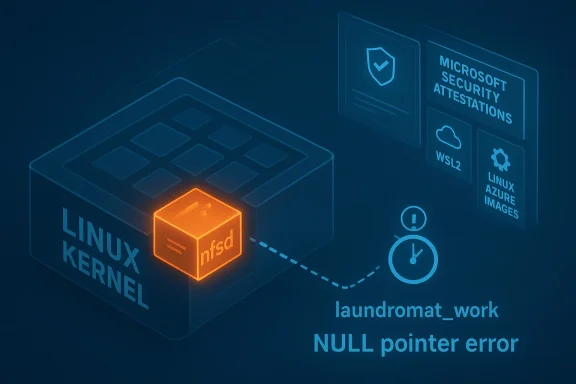 What the vulnerability actually is (technical summary)
The bug, in plain terms
- The defect lives in the NFS server (nfsd) path, specifically around nfs4_state_start_net() and the laundromat worker scheduling.
- Under certain timing / userspace wait conditions the delayed laundromat_work can execute before nfsd_ssc has been initialized.
- If laundromat_work then dereferences nfsd_ssc (via nfs4_laundromat -> nfsd4_ssc_expire_umount), the kernel will experience a NULL-pointer dereference (kernel oops / panic).
Why this matters
A NULL-pointer dereference in kernel space is not a benign bug: it reliably causes a kernel oops and can destabilize or crash the host. In multi‑tenant or shared-infrastructure contexts (cloud VMs, container hosts, multi-user servers), an unprivileged local actor or misbehaving process can trigger such a crash repeatedly, producing availability outages. Public trackers and major distributions assigned this CVE a medium-to-important operational severity and listed fixed kernel packages or backports soon after upstream commits were merged.What Microsoft’s Azure Linux attestation DOES — and what it DOES NOT — say
What it does say (and why that’s useful)
- Microsoft has inspected its Azure Linux distribution artifacts (kernel packages/images) aream kernel code corresponding to CVE‑2025‑38231 is present in those builds. That is a high-confidence, product-scoped inventory result and it gives Azure Linux customers a clear, prioritized remediation target.
- Microsoft’s rable CSAF/VEX attestations lets enterprises automate triage for named products (Known Affected / Fixed / Not Affected / Under Investigation), which reduces uncertainty in large estates.
What it does not say (and why that matters)
- The attestation is not a universal negative for every Microsoft artifact. Microsoft ships many Linux kernel artifacts — WSL2 kernels, linux-azure builds for some VM SKUs, Azure Marketplace images, AKS node images, container base images, and bespoke kernels used by platform services. Whether any of those artifacts includes the vulnerable code depends on the exact kernel version, configuration, and commits used when those kernels were compiled. Absence of public attestation for a product is not proof that product is free of the code.
- In practice, this means that while Azure Linux has been confirmed as an affected Microsoft product, other Microsoft-provided images or kernels may also be carriers until they are inventoried and declared Not Affected or Fixed. Microsoft has committed to update CVE product mappings as it discovers more, but vendors commonly publish attestations product-by-product as inventory checks are completed. Treat the Azure Linux attestation as a clear remediation priority, and treat other Microsoft artifacts as “unknown” until verified.
Cross‑verification: what independent sources show
To avoid relying on a single vendor statement, operators should cross-check the technical facts and package mappings with independent sources. The following public trackers and vendor advisories all describe the same vulnerability and document where fixes landed:- NVD and Debian/Ubuntu trackers: canonical CVE description and stable-tree fix commits.
- Distribution advisories and vendor trackers (Amazon ALAS, SUSE, Ubuntu): list which kernel packages and releases received the backport or fixed kernel. These make it possible to map the vulnerability to specific distro package versions.
- Security analysts and vulnerability databases (Wiz, Rapid7, TuxCare): provide plain‑language summaries, CVSS scoring, and remediation guidance consistent with upstream and distro advisories.
Practical implications for Microsoft customers and admins
Short answer to the user’s question
No — Azure Linux is not necessarily the only Microsoft product that could include the vulnerable open‑source component referenced by CVE‑2025‑38231. Azure Linux is simply the product Microsoft has publicly attested to include the implicated upstream kernel file so far. Because Microsoft builds and ships multiple kernel artifacts and images, other Microsoft-supplied images (WSL2 kernels, linux-azure images, Marketplace images, AKS node images, container base images, or bespoke platform kernels) could also include the same vulnerable code depending on build-time chattestation is not proof of absence.Operational posture you should take now
- Prioritize Azure Linux images: treat MSRC’s attestation as a high‑confidence remediation item. If you run Azure Linux images, apply Microsoft’s supplied kernel updates or image updates immediately and reboot as required.
- Inventory other Microsoft artifacts in your estate: perform artifact-level discovery for kernels and images provided by Microsoft — this includes WSL2 kernels on developer machines, Azure Marketplace images, AKS node images, and any container base images procured from Microsoft repositories. Treat artifacts with unverified kernel versions as Unknown and investigate.
- Cross-check distro advisories and kernel versions: for on‑prem or hybrid systems running other Linux distributions, review your distro’s security advisories (Debian, Ubuntu, Red Hat, Amazon Linux, SUSE) for the fixed kernel package versions and apply their fixes if your kernel falls in affected version ranges.
- If you build custom kernels or images: cherry-pick or apply the upstream stable commit that moves nfsd_ssc initialization before laundromat_work; rVerify the fix by examining the kernel changelog and commit history.
Actionable checklist (for security teams and platform ops)
- Inventory (immediate)
- Query your VM inventory for images labeled **Azure Linul versions in those images. Patch those images as a first priority.
- Search container registries and image man images that match vulnerable distro kernels (check uname -r, package metadata, or /proc/config.gz when accessible).
- Inspect WSL2 kernel downloads and developer machines that may run Microsoft-published WSL kernels; record kernel versions.
- Patch (near term)
- Apply Microsoft-supplied kernel updates for Azure Linux images and reboot as required.
- For other distributions, install the distribution-specific kernel packages or stable-tree patches listed in vendor advisories (Debian DSA, Ubuntu security updates, ALAS advisories, SUSE errata).
- For custom kernels, amit that initializes nfsd_ssc before scheduling laundromat_work; rebuild and promote to production.
- V - Confirm the running kernel package/version matches the fixed package version from your vendor advisory. Use uname -r and your package manager’s query functions. ([ubuntu.com](CVE-2025-38231 | Ubuntu? - Reproduce normal NFS workloads and monitor memory use and kernel logs for laundromat_work or nfsd related traces; verify no oopses occur under the workload.
- Monitor & compensate (medium term)
- Enable kernel OOPS/oomd alerts, and set up telemetry to detect repeated laundromat_work errors or uninitialized pointer traces in dmesg/journal.
- If you cannot patch immediately, restrict untrusted local access and consider disabling unused kernel modules that could expose NFS server interfaces. Longer-term, adopt automated SBOM/dependency scanning for images.
How to verify Microsoft’s product mappings and when to trust them
What to expect from Microsoft’s CSAF/VEX attestations
Microsoft’s CSAF/VEX feed is useful because it provides machine-readable attestations of product impact (Known Affected / Fixed / Not Affected / Under Investigation). When Microsoft lists a product as “Known Affected,” that generally means the company inspected the build artifacts for that product and found the relevant upstream code mapped to the CVE. Microsoft has pledged to expand those attestations and to update CVE pages if additional products are identified. Use the Microsoft VEX feed to automate triage for their explicitly listed products.Why you still must do your own discovery
Inventory attestations are only as complete as the vendor’s artifact coverage at the time of publication. Large vendors ship many artifacts; the same upstream source can appear in multiple product images or kernel builds depending on build choices. A vendor's lack of an attestation for a given product does not prove the product is clean — it simply means that the vendor has not yet published the inventory result for that product. For this reason, defenders should:- Treat vendor attestations as high-confidence data for named artifacts, and
- Independently verify any Microsoft artifacts you run which are not explicitly attested (WSL kernels, Marketplace images, AKS node images, etc.).
Detection and forensic guidance
- Look for kernel oopses referencing nfsd, laundromat, nfs4_laundromat, or nfsd_ssc in dmesg and system journal logs. These are the typical signatures when the buggy code path is exercised.
- Correlate any spikes in system instability following NFS operations or during NFS delegation/grace handling; the bug can surface when the kernel waits for long userspace responses in NFS state startup paths.
- If you suspect exploitation or repeat crashes, capture the kernel oops text, record package/kernel versions, preserve relevant images and logs, and treat the event as an availability incident for triage and postmortem.
Risk assessment: exploitability and real-world likelihood
- Attack vector: Local (an unprivileged local account or guest on a VM can trigger the NFS server code paths under certain configurations). The public trackers classify the attack vector as local.
- Impact: Availability-first (kernel oops / panic). There’s no credible public evidence that this particular NULL dereference yields remote code execution or privilege escalation on its own. However, any kernel-level crash on shared infrastructure is operationally significant.
- Exploit telemetry: Historically, NULL-pointer dereferences are straightforward to trigger given local access, so while the CVE is not a high‑severity remote RCE, it is a pragmatic DoS primitive in environments where untrusted local access is possible (e.g., multi-tenant hosts, shared developer machines).
Longer-term lessons and supply-chain hygiene
This CVE highlights some recurring patterns that operators should harden againeteness matters. Machine-readable VEX/CSAF attestations are valuable, but they are a product-by-product rollout; do not treat the absence of an attestation as proof of safety. Asovery remains essential.- Build-time choices drive exposure. A vulnerable upstream source file may appear in any kernel image built from a range that includes the offendinroducible builds and record kernel config and commit metadata for every image you ship or consume.
- Automate validation. Use SBOMs, automated image scanning, and kernel-package mapping to reduce the “unknown” population. Integrate vendor VEX/CSAF feeds with your vulnerability-management tooling so attested changes from Microsoft are ingested and acted on rapidly.
Clear, practical next steps (summary)
- Patch Azure Linux images immediately usingreat the MSRC attestation as a high-priority remediation item.
- Inventory other Microsoft-supplied artifacts in your estate (WSL2 kernels, Marketplace images, AKS nodes, container base images) and mark them Unknown until verified.
- Cross-reference distribution advisories (Debian, Ubuntu, Amazon Linux, SUSE, Red Hat) and apply kernel package updates where your kernels fall in the affected ranges.
- If you build kernels, apply the upstream fix (move nfsd_ssc initialization before laundromat_work), rebuild, and redeploy.
- Monitor kernel logs for nfsd-related oopses and enable alerting for repeated laundromat_work failures.
Conclusion
Microsoft’s MSRC message naming Azure Linux is a useful, actionable inventory attestation: if you run Azure Linux images, you should treat them as affected and apply Microsoft’s updates without delay. However, the attestation is not an exclusivity guarantee. Because the vulnerable code is upstream kernel source, any Microsoft artifact that ships a kernel built from the affected commit range and with the relevant configuration could also be a carrier. That reality means defenders must both act promptly on Microsoft’s attested findings (patch Azure Linux) and conduct artifact-level discovery and validation across other Microsoft-supplied images and kernels in their estates. Practical remediation is straightforward — apply vendor/kernel fixes, rebuild images where necessary, and validate — but the operational work of discovery and SBOM-driven verification remains the enduring homework for security teams.Source: MSRC Security Update Guide - Microsoft Security Response Center
