

The short answer is: Microsoft has publicly attested that the Azure Linux distribution includes the vulnerable GnuTLS component for CVE‑2025‑32989, but that attestation is product‑scoped — it is not proof that no other Microsoft product or image can include the same upstream library. In practice, other Microsoft‑distributed artifacts (notably CBL‑Mariner / Azure Linux lineage, Azure VM and Marketplace images, container base images, and any Microsoft‑curated or consumer‑facing Linux images) can and do carry upstream open‑source libraries like GnuTLS — so defenders should treat non‑attested Microsoft artifacts as “unverified” until inventoryed, scanned, or explicitly marked Not Affected by Microsoft. ps://www.microsoft.com/en-us/msrc/blog/2025/10/toward-greater-transparency-machine-readable-vulnerability-exploitability-xchange-for-azure-linux)
CVE‑2025‑32989 is a heap‑buffer overread in GnuTLS that occurs when the library parses the Certificate Transparency (CT) Signed Certificate Timestamp (SCT) extension inside an X.509 certificate. The defect allows a maliciously crafted certificate to cause out‑of‑bounds memory reads during certificate validation; distributors and upstream GnuTLS classify the issue as medium severity and recommend upgrading to the patched release.
GnuTLS’s upstream advisory explicitly calls out the fix and recommends users upgrade to GnuTLS 3.8.10 or later (or rebuild with stronger compile‑time hardening). Distribution vendors (Ubuntu, Red Hat, Oracle, Amazon Linux, SUSE and others) issued security updates and package backports shortly after the disclosure. Those distribution patches are the practical remediation path for most deployments.
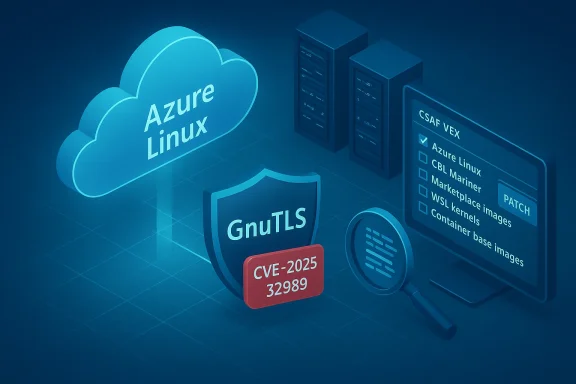
Microsoft’s Security Response Center (MSRC) published a short product mapping for this class of Linux/open‑source CVEs that reads, in effect: “Azure Linux includes this open‑source library and is therefore potentially affected by this vulnerability.” That line is a deliberate, product‑level attestation in Microsoft’s phased CSAF/VEX program — a machine‑readable inventory statement for the specific product named (Azure Linux). Microsoft has also stated it will update CVE/VEX records if it discovers additional Microsoft products that ship the implicated upstream component.
This CVE exemplifies a common supply‑chain reality: vendor attestations are valuable and actionable, but they are usually phased and scoped. Use Microsoft’s attestation to prioritize Azure Linux remediation, but complement it with artifact‑level discovery and image scanning to ensure no other Microsoft‑distributed or third‑party artifact in your environment carries the same vulnerable library.
Conclusion: Azure Linux is the only Microsoft product Microsoft has named so far — but it is not the only possible carrier. Assume “unknown” for other artifacts until they are verified or patched, and act accordingly.
Source: MSRC Security Update Guide - Microsoft Security Response Center
 Background / overview
CVE‑2025‑32989 is a heap‑buffer overread in GnuTLS that occurs when the library parses the Certificate Transparency (CT) Signed Certificate Timestamp (SCT) extension inside an X.509 certificate. The defect allows a maliciously crafted certificate to cause out‑of‑bounds memory reads during certificate validation; distributors and upstream GnuTLS classify the issue as medium severity and recommend upgrading to the patched release.GnuTLS’s upstream advisory explicitly calls out the fix and recommends users upgrade to GnuTLS 3.8.10 or later (or rebuild with stronger compile‑time hardening). Distribution vendors (Ubuntu, Red Hat, Oracle, Amazon Linux, SUSE and others) issued security updates and package backports shortly after the disclosure. Those distribution patches are the practical remediation path for most deployments.
Microsoft’s Security Response Center (MSRC) published a short product mapping for this class of Linux/open‑source CVEs that reads, in effect: “Azure Linux includes this open‑source library and is therefore potentially affected by this vulnerability.” That line is a deliberate, product‑level attestation in Microsoft’s phased CSAF/VEX program — a machine‑readable inventory statement for the specific product named (Azure Linux). Microsoft has also stated it will update CVE/VEX records if it discovers additional Microsoft products that ship the implicated upstream component.
Parsing Microsoft’s message: what “Azure Linux includes this library” actually means
Product‑scoped attestation, not a universal exclusion
Vendors commonly face a practical trade‑off in vulnerability mapping: do you publish a conservative, scoped inventory for artifacts you have inspected, or do you attempt a costly and slow universal scan across every product image? Microsoft chose the former for its CSAF/VEX rollout, starting with Azure Linux. The wording used in MSRC advisories is therefore an inventory statement about the product Microsoft has completed checks on — not a categorical technical guarantee that other Microsoft products cannot include the same upstream code.n MSRC says Azure Linux “includes” a library, it means Microsoft inspected Azure Linux images and found the upstream component mapped to the CVE.- When Microsoft says it will update the CVE if more Microsoft productsignals the rollout is phased and the absence of an attestation for a product equals “not yet attested,” not “not affected.”
Why that nuance matters operationally
Many teams treat a vendor’s single‑line advisory as binary: “if my vendor didn’t name product X, I’m safe.” That’s risky for large vendors and cloud platforms that produce many thousand artifacts (VM images, Marketplace appliances, managed node images, WSL kernels, container base images, telemetry agents, curated SDKs). The presence of a library is a build‑time property determined by the exact package set, build flags, and backports used for each artifact. Until the vendor publishes a per‑artifact VEX/CSAF attestation or you verify the artifact yourself, the product remains unverified.Is Azure Linux the only Microsoft product that includes GnuTLS (and so could be affected)?
No — but with key nuance.- Azure Linux is the only Microsoft product Microsoft has publicly attested (so far) to ship the GnuTLSby CVE‑2025‑32989; that attestation is authoritative for Azure Linux.
- However, other Microsoft artifacts and distributions related to the Azure Linux / CBL‑Mariner lineage do and have shipped GnuTLS and other userland libraries in the past; evidence in public package/plugin feeds and Microsoft’s own Azure Linux release notes shows GnuTLS was patched in recent Azure Linux/CBL‑Mariner releases. That demonstrates Microsoft’s internal distributions and the Cloud Linux lineage do carry the library.
- Azure Linux 3.0 (scanner plugins flag gnutls updates for CVE‑2025‑32989).
- CBL‑Mariner (Microsoft’s lightweight Linux used across cloud appliances) — security checks and distribution plugins explicitly reference gnutls patching.
Where else the library can show up inside Microsoft’s ecosystem (and why you should care)
GnuTLS is a widely reused TLS/X.509 library. Within a vendor the size of Microsoft, the library can propagate in many ways:- Embedded in Linux distribution images that Microsoft publishes (Azure Linux, CBL‑Mariner and any derivative VM or node images).
- Included transitively witmages** or customer Marketplace images that Microsoft curates or publishes. These images can contain downstream distro packages (and so carry gnutls if the distro package is present).
- Present in developer tooling and package managers (for example, Mand other OSS tooling) that can be used to build artifacts containing GnuTLS. Such tooling can seed libraries into binaries that later ship inside other products.
- Bundled in **third‑party appliances and ibuted via Marketplace — these are often “publisher” images but appear on Microsoft distribution channels and can include upstream libraries.
- Present in customer workloads running on Azure — not a Microsoft product per se, but relevant because the "blast radius" of a vulnerable library often depends on where the code executes; workloads in Azure VMs or AKS nodes that use distro packages may run with vulnerable gnutls. Distribution advisories and scanner feeds (Ubuntu/Red Hat/Oracle/AlmaLinux/etc.) show fixes and package names to check.
Evidence: cross‑checking the claim with independent sources
- GnuTLS upstream advisory recommends upgrading to 3.8.10+ to remediate CVE‑2025‑32989 and describes the SCT parsing fix.
- NVD and other mainstream vulnerability trackers list CVE‑2025‑32989 with a medium severity vector and consistent technical description.
- Distribution trackers and vendor advisories (Ubuntu USN, Red Hat errata, Oracle Linux) published patched package releases shortly after disclosure, showing the problem and fix landed broadly in distro packages.
- Microsoft’s own Azure Linux release notes and GitHub release tags show gnutls patches as part of posted Azure Linux / CBL‑Mariner releases (patches for multiple CVEs including the gnutls fixes appear in release notes), and security scanner feeds (Tenable / Nessus plugins) list Azure Linux and CBL‑Mariner plugin checks for the gnutls CVEs. Together these demonstrate Microsoft’s Azure Linux/Mariner lineage contains gnutls and was patched.
Practical guidance for defenders and administrators
If you operate systems on Azure or manage Microsoft‑supplied images, follow a prioritized, verifiable triage path.1) Start with inventory and detection (immediately)
- Treat Azure Linux images as confirmed in‑scope and patch them per Microsoft guidance. Microsoft’s attestation and corresponding Azure Linux release notes and scanner rules make Azure Linux a high‑priority target for remediation.
- For all other Microsoft artifacts (Marketplace images, WSL kernels, AKS node images, container base images, custom Marketplace appliances), do not assume safety. Instead:
- Extract SBOMs where available.
- Scan images and packages for gnutls packages or libraries.
- Search for packaged binaries or runtime linkages that reference GnuTLS.
- On RPM‑based systems: rpm -qa | grep -i gnutls
- On DEB/Ubuntu systems: dpkg -l | grep -i gnutls
- For container images: run an image scan (e.g., distro package list inside a container or a container scanning tool), or run a one‑off container and query /usr/lib or package metadata.
2) Patch or rebuild (next 24–72 hours, based on exposure)
- Upgrade GnuTLS to 3.8.10 or later where available, or apply your distribution vendor’s security update packages (apply vendor backports if present). Upstream GnuTLS and distro advisories specify the fixed versions and recommended packages.
- For container images or baked‑in binaries, rebuild images using updated base packages and push replacements; do not rely only on host package upgrades if containers are immutable and carry their own copies of the library.
- For statically linked binaries, identify and rebuild with fixed library versions or vendor fixes.
3) Prioritize based on exposure and functionality
- Highest priority: services that perform certificate parsing or process untrusted TLS certificates using GnuTLS (for example, custom HTTPS servers, proxying layers that trust client certificates, or feed‑parsers that validate certificate chains). The vulnerability is triggered by crafted certificates, so network‑exposed certificate parsers are the most at risk.
- Medium priority: general system components that include GnuTLS but operate in tightly controlled, non‑networked contexts (e.g., internal tooling that never ingests untrusted certs).
- Lower priority: systems where GnuTLS is present but the affected code path is not used (still advisable to patch, but can be scheduled later based on impact).
4) Detection, monitoring and post‑patch validation
- Monitor logs for crashes, certificate validation errors, or unusual process terminations in services that rely on GnuTLS.
- After patching, validate that services start cleanly and certificate paths function as expected; run integration tests that exercise TLS certificate parsing and validation where practical.
5) If you cannot patch immediately: mitigate
- Where possible, restrict exposure of services that perform certificate parsing, and enforce stricter ingress validation or WAF rules to limit attacker input.
- Disable or restrict the code paths that parse SCTs if your application allows it (this can be application specific and is not always feasible).
- Increase logging and monitoring for anomalous TLS certificate inputs.
Guidance specifically for Azure customers and Microsoft product operators
- If you run Azure Linux images, treat Microsoft’s MSRC attestation as a direct remediation signal and apply the available Azure Linux updates Microsoft published for the release that contains the gnutls fixes. Microsoft’s Azure Linux release notes and published patches contain the relevant package updates.
- If you rely on other Microsoft images (Marketplace images, AKS node images, WSL distributions, or Microsoft‑published container base images), run the inventory and detection steps above. Do not assume “no attestation = safe.” Microsoft’s VEX/CSAF rollout is phased and will expand to more products over time; until an artifact is attested as Not Affected, treat it as unverified.
- Watch for updated Microsoft CVE/VEX attestations. Microsoft has committed to updating its CVE records and VEX files when it identifies additional affected products; when that happens, the MSRC/CSAF files become authoritative machine‑readable signals you can ingest into vulnerability automation.
Risks, caveats and things that cannot be proven externally
- Vendor attestations are only as complete as the inventory they reflect. Large vendors change artifacts frequently; a single binary, imlied Marketplace appliance may differ from the vendor’s canonical product image. That means outside observers cannot prove a universal negative (“no other Microsoft product is affected”) without access to full vendor inventories or per‑artifact SBOMs. Microsoft explicitly framed its Azure Linux statement as a product attestation and promised to expand VEX coverage, which is consistent with industry practice.
- Some Microsoft artifacts are produced by third parties and simply distributed via Microsoft channels (Marketplace publisher images). Those third‑party images can carry arbitrary upstream packages and thus can introduce GnuTLS into environments in ways Microsoft’s initial attestation does not cover. That’s why customer‑side scanning is essential.
- If your risk model depends on absolute proof that a vendor has no exposure anywhere in its artifact set, you will likely not get that proof from a single CVE page. Use SBOMs, VEX attestations as they arrive, and artifact image scanning to reach the operational certainty you need.
How we verified the key claims (methodology)
This analysis cross‑checked:- Upstream vendor advisory (GnuTLS security notices) for the technical fix and recommended fixed version.
- Canonical vulnerability databases (NVD and related trackers) for the CVE description and metrics.
- Distribution advisories (Ubuntu, Red Hat, Oracle, Amazon Linux) and scanner plugin feeds for evidence of patched packages and which distributions published fixes.
- Microsoft’s own release notes and public VEX/CSAF blog posts to interpret MSRC’s attestation approach and the scope of the Azure Linux mapping.
- Public security scanner and vendor rule sets (Tenable/Nessus) that list Azure Linux and CBL‑Mariner checks for the gnutls CVE, confirming that Microsoft’s Azure Linux/Mariner lineage was included in typical scanning feeds.
- Independent explainers and operational analyses (internal‑style advisories and community forum writeups) that interpret MSRC wording and explain the product‑scoped nature of VEX attestations. Those materials document the exact operational nuance organizations need to treat “attested” vs “exclusive” differently.
Bottom line — concrete, actionable answer to your question
- Is Azure Linux the only Microsoft product that includes the GnuTLS library and is therefore potentially affected by CVE‑2025‑32989?
- No — not necessarily. Azure Linux is the only Microsoft product Microsoft has publicly attested (so far) to include the implicated GnuTLS code for this CVE, and that attestation is authoritative for Azure Linux images. However, the library can and does appear in other Microsoft‑distributed artifacts and in third‑party images published through Microsoft channels, and those artifacts remain unverified until Microsoft publishes additional VEX attestations or until you perform artifact‑level inventory and scanning. Treat Azure Linux as confirmed in‑scope and patch it; treat other Microsoft artifacts as unverified and perform the inventory/scan steps described above.
- Practical next steps (short checklist):
- Patch Azure Linux images immediately per Microsoft guidance.
- Run package/image scans across your Microsoft‑supplied artifacts (Marketplace, AKS nodes, WSL distributions, container base images) to detect any presence of gnutls.
- Upgrade GnuTLS to 3.8.10+ or apply vendor distro updates where available.
- Rebuild containers and statically linked binaries that include the library, then redeploy.
- Monitor Microsoft’s VEX/CSAF feeds for additional attestation updates and ingest those into your vulnerability automation.
This CVE exemplifies a common supply‑chain reality: vendor attestations are valuable and actionable, but they are usually phased and scoped. Use Microsoft’s attestation to prioritize Azure Linux remediation, but complement it with artifact‑level discovery and image scanning to ensure no other Microsoft‑distributed or third‑party artifact in your environment carries the same vulnerable library.
Conclusion: Azure Linux is the only Microsoft product Microsoft has named so far — but it is not the only possible carrier. Assume “unknown” for other artifacts until they are verified or patched, and act accordingly.
Source: MSRC Security Update Guide - Microsoft Security Response Center
