

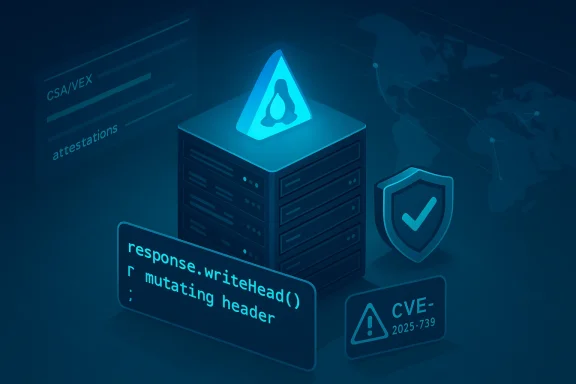
The open-source Node.js middleware library on-headers was assigned CVE-2025-7339 after a bug was found that can cause unintended modifications to HTTP response headers when an array is passed to response.writeHead(). Microsoft’s public advisory for the CVE calls out the Azure Linux distribution as a confirmed carrier of the affected component and says Microsoft will update the CVE mapping if additional Microsoft products are found to include the same library. That single sentence—accurate but compact—has generated an important operational question for enterprise defenders: is Azure Linux the only Microsoft product that ships the vulnerable on-headers component? The short, precise answer is: Azure Linux is the only Microsoft product Microsoft has publicly attested so far to include the vulnerable library, but that attestation is not a technical guarantee of exclusivity. Large vendors ship many distinct artifacts; absence of a public attestation for another product is not proof that the product is free of the upstream component.
on-headers is a small Node.js helper that lets code attach listeners to the moment when an HTTP response’s headers are being written. It’s commonly pulled in directly by applications or transitively through frameworks and middleware (for example, logging or response-munging libraries). In July 2025 a flaw in on-headers versions older than 1.1.0 was disclosed: passing an array-formatted headers argument to
Security trackers and advisories catalog the same basic facts:
This is a classic improper handling of unexpected data types (CWE‑241) issue: the parser assumed a specific internal structure and did not adequately validate the incoming array’s shape before indexing into it.
That statement is authoritative for Azure Linux: Microsoft examined the Azure Linux distribution artifacts and found the upstream component. For customers running Azure Linux images, that attestation is a direct call to action: inventory those images, apply the vendor-provided package updates, and verify nodes are rebuilt with patched packages.
Large vendors like Microsoft ship thousands of distinct artifacts (distribution images, Marketplace VM images, container base images, managed runtime images, WSL kernels, specialized appliances, SaaS runtimes, and internal build artifacts). Whether any particular Microsoft artifact includes a given upstream package depends on build-time choices, packaging decisions, and backporting choices. For this reason:
Source: MSRC Security Update Guide - Microsoft Security Response Center
 Background / Overview
on-headers is a small Node.js helper that lets code attach listeners to the moment when an HTTP response’s headers are being written. It’s commonly pulled in directly by applications or transitively through frameworks and middleware (for example, logging or response-munging libraries). In July 2025 a flaw in on-headers versions older than 1.1.0 was disclosed: passing an array-formatted headers argument to response.writeHead() could be misinterpreted by on-headers’ header-handling routine and result in malformed or altered response headers.Security trackers and advisories catalog the same basic facts:
- The vulnerability affects on-headers < 1.1.0 and was patched in 1.1.0.
- The reported CVSS v3.1 base score is 3.4 (Low), reflecting limited impact and exploitability constraints.
- A pragmatic workaround is to avoid passing arrays to
response.writeHead()(pass an object instead) until packages can be upgraded.
What CVE-2025-7339 actually is
The technical root cause
At its core the bug depends on howon-headers processes the headers argument when response.writeHead() is invoked. Node’s HTTP API accepts headers in multiple shapes (objects, arrays of pairs). The vulnerable code path inside on-headers made an unsafe assumption about array shape and indexing, leading to situations where a flat array or an unexpected array shape would be walked incorrectly. That logic could extract characters or wrong values and inadvertently set malformed header names/values on the outgoing response.This is a classic improper handling of unexpected data types (CWE‑241) issue: the parser assumed a specific internal structure and did not adequately validate the incoming array’s shape before indexing into it.
Practical impact and exploitability
- Attack vector: the vulnerability requires control over or influence on a response path where
response.writeHead()is called with an array-type header argument. Because those calls typically happen server-side and require high privileges to alter server behaviour, the practical attack vector is constrained. - Privilege requirements: exploitation requires the ability to run code in the same process or otherwise control request-handling code path—meaning a compromised application instance or misconfiguration is a necessary precursor in many real-world scenarios.
- Consequences: the primary risk is integrity — headers could be altered in ways that change security semantics (e.g., remove or corrupt Content-Security-Policy, change cookie flags). The low CVSS score reflects that this is unlikely to be trivially exploitable remotely without other preconditions.
Remediation
- Upgrade affected packages to on-headers 1.1.0 or later.
- If immediate upgrade isn’t possible, refactor code to pass header values as an object to
response.writeHead()rather than an array. - For transitive dependencies, rebuild images and reinstall dependencies after dependency tree updates so that the patched version is used.
Is Azure Linux the only Microsoft product that includes on-headers?
What Microsoft actually attested
Microsoft’s public advisory language for the CVE explicitly confirms that Azure Linux includes the implicated open‑source library and is therefore potentially affected. Microsoft also explains that it began publishing CSAF/VEX attestations in October 2025 and that this is a phased rollout—Azure Linux was the initial product family for those machine-readable attestations.That statement is authoritative for Azure Linux: Microsoft examined the Azure Linux distribution artifacts and found the upstream component. For customers running Azure Linux images, that attestation is a direct call to action: inventory those images, apply the vendor-provided package updates, and verify nodes are rebuilt with patched packages.
Why “attested presence” is not “exclusive presence”
Inventory attestations answer a different question from binary inclusion: they say “we checked this product and found the component.” They do not—and practically cannot—declare that no other product contains the same upstream code unless the vendor has completed a full, artifact-by-artifact inventory across every internal and externally shipped image, runtime, and appliance.Large vendors like Microsoft ship thousands of distinct artifacts (distribution images, Marketplace VM images, container base images, managed runtime images, WSL kernels, specialized appliances, SaaS runtimes, and internal build artifacts). Whether any particular Microsoft artifact includes a given upstream package depends on build-time choices, packaging decisions, and backporting choices. For this reason:
- An attestation that Azure Linux contains on-headers means exactly that: Azure Linux has the library and should be patched.
- It does not mean other Microsoft products (App Service runtime images, Marketplace images, container base images, WSL, Azure Kubernetes node images, partner-published VM images etc.) are guaranteed clean.
- Microsoft explicitly said it will update the CVE record if additional impacted Microsoft products are found; the phrasing signals a phased inventory and notification process rather than an exhaustive scoping in one shot.
The operational reality for defenders
Treat Microsoft’s attestation as a positive signal for Azure Linux and a lack of attestation for other Microsoft products as “not yet checked” rather than “not affected.” In practice, defenders should:- Immediately patch and remediate Azure Linux images per Microsoft guidance.
- Inventory other Microsoft-supplied images and hosted runtimes in your estate to determine if they include Node.js stacks or container images that could pull in on-headers transitively.
- Perform targeted dependency scanning across images, containers, and application code to detect on-headers in the dependency graph.
Where else could on-headers appear in a Microsoft-heavy environment?
You should assume that any Microsoft-distributed artifact that runs Node.js or hosts user-supplied Node.js code could, in principle, be affected if the library is present in the dependency tree. Typical candidate artifact classes to inspect:- Azure Marketplace VM images and publisher-provided VM images that include preinstalled web stacks.
- Azure App Service (Linux) runtime images and default language runtime images used to host Node.js apps.
- Azure Container Registry images (if you or partners push containers that include Node.js stacks).
- Azure Kubernetes Service (AKS) node images only insofar as your container images include on-headers; AKS node OS images are less likely but still worth inventorying if derived from a base image that bundles Node.js components.
- Custom container base images or CI-built artifacts published to internal registries.
- WSL kernels or WSL-based user-space images are less likely to include an npm package like on-headers unless a node runtime was intentionally installed.
- Third-party or partner tools distributed through Microsoft channels (appliances, marketplace offerings) that bundle Node.js stacks.
Practical detection and verification steps for defenders
Short checklist to hunt and validate presence of on-headers across environments:- For application source trees and repositories:
- Run
npm ls on-headers(orpnpm,yarnequivalents) in the repository root to find direct or transitive references. - Search lockfiles:
grep -R "on-headers" package-lock.json yarn.lock pnpm-lock.yaml. - For container images:
- Pull the image locally or use an image scanner.
- Run a quick scan:
docker run --rm -it --entrypoint sh <image> -c "cat package-lock.json 2>/dev/null | grep 'on-headers' || true". - Use a commercial or open-source SBOM/dependency scanner to flag the package (Grype, Trivy, Anchore).
- For artifacts you cannot easily inspect (managed runtime images, platform-managed stacks):
- Query vendor attestations and SBOMs if available.
- For Azure-hosted managed services, check the product’s runtime stack and vendor CVE mappings; consider raising a support ticket to request confirmation if the vendor mapping is absent.
- For production servers and nodes:
- Use configuration management / remote inventory tooling to extract installed npm modules or container images and scan them centrally.
- Correlate findings with asset metadata (which image, which build, when created) to locate where a vulnerable version was used.
- In a Node project:
npm ls on-headers || true - Search across repositories:
grep -R "on-headers" . || true - Using Trivy to scan an image:
trivy image --format table <image>
Remediation playbook (prioritized)
- Azure Linux customers
- Prioritize patching: apply the distribution packages or security update Microsoft published for the CVE and rebuild images.
- Validate: rebuild any VM/AMI/container images that used the affected package and redeploy.
- Application owners (Node.js apps)
- Update dependencies: bump on-headers to 1.1.0 if directly depended on; otherwise update your top-level dependencies (or run
npm update/npm audit fix) to refresh transitive packages. - Test and deploy: run unit and integration tests after the upgrade and redeploy.
- Containerized environments
- Rebuild images from patched base images and redeploy orchestrators (AKS, etc.) or replace running pods with updated images.
- Managed platform customers
- For PaaS runtimes (App Service on Linux, Functions, etc.) check the runtime stack version. If Microsoft has not attested, assume potential exposure and ask for vendor confirmation; where confirmation is not available, consider migrating to a patched custom container as a short-term mitigation.
- Monitoring and compensating controls
- Where immediate upgrades aren’t possible, employ compensating controls: tighten WAF / edge filters, limit untrusted inputs to the affected response paths, and monitor for unexpected header mutations in HTTP responses.
- Add runtime telemetry to detect anomalies in response headers (logging masks for header changes or checksum comparisons between expected and output headers).
Critical analysis: Microsoft’s VEX/CSAF approach — benefits and limits
Strengths and measurable benefits
- Transparency for Azure Linux customers: publishing CSAF/VEX attestations for Azure Linux gives defenders a machine-readable way to determine whether a specific vulnerability affects that product family.
- Reduction of false positives: VEX reduces noise by indicating “Not Affected,” “Under Investigation,” “Known Affected,” or “Fixed” on a per-product basis—this helps security teams prioritize remediation effort where it matters.
- Operational clarity: the explicit commitment to update CVE entries as further affected products are found creates a clear, auditable vendor workflow for customers who rely on vendor-supplied attestations and SBOMs.
Limitations and operational risks
- Phased rollout creates gaps: starting with a single product family (Azure Linux) necessarily leaves a gap: other product families may not be represented yet and could still carry the same vulnerable component.
- Attestation ≠ exhaustive scanning: machine-readable attestations are useful where available; absence of an attestation can be misinterpreted by defenders who do not understand the vendor’s phased disclosure model.
- Supply chain complexity: large vendors ship a wide variety of artifacts and build configurations; assembling a complete inventory is non-trivial and time-consuming, so some artifacts will lag in attestations.
- Customer expectations: some customers may treat Microsoft’s public mention of a single product as a blanket assurance that other Microsoft offerings are safe; that misreading can produce a risk of unpatched exposures.
Practical implications for enterprise security teams
- Design your vulnerability response workflow to treat vendor attestations as a starting point, not the final word. Use attestations to prioritize, but maintain independent discovery tooling to verify presence across your environment.
- Maintain an SBOM-driven procurement and deployment pipeline: knowing exactly which open-source components and versions are in each artifact is the only reliable way to assert exposure or absence at scale.
- Consider vendor support contracts or security SLAs that require prompt attestation updates for artifacts you rely upon heavily.
Recommendations: how organizations should operate now
- Use multiple detection techniques: static dependency scanning, SBOM ingestion, container image scanning, and runtime telemetry.
- Treat Microsoft’s Azure Linux attestation as an authoritative “yes” for that product and apply vendor patches immediately.
- For all other Microsoft-hosted artifacts, adopt a defensive stance: inventory, scan, and if in doubt, assume potential exposure until you can conclusively prove absence.
- Automate rebuilds and redeployments: where an update is available, make package upgrades part of a CI/CD pipeline so patched components propagate quickly to runtime images.
- Subscribe to vendor machine-readable feeds (CSAF/VEX where available) and integrate them into your vulnerability management platform so changes to attestations database (for example, Microsoft adding an affected product) are automatically ingested.
- Maintain clear incident runbooks that include steps for verifying whether a given product or image is affected and how to escalate to vendor support for attestations if coverage is missing.
When a vendor mapping is absent: how to ask for clarity
If you can’t find a vendor attestation for a Microsoft product or runtime you use, be explicit and procedural in your request to Microsoft support or your vendor contact:- Identify the exact artifact (image name + digest, VM SKU + build, App Service runtime stack version).
- Ask whether the artifact includes the given component (by package name and version) and request an SBOM or VEX/CSAF attestation for that artifact.
- If the vendor can’t provide direct attestation, request guidance on mitigating actions or a timeline for inventory completion.
Final verdict: answer to the user’s question
Azure Linux is the only Microsoft product Microsoft has publicly attested to include the vulnerable on-headers library for CVE‑2025‑7339. That attestation is authoritative and actionable for Azure Linux customers and should trigger immediate patching in those environments. However, Microsoft’s attestation approach is explicitly phased: it began with Azure Linux when Microsoft launched CSAF/VEX publishing in October 2025 and will expand to other product families over time. Therefore, the statement that “Azure Linux includes the open-source library and is potentially affected” does not prove exclusivity. Defenders should assume other Microsoft artifacts could include the same component until they verify each artifact via SBOMs, dependency scans, or vendor attestations—and treat missing attestations as “not yet checked” instead of “not affected.”Closing guidance: practical next steps for WindowsForum readers
- If you run Azure Linux images: patch now and rebuild images using the vendor’s updated packages.
- If you run Node.js apps or containers anywhere in your environment: scan for on-headers in your dependency tree and upgrade to on-headers 1.1.0 where present.
- If you rely on managed Microsoft runtimes or Marketplace images: request artifact-level attestations or SBOMs and incorporate them into your vulnerability-management tooling.
- Automate dependency scanning and SBOM ingestion—these are the only scalable ways to avoid surprises when upstream open-source components are updated or found vulnerable.
Source: MSRC Security Update Guide - Microsoft Security Response Center
